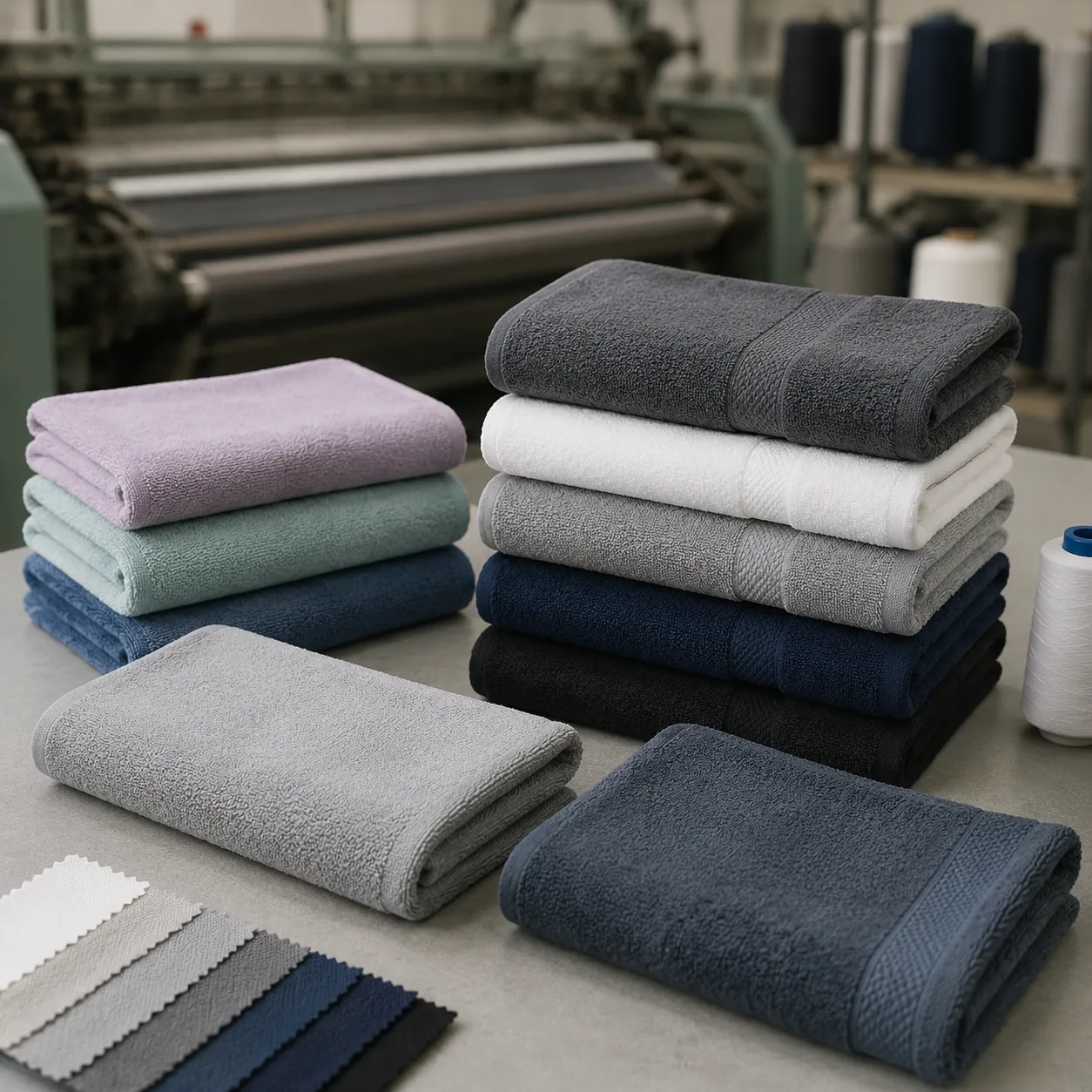
Why MOQ Gets Complicated on Small Fitness Towels
Sweat towels look simple because the unit is small. Most gym sizes sit between 30×80 cm and 40×100 cm, usually 320-480 GSM for cotton terry or 220-320 GSM for microfiber. The mistake we see is treating a compact towel like a promotional sticker: buyers split one program into too many colors, logos, and packaging versions before the production math has been checked.
At our mill, the standard MOQ is 500 pcs per design / per color. That limit is not set to block small buyers. It comes from dye vat loading, yarn preparation, loom setup, embroidery file handling, label sewing, carton marking, and the QC sample size under ISO 2859-1 AQL inspection. Below 500 pieces, the fixed setup time is spread across too few towels, so the per-piece cost jumps quickly.
For gym towels, the negotiation usually works better when we consolidate the hard production variables and give the buyer flexibility in the softer variables. A single towel body can support several club locations if the woven label, hangtag, or carton sticker changes after bulk sewing. A single dyed ground color can also carry different embroidery thread colors with much less disruption than running separate towel body colors.
| Variable | Usually fixed at MOQ | More negotiable | Factory reason |
|---|---|---|---|
| Towel body color | 500 pcs per color | One shared neutral color across locations | Vat loading, shade control, and lab dip approval are color-specific |
| Size | One cut size per PO line | Two nearby sizes if total volume is above 3,000 pcs | Cutting templates and hem allowance change by size |
| Logo artwork | 500 pcs per embroidered design | Thread color changes on the same logo | Digitizing and frame setup are design-specific |
| Packaging | Carton-level changes | Different carton stickers or hangtags | Packing line can switch labels faster than towel production can switch colors |
Gym Sweat Towel MOQ Negotiation Guide: Start With the Body
The strongest lever in a gym sweat towel moq negotiation guide is the towel body spec. If the body is stable, we can often help with logo, label, and packing flexibility. If the body changes every 300 pieces, the whole order becomes a group of small production runs.
For gym programs, we usually quote three body constructions. A 32/2 ring-spun cotton terry at 360-400 GSM gives good absorbency and handles commercial laundering. A 21/1 open-end cotton terry at 300-340 GSM lowers unit cost but loses hand feel faster after 40-60 wash cycles. A microfiber option at 240-280 GSM dries faster in a locker-room environment, but it needs different heat settings in laundry and different logo methods.
- Best MOQ position: one body color, one size, one GSM, then vary logo thread or packing label.
- Weak MOQ position: several towel colors plus several sizes plus separate polybags for each branch.
- Good compromise: 70% of volume in one main color and 30% in a second seasonal color if the total order reaches 2,000 pcs.
- Risky shortcut: mixing different yarn constructions under one SKU name; your reorder will not match the first delivery.
If your buyer team is still deciding size and fabric, use sweat towels for gym spec guide and towel GSM decision framework before asking for final pricing. A mill can estimate early, but the MOQ negotiation only becomes real after size, GSM, yarn, color, and decoration are fixed enough to build a production route.
Colorway Planning Beats Asking for an Exception
The easiest MOQ approval is not a special exception. It is a colorway plan that lets the dye house run efficiently. Cotton gym towels need reactive dyeing, rinsing, softening, drying, and shade inspection under D65 light. We check shade with a grey scale target of grade 4 or better, and for dark gym colors we also watch crocking because towels rub against benches, bags, and apparel.
A common problem is requesting black, charcoal, navy, forest green, burgundy, and cream at 500 pieces each, then asking to reduce every color to 250 pieces. For a 35×85 cm towel at 380 GSM, each towel uses roughly 113 g of fabric before sewing loss. A 250-piece color run creates only about 28-31 kg of towel fabric, which is too small for efficient shade control on many dye machines. The dyeing cost per kg increases, and shade variation is harder to manage.
| Color plan | Total pcs | MOQ strength | Typical outcome |
|---|---|---|---|
| 1 color × 1 logo | 500 pcs | Strong | Standard MOQ, cleanest price, fastest sampling |
| 2 colors × 500 pcs | 1,000 pcs | Strong | Good for chain gyms testing two brand colors |
| 4 colors × 250 pcs | 1,000 pcs | Weak | Usually repriced as small runs or converted to 2 colors |
| 1 body color × 4 thread colors | 1,000 pcs | Good | Often workable if embroidery design stays unchanged |
| 3 location labels on same towel | 1,500 pcs | Good | Can be packed by location with carton marks |
For wholesale sweat towels, neutral colors are not only cheaper to control; they also reduce laundry complaints. White and light grey show makeup and iron stains quickly, while very dark navy can expose lint transfer from cotton fleece apparel. For most fitness clubs, charcoal, medium grey, slate blue, and sand beige are safer recurring colors than pure black or optical white.
Decoration Choices That Help or Hurt MOQ
Logo method can either protect your MOQ position or destroy it. Embroidery is common on cotton gym towels because it survives wash cycles and feels familiar to club members. But embroidery is not free to split. Each logo needs digitizing, thread selection, frame testing, backing choice, and a stitch-count estimate.
On a 35×85 cm sweat towel, we prefer embroidery under 7,500 stitches. Above that, the towel can pucker if the pile is high or the logo sits too close to the hem. We test this by washing samples under ISO 6330 conditions, then checking whether the embroidered zone twists or tunnels. A dense badge logo may look clean on a polo shirt but behave poorly on a 380 GSM terry towel.
| Logo method | MOQ impact | Best use | Watch point |
|---|---|---|---|
| Embroidery | Per logo design | Club logo, member towel, retail towel | Keep stitch density controlled to avoid puckering |
| Woven jacquard | Higher setup, better at scale | Large repeat pattern or tonal brand mark | Usually needs larger order volume than basic embroidery |
| Sublimation microfiber | Artwork flexible, fabric-specific | Full-color fitness merchandise | Only works on polyester face, not cotton terry |
| Woven label | Low disruption | Location split, private label, resale packaging | Label placement must not scratch skin during use |
If your order needs several logos for different branches, ask whether the same towel body can be sewn first and decorated in grouped batches. This does not remove the 500-piece MOQ per design/color rule, but it may reduce the number of dyed towel bodies. For a deeper decoration comparison, see embroidery vs sublimation vs jacquard and gym towel logo durability decoration specs.
Price Bands by Volume and Spec
MOQ negotiation is easier when the buyer separates price pressure from spec pressure. If the target is a cotton terry gym towel that still looks acceptable after repeated laundry, there is a lower limit. Below that line, the towel becomes thin, hems curl, or the logo costs more than the towel body deserves.
The pricing below is a realistic OEM range for custom gym towels bulk orders from our production base, before international freight and import duty. It assumes standard export carton packing, OEKO-TEX 100 Class I compliant materials, ISO 9001 process control, and BSCI-audited production. Exact pricing changes with cotton market, exchange rate, logo stitch count, and carton packing density.
| Spec | 500 pcs | 1,500 pcs | 5,000 pcs | Best buyer fit |
|---|---|---|---|---|
| 30×80 cm cotton, 330-360 GSM, plain hem | USD 1.42-1.72 | USD 1.18-1.46 | USD 0.96-1.22 | Budget class packs or trial programs |
| 35×85 cm cotton, 380-420 GSM, embroidery | USD 2.05-2.62 | USD 1.72-2.20 | USD 1.43-1.86 | Fitness clubs and boutique studios |
| 40×100 cm cotton, 430-480 GSM, border logo | USD 3.10-3.88 | USD 2.64-3.22 | USD 2.18-2.76 | Premium locker-room programs |
| 35×90 cm microfiber, 250-290 GSM, sublimation | USD 2.28-2.95 | USD 1.86-2.42 | USD 1.55-2.05 | Retail fitness merchandise |
Here is a practical cost-per-use view. A 30×80 cm towel at 330 GSM might land around USD 1.35 at mid-volume, but if it is retired after 55 washes because the hem waves and the pile mats, the towel costs about 2.5 cents per use before laundry. A better 35×85 cm towel at 400 GSM may cost USD 1.94 and last 105 washes in the same facility, or about 1.8 cents per use. The cheaper invoice can become the more expensive operating item.
How to Trade MOQ Without Damaging Margin
A good negotiation gives the factory something operationally useful in exchange for flexibility. Asking for 200 pieces in five colors at the 2,000-piece price does not work. Offering a shared towel body, approved lab dip, simple carton marks, and a reorder forecast gives us a real way to reduce risk.
- Lock one towel size and GSM before discussing color splits.
- Group locations by the same towel body color, then vary carton sticker or hangtag.
- Keep embroidery artwork identical and change only thread color if branch identity is needed.
- Approve a main color for the first shipment and move seasonal colors into the reorder.
- Share a 6- or 12-month forecast so yarn and greige fabric planning can support repeat shade matching.
The most workable fitness towel minimum order quantity request we see is this: 1,500 total pieces, one 35×85 cm towel body at 400 GSM, three gym locations packed separately at 500 pieces each, same embroidered logo, different carton labels. That is much easier than 1,500 pieces split into three towel colors, three logos, and three printed belly bands.
If you need MOQ flexibility, reduce production changes first. We can negotiate around packing and planning more easily than around dye lots and loom setup.
Sample Approval Before You Commit to Volume
MOQ negotiation should not happen in isolation from sample approval. A buyer may secure a smaller first order, then discover the towel is too narrow for locker-room racks or the logo scratches during face use. Sampling is the stage where we find those problems before bulk.
- Lab dip: 3-5 days for cotton color approval under D65 and TL84 light sources.
- Proto sample: 7-10 days if using available yarn and a standard towel size.
- Logo strike-off: 5-8 days for embroidery or label placement confirmation.
- Wash check: 3-5 extra days for ISO 6330 wash and tumble-dry review.
- Bulk pre-production sample: 5-7 days after all artwork, color, and packing details are locked.
For sweat towels, we also recommend an absorbency check after softener selection. Too much silicone softener can make the towel feel smooth in hand but slow down water pickup. We use an internal drop test based on AATCC TM79 principles: if the water drop sits too long on the terry surface, the towel may feel dry but perform poorly during workouts.
Related reads: why gym towels fail after 50 washes, build towel tech pack that mills can quote, and pantone color matching custom towels are useful before approving a low-MOQ order.
Production Timing and Reorder Windows
For a new gym towel order, plan around 28-42 days for bulk production after sample approval and deposit. Add 5-12 days if the order includes several embroidered versions or special retail packing. Sea freight adds roughly 18-35 days depending on destination port, while air freight can move faster but often costs more than the towel margin allows.
Reorders are where MOQ negotiation becomes easier. If the first order uses a stable yarn count, towel size, border layout, and approved shade standard, the second run can move faster. We still need to control dye shade and cotton lot variation, but the artwork and packing decisions no longer start from zero.
| Stage | New order timing | Reorder timing | Buyer action |
|---|---|---|---|
| Tech pack review | 1-3 days | 1 day | Confirm size, GSM, logo, packing, and carton marks |
| Lab dip or shade check | 3-5 days | 2-4 days | Approve color against physical standard |
| Sampling | 10-18 days | 5-10 days | Review towel body, logo, and wash result |
| Bulk production | 28-42 days | 22-35 days | Release PO before stockout pressure |
| Final inspection and packing | 2-4 days | 2-3 days | Use ISO 2859-1 AQL level agreed in PO |
For gyms with daily laundry, we prefer reorder planning by wash load, not by calendar only. If a club uses 900 towels per day and washes each towel every second day, a 3,000-piece inventory can look large but may be under pressure during weekends, equipment events, or towel loss. Link your MOQ plan with expected loss rate, laundry capacity, and replacement cycle.
What to Put in the RFQ
A clear RFQ reduces back-and-forth and improves your negotiation position. If we receive only a photo and the words “best price,” we have to quote with assumptions. If we receive a complete spec, we can show where MOQ can be adjusted and where it cannot.
- Towel size in cm, target GSM, and acceptable tolerance such as ±5%.
- Material choice: cotton terry, combed cotton, ring-spun cotton, microfiber, or blended construction.
- Color standard with Pantone TCX, TPX, or physical towel reference.
- Logo method, artwork file, stitch count target, placement distance from hem, and thread colors.
- Packing plan: bulk carton, polybag, belly band, hangtag, barcode, or location-specific carton mark.
- Compliance needs: OEKO-TEX 100 Class I, BSCI, ISO 9001, and any brand restricted substance list.
- Order split by color, design, destination, and expected reorder date.
Related reads: negotiate towel MOQ without killing margin, container vs air freight towel orders, and microfiber vs cotton towel comparison cover the broader sourcing decisions around MOQ, freight, and material choice.
A Workable MOQ Scenario for Fitness Chains
For a 12-location fitness chain launching a towel rental and retail program, we would usually recommend one core towel body first: 35×85 cm, 400 GSM ring-spun cotton terry, charcoal grey, low-twist enough for softness but not so loose that lint becomes a complaint. Start with 6,000 pieces packed by location in 500-piece carton groups. Use the same embroidered logo on every towel, and separate locations by carton sticker and inventory barcode.
That structure gives the brand a clean first shipment, keeps the dye lot unified, and lets the operations team measure loss before adding more colors. If the first 90 days show strong retail sales, the second order can introduce a 1,500-piece seasonal color while maintaining the charcoal rental towel as the operational base.
- First order: 6,000 pcs core towel, one body color, one logo, location carton labels.
- Second order: 4,000 pcs replenishment plus 1,500 pcs seasonal color if sales justify it.
- Laundry test: pull 20 towels after 30, 60, and 90 wash cycles for weight loss and hem review.
- QC standard: inspect finished goods under ISO 2859-1 with agreed AQL before shipment.
- Contact route: send specs by WhatsApp at +86 13205717266 or email [email protected].
We manufacture custom towels in Gaoyang with 220 employees and an annual output around 2.4M towels. Our role in MOQ discussion is not to push the biggest PO possible; it is to keep the first order manufacturable, washable, and repeatable. A smaller order that can be reordered cleanly is more useful than a complicated launch that cannot be matched six months later.
Send Us Your Gym Towel MOQ Plan
Share your size, GSM, color split, logo method, packing needs, and forecast. We will mark which parts can flex and which parts should stay fixed for stable production.
Request MOQ Review →