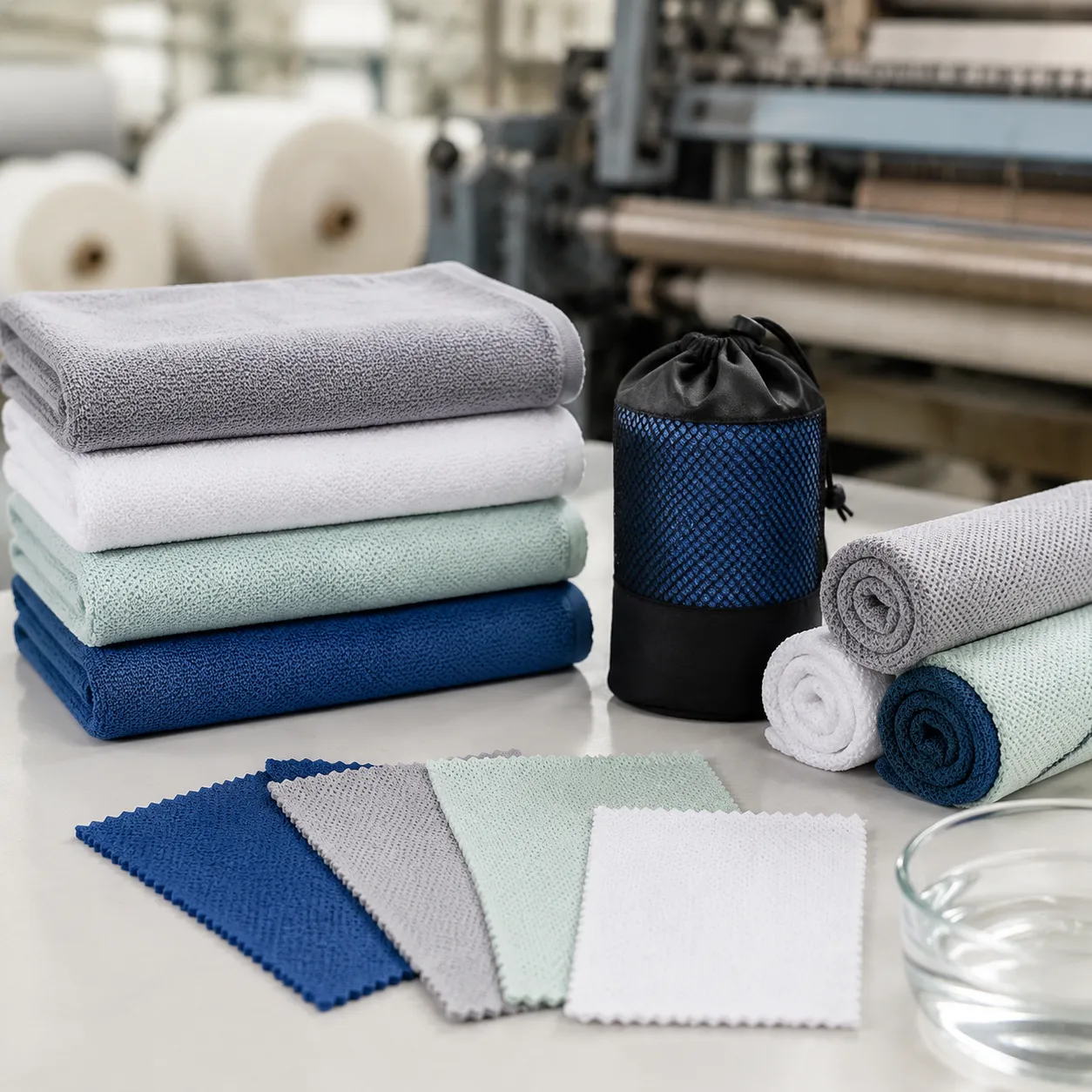
What actually separates a towel that cools in 40°C conditions
The product category is often oversimplified. A cooling towel is not judged by handfeel alone, and not by a one-time showroom snap test where someone waves it in the air for ten seconds. In extreme heat, performance comes from three measurable factors working together: water uptake per square meter, evaporation rate under airflow, and usable surface contact after wringing. If one of those is out of balance, the cloth either dries too fast, drips on the user, or loses the cool-touch effect after a short cycle.
For branded programs, we compare candidate constructions under a simple lab routine tied to known benchmarks: conditioned room start at 21±1°C, fabric wet pickup measured after a 2-minute soak and standardized wring, then surface temperature drop tracked against ambient using a contact probe and a thermal camera over 15 minutes under 1.5 m/s airflow. That is more reliable than an IR gun pointed at a fluttering fabric panel, which often overstates cooling because emissivity changes when the surface is glossy or partially saturated.
| Performance factor | What we measure | Good commercial target |
|---|---|---|
| Water uptake | Wet pickup % vs dry fabric weight | 180-260% for knit microfiber cooling styles |
| Cooling persistence | Surface stays at least 4°C below ambient skin-contact baseline | 8-14 minutes per re-wet cycle |
| Usability after wring | No heavy drip, fabric remains flexible | Residual water low enough for neck or face use |
| Reactivation speed | Dip-wring-snap cycle time | Under 20 seconds |
| Durability | Appearance and edge stability after wash | Pass 30 home-laundry cycles without seam distortion |
The fabric choice matters more than the marketing claim
If the brief says "for marathon aid stations" or "for construction crews in Gulf summer," the first decision is fabric system, not logo placement. The two constructions that dominate are PVA sheet and warp-knit polyester/polyamide microfiber. Both can create evaporative cooling, but they behave very differently in storage, feel and repeat use.
- PVA towels cool strongly right after wetting, but they harden if stored dry, can feel tacky, and often need a tube pack or moisture-controlled storage to avoid cracking.
- Warp-knit microfiber cooling towels are softer, lighter, easier to fold into pouches, and more practical for sports, travel and retail resale.
- Mesh or perforated knits reactivate quickly because airflow moves through the structure, but if the knit is too open they lose water too fast in desert climates.
- High-polyamide blends improve water spread and cool-touch feel, but push cost up and can slow sublimation color brightness slightly.
For most private-label projects asking for the best cooling towel for extreme heat, the sweet spot is not the cheapest 100% polyester tricot. It is usually a warp-knit 88/12 or 85/15 polyester-polyamide blend in the 145-190 GSM range. That blend wets evenly, wrings cleanly, and stays supple after repeated dip cycles. If a buyer specifies 120 GSM to save a few cents, the cloth often dries so quickly outdoors that the user keeps re-wetting it every few minutes.
| Construction | Typical GSM | Pros | Limits |
|---|---|---|---|
| PVA sheet | 150-230 | Fast initial chill, strong water retention | Hardens when dry, less comfortable on face, packaging control needed |
| Warp-knit microfiber 100% polyester | 140-170 | Lower cost, easy print surface, quick dry | Cooling duration shorter, weaker water spread |
| Warp-knit microfiber 88/12 polyamide blend | 150-185 | Balanced cooling, soft hand, good repeat use | Mid-range cost |
| Mesh-knit microfiber 85/15 blend | 160-190 | Better airflow, fast reactivation, sporty feel | Can dry too fast in windy arid zones if too open |
How we test for heat relief instead of showroom theatrics
The strongest revisions in this category came after buyers stopped accepting generic "instant cool" claims. We now recommend a test sheet with named methods and pass/fail bands. There is no single global cooling-towel ISO standard, so the safest route is to combine textile tests with a controlled in-house cooling protocol.
- Condition the dry fabric for 24 hours under ISO 139 atmosphere so basis comparisons are stable.
- Measure absorbency by wet pickup after immersion and standard wring, recorded as % of dry weight.
- Run moisture management on an MMT instrument, such as AATCC 195, to compare one-way transport and spreading speed.
- Track drying curve under fixed airflow and ambient temperature, with mass loss checked at 2-minute intervals.
- For cooling effect, place the activated towel on a skin-simulating plate at 33°C and log surface drop with a contact thermocouple over 15 minutes.
On one recent trial of three candidate knits, the cheapest 135 GSM polyester style showed a fast first drop of 6.1°C on the probe but climbed back within 3°C of baseline by minute 5. A denser 172 GSM 88/12 warp-knit dropped 4.8°C initially yet stayed beyond the 4°C threshold until minute 11. That second result sells better in real use, especially for sideline sports, hiking and queue-based events where the user cannot keep re-wetting every few minutes.
A cooling towel for extreme heat should be judged on the full 10-15 minute cycle, not the coldest second right after the snap.
Size and shape: small errors here make the product annoying
Dimension affects both user comfort and freight cost. The common online assumption is that bigger is always better. In practice, oversized formats trap too much water and become heavy around the neck. A very narrow format cools well but has poor coverage on shoulders or forearms.
| Use case | Recommended size | Dry weight target | Comment |
|---|---|---|---|
| Running, gym, cycling | 30 x 100 cm | 48-62 g | Easy neck wrap, low bulk |
| Outdoor labor, hiking | 30 x 110 cm | 55-70 g | Better forearm and neck coverage |
| Team event giveaway | 25 x 90 cm | 38-50 g | Lower cost, suitable for pouch pack |
| Retail multipack or premium sports line | 32 x 100 cm | 58-74 g | Feels more substantial without becoming heavy |
The edge also matters. Overlock is cost-efficient, but in very light fabrics it can wave after repeated wet/dry cycles. For a cleaner retail program, a narrow turned edge with 4-needle coverstitch looks better, though it adds labor and slightly stiffens the perimeter. On mesh knits, we often reject thick fold-over elastic binding because it creates a hot band that does not cool like the body fabric.
Decoration choices can quietly ruin cooling performance
Brand teams often focus on the print first. That is understandable, but heavy decoration can block evaporation. A full-coverage plastisol transfer on one side may look bold and still make the cloth feel warmer in use. For this category, decoration should preserve open surface area and drape.
- Sublimation is usually the safest option for microfiber cooling fabric because it adds almost no hand buildup.
- Small woven labels stitched into the short edge work better than large sewn-on patches.
- Screen print is acceptable only for small logos with low ink laydown.
- Embroidery is rarely a good choice on lightweight cooling knits because needle perforation can pucker the fabric and create a stiff hot spot.
Artwork coverage should also be specified. We often cap dark full-panel print at around 65-70% coverage on ultra-light constructions intended for desert events. Dark saturated print raises solar heat gain under direct sun, even when the evaporative mechanism is still functioning. If the design brief requires a black ground, stepping up GSM slightly can stabilize the user experience.
Related reads: embroidery-vs-sublimation-vs-jacquard, pantone-color-matching-custom-towels, and build-towel-tech-pack-that-mills-can-quote.
Price bands: where the money goes
Cooling towels cover a wide price spread because the fabric blend, print process and packaging all matter. A buyer comparing only piece price can miss the cost impact of pouch type, carabiner quality, insert cards and retail barcode work. Below are realistic FOB China ranges for 2026 based on standard colors and mainstream trim.
| Spec level | MOQ | FOB unit price | What is included |
|---|---|---|---|
| Promo grade, 100% polyester 25 x 90 cm | 5,000 pcs | USD 0.58-0.84 | Basic knit, overlock edge, simple mesh pouch, 1-color print |
| Mid-grade 88/12 blend 30 x 100 cm | 3,000 pcs | USD 0.96-1.34 | Better cooling balance, sublimation print, drawstring pouch |
| Retail grade 85/15 mesh knit 32 x 100 cm | 2,000 pcs | USD 1.42-1.96 | Higher GSM, custom pouch, insert card, barcode sticker |
| PVA tube-packed program | 3,000 pcs | USD 1.28-1.88 | PVA fabric, moisture tube, printed label, more complex packing |
MOQ at our mill is 500 pcs per design per color, but true efficiency starts higher for custom cooling programs because pouches, insert cards and print setup create their own minimums. For a small launch, a two-color assortment in a shared pouch style is usually more economical than six shades with identical total volume.
Cost-per-use also changes the sourcing logic. A USD 0.67 promo towel that loses edge shape and print clarity after 10-12 wash cycles can be more expensive than a USD 1.18 branded sports version that still performs after 35 cycles. For event giveaways, that may not matter. For retail, team merchandise or repeat training use, it does.
Packaging should protect usability, not just look good on a peg
Packaging in this category often gets overbuilt. Thick zipper EVA bags, molded tubs and metal clips can add more cost than the fabric upgrade that would improve real cooling. The pack should fit the sales channel and the post-use reality: the towel goes back wet at least part of the time.
- Mesh pouch with drawcord is the most practical for sports and outdoor use because the towel can breathe after re-packing.
- RPET pouch with hang tab works for retail shelves when you need a cleaner presentation without trapping moisture completely.
- Tube packaging fits PVA programs better than microfiber because the sheet is commonly stored differently and often sold as a novelty format.
- Instruction card should explain soak, wring and snap clearly; returns rise when end users think the towel is defective because it feels dry after shipping.
Keep the insert concise. One front visual, one care panel, one warning not to store sealed while heavily wet for long periods. If you add a carabiner, test its plating in salt spray if the product is sold for coastal sports or boating kits; cheap clips often rust before the fabric fails.
QC failures we see on cooling towel orders
The defects here are not the same as cotton towel defects. Cooling towel claims fail because of fabric response, not plushness. The inspection plan should reflect that.
- Uneven wet-out: water beads in printed areas or along finishing streaks, creating patchy cooling.
- Edge roping after wash: seams torque and the towel twists, common when knit relaxation is not stabilized before cutting.
- Color migration in dark sublimation panels: damp white pouch picks up loose surface stain if heat setting was incomplete.
- Harsh hand after finishing: excessive chemical finish reduces drape and slows re-wetting.
- Pouch mismatch: folded towel does not return cleanly into the supplied bag after first use, which creates customer complaints.
For release, we usually recommend AQL 2.5 on major defects, colorfastness to washing checked to ISO 105-C06, and dimensional stability after wash by ISO 5077. If the item is sold to children or family sports channels, OEKO-TEX Standard 100 Class I is the safer compliance target. Our mill is OEKO-TEX 100 Class I, BSCI and ISO 9001 certified, which keeps documentation straightforward for brand audits.
Related reads: how-to-read-oeko-tex-certificate, why-gym-towels-fail-after-50-washes, and microfiber-vs-cotton-towel-comparison.
Lead times and launch planning
Cooling towels move fast before summer, sports seasons and outdoor promotions, so timing matters more than many buyers expect. A clean program with approved art and standard pouch trim can move quickly, but custom packaging can become the bottleneck.
| Stage | Typical days | Notes |
|---|---|---|
| Lab dips / print strike-off | 3-5 days | Needed for exact brand shades |
| Prototype sample | 7-10 days | Include pouch and fold method if retail packed |
| Bulk fabric and cutting | 10-14 days | Longer if custom knit structure is booked |
| Printing, sewing, packing | 12-18 days | Decoration coverage affects speed |
| Final inspection and export prep | 3-5 days | Carton drop test if e-commerce channel |
In practical terms, most orders ship in 28-45 days after sample approval. Air freight works for launch top-ups, but for larger replenishment we point buyers to container-vs-air-freight-towel-orders, because light goods still become expensive by volume once pouches are packed.
A workable spec for hot-weather retail or event programs
If a client asks us to narrow the field quickly, this is a dependable starting brief for a mid-market branded line positioned as the best cooling towel for extreme heat without drifting into overengineered packaging.
- Fabric: warp-knit microfiber, 88/12 polyester-polyamide
- Weight: 168-178 GSM
- Size: 30 x 100 cm finished
- Decoration: sublimation one side, coverage under 70% for dark panels
- Edge: narrow coverstitch or clean overlock with wash stability test
- Pack: breathable mesh pouch with printed instruction card
- Compliance: OEKO-TEX Standard 100 Class I, BSCI, ISO 9001 production system
- MOQ: 500 pcs per design per color; 2,000+ pcs preferred for better pouch economics
That brief is suitable for gym chains, running brands, outdoor merch, tournament kits and hot-climate travel accessories. It is not the cheapest route, but it avoids the common trap of buying a visually attractive cooling cloth that underperforms after the first few re-wet cycles.
Need a cooling towel spec reviewed?
Send your target size, artwork, pouch idea and price band. We can check whether the fabric and packaging match real hot-weather use. MOQ 500 pcs per design per color. WhatsApp +86 13384590853 or email [email protected].
Request a Quote →