Start with the towel body, not the logo
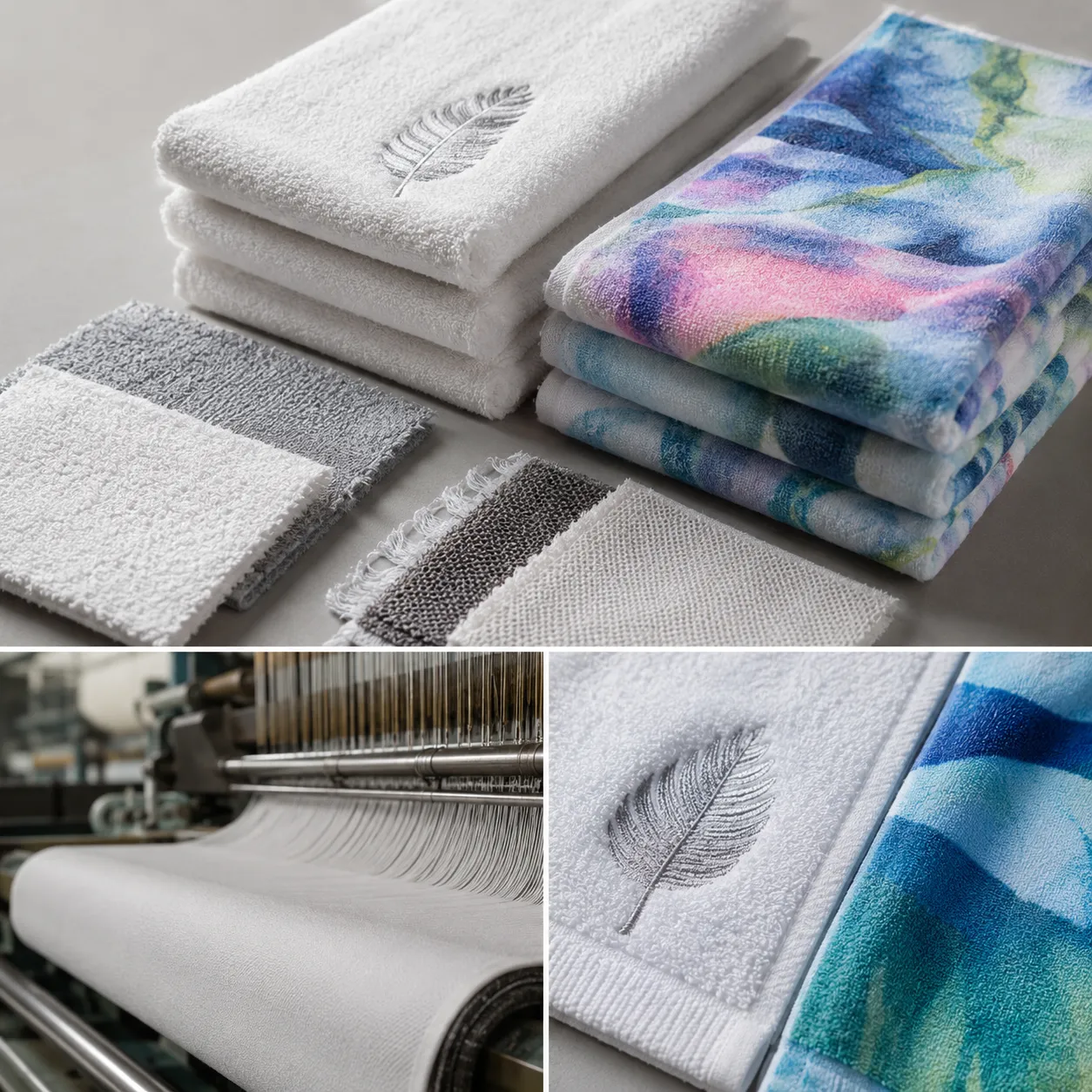
The first mistake is treating decoration as a separate step. In an embroidery vs sublimation towels gsm comparison, the base fabric decides how the decoration behaves. A 380 GSM cotton hand towel can carry satin embroidery cleanly, while a 300 GSM polyester towel is usually better suited to sublimation because the print sits in the fiber rather than on top of it.
If a buyer sends the same artwork for both methods, the result can look unfair. Embroidery adds thread bulk and needle tension. Sublimation needs a polyester-rich surface that can accept heat-transfer ink without ghosting. So the right comparison is not just logo method versus logo method; it is towel fiber, pile height, and end use together.
| Decoration method | Best base fabric | Typical GSM range we quote | What fails first |
|---|---|---|---|
| Embroidery | Cotton terry, cotton velour, or cotton-rich blends | 360-600 GSM | Puckering, heavy stitch density, loop distortion |
| Sublimation | Polyester microfiber or polyester-faced towels | 220-340 GSM | Faded transfer, heat marks, edge ghosting |
| Mixed program | Cotton towel with synthetic patch or label panel | 320-500 GSM | Panel lift, wash edge curl, mismatch after laundering |
Why GSM changes the decoration decision
GSM is not only about softness. It also changes how much structure the towel has to hold a decoration. Lower-GSM towels have less fiber mass, so embroidery can pull the ground fabric out of shape if the stitch count is too high. On a 280 GSM microfiber towel, a dense logo can feel like a hinge after heat sealing and stitching. On a 520 GSM ring-spun cotton bath towel, the same logo can sit flat if the underlay and backing are balanced.
For sublimation, higher GSM is not automatically better. The print quality depends more on surface finish and polymer content than on absorbency. A 300 GSM microfiber sports towel can print sharper than a 450 GSM cotton terry, because cotton does not bond with sublimation inks the way polyester does. That is why the towel type matters before the logo method is chosen.
| GSM band | Embroidery fit | Sublimation fit | Common buyer use |
|---|---|---|---|
| 220-280 | Usually weak unless logo is tiny | Strong if polyester-rich | Promo towels, event giveaways |
| 300-360 | Possible for light logos | Strong | Gym, travel, retail microfiber |
| 380-450 | Good for standard monograms | Weak unless blended or coated | Hotel hand towels, spa hand towels |
| 500-600 | Very good for dense logos with care | Rarely used | Bath towels, premium hospitality |
Embroidery works best when the loop structure can support it
We prefer embroidery when the buyer wants a tactile mark, not just a visual one. On cotton terry, the loops can hide the stitching edge if the density is correct. The main risk is loop collapse around the logo, especially with small text or a high stitch-per-square-centimeter fill. We usually cap tiny lettering at a size that still leaves room for the needle path and backing removal.
A useful factory check is the pull test after hooping. If the towel face shifts too much under the frame, the logo will ripple after washing. This happens often on lightweight hand towels and on loose-twist cotton where the pile is less stable. In those cases we either reduce stitch density, move the logo to a border, or recommend a woven label or patch instead.
- Use embroidery for logos that need a raised hand feel and a formal look.
- Keep stitch density moderate on 320-420 GSM towels.
- Avoid large solid fills on low-GSM terry; they stiffen the hand feel.
- Place embroidery away from the fold line when the towel must stack flat.
Sublimation needs the right fiber and surface
Sublimation is a fabric chemistry choice more than a decoration choice. The ink turns into gas under heat and bonds with polyester fibers. That gives strong color range, gradients, and fine artwork, but only if the towel surface accepts it. Cotton terry will not hold a true sublimation image. If a buyer asks for a full-color print on cotton, we usually suggest reactive print, screen print on a panel, or a polyester insert instead.
On microfiber, the surface finish matters. A brushed microfiber towel with a tighter knit face gives sharper edges than a very lofty cut pile. Too much pile can blur thin lines because the heat press does not transfer evenly across the peaks and valleys. For that reason, artwork with small text should be tested at production size, not just viewed on a screen.
| Sublimation factor | Preferred spec | Risk if ignored | Shop-floor note |
|---|---|---|---|
| Polyester content | 85%+ for reliable transfer | Washed-out color | Blend tolerance drops fast below this point |
| Face structure | Smooth knit or short-pile face | Blurry edges | Long pile traps pressure marks |
| Heat window | Controlled press time and temperature | Yellowing or ghosting | We check the first 10 pcs under the same press settings |
| Artwork size | Clear strokes and enough negative space | Ink fill-in | Fine serif text is the first to fail |
A practical embroidery vs sublimation towels gsm comparison by use case
This is where the buyer’s channel matters. A hotel guest towel, a gym sweat towel, and a beach promo towel do not need the same construction. The logo method should follow laundering, touch, and brand visibility. In an embroidery vs sublimation towels gsm comparison, we usually see embroidery win for hospitality and sublimation win for promotional and athletic programs.
| Use case | Recommended towel GSM | Decoration choice | Why it works |
|---|---|---|---|
| Hotel hand towel | 380-450 GSM | Embroidery | Quiet branding, good wash retention, neat stacking |
| Spa facial towel | 300-380 GSM | Small embroidery or woven label | Soft hand feel matters more than graphic coverage |
| Gym sweat towel | 280-360 GSM | Sublimation on microfiber | Color detail survives heavy brand graphics and quick turnaround |
| Beach giveaway towel | 220-320 GSM | Sublimation | Large artwork and sponsor logos print well |
| Bath towel for retail | 500-600 GSM | Embroidery | Higher perceived value and stable face structure |
A hotel buyer once asked us to sublimate a cotton bath towel because the design was highly colorful. We declined. The better answer was a cotton towel with a small embroidered mark on the border and a separate printed packaging sleeve. That kept the towel absorbent, avoided wash-fade complaints, and preserved the soft hand feel the guest expects.
Wash life, hand feel, and defect modes
Decoration failures do not always show on day one. Embroidery problems usually appear as puckering, thread snagging, or backing stiffness after the first few wash cycles. Sublimation problems show up as color drift, edge haze, or press shadow if the base fabric or heat profile is wrong. We check both with the same discipline, but the failure modes are different.
- Embroidery defect mode: puckering around fine lettering after laundering.
- Embroidery defect mode: loop snagging if the backing is not trimmed cleanly.
- Sublimation defect mode: ghosting when the press closes unevenly.
- Sublimation defect mode: washed-out panels on low-polyester blends.
For wash validation, we normally reference ISO 6330 domestic laundering conditions during sampling when a buyer wants a consistent screen across suppliers. For color and finish control, OEKO-TEX Standard 100 certification still matters because buyers need confidence that the base material and dyes are acceptable for the end market. If the program is for a hotel or wellness operator, we also track shrinkage, edge curl, and thread breakage after repeat washing, not just the first appearance.
Pricing changes with decoration density, not just method
Price discussions get messy when buyers compare the logo method without comparing artwork size. A tiny monogram in one corner and a full-chest graphic are not the same job. Embroidery cost rises with stitch count, color changes, and backing removal. Sublimation cost rises with print area, paper transfer, and heat-press time. The base towel GSM also changes the total because heavier fabric consumes more yarn and more freight cube.
| Order tier | Embroidery quote per pc | Sublimation quote per pc | What is usually included |
|---|---|---|---|
| 500-1,999 pcs | USD 0.42-1.10 | USD 0.28-0.86 | One logo, one placement, standard artwork setup |
| 2,000-4,999 pcs | USD 0.34-0.92 | USD 0.22-0.68 | Lower labor spread and better transfer efficiency |
| 5,000+ pcs | USD 0.26-0.74 | USD 0.18-0.54 | Best case for stable repeat programs |
For the towel itself, a 320 GSM microfiber promo towel may land around USD 1.15-1.95 ex-works at 500 pcs, while a 480 GSM cotton terry towel with embroidery can sit closer to USD 2.40-4.10 depending on yarn quality, towel size, and logo density. Those numbers move quickly if the buyer adds hem color, custom packaging, or special wash testing.
Sampling rules that prevent a bad approval
The sample must match the final construction, or the approval is meaningless. For embroidery, we need the final towel GSM, exact stitch file, thread shade, and backing choice. For sublimation, we need the final polyester content, face finish, and press settings. If a buyer approves a sample on a different base cloth, the bulk result can still fail even if the logo looks similar.
- Confirm towel composition and GSM first.
- Approve logo size on the real towel body, not on paper.
- Check the first wash for puckering, bleed, and edge curl.
- Lock the production color against a physical reference.
- Keep one retained sample from the approved lot.
When the artwork is complex, we ask for a vector file and a placement map. That matters even more on mixed programs where the front face is decorated and the back stays plain. A clean tech pack reduces revision loops and makes the difference between a two-round sample and a four-round sample.
What we would quote by channel
For hotel and spa buyers, embroidery usually wins because the towel must feel quiet, durable, and easy to fold. For athletic brands, event organizers, and beach promotions, sublimation is often the better route because color blocks, sponsor logos, and fast artwork changes matter more than a raised hand feel. If a buyer wants one program that covers both, we often split it into two SKUs rather than compromise the whole range.
- Hotel and spa: cotton terry, 380-550 GSM, embroidery on border or corner.
- Gym and sports: microfiber, 280-340 GSM, sublimation on the face.
- Beach promo: microfiber or polyester-face towel, 240-320 GSM, sublimation.
- Retail gift set: heavier cotton towel with restrained embroidery and matched packaging.
If you are comparing decoration methods for a private-label launch, it also helps to think about replenishment. Embroidery keeps its look well across reorders if the thread spec stays locked. Sublimation is more flexible for seasonal graphics, but the artwork file and fabric composition must be controlled tightly. That is why buyers with frequent design refreshes often choose sublimation, while buyers with one core brand mark often choose embroidery.
Where this fits in the sourcing workflow
Once the decoration path is clear, the sourcing file becomes much simpler. The towel GSM, yarn type, decoration size, and wash target should be in the same tech pack. If you need help with the spec side, our team usually cross-checks against build-towel-tech-pack-that-mills-can-quote.html and towel-gsm-decision-framework.html. For artwork choice, embroidery-vs-sublimation-vs-jacquard.html is a useful companion read.
For buyers building a hotel or spa program, spa-towel-program-treatment-room-specs and hotel-towel-sourcing-guide-2026.html are good reference points. If the order is promotional or event-led, custom-rally-towel-oem-event-specs and printed-towel-artwork-and-fabric-oem-guide help avoid artwork issues before sampling starts.
What to send for a real quote
To quote accurately, we need the towel size, GSM target, fiber content, decoration method, logo size, order quantity, and delivery country. Without those details, the numbers will swing too much to be useful. With them, we can usually return a realistic quote within 24 to 48 hours and flag whether embroidery or sublimation is actually the better business choice.
- Towel size and intended use
- Target GSM and fiber composition
- Logo file in vector format
- Decoration placement and size in millimeters
- Order quantity, ship-to country, and timeline
We manufacture from Gaoyang, Zhejiang, China, with MOQ starting at 500 pcs per design per color. Our mill is OEKO-TEX 100 Class I, BSCI, and ISO 9001 certified. For programs that need a quick decision on decoration and GSM, contact us on WhatsApp at +86 13205717266 or email [email protected].
Related reads: microfiber-vs-cotton-towel-comparison.html, pantone-color-matching-custom-towels.html, how-to-read-oeko-tex-certificate.html.
Request a factory quote
Send your towel size, GSM, artwork, and target market. We will advise whether embroidery or sublimation fits the fabric and wash life, then price the sample and bulk run.
Get Quote →