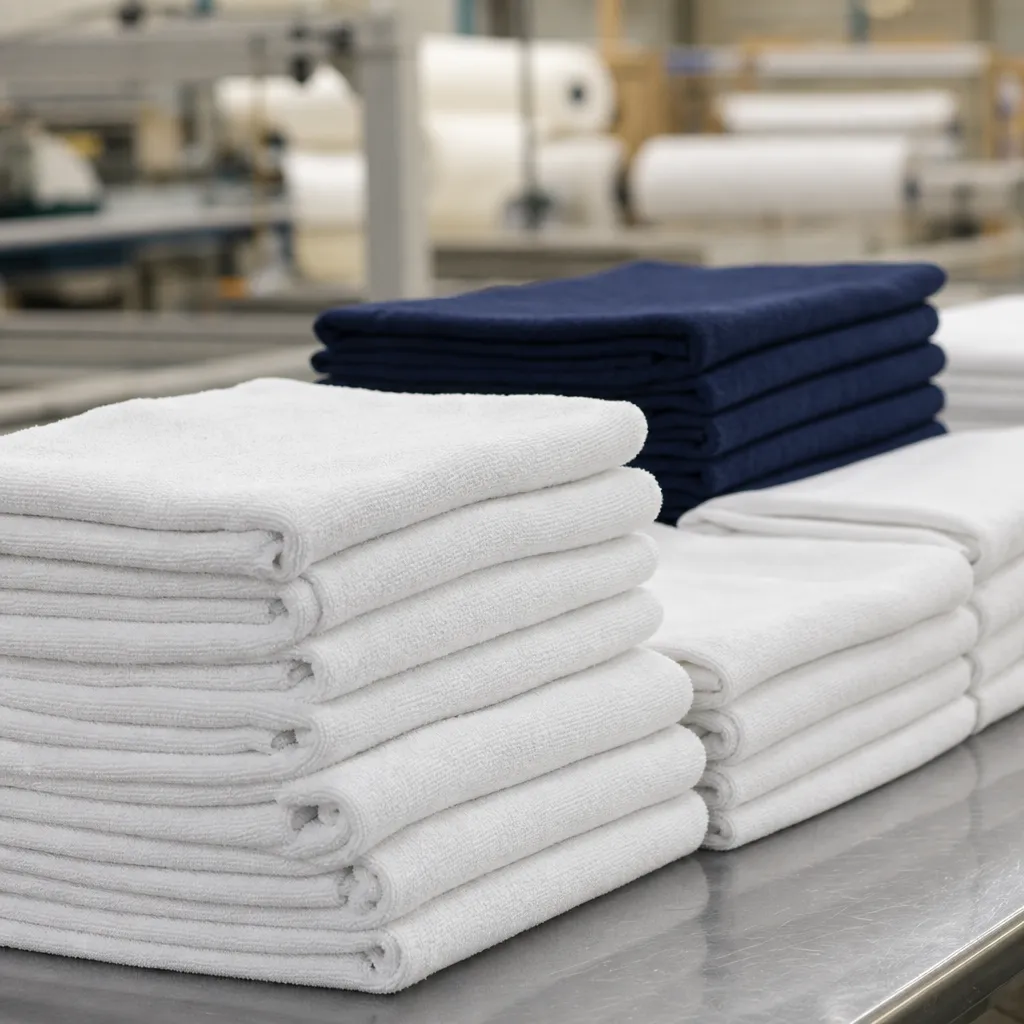
Start the monogram bath towel supplier checklist with the towel base
Embroidery cannot rescue a weak towel base. Before we discuss thread color or letter height, we ask buyers to lock the bath towel construction: size, GSM, yarn type, pile height, border position and shrinkage target. These details decide whether the monogram sits cleanly or sinks into the pile.
For hotel and spa bath towels, our normal base range is 500-700 GSM in 100% cotton. Retail gift towels sometimes move to 450-550 GSM to reduce parcel weight. A dense 650 GSM towel gives a richer hand feel, but it also makes small serif letters harder to read unless we add underlay stitches and increase the embroidery height.
| Use case | Common size | Practical GSM range | Embroidery note |
|---|---|---|---|
| Hotel room bath towel | 70 x 140 cm or 76 x 152 cm | 550-650 GSM | Works well with 55-85 mm initials if pile is not too high |
| Spa treatment towel | 70 x 140 cm | 500-600 GSM | Avoid heavy backing if towel touches face or shoulders |
| Retail monogram gift towel | 76 x 150 cm | 500-620 GSM | Packaging weight matters; embroidery needs neat back side |
| Luxury suite towel | 80 x 160 cm | 650-750 GSM | Large monograms need sampling because plush pile can bury detail |
A small construction change affects the decoration. If the towel uses a wide dobby border, the logo position may need to move 90-120 mm above the border to avoid distortion at folding. If the pile is zero-twist and very soft, we usually advise bolder lettering rather than thin script. For yarn selection, our related guide on combed and zero-twist cotton explains why soft hand feel and embroidery clarity are not always the same target.
- Confirm towel size after washing, not only greige or pre-wash size.
- Set a GSM tolerance, usually plus or minus 5%, rather than accepting a loose verbal range.
- Ask whether the embroidery area is on pile, border or a dedicated flat panel.
- Check that the towel base has passed absorbency finishing before decoration.
- Keep one approved towel base as the control sample for all later thread and monogram approvals.
Embroidery capability is more than owning machines
A supplier may show a 12-head embroidery machine and still fail on bath towels. Towels are not flat shirting fabric. The pile moves, the hoop pressure can leave marks, and small letters can close up after washing. We look at digitizing skill, stabilizer choice, hooping method and operator consistency.
For monogrammed bath towels, we normally test satin stitch width between 2.0 and 4.0 mm, depending on the font. Anything thinner than about 1.6 mm can disappear into 600 GSM pile. For a three-letter monogram, a practical height is 60-90 mm on most hotel bath towels. Retail oversized towels can go larger, but high stitch density increases cost and can make the towel stiff at the chest when wrapped around the body.
| Embroidery checkpoint | What we verify at sample stage | Risk if skipped |
|---|---|---|
| Digitized file | Stitch direction, underlay, pull compensation and trims | Letters warp or look uneven after laundering |
| Backing type | Tearaway, washaway or light cutaway by towel weight | Back side feels scratchy or puckers around initials |
| Thread specification | Polyester embroidery thread, color code and wash resistance | Color bleed or thread dulling after industrial laundry |
| Hoop pressure | Pile recovery after 24 hours and after steam | Visible hoop ring on dark or plush towels |
| Needle and speed | Needle size and RPM adjusted for towel pile | Broken loops, thread nesting or skipped stitches |
One towel-specific defect we watch closely is pile trapping inside satin stitches. If loose loops are caught by the needle and then trimmed during finishing, the face can show bald dots around the monogram. Another is backing shadow: white stabilizer may show through navy or charcoal towels if the design has open spaces. These are not cosmetic opinions; they are predictable production failure modes.
Ask for samples that copy the real order, not showroom pieces
The safest sample is made on the same towel weight, same color, same thread, same monogram size and same backing planned for bulk. A showroom sample on white 500 GSM cotton tells us very little about navy 650 GSM hotel towels with champagne thread.
- Approve the towel base first: size, GSM, yarn, border and wash shrinkage.
- Approve lab dips or stock colors under D65 and TL84 lighting if color matching matters.
- Approve embroidery on the correct color towel, not on substitute fabric.
- Wash the decorated sample at least five cycles before final signoff.
- Keep one sealed approval sample at the factory and one with the buyer.
For laundry testing, we use internal wash checks and buyer-specific methods. A typical hotel trial is five to ten cycles at 60°C with tumble drying, then visual grading for thread fuzz, puckering, color transfer and towel shrinkage. If the towels are going into outsourced commercial laundry, we ask for the laundry chemistry early because peroxide, alkali level and drying temperature change results.
If your team is still building the full towel brief, the article on creating a towel tech pack mills can quote is a useful companion. For decoration choices beyond embroidery, we also compare embroidery, sublimation and jacquard with the trade-offs we see on our production floor.
Compliance: set the right certificate level for the end use
We do not tell every buyer to require the highest certificate class by default. That adds confusion and sometimes cost without improving the product. For general adult bath towels, OEKO-TEX Standard 100 Class II is commonly suitable because the towel has direct skin contact. Class I is relevant when the product is designed for babies and toddlers. If a hotel uses one towel line across adult rooms and family baby amenities, then Class I may be worth specifying.
Our mill operates with OEKO-TEX Standard 100, BSCI and ISO 9001 systems. For a monogram program, buyers should check whether the certificate scope covers the finished towel, the dyeing route and the embroidery thread or whether extra thread declarations are needed. A certificate that only covers greige fabric is not enough for a finished, dyed, embroidered towel.
- Ask for the current OEKO-TEX certificate number and expiry date, then verify it on the OEKO-TEX label check system.
- Match the product class to the real user: Class II for most adult skin-contact towels, Class I for infant or baby use.
- Confirm that embroidery thread and backing are included through supplier declarations or separate material certificates.
- Request BSCI or equivalent social audit records if your brand requires factory social compliance.
- Check ISO 9001 procedures for incoming material inspection, needle control and final inspection records.
The most common certificate mistake is a date mismatch. A buyer approves a 2025 certificate during sampling, but bulk ships in 2026 after the document expires. In our July 2026 orders, we attach the active certificate set to the pre-production file before cutting, so the compliance record matches the shipment window.
For buyers new to certification language, our note on how to read an OEKO-TEX certificate explains product class, annex version and facility scope in plain terms.
FOB China pricing: July 2026 ranges we are seeing
Price ranges below are based on our July 2026 FOB China quotation experience for custom cotton bath towels with one embroidered monogram position. They are not a market index and they move with cotton yarn, dyeing load, thread brand, exchange rate and packing method. Still, they give procurement teams a realistic starting point before RFQ comparison.
| Order quantity | Typical spec assumption | FOB China price range, July 2026 | What moves the price most |
|---|---|---|---|
| 500-999 pcs | 70 x 140 cm, 520-580 GSM, one 60 mm monogram | USD 4.35-6.20 / pc | Setup cost spread over fewer units; color splits matter |
| 1,000-2,999 pcs | 70 x 140 cm or 76 x 152 cm, 550-620 GSM | USD 3.85-5.45 / pc | Towel GSM, stitch count and individual polybag choice |
| 3,000-7,999 pcs | Hotel bath towel, 580-650 GSM, standard carton pack | USD 3.45-4.95 / pc | Yarn grade, dye shade, embroidery density |
| 8,000+ pcs | Program order with controlled colorways | USD 3.10-4.55 / pc | Production efficiency, carton optimization, repeat artwork |
Embroidery cost is not only the visible letter size. A 75 mm three-letter serif monogram may carry 7,500-11,000 stitches depending on font and underlay. A cleaner block monogram at the same height may be closer to 5,000-7,000 stitches. On 2,000 pieces, that difference can add roughly USD 0.16-0.32 per towel in thread time and machine capacity at current factory costing.
The cheap quote usually removes something: lower GSM, open-end yarn, minimal backing, loose trimming standard or no wash test. A 540 GSM towel at USD 3.95 that survives 80 hotel washes can cost about USD 0.049 per use. A softer-looking 620 GSM towel at USD 4.70 that starts fraying at the monogram edge after 45 washes costs USD 0.104 per use, before guest complaints or replacements. That is why we compare construction and laundry result, not only FOB line price.
MOQ, color splits and personalization rules
Our normal MOQ is 500 pcs per design per color. That applies cleanly when the towel color, size, embroidery position and monogram artwork are the same. Personalization makes planning more complicated because initials can change piece by piece, but the towel base still needs dyeing, cutting and sewing in efficient lots.
For hotel programs, we recommend separating true monogram programs from name personalization. A hotel logo or fixed three-letter brand monogram is straightforward. Guest-name towels require a different workflow: blank towel stock, embroidery order batching, barcode control and extra inspection after each name run.
- For fixed brand monograms, plan at least 500 pcs per towel color to keep dyeing and embroidery setup efficient.
- For multiple hotel departments, combine the same towel base and vary only thread color where possible.
- For individual names, allow extra overage because spelling corrections and single-piece rework create handling loss.
- Avoid mixing four towel colors and three thread colors at the MOQ level unless the program can absorb higher unit cost.
- If you need a smaller launch, consider one core towel color first, then add colorways after sell-through data.
Buyers sometimes ask whether 200 pieces can be made at a low bulk price. Technically, sampling and small batch production are possible, but the cost per unit rises because dyeing, cutting, embroidery setup, QC and export documents still happen. For a realistic discussion of quantity breaks, see our guide on negotiating towel MOQ without damaging margin.
Lead time should be counted by approval gates
A calendar promise without approval dates is not useful. As of July 2026, our typical timeline for monogrammed bath towels is 7-12 days for base and embroidery sampling after artwork and color references are complete, then 28-45 days for bulk production after deposit and final approval. Ocean freight is separate.
| Stage | Typical timing in working days | Buyer action that prevents delay |
|---|---|---|
| Artwork and tech pack review | 1-3 days | Send vector artwork, towel size, GSM, Pantone or TCX references |
| Lab dip or color confirmation | 4-8 days | Approve under agreed lighting and note tolerance |
| Embroidery strike-off on towel | 5-9 days | Review front, back, hand feel and washed result |
| Pre-production sample | 3-6 days after materials ready | Sign off size, label, carton mark and packout |
| Bulk weaving, dyeing, sewing, embroidery | 28-45 days | Avoid late changes to font, thread color or carton pack |
| Final inspection and booking | 2-5 days | Confirm AQL level, shipping marks and forwarder details |
Lead time stretches when buyers approve a logo on screen but change the font after seeing stitch-out, or when the towel color is approved before checking thread contrast. Dark towels with tone-on-tone embroidery often need one extra strike-off because the monogram can vanish under hotel bathroom lighting.
If the launch is tied to a property opening, we recommend mapping freight after the production calendar, not at the last minute. Our article on container versus air freight for towel orders lays out when air freight is worth paying for and when carton cube makes it painful.
QC points that matter on embroidered bath towels
Final inspection should include towel defects and embroidery defects together. A towel can pass weight and size checks but fail because the monogram is off-center by 18 mm. Another towel can have a perfect monogram but poor selvedge stitching. The inspection plan has to see the finished product as the guest sees it.
For export orders, we commonly use ANSI/ASQ Z1.4 sampling logic with AQL levels agreed in the purchase order. Many brand buyers choose AQL 2.5 for major defects and 4.0 for minor defects, but the exact level should match the order risk and channel. For luxury retail or five-star hotel opening stock, we often tighten visual criteria for embroidery placement and thread trimming.
- Measure towel size after conditioning and compare with approved tolerance, often plus or minus 3% after washing.
- Check GSM from cut samples or approved weight method, not by hand feel.
- Inspect monogram placement from towel edge and border, using the same fold direction planned for presentation.
- Review thread tails, skipped stitches, thread nests, loose backing and visible stabilizer.
- Run rub checks on dark embroidery thread against light towel ground where contrast is high.
- Open export cartons during inspection to verify assortment, labels, barcode position and polybag suffocation warnings where required.
Two factory details are easy to miss. First, needle control records matter on towel embroidery because broken needle fragments can hide in thick pile. We use needle issue and return logs at the embroidery line. Second, trimming must happen before final lint removal, otherwise small thread ends stick to terry loops and appear like contamination inside the polybag.
For hotel bath programs that also need plain towels, the hotel towel sourcing guide gives broader context on towel weights, replenishment and laundry life. For brand teams building a luxury line, the article on monogrammed bath towels for luxury brands goes deeper into placement and presentation.
Purchase-order lines we want buyers to write clearly
A good supplier checklist ends with a clear PO. If the PO says only “white bath towel with embroidered logo,” both sides will spend time arguing later. The purchase order should convert the approved sample into measurable lines.
- State towel size, GSM, yarn type, color reference and allowed tolerance.
- State embroidery artwork file name, size in millimeters, thread code, stitch position and backing type.
- State label, hangtag, polybag, carton quantity, carton mark and any barcode requirements.
- State compliance requirements by certificate name, product class if applicable and document expiry expectations.
- State inspection standard, AQL level, retained sample rule and shipment approval process.
- State Incoterm, loading port, required ship window and forwarder contact.
For private-label orders, we also ask for packaging drawings early. A thick 650 GSM towel packed in a tight belly band may crease the monogram. A towel rolled for spa display needs a different logo orientation from a towel folded for retail shelving. Those are not decoration decisions only; they affect carton cube, labor time and guest presentation.
Related reads: procurement teams comparing supplier options may also find hotel towel wholesale supplier guidance, Pantone color matching for custom towels and our towel size and dimension guide useful before sending RFQs.
Related reads for adjacent programs: if your property also buys pool or resort towels, review the beach club towel program notes. For gym and spa areas, our gym sweat towel specification guide and spa cotton versus hotel cotton article help avoid using one towel spec for every department.
What we need to quote responsibly
LUMA & CO. TEXTILE has produced towels since 2007 with a 220-person team in Gaoyang, Zhejiang. We supply more than 80 brand clients across 47 countries, with annual output around 2.4 million towels. For monogrammed bath towel work, our practical starting point is still 500 pcs per design per color, with sampling and bulk timing tied to approvals.
To quote a monogram bath towel supplier checklist request accurately, we need the towel size, GSM target, quantity by color, artwork file, thread color direction, packing method, destination port and compliance requirement. If you only have a reference photo, send it, but expect one extra round to translate that photo into a technical spec.
You can reach our merchandising team by WhatsApp at +86 13205717266 or email [email protected]. We will tell you if a requested construction is likely to fail in laundry; it is easier to adjust the spec before sampling than to explain puckered monograms after bulk production.
Build a monogram bath towel RFQ
Send us your towel base target, artwork and quantity split. We will return a factory-side quotation with sample timing, FOB China range and QC notes.
Request a quote →