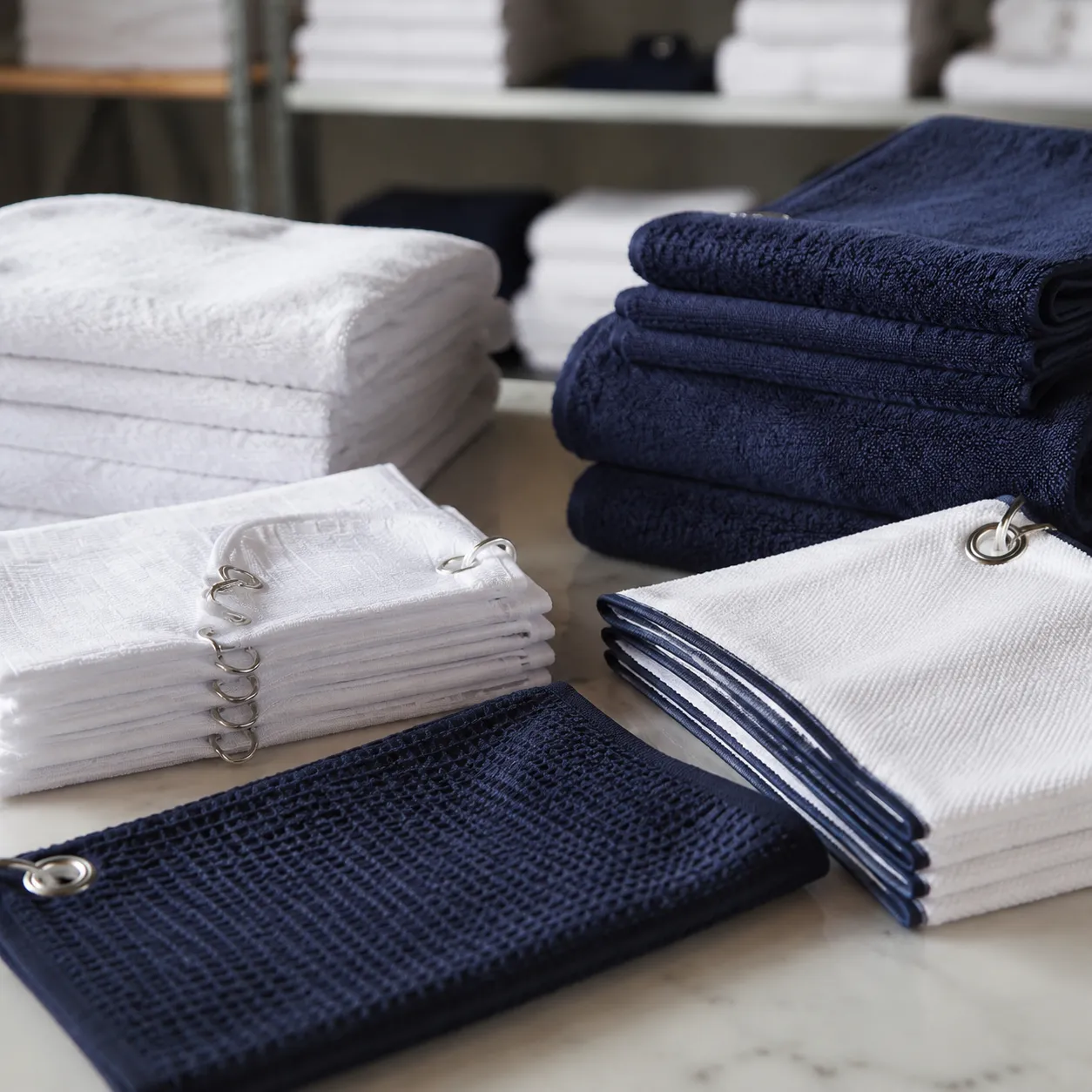
Start with the fabric, not the artwork
Most cooling towels we produce are warp-knit or circular-knit microfiber in the 140-220 GSM range, usually polyester or a polyester-polyamide blend. The decoration decision changes once you know whether the towel must stay slick and cool on first wet-out, whether it will be snapped in the air repeatedly, and whether the brand wants edge-to-edge color or only a small mark near the hem.
This is why a cooling sport towel logo decoration comparison has to begin with fabric behavior. A dense print film that works on a 380 GSM cotton hand towel can block evaporation zones on a 155 GSM cooling mesh. On the other hand, a woven label or small embroidery that looks harmless can create drag points on a towel that users wrap around the neck.
- For event giveaways, we usually see 150-170 GSM microfiber with full-coverage artwork or repeat logos
- For retail sports accessories, a more stable 175-210 GSM knit is common because it handles better after repeated wet-dry cycles
- For team or outdoor promotion packs in pouches, buyers often want low bulk thickness under 2.8 mm after finishing
| Base fabric | Typical GSM | Branding methods that fit best | Methods we usually avoid |
|---|---|---|---|
| Warp-knit polyester cooling towel | 145-165 | Sublimation, screen print on limited area, transfer label | Embroidery, heavy silicone patch |
| Polyester/polyamide cooling knit | 160-190 | Sublimation, deboss on suede side if construction allows | Large plastisol layers |
| Dual-surface cooling towel with smooth face | 185-220 | Sublimation, heat transfer badge, woven label | High-density stitching near center panel |
The four methods that actually stay in the conversation
On paper, buyers ask about six or seven branding options. In production, four methods usually survive the sampling stage: sublimation print, screen print, emboss or deboss on suitable constructions, and a small sewn-on label. We rarely recommend embroidery for a true cooling towel, even when the logo is simple, because needle penetration can snag knit loops and create pucker after the first wet cycle.
Two process details matter here. First, sublimation needs a polyester-rich face; below roughly 85% polyester, image brightness drops and line edges soften. Second, for screen print on cooling knits, we watch elongation under tension because the mesh can open during drying, which is where micro-cracking begins on thicker ink deposits.
| Method | Best use case | Visual effect | Main risk |
|---|---|---|---|
| Sublimation | Full-panel graphics, gradients, sponsor walls | Sharp color and unlimited artwork | Requires polyester face and tight artwork control |
| Screen print | Simple logos, one to three spot colors | Strong block logo on limited area | Ink hand-feel and crack risk after stretch |
| Emboss or deboss | Tone-on-tone retail look | Quiet branding with no extra color | Only works on specific surface constructions |
| Sewn label | Small brand mark near edge | Clean and low-cost secondary branding | Can irritate skin if label placement is wrong |
Why sublimation usually wins on cooling towels
If the artwork is part of the selling point, sublimation is usually the cleanest route. The dye migrates into the polyester face instead of sitting on top of it, so the towel keeps a lighter hand feel than a heavy surface print. For cooling articles, that matters because the user notices stiffness immediately when the towel is wet and folded.
We still qualify that recommendation. A large dark flood can increase solar heat absorption in outdoor use, especially on navy, black, or saturated red layouts. Buyers focused on summer races or golf sideline packs should think about where the towel sits between uses. A pale ground with localized graphics can feel more comfortable in direct sun even if the lab cooling mechanism is unchanged.
- Good fit for microfiber cooling towel logo programs with photographic or multi-color art
- Best result when artwork files are built in CMYK with tolerance discussed in advance against physical strike-off
- Works well for repeat prints because there is no ink buildup at logo edges
- Needs careful heat-setting so towel dimensions stay within commercial tolerance after first wash
In our mill workflow, we check print stability after finishing with a simple stretch-and-recovery review on the panel, then confirm colorfastness to washing and perspiration against buyer-required standards. For branded sports accessories, we commonly reference ISO 105-C06 for domestic laundering and ISO 105-E04 for colorfastness to perspiration. If a buyer expects outdoor retail exposure, we may also discuss light fastness under ISO 105-B02, but not every promotional program needs it.
| Sublimation order size | Typical FOB USD/pc | Lead time after approval | Notes |
|---|---|---|---|
| 1,000-2,999 pcs | 0.92-1.34 | 18-24 days | Standard 30x100 cm to 30x110 cm, pouch separate if needed |
| 3,000-9,999 pcs | 0.74-1.08 | 20-26 days | Artwork complexity affects transfer paper and setup |
| 10,000+ pcs | 0.61-0.89 | 24-32 days | Best value for event programs with repeated art across colorways |
Where screen print still makes sense
Screen print is not obsolete here. It still works when the logo is bold, the budget is tight, and the brand mark sits in one stable zone instead of running across the entire towel. We use it most on simple promotional orders where the client wants one or two spot colors and accepts a more obvious printed hand.
The failure mode is usually not immediate wash-off. It is edge fatigue. A cooling towel gets twisted, wrung, snapped, and stretched diagonally. If the ink layer is too thick or the curing window is too aggressive, the logo develops hairline fractures that buyers describe as 'aged' after only a few cycles. On some open-knit constructions, we reduce this risk by shrinking the solid logo area or using broken-line art instead of one heavy block.
- Confirm elongation of the knit before artwork placement
- Keep the logo away from the highest fold line if users will knot the towel
- Specify maximum print area, not only logo width
- Approve a wet-hand sample, not a dry sample only
Pricing can be attractive, but only within a narrow spec window. On a 160 GSM polyester cooling towel at 30x100 cm, one-color screen print on one position may land around USD 0.68-0.95 FOB at 2,500-5,000 pcs. Add a second print location or large solid coverage and the savings over sublimation can disappear quickly because reject risk rises and the process slows.
Embossed looks clean, but only on the right construction
Buyers often ask for an embossed cooling towel because they want a quieter retail appearance. The problem is that not every cooling fabric can hold that impression cleanly. A loose mesh or highly elastic knit rebounds too much, so the logo fades visually after packaging compression and first wet use.
We only put emboss or deboss into sampling when the towel has a stable face, usually a smoother suede-like side or a brushed construction around 180-220 GSM. Even then, the logo needs open shapes. Thin serif text or fine outlines do not survive pressure variation well, especially across larger panels.
If the buyer wants the towel to feel almost unchanged in hand, emboss is attractive. If the buyer wants the logo to read from three meters away, emboss is usually the wrong answer.
| Emboss scenario | Visual result | Commercial fit | FOB add-on |
|---|---|---|---|
| Small chest-size logo near hem | Subtle and neat | Retail pack-ins, clubs, premium gifts | USD 0.10-0.18/pc |
| Mid-size centered logo | Readable only on stable face | Selective use | USD 0.14-0.24/pc |
| Large panel emboss | Often inconsistent | Usually not recommended | Not quoted unless sampled first |
Why we usually push back on embroidery
This is one place where we need to be direct. Embroidery looks familiar, but on most cooling towel programs it solves the wrong problem. Stitch density adds local stiffness, the backing can rub the neck, and repeated wetting makes puckering more visible than it was on the approval sample.
There is also a construction risk. Cooling towels are often made from filament microfiber knits that can ladder if the needle creates a weak path near the edge or corner. That does not happen on every run, but when it happens, the complaint rate is out of proportion to the value of the decoration. For the same reason, we do not like large merrowed patches on lightweight cooling styles.
- We may accept very small embroidery only on heavier dual-surface towels above 200 GSM
- Placement should stay close to the hem, not in the neck-contact zone
- Stitch count should be capped and sample reviewed after wet use, not just after pressing
- For most promotional volumes, a woven label or printed mark is safer and cheaper
What buyers should test before approving artwork
A cooling towel sample can pass visual review and still fail in use. We recommend a short approval sequence that reflects how the product is actually handled in sport and outdoor settings. This is more useful than adding another long spec sheet with unsupported claims.
- Wet the sample completely, wring by hand, and fold it twice to check whether the logo area stiffens more than the blank area
- Snap the towel 15-20 times to see whether printed zones show stress whitening or crack initiation
- Place it around the neck for five minutes to check irritation from labels, backing, or raised decoration
- Wash it three cycles at the intended care standard and compare edge shape, print hold, and recovery
- Review one bulk-color standard under daylight, not office LED only
For quality control, we typically write decoration comments directly into the pre-production sample record: maximum logo dimensions, location tolerance in millimeters, approved hand feel, and acceptable edge clarity. This prevents a common problem on repeat orders where the artwork file is unchanged but the knit lot behaves slightly differently in finishing.
A practical cooling sport towel logo decoration comparison by order type
Not every program should choose the same branding route. Event distribution, retail merchandising, and club resale have different failure costs. A marathon giveaway can accept lower unit value if the logo reads clearly on day one. A sports accessories line on shelf cannot accept a decoration that makes the towel feel cheap in the hand.
| Order type | Best method | Why | Typical MOQ |
|---|---|---|---|
| Large event giveaway | Screen print or sublimation | Depends on artwork complexity and budget ceiling | 2,000 pcs per design |
| Retail cooling towel with pouch | Sublimation | Best graphic control and softer hand | 1,000 pcs per design |
| Club or team resale item | Sublimation plus woven label | Branding on both display and use moments | 1,000 pcs per design |
| Quiet premium gift item | Emboss plus small label | Low-noise visual identity | 1,500 pcs per design |
Our regular MOQ is 500 pcs per design per color, but for cooling towels with custom decoration, many programs become commercially cleaner above 1,000 pcs because print setup, pouch matching, and shade control stabilize there. If the order is split across several sponsor versions, we usually suggest keeping the towel ground common and changing only overprint or insert card where possible.
Related reads: embroidery-vs-sublimation-vs-jacquard, sport towel microfiber oem spec guide, and custom microfiber towels wholesale guide.
Cost comes from error prevention more than from the logo itself
A lot of quotations look close on paper. The bigger cost difference appears later, in rework, approval delay, and complaint risk. We see this especially when a buyer chooses a low setup method but adds difficult art, dark grounds, retail folding, matched pouches, and a short ship window. That combination is where a seemingly cheap option stops being cheap.
- Artwork with gradients or photo imagery points naturally toward sublimation
- Very short lead times favor methods with fewer physical screens or patch components
- Retail folding makes center-panel defects more visible than loose bulk packing
- Matching towel and pouch colors adds one more approval checkpoint
As a realistic planning range, sample development is usually 5-8 days for simple screen print and 6-10 days for sublimation with corrected artwork. Bulk production often runs 18-32 days after final approval, depending on quantity, pouch assembly, and booking window. If the order includes branded mesh bags, barcode stickers, and PDQ cartons, add several days for pack-out coordination.
Related reads: build a towel tech pack that mills can quote, negotiate towel MOQ without killing margin, and container vs air freight towel orders.
The shortest recommendation we give buyers
If the artwork is a major selling feature, choose sublimation on a polyester-rich cooling knit and approve the sample wet. If the logo is simple and the budget is tight, screen print can work on a controlled print area. If the brief calls for a quiet retail finish, test emboss only on a stable, smooth-faced construction. We do not recommend standard embroidery on most lightweight cooling towels.
That is the most honest cooling sport towel logo decoration comparison we can give from the factory side of sampling and bulk production. The best-looking method in a PDF is not always the one that survives wet use, folding, and repeat handling.
Need a decoration shortlist for your cooling towel program?
Send us your towel size, fabric target, artwork, quantity, and packing plan. We will tell you which branding methods are commercially realistic before sampling starts. MOQ 500 pcs per design per color. OEKO-TEX 100 Class I, BSCI, ISO 9001.
Request a quote →For program reviews, reach us at [email protected] or WhatsApp +86 13205717266.