Start the quote with the packout, not the fabric
For this category, buyers often start with size and GSM. We ask about retail packout first because the same 30 x 100 cm towel can run through very different workflows. A loose-folded towel in an OPP bag is fast to cut, print, fold, and carton. A rolled towel inserted into a 220 ml bottle with carabiner adds bottle sourcing, logo application on the bottle, manual rolling consistency, cap torque checks, and a slower packing line. If your target shelf format is fixed, we can give a tighter FOB range on day one.
| Packout format | Common MOQ per color/design | Typical FOB USD/pc at 5,000 pcs | Packing notes |
|---|---|---|---|
| OPP bag + care card | 1,000 | 0.78-1.08 | Lowest packing labor, best for promotions |
| Mesh pouch + hangtag | 1,500 | 0.96-1.28 | Better airflow after use, extra sewing step |
| PET bottle + printed insert | 3,000 | 1.12-1.56 | Bottle diameter must match rolled towel bulk |
| Tube canister + label | 5,000 | 1.34-1.82 | Mostly retail programs, more cube in freight |
- If the bottle is a stock transparent PET bottle, the towel can usually keep MOQ at 3,000 pcs per colorway.
- If you want a custom color bottle body or custom cap mold tone, practical MOQ moves closer to 8,000-10,000 pcs because bottle suppliers batch by resin color.
- A mesh pouch looks simpler than a bottle, but it still adds a sewing operation and a second logo surface.
The fabric choices that actually show up in orders
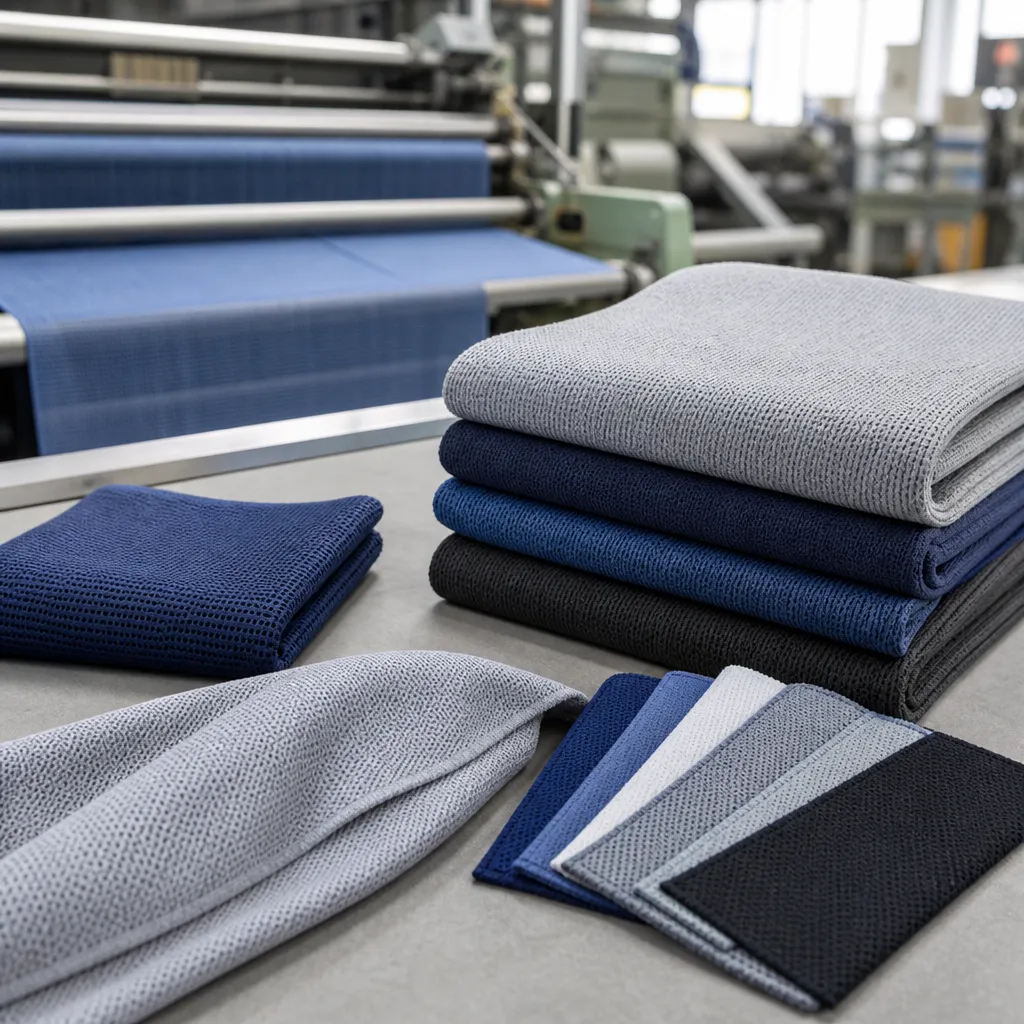
Most neck-cooling programs are not cotton. They use warp-knitted polyester or polyester/polyamide microfiber because the cooling effect comes from water retention plus evaporation, not from pile absorbency. The three constructions we quote most often are 120-140 GSM knitted polyester for giveaways, 145-165 GSM suede microfiber for better handfeel and print coverage, and 130-150 GSM RPET microfiber where recycled content is a buying requirement.
There is also a construction detail buyers miss: edge build. Laser cut with rounded corners gives a clean sport look, but some fabrics harden at the perimeter after heat cutting if machine temperature is too high. Overlock edge costs a little more in labor but feels softer around the neck and reduces complaints about stiff edges in long wear.
| Fabric option | Usual GSM | Best use | FOB USD/pc at 10,000 pcs in OPP |
|---|---|---|---|
| 100% polyester cooling knit | 120-140 | Mass event giveaways | 0.69-0.88 |
| Polyester suede microfiber | 145-165 | Fitness and retail-adjacent programs | 0.82-1.04 |
| RPET suede microfiber | 130-150 | Sustainability-led campaigns | 0.91-1.16 |
| Polyamide-rich microfiber blend | 160-180 | Higher absorbency, smaller volume programs | 1.08-1.42 |
For cooling towels for neck MOQ and pricing, the cheapest fabric is not always the cheapest delivered program. A 125 GSM knit saves fabric cost, but if you need dense photo artwork, we often need to move to suede microfiber because print definition is cleaner and reprint risk is lower.
Print method changes both MOQ and waste rate
If the artwork is a one-color slogan, we usually recommend screen printing on dyed ground. For all-over graphics, sublimation on white microfiber is the standard route. Embroidery is rare on this product because a stitched area becomes stiff when wet and creates an uneven cooling zone against skin.
The reason print method affects price is not only ink cost. It affects fabric base color, setup waste, strike-off approval, and inspection criteria. On sublimation orders we inspect image migration at fold lines and ghosting near seam edge. On screen-printed cooling towels we check handfeel after curing because over-deposited ink can block evaporation in the printed area.
- Screen print on dyed fabric: good for simple logos, lower setup cost, usually 1-2 spot colors.
- Sublimation on white microfiber: best for gradients and photographic graphics, higher paper and transfer cost, stronger artwork flexibility.
- Printed bottle label + plain towel: sometimes cheaper for licensed events where the towel itself can stay generic and compliance review stays on the packaging.
| Decoration route | MOQ signal | Typical extra FOB vs plain towel | Technical note |
|---|---|---|---|
| 1-color screen print | 1,000+ | 0.05-0.10 | Best on flatter knit surfaces |
| 2-color screen print | 1,500+ | 0.08-0.15 | Registration tolerance matters on thin fabric |
| Full sublimation one side | 1,000+ | 0.12-0.24 | Artwork must include 8-10 mm bleed |
| Bottle sticker + plain towel | 3,000+ | 0.04-0.09 | Label adhesion should be checked after condensation |
A usable quote sheet for cooling towels for neck MOQ and pricing
If your RFQ arrives with only "cooling towel, logo, bottle," the FOB range will be wide. We can still quote, but it will be a budgeting number. To narrow it, buyers should lock a few fields early. This product has more moving parts than a plain gym towel because trim, folding method, and insert format are all cost lines.
- State finished size, for example 30 x 90 cm or 30 x 100 cm, with tolerance expectation.
- Name the fabric and GSM target, or at least the intended use if you want us to recommend one.
- Send artwork count and print positions for both towel and package.
- Specify packout: OPP, pouch, bottle, tube, or retail box.
- Confirm whether color assortment can share one bottle spec or needs bottle-by-bottle differentiation.
- List compliance needs such as OEKO-TEX Standard 100 Class I, REACH sensitivity from your market, or retailer restricted substance protocol.
We also ask whether the towel will be pre-wetted at retail. If yes, the project changes completely because liquid filling, preservative system, leak control, and transport conditions move outside a standard dry-textile order. Our normal cooling towel program is a dry towel only.
Where the FOB number usually lands by volume
These bands assume China FOB, dry goods, standard export carton, OEKO-TEX compliant fabric inputs, and no special retail display box. They are based on current programs we see for sports events, gym promotions, and outdoor retail support packs. They are not valid for pre-wet products or insulated gift sets.
| Volume | Dyed knit + OPP | Sublimated microfiber + OPP | Sublimated microfiber + PET bottle |
|---|---|---|---|
| 1,000-2,999 pcs | 0.92-1.21 | 1.05-1.34 | 1.36-1.78 |
| 3,000-4,999 pcs | 0.81-1.07 | 0.94-1.22 | 1.22-1.61 |
| 5,000-9,999 pcs | 0.74-0.98 | 0.87-1.13 | 1.12-1.50 |
| 10,000+ pcs | 0.69-0.91 | 0.82-1.06 | 1.05-1.42 |
Two short notes on basis. First, bottle packout has a wider spread because bottle resin cost changes with oil markets and because freight-in from the bottle vendor can shift if the bottle source is outside our towel cluster. Second, sublimation price spread depends on artwork coverage and whether we run transfer paper with nested layouts that leave efficient waste margins.
If you are comparing two cooling-towel quotes and one is lower by USD 0.18, check whether both include the same bottle, insert, hangtag, and carton count. On this product, packing assumptions hide more than fabric assumptions.
Sampling and bulk timing buyers should book against
Lead time is usually shorter than cotton towel programs, but packaging can delay approval. Fabric is not the slow part. Printed inserts, custom bottle labels, and third-party lab booking often set the calendar.
- Plain fabric handfeel sample: 3-5 days if stock greige is available.
- Printed strike-off or sublimation mockup: 5-7 days.
- Bottle or pouch packout sample: 7-10 days depending on bottle inventory.
- Bulk production after approval: 18-28 days for 5,000-20,000 pcs.
- Third-party testing if required before shipment: add 4-6 working days.
For event-driven orders, we usually tell buyers to work backward from ex-factory date, then build in freight buffer. If the job uses custom bottles, lock the artwork before the towel print approval if possible. Bottle vendors do not like repeated small label changes because minimum label runs are relatively high compared with the towel value.
Related reads: custom microfiber towel programs, air vs container decisions, and how to build a towel tech pack mills can quote.
The test points that matter on this item
Compliance claims should match an actual test route. For skin-contact sports towels, we normally work with OEKO-TEX Standard 100 Class I compliant material packages when the buyer requests it, and we keep mill records under our ISO 9001 process controls. Social compliance sits under our BSCI audit framework, but that is a factory-system statement, not a fabric performance test.
Performance checks for cooling towels are more practical than glamorous. We run wash checks for print hold and edge behavior, and some buyers ask for simple cooling retention comparisons between options. There is no single universal "cooling towel ISO" test, so we define the method in advance and keep it consistent across sample and bulk approval.
- Colorfastness to washing: commonly checked to ISO 105-C06 on printed and dyed versions.
- Colorfastness to rubbing: commonly checked to ISO 105-X12, useful when the towel is worn around a light shirt.
- Water absorption / wicking comparison: internal side-by-side bench test using controlled wet pickup by fabric weight.
- Dimensional stability after washing: useful on laser-cut styles because edge curl can increase after the first cycles.
One defect mode worth mentioning is transfer-paper ghosting on sublimation if folded too soon after pressing. Another is cap scuffing on bottle packs during inland transit, which sounds minor until retail rejects mixed glossy and scratched caps on shelf. We separate caps with inner liners or dividers when the bottle finish is high gloss.
How to keep MOQ workable across colorways
The base MOQ at our mill is 500 pcs per design per color, but cooling-towel programs with special packout usually run above that because bottle and print vendors impose their own minimums. Buyers who want six team colors for one event often overcomplicate the order and lose the price they expected.
- Keep the towel white and change only the sublimation artwork if you need many visual versions in one run.
- Use one stock bottle body across all colorways and differentiate with insert card or sticker.
- Merge low-volume variants into mixed export cartons only after confirming retailer carton rules.
- If the event date is tight, avoid custom cap colors; they add an approval chain with another supplier.
For example, a 12,000-piece program split into six towel artworks with one standard bottle often prices better than the same volume split into six bottle colors and six towel artworks. The added bottle complexity can increase total landed cost by around USD 0.11-0.17 per piece once relabeling, separate storage, and slower packing are included.
Related reads: MOQ negotiation without damaging margin, microfiber vs cotton trade-offs, and gym towel durability lessons.
What we need before we lock production
The cleanest purchase orders on this category are short and specific. We do not need a presentation deck. We need the dimensions, fabric callout, artwork files, packaging spec, barcode placement if retail, and the test or certificate expectations. If there is a bottle, include a photo or reference size because bottle neck diameter and body height affect whether the rolled towel fits without forcing the cap.
LUMA & CO. TEXTILE runs with a 500 pcs per design per color base MOQ, OEKO-TEX Standard 100 Class I capability, BSCI and ISO 9001 systems, and annual towel output around 2.4 million pieces across categories. For cooling towel projects, the quickest route to an accurate quote is a simple RFQ sheet plus artwork and target ship window. You can send that to [email protected] or WhatsApp +86 13205717266.
Request a Cooling Towel Quote Sheet
Send size, fabric, artwork, packout, and target quantity. We will return MOQ, FOB band, sample timing, and the points that still need confirmation.
Get Quote →