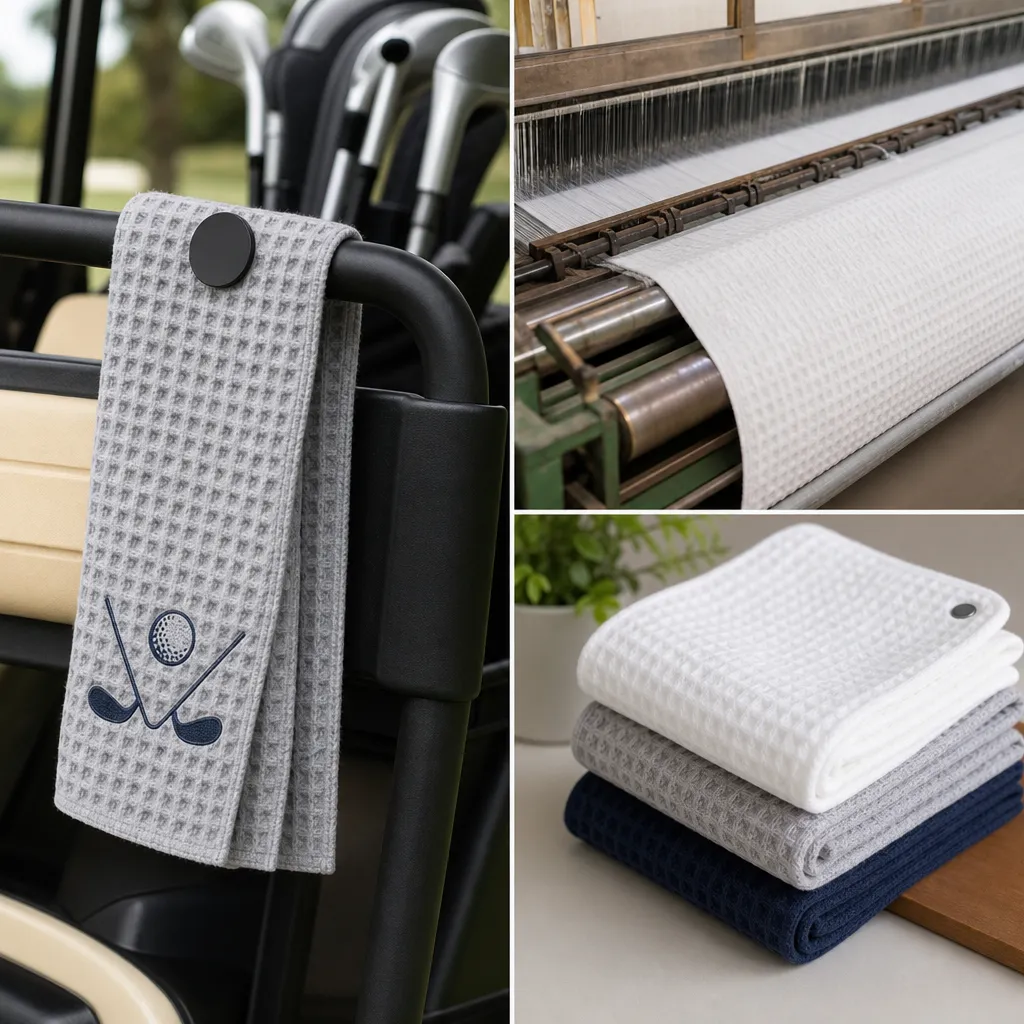
What Makes a Stick It Golf Towel Different
For OEM development, a stick it golf towel is a golf towel with a magnet system built into one corner or end panel. The user does not need a carabiner, grommet, or plastic hook. The towel can attach to a cart post, iron head, rangefinder cart mount, or bag hardware, depending on the magnet strength and the fabric thickness around it.
That convenience creates three factory problems. First, the magnet needs enough holding force without becoming a hard lump in the towel. Second, the magnet pocket must be sealed so it does not migrate during wash or tumble drying. Third, logo decoration needs to stay away from the magnet zone, because a dense embroidery field over a hidden magnet can pucker after shrinkage.
We treat this as a hardware-plus-textile item, not a normal tri-fold towel. The sampling worksheet includes magnet grade, coated diameter, pocket stitch pattern, fabric GSM, shrinkage target, colorfastness route, and logo placement. Leaving any one of those open creates rework later.
| Spec area | Factory decision | Why it matters on course |
|---|---|---|
| Magnet | N35 to N42 neodymium, epoxy or nickel-copper-nickel coated | Controls holding force and corrosion resistance |
| Hidden corner pouch with bar-tack reinforcement | Prevents magnet rotation and edge tearing | |
| Fabric | 380-520 GSM cotton terry or 300-420 GSM waffle microfiber | Balances absorbency, drying speed, and hand feel |
| Decoration | Embroidery, woven label, jacquard border, or silicone badge | Keeps branding readable without blocking the magnet |
Magnet Strength Is a Measured Spec, Not a Guess
The magnet discussion should start with target use. A towel that only needs to sit on a cart rail can use a smaller magnet than one meant to lift from an iron head after wiping grooves. On our line, the most workable range is a round 18-25 mm neodymium magnet at 2.5-4.0 mm thickness. Below that, the towel may slide on powder-coated cart frames. Above that, the corner becomes heavy and can slap against the leg during walking rounds.
We do not quote magnetic pull force as a loose claim. For development samples, we measure breakaway force with a calibrated digital force gauge against a flat low-carbon steel plate, then repeat on a painted curved tube to mimic a cart frame. The steel-plate number is cleaner for comparison, but the curved-tube result tells more about real use. For seam retention around the magnet pocket, we reference ISO 13935-2 strip tensile principles on cut panels, then use an adapted pull check on finished towels.
A practical range for a golf towel with magnet is 1.8-3.4 kgf breakaway on a flat plate after the magnet is sewn into fabric. The same magnet can test 15-35 percent lower on a curved painted surface, depending on coating thickness and fabric layers. That loss is why a catalog magnet rating alone is not enough.
- Cart-first use: choose 18-20 mm magnet, lighter towel body, lower corner bulk.
- Club-head use: choose 22-25 mm magnet and keep fabric over the magnet thin enough for contact.
- Tournament giveaway: avoid oversized magnets; freight weight and safety labeling become more important.
- Retail boxed product: specify magnet coating and include a corrosion check after wash testing.
Fabric Choices That Work With Hidden Hardware
Cotton terry gives a familiar club-towel feel and absorbs water well when the towel is dampened before play. Waffle microfiber dries faster and cleans grooves well, but the magnet can feel more obvious because the base cloth is thinner. A stick it golf towel aimed at pro shops often sits between these two: cotton terry face with a tighter dobby or waffle-style border at the magnet end.
For cotton, we normally stay in the 420-520 GSM range. A 350 GSM towel can look cost-efficient, but it may twist around the magnet corner after washing. At 580 GSM and above, the towel feels substantial, yet the magnet needs to be larger because there is more fabric between the magnet and metal surface. For microfiber waffle, 320-380 GSM is a useful band for fast drying, especially when the towel is clipped nowhere and spends time on a cart rail.
| Construction | Recommended GSM | Best fit | Watch point |
|---|---|---|---|
| Cotton terry, hemmed edge | 420-520 GSM | Club shops, member gifts, resort golf programs | Shrinkage around magnet pocket |
| Cotton waffle/terry hybrid | 360-460 GSM | Higher perceived texture with moderate weight | Waffle distortion under dense embroidery |
| Microfiber waffle | 320-380 GSM | Fast-dry towel for wet weather and travel | Heat sensitivity during transfer decoration |
| Tri-fold cotton with center panel | 450-540 GSM | Classic golf towel styling with magnetic corner | Heavier freight and slower drying |
Pre-shrinkage control is more important here than on a plain towel. We test dimensional change using ISO 6330 domestic washing procedures, then inspect whether the magnet corner curls. A 4 percent body shrinkage can be acceptable on a standard golf towel, but if the corner pocket shrinks unevenly, the magnet edge begins to print through the fabric.
Pocket Engineering: Where Failures Start
The magnet pocket is small, so it is tempting to treat it as a sewing detail. It is actually the part most likely to fail first. If the magnet is placed inside a loose square pocket, it rotates, pulls at one stitch line, and creates a hard point. If the opening is closed with only a straight stitch, repeated tugging can open the seam and expose the magnet.
Our standard build uses a double-layer fabric patch, a fixed magnet position, and two short bar tacks outside the magnet edge. For thicker cotton terry, we reduce pile inside the pocket zone so the magnet sits closer to the contact surface. For waffle microfiber, we add a thin woven stabilizer so the pocket does not stretch diagonally.
- Cut the towel body and magnet pocket panel with grain direction marked.
- Insert coated magnet into a pre-sized pocket, not a loose corner cavity.
- Close the pocket with lockstitch and bar-tack reinforcement outside the magnet edge.
- Run needle-detection and metal-position checks so the magnet does not shift before packing.
- Wash the sample set, then repeat the breakaway check on the same towels.
A named safety standard is useful when the product may be sold through retail or gift channels. While golf towels are not toys, buyers sometimes ask for small-part style checks because magnets can be hazardous if removed. We can adapt the tension method from ASTM F963 for attachment screening and document the method on the inspection sheet. The important point is to state the protocol, sample size, and acceptance rule before bulk production.
Logo Placement Without Killing the Hand Feel
Decoration has to respect the hardware. For a magnetic golf towel, embroidery should sit away from the hidden magnet and away from the main fold crease. A left-lower or center-lower logo often works better than a top-corner logo, because the user grabs the magnet end frequently. Heavy stitching in that corner feels rough and can weaken the pocket seam.
For club crests, we keep embroidery density around 8,000-12,000 stitches for a 70-85 mm logo on terry. Small lettering below 4 mm height loses clarity in pile fabric, so woven labels or silicone badges can be cleaner. For microfiber waffle, sublimation can reproduce detailed artwork, but it only fits polyester-rich fabric. Cotton terry needs embroidery, jacquard, woven label, or reactive printing depending on the design.
- Embroidery: strongest for club crests and initials, but needs backing and density control.
- Woven label: clean for small text, useful when the towel body is dark.
- Silicone badge: modern retail look, higher unit cost, needs wash and peel checks.
- Jacquard border: good for repeat branding, less suitable for small shield details.
For more on choosing between decoration routes, see our factory notes on embroidery, sublimation, and jacquard and the golf program planning article for country club towel assortments. Artwork that looks fine on a cap or polo may still need simplification for pile fabric.
Size, Fold, and Weight Decisions
The common sizes for this product are not the same as gym or hotel towels. A magnetic towel needs enough surface area for wiping grips and club faces, but it should not swing too low from a cart frame. We see the best balance at 38 x 60 cm, 40 x 65 cm, and 45 x 70 cm. Larger sizes can work for resort retail, but the magnet end must be positioned so the towel hangs cleanly.
A useful buyer calculation is shipped weight, because magnets add grams and can affect air freight. For example, a 40 x 65 cm towel at 460 GSM has a fabric weight of about 120 g before hem, embroidery, label, and magnet. A coated 22 mm magnet plus pocket reinforcement can add 12-18 g. Packed in a printed belly band and polybag, the export carton may land around 15.5-17.5 kg for 100 pieces, depending on carton board.
| Finished size | Typical fabric GSM | Approx. packed weight per pc | Use case |
|---|---|---|---|
| 38 x 60 cm | 400-460 GSM | 125-150 g | Tournament gifts and cart use |
| 40 x 65 cm | 430-500 GSM | 145-180 g | Club shop and member programs |
| 45 x 70 cm | 450-520 GSM | 180-225 g | Retail boxed towel or resort golf |
| 50 x 80 cm | 420-480 GSM | 220-280 g | Oversized towel, higher freight impact |
If a buyer wants a clipless golf towel at the lowest possible unit price, the best savings usually come from size and packaging, not from removing reinforcement around the magnet. A failed pocket turns a low-cost towel into a return problem.
Testing and Certification We Put on the File
A magnetic towel needs the normal textile tests plus checks for the hardware. For cotton towel bodies, we use OEKO-TEX Standard 100 Class I material routes when requested, even though golf products are not baby items. The Class I route is stricter for certain substances and helps brands that want one chemical standard across accessories. Our mill also operates under BSCI social audit requirements and ISO 9001 quality management procedures.
Colorfastness depends on the fabric and dye process. For dyed cotton, ISO 105-C06 washing colorfastness and ISO 105-X12 rubbing colorfastness are practical references. For microfiber sublimation, we check print transfer stability after washing and heat exposure. For shrinkage, ISO 6330 gives the laundering procedure, while the pass/fail limit should be written into the purchase order.
- Dimensional change: target within +/-5 percent after the agreed ISO 6330 wash cycle.
- Colorfastness to washing: ISO 105-C06, commonly grade 4 or better for visible shade change.
- Colorfastness to rubbing: ISO 105-X12, dry grade 4 and wet grade 3-4 as a workable target.
- Magnet pocket retention: documented force-gauge pull check before and after wash.
- Needle and metal control: inline needle detection plus finished-piece magnet position inspection.
The QC report should not say only "magnet strong enough." It should state the test surface, gauge type, number of pieces tested, measured breakaway range, and whether the towel was tested before or after laundering. That wording keeps the claim inspectable.
MOQ, Pricing, and the Cost of Cheap Magnets
Our MOQ is 500 pieces per design per color for custom OEM towel production. For a stick it golf towel, the MOQ matters because the magnet pocket setup, embroidery digitizing, and packaging artwork all create fixed costs. Sampling one logo on three towel colors is possible, but bulk pricing is cleaner when each color reaches the minimum.
Unit pricing changes with fabric, size, decoration, magnet grade, and packing. A small 38 x 60 cm cotton towel with one-color embroidery and a standard magnet sits in a different cost band from a 45 x 70 cm retail towel with silicone badge, printed box, and stronger magnet. For 2026 quoting, the realistic FOB China bands below are where most projects land.
| Order volume | Basic magnetic towel | Mid-spec club towel | Retail boxed spec |
|---|---|---|---|
| 500-999 pcs | USD 2.45-3.10 | USD 3.20-4.05 | USD 4.35-5.60 |
| 1,000-2,999 pcs | USD 2.05-2.75 | USD 2.85-3.55 | USD 3.85-4.95 |
| 3,000-7,999 pcs | USD 1.78-2.35 | USD 2.48-3.15 | USD 3.35-4.30 |
| 8,000+ pcs | USD 1.55-2.05 | USD 2.20-2.85 | USD 2.95-3.85 |
A lower-grade magnet can save USD 0.06-0.12 per towel, but the risk is not only weaker attachment. Poor coating can corrode after wet storage, especially if the towel is packed before fully drying at a tournament. If 6 percent of a 2,000-piece order generates replacements at USD 4.70 landed cost each, the service cost is about USD 564 before staff time. That is more than the original magnet saving on many orders.
Sampling and Production Calendar
The production calendar should include hardware validation before bulk cutting. A plain golf towel sample can move quickly once artwork is approved. A magnetic towel needs one extra loop because the buyer should test the towel on the actual cart, bag, or club surface used by the target customer.
- Spec confirmation and artwork review: 1-2 working days.
- Embroidery digitizing or badge mold review: 2-4 working days.
- Prototype sample with magnet pocket: 6-9 working days.
- Buyer fit and attachment review: 3-7 calendar days, depending on shipping and feedback.
- Bulk production after deposit and sample approval: 22-35 days.
- Final inspection, packing, and export handover: 3-5 days.
Air freight can work for 500-1,000 pieces when an event date is close, but magnets require accurate packing lists and carrier review. For larger orders, sea freight or consolidated LCL is normally more sensible. Our logistics article on container versus air freight gives the broader towel freight framework, and building a towel tech pack explains which files reduce sampling delays.
How to Brief the Factory
A clear brief lets the mill quote the same product the buyer has in mind. The minimum information is size, fabric preference, GSM target, towel color, logo method, logo dimensions, magnet use case, packaging, certification need, and delivery market. If the towel must attach to a specific cart model or club head, send a photo and the contact surface dimension.
- State whether the towel is for retail sale, member gift, resort inventory, or tournament giveaway.
- Choose cotton terry, cotton waffle hybrid, or microfiber waffle before comparing prices.
- Mark the magnet position on a flat artwork layout with distance from edges.
- Send Pantone TCX or TPX references for dyed cotton, and coated Pantone references for printed packaging.
- List required standards such as OEKO-TEX Standard 100, BSCI, ISO 9001 documentation, or destination-market labeling.
Related reads: our Pantone color matching guide is useful for club-color approvals, while the towel GSM decision framework helps compare hand feel against drying time. For broader golf assortments, start with the custom golf towel program article.
Related reads for adjacent products: microfiber versus cotton towels explains fiber behavior, and how to read an OEKO-TEX certificate shows what buyers should verify before approving material claims.
Build a Magnetic Golf Towel Spec
Send towel size, logo artwork, target GSM, magnet use case, order quantity, and delivery country. We will return a practical OEM quote with sampling time, bulk lead time, and test options. WhatsApp: +86 13384590853. Email: [email protected].
Request a Quote →