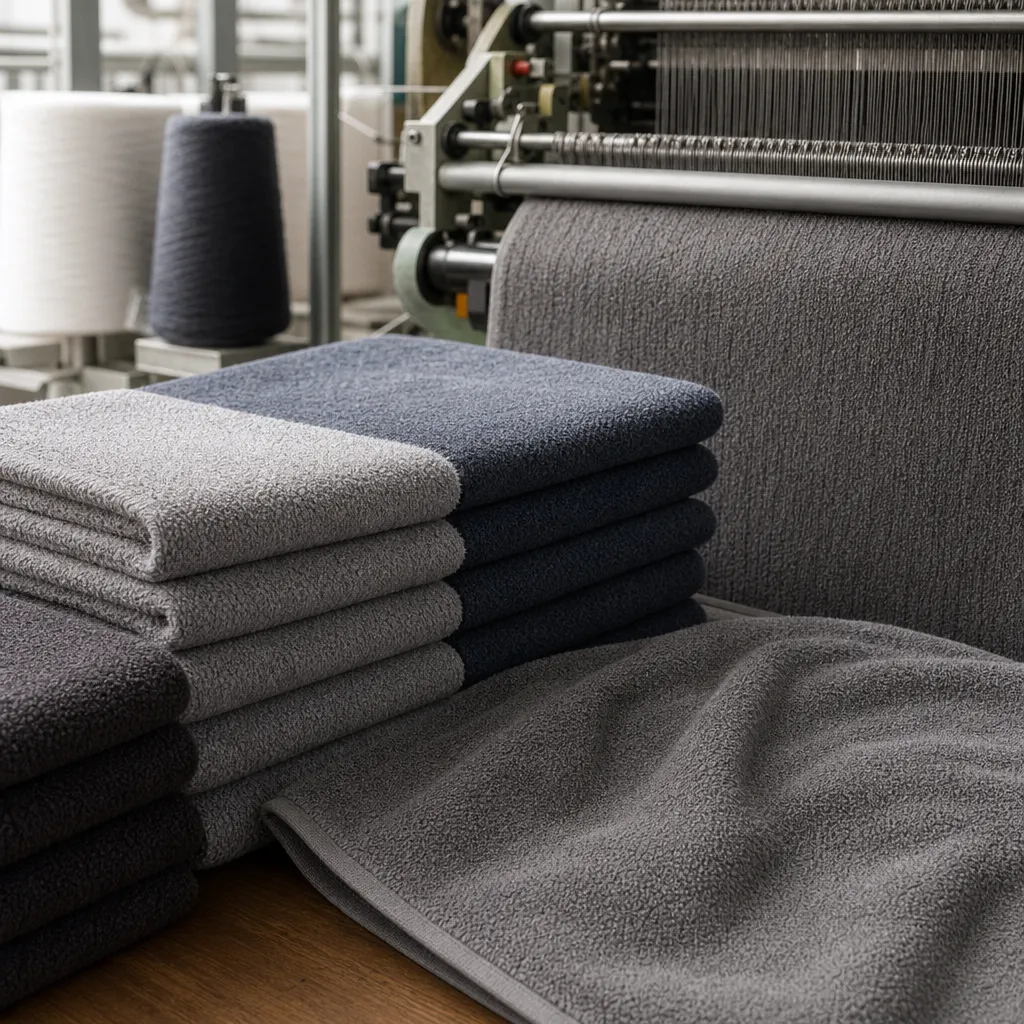
Why car drying towels fail in real wash bays
Automotive buyers usually judge a towel by hand feel, size, and absorbency in the sample room. Those are useful checks, but they do not show whether the towel will drag on ceramic coating, shed along a sewn border, or trap grit after a tunnel wash shift. In our mill, we treat these as working textiles, not retail accessories.
The main failure modes are lint release, edge scratching, slow drying between uses, and loss of pile height after industrial washing. A 420 GSM towel can outperform a 700 GSM towel if the split microfiber ratio, pile geometry, and edge construction suit the workflow. A heavier towel only helps if the fiber can open, hold water, and rinse clean.
| Failure mode | Factory cause we usually find | Buyer-side symptom |
|---|---|---|
| Lint on dark paint | Poor filament splitting or loose overlock yarn | White fibers visible after wiping black panels |
| Micro-marring risk | Hard polyester binding or trapped cutting dust | Fine arcs under inspection lights |
| Low absorbency after washing | Softener contamination or dense pile with poor capillary space | Towel pushes water instead of pulling it |
| Bad odor in rotation | Too heavy for drying conditions in the bay | Damp towels stacked for several hours |
Choose the construction before choosing GSM
For OEM car wash programs, we start with construction because GSM alone is a blunt number. The common choices are twisted loop microfiber, coral fleece, waffle microfiber, and dual-pile plush. Each behaves differently when it touches wet paint.
A twisted loop towel uses long looped yarns that stand up and create channels for water intake. It is good for the first drying pass on large panels. Coral fleece feels softer in hand and can be a good finishing towel, but very tall pile may trap grit if staff use it on lower rocker panels without rinsing. Waffle microfiber has faster release in washing, though it usually carries less water per square meter than thick loop constructions.
| Construction | Typical GSM | Best use | Watch point |
|---|---|---|---|
| Twisted loop microfiber | 480-650 GSM | Primary drying towel for roof, hood, doors | Loops must be stable after 20 wash cycles |
| Coral fleece microfiber | 360-520 GSM | Finishing wipe, interior touch-up, coated paint | Long pile can hold grit if process control is poor |
| Waffle microfiber | 300-430 GSM | Fast-dry towel for mobile detailers | Less plush cushioning on dirty surfaces |
| Dual-pile plush | 450-600 GSM | Retail detailing kit or premium service lane | Needs clear face-side labeling for staff |
- High-volume tunnel wash: 420-520 GSM waffle or short twisted loop, because drying speed between cycles matters.
- Detailing studio: 520-650 GSM twisted loop or dual-pile plush, where fewer towels are used more carefully.
- Mobile car wash: 350-480 GSM compact microfiber drying towel, because laundry weight and storage space affect daily cost.
- Retail bundle: 500-600 GSM with soft suede or ultrasonic-cut edge, packed with care label and barcode.
Microfiber split ratio and filament quality
Most automotive microfiber towels are made from polyester and polyamide. The common ratios are 80/20 and 70/30. More polyamide generally improves water absorption and hand softness, but it also raises cost. For car drying, we usually quote 80/20 for commercial wash chains and 70/30 for higher-end detailing brands where the towel is part of the customer experience.
The detail that buyers do not see on a quotation is splitting quality. During finishing, microfiber filaments must open properly so the towel can pull water into the pile. If splitting is uneven, the fabric may pass a quick weight check but behave like a flat synthetic cloth on the vehicle. We check this by absorbency timing, visual pile inspection, and lint assessment after tumble washing.
For car wash towels, a soft hand is not enough. We want the towel to absorb quickly, release dirt in washing, and keep the edge from becoming the hardest part of the product.
Size, weight, and operator fatigue
A towel that looks generous in a retail photo can be tiring in a wash bay. Once wet, a very large towel becomes heavy, and staff may drag it across the vehicle instead of folding and lifting it. That is how a good textile becomes a poor process.
For a 50 x 80 cm towel at 550 GSM, the fabric weight is about 220 g before edging and label. After absorbing water, the working weight can exceed 700 g depending on wringing habits. For a 60 x 90 cm towel at 650 GSM, dry fabric weight is about 351 g, and the wet handling load can become too high for rapid service lanes.
| Size | Recommended GSM | Approx. dry fabric weight | Typical buyer |
|---|---|---|---|
| 40 x 60 cm | 350-450 GSM | 84-108 g | Mobile detailer, interior finishing |
| 50 x 80 cm | 480-600 GSM | 192-240 g | Car wash chain, detailing studio |
| 60 x 90 cm | 550-650 GSM | 297-351 g | Premium drying service, retail kit |
| 70 x 100 cm | 500-620 GSM | 350-434 g | Large vehicle or SUV drying, lower turnover use |
Edges, labels, and scratch control
The towel edge is where many automotive programs go wrong. A normal polyester overlock is acceptable for household cleaning, but it can feel hard against coated paint, especially after heat drying. We offer three main edge routes: microfiber suede binding, soft overlock, and ultrasonic cut.
Ultrasonic cutting creates an edgeless microfiber towel with a clean sealed edge, but it is not automatically better for every design. On very high pile twisted loop fabric, the cut edge must be tested for shedding after washing. Suede binding costs more but gives a tidy retail look and better durability when staff pull towels from carts all day.
- Avoid woven neck labels on paint-contact towels unless they are placed on a corner loop away from the wiping surface.
- Use heat-transfer care labels for retail towels when the brand wants a clean face and fewer hard contact points.
- Specify thread color carefully because contrast stitching looks sharp in photos but makes lint complaints more visible.
- Request edge abrasion review after washing, not only on the pre-production sample.
For private label auto detailing towels, we usually place the brand on a belly band, hang tag, woven corner tab, or polybag sticker rather than directly on the wiping face. Decoration should not compromise the working surface. For broader decoration choices, our comparison of embroidery, sublimation, and jacquard explains where each method belongs.
Testing we run before approving bulk
For lint free car towels, the test plan should match the job. We normally wash the sample before judging it because loose cutting fibers and finishing residues can make the first use misleading. Our internal check includes a dark-panel wipe, absorbency timing, dimensional change, seam review, and pile pull at the corners.
For export programs, we can align testing with ISO 6330 domestic washing procedures for dimensional change and appearance after washing. Color fastness can be checked against ISO 105-C06 for washing and ISO 105-X12 for rubbing. OEKO-TEX Standard 100 Class I can be used when the buyer wants strict chemical safety, even though the product is not a baby textile. Our factory also operates under BSCI social compliance and ISO 9001 quality management.
- Wash sample towels at 40 degrees Celsius without fabric softener, then tumble dry on medium heat.
- Wipe a clean black painted panel or black acrylic sheet under strong light.
- Check edge yarn, corner label, and pile release after the panel wipe.
- Measure shrinkage against the original size and record weight change.
- Repeat after 10 and 20 wash cycles for chain programs with heavy rotation.
One construction quirk we check on twisted loop fabric is loop snagging near the edge knife line. If the loops are too long and the edge seal is weak, a towel can look excellent before washing and then develop small pulled loops along the border. That defect is specific to this category and should be caught before production fabric is cut.
Pricing bands and cost-per-use logic
Pricing depends on fiber ratio, GSM, size, edge type, dyeing, packaging, and order volume. Our MOQ is 500 pcs per design per color, but automotive programs usually become more efficient at 2,000 pcs because dyeing, cutting, and packing waste spread across more units.
| Specification | 500 pcs | 2,000 pcs | 10,000 pcs |
|---|---|---|---|
| 40 x 60 cm, 380 GSM waffle, soft overlock | USD 1.18-1.42 | USD 0.96-1.16 | USD 0.78-0.94 |
| 50 x 80 cm, 520 GSM twisted loop, ultrasonic edge | USD 2.35-2.78 | USD 1.94-2.32 | USD 1.62-1.95 |
| 60 x 90 cm, 600 GSM 70/30 plush, suede edge | USD 4.10-4.85 | USD 3.48-4.05 | USD 2.98-3.45 |
| Retail pack with belly band and barcode sticker | Add USD 0.18-0.32 | Add USD 0.12-0.22 | Add USD 0.08-0.16 |
A cheap towel is not cheap if staff need two pieces to dry one sedan. For example, a 50 x 80 cm 520 GSM towel at USD 2.08 that survives 90 wash cycles costs about USD 0.023 per use before laundry. A lighter USD 1.34 towel that loses absorbency after 38 cycles costs USD 0.035 per use and slows the bay because operators reach for a second towel. That gap becomes visible when a site processes 140 vehicles per day.
For buyers comparing microfiber with cotton, the material behavior is very different. We covered the broader absorbency and laundering trade-offs in microfiber vs cotton towel comparison. For automotive cleaning programs beyond drying, see our auto detailing microfiber towel program and custom microfiber towels wholesale guide.
Production timeline and approval checkpoints
A normal OEM timeline is 28-42 days after sample approval and deposit, assuming yarn and dye availability are normal. Custom-dyed microfiber takes longer than stock-color cutting because we need lab dips, bulk dyeing, finishing, and shade control. If the buyer requests printed packaging, barcode labels, or carton marks for multiple sites, artwork approval can add 3-6 days.
- Day 1-3: confirm size, GSM, fiber ratio, edge, packaging, and target price.
- Day 4-9: prepare lab dip or stock-color sample; custom edge or label may need extra time.
- Day 10-13: buyer reviews absorbency, lint, hand feel, and packaging layout.
- Day 14-28: bulk knitting or weaving, dyeing, finishing, cutting, and sewing.
- Day 29-36: inspection, metal detection where required, packing, carton marking, and export documents.
For repeat programs, we keep an approved production file with fabric weight tolerance, shade reference, edge photo, carton pack count, and care label artwork. That file prevents a common problem: the second order being quoted from a photo instead of the actual approved towel.
Spec sheet details a mill needs to quote accurately
A good RFQ saves several days. If a buyer only asks for car drying towels with logo, the price range can vary by more than 60 percent because construction, size, and edge type are still unknown. We prefer a compact spec sheet with the operating use case clearly stated.
- Towel size in centimeters and allowed tolerance, usually plus or minus 2 cm after washing.
- Target GSM and acceptable range, such as 520 GSM with tolerance of plus or minus 5 percent.
- Microfiber ratio, typically 80/20 or 70/30 polyester-polyamide.
- Construction preference: twisted loop, waffle, coral fleece, or dual-pile plush.
- Edge type, label position, packaging, carton quantity, and destination port.
- Compliance needs: OEKO-TEX Standard 100, BSCI audit record, ISO 9001 factory documentation.
If your team is still building the document, our guide on how to build a towel tech pack that mills can quote is useful. Buyers planning mixed towel assortments can also review towel GSM decision framework and towel sizes and dimensions complete guide.
Operational fit: laundry, storage, and color coding
The best towel spec can still fail if the wash process is wrong. Fabric softener coats microfiber and reduces absorbency. High heat can harden bindings and shorten service life. Towels used below the beltline should be separated from towels used on hood and glass surfaces, especially in sandy or winter-road markets.
Color coding helps. We often make blue for exterior drying, gray for wheel-adjacent areas, yellow for glass, and black for lower panels. This is not decoration; it is process control. A staff member can follow the system without reading a manual during a busy shift.
- Wash microfiber separately from cotton lint sources.
- Avoid chlorine bleach and fabric softener.
- Use moderate detergent and rinse fully to remove residue.
- Dry at low to medium temperature, then cool before stacking.
- Retire towels with embedded grit, hardened edges, or visible pile thinning.
For freight planning, microfiber towels are dense enough that carton size and gross weight matter quickly. A 10,000 pc order of 50 x 80 cm towels may ship around 70-95 cartons depending on compression and packing style. For larger programs, our notes on container vs air freight towel orders can help the purchasing team avoid surprise landed costs.
How we build samples for car wash buyers
When we sample for a car wash towel supplier program, we normally prepare two or three versions rather than one perfect-looking sample. One may be a lower GSM option for cost control, one may be the balanced working spec, and one may use a softer edge or higher polyamide ratio for retail or VIP service use.
Our factory in Gaoyang has 220 employees and has produced OEM towels since 2007. Annual towel output is about 2.4 million pieces across hotel, beach, gym, spa, golf, microfiber, and promotional categories. For automotive microfiber, the important factory habit is discipline: confirm the approved pile, edge, label, and wash result before bulk cutting begins.
We support MOQ 500 pcs per design per color, but we will tell a buyer when that quantity makes a spec inefficient. A custom 70/30 dyed twisted loop towel with retail packaging is usually more sensible at 1,500-2,000 pcs. A stock-color 40 x 60 cm waffle towel can work at 500 pcs if the brand needs a trial batch.
To request a quote, send the target size, GSM, construction, color, edge type, packaging, destination country, and annual forecast. Our team can be reached by WhatsApp at +86 13205717266 or email at [email protected].
Build a car drying towel spec that works
Send us your target use case, size, GSM, and order volume. We will quote practical options with MOQ, lead time, and test recommendations.
Request OEM Quote →