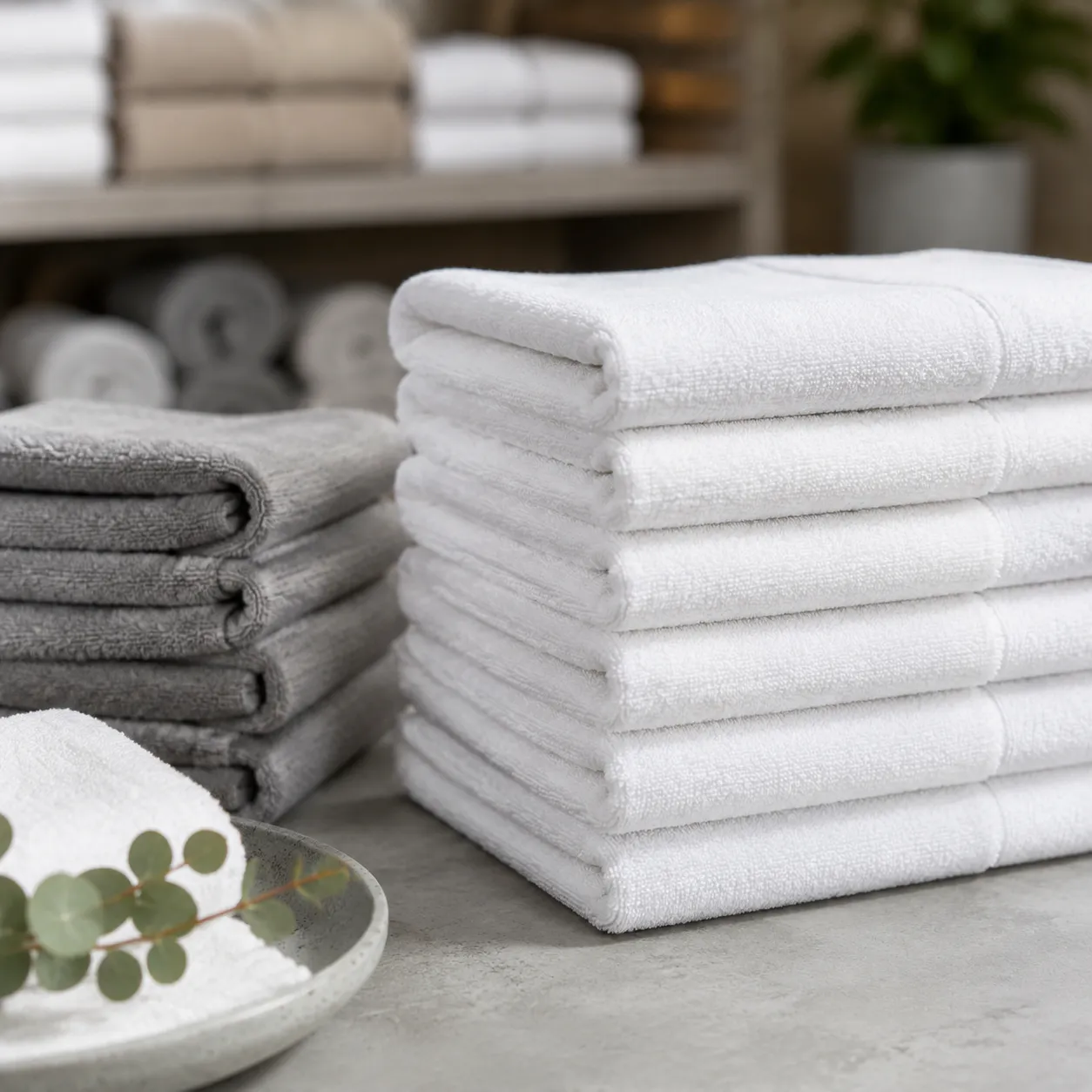
The treatment-room job is harsher than it looks
Facial towels are small, but they work harder than many bath towels. In a hotel room, a guest may use a face towel once. In a spa cabin, the same towel may see cleanser, massage oil, clay mask residue, enzyme product, hot cabinet storage, sanitizer, and a high-temperature wash cycle in one day.
That is why we do not treat esthetician towels as generic washcloths. For facial service, the towel must be dense enough to hold heat, soft enough for cheeks and eye area, and stable enough not to shrink into a curled square after 20 washes. In our mill, the biggest defect claims on spa face towels are not weaving holes. They are edge curling, yellowing from warmer storage, and rough hand feel after alkaline detergent.
For a professional program, we usually start with 420-520 GSM cotton terry. Below 380 GSM, the towel feels thin after extraction and loses heat quickly. Above 560 GSM, it can feel plush, but drying time increases and warmers hold fewer pieces per load. That matters when a spa has six cabins and runs back-to-back facials on weekends.
| Service use | Recommended size | GSM range | Construction note |
|---|---|---|---|
| Basic facial cleanse | 25×25 cm or 30×30 cm | 380-450 GSM | Good for wiping cleanser and toner; fastest drying |
| Hot towel facial service | 30×30 cm or 32×32 cm | 450-520 GSM | Holds steam heat better without overloading cabinet |
| Neck and décolleté work | 30×50 cm | 430-500 GSM | Longer fold, easier drape under chin |
| Luxury mask removal | 35×35 cm | 500-560 GSM | Higher surface area; check laundry drying capacity first |
What makes the best facial towels for estheticians work in daily laundry
The best facial towels for estheticians are built around laundering, not showroom softness. A towel that feels beautiful in a sample pack can fail quickly if the loop yarn is too loose, the hem thread is weak, or the dye cannot tolerate peroxide-based spot treatment.
For most spa programs, we recommend ring-spun or combed cotton pile with a balanced ground. Combed cotton removes shorter fibers, so lint is lower and the towel face stays smoother after repeated washing. Zero-twist cotton is soft, but for treatment rooms we use it carefully because open yarn can snag on facial tools, rings, or rough laundry drum edges.
A useful benchmark is 30×30 cm at 470 GSM. The theoretical fabric weight is about 42 g before hem allowance and moisture regain. Finished towel weight normally lands around 44-48 g depending on border and shrinkage. If a supplier quotes a 30×30 cm towel at 500 GSM but the finished weight is only 36 g, the number is not matching the product.
- Loop height: medium loop, usually 3.5-4.5 mm, gives good absorbency without easy snagging.
- Hem width: 8-12 mm double-needle hem reduces edge rolling after tunnel drying.
- Shrinkage target: under 6% after three industrial wash cycles is realistic for cotton terry.
- Lint control: pre-wash or tumble finishing helps, but yarn quality matters more than one finishing step.
- Skin contact: OEKO-TEX Standard 100 Class I is our default for face and baby-contact textiles.
Size choice changes cabinet capacity and service rhythm
Spa buyers often choose a face towel size by touch, then discover the warmer does not hold enough pieces. A 30×30 cm towel folded twice is compact. A 35×35 cm towel at high GSM feels more generous, but it occupies more vertical space and holds more retained moisture. If the team packs the cabinet too tightly, inner towels may warm unevenly and develop a stale odor.
In factory sampling, we ask buyers to tell us their warmer model or at least the internal shelf dimensions. A typical 16 L counter warmer may hold around 24-32 pieces of 30×30 cm towels at 470 GSM when folded neatly. The same cabinet may hold only 16-20 pieces of 35×35 cm towels at 540 GSM. That difference affects labor because attendants refill the warmer more often.
For spas running express facials, 25×25 cm can work well because turnover is fast and laundry volume stays low. For higher-touch esthetician services, 30×30 cm is the safest default. For hot compress and mask removal, 30×50 cm gives better coverage but should be counted as a separate SKU in laundry planning.
| Size | Approx. finished weight at target GSM | Cabinet behavior | Best-fit buyer |
|---|---|---|---|
| 25×25 cm at 420 GSM | 28-31 g | Fast warm-up, low heat retention | Waxing rooms, quick cleanse, nail spa add-on |
| 30×30 cm at 470 GSM | 44-48 g | Balanced capacity and warmth | Most facial treatment towels |
| 32×32 cm at 500 GSM | 53-57 g | Softer hand, moderate cabinet load | Boutique spas with longer treatments |
| 30×50 cm at 460 GSM | 72-78 g | Good drape, slower drying | Neck, shoulder, hot compress service |
White, beige, or dark color: decide by chemistry
Color is not only a design decision. It is a chemical compatibility decision. White towels can be washed hotter and treated more aggressively, but they show clay mask stains and oil shadowing. Beige and warm grey hide light staining, but colorfastness must be tested if the laundry uses peroxide or chlorine boosters. Dark charcoal looks clean in the cabin, but it can show lint and may fade if the wash formula is too alkaline.
For facial products that include benzoyl peroxide, strong acids, or retinoid residue, no dyed cotton towel is completely safe from bleaching marks. We push back when a buyer wants deep espresso towels for acne-treatment cabins and expects no spotting. A better solution is white or undyed ecru for the treatment step, with branded darker hand towels used only at reception.
We normally test dyed spa towels to ISO 105-C06 for domestic and commercial laundering colorfastness. For face-contact towels, we also check pH by ISO 3071 because an overly alkaline towel can feel harsh on damp skin. Our internal target after finishing is pH 6.0-7.5. For color rubbing, ISO 105-X12 is useful when dark towels may contact white spa robes or headbands.
- Choose white when the laundry team needs maximum heat and stain-treatment flexibility.
- Choose ecru or oatmeal when the brand wants a softer spa look and product staining is moderate.
- Choose grey or taupe only after confirming the wash formula and spot-treatment chemicals.
- Avoid deep dyed towels for acne cabins using benzoyl peroxide unless spotting is accepted as normal wear.
- Keep one control towel from the approved sample and compare it after every 10 laundry cycles during launch.
Warmer performance: heat retention, odor, and yellowing
A towel warmer exposes weak finishing. If cotton towels are stored damp and hot for too long, residual detergent, oil, and skin protein can oxidize. The result is yellowing near folded edges or a sour smell when the cabinet opens. This is not always a towel defect, but towel construction can make the problem better or worse.
Dense towels with poor rinsing hold chemical residue. Very loose towels can collapse and feel wet rather than warm. Our practical recommendation is to wring or spin towels to damp, not dripping, before loading the warmer. A towel that enters the cabinet with too much free water warms slowly and encourages odor. We also advise not storing damp towels overnight in a closed warmer.
During sample approval, buyers can run a simple warmer cycle test: wet ten towels to the same pickup level, fold them in the intended service fold, warm for 45 minutes, then check center temperature and smell. After cooling, inspect fold lines for yellow cast. For higher-volume spa groups, we can prepare sample sets for five wash-and-warmer cycles before bulk approval.
- Weigh dry towels from the sample lot and record the average weight.
- Wet and extract them to about 140-170% wet pickup, meaning a 46 g towel becomes roughly 110-124 g before warming.
- Load the cabinet with the same count used in real service, not only two or three pieces.
- Check towels from the top, middle, and bottom shelf after 45 minutes.
- Reject the spec if inner towels remain cool or if sour odor appears after repeated cycles.
Decoration should stay away from the facial contact zone
Decoration is possible, but it must not interfere with skin feel. For esthetician towels, we prefer a small woven label, low-profile embroidery near one corner, or a narrow jacquard border on a larger towel. A dense embroidered logo in the center of a 30×30 cm towel is uncomfortable on the face and can trap product residue.
If embroidery is required, our decoration team usually keeps the stitch count under 2,500 stitches for a small corner mark. We use soft backing and place the logo at least 20 mm from the hem so it does not distort during sewing. For darker towels, tone-on-tone embroidery reduces visible wear because high-contrast thread can look tired faster after hot washing.
Jacquard is cleaner for repeat branding, but on small face towels the pattern must be simple. Fine lettering in terry jacquard can close up after shrinkage. If the brand mark is detailed, a woven side label is often more durable and less irritating. For broader decoration choices, our comparison of embroidery, sublimation, and jacquard gives the trade-offs by method.
| Branding method | Recommended placement | Risk to manage | Typical added cost |
|---|---|---|---|
| Woven label | Side seam or corner hem | Label edge must be soft for face contact | USD 0.035-0.075 per towel |
| Small embroidery | One corner, away from wipe area | Backing stiffness and thread abrasion | USD 0.08-0.18 per towel |
| Jacquard border | Border on 30×50 cm or larger | Small letters lose clarity after shrinkage | USD 0.10-0.24 per towel |
| Printed logo | Generally not preferred on cotton face towels | Print hand feel and wash fade | Project-specific; sample first |
Pricing bands we quote for spa facial towel programs
Pricing depends on cotton, GSM, dyeing, size, decoration, and packing. The bands below are realistic FOB China ranges for regular cotton terry facial towels, not luxury gift-box retail towels. They assume OEM production from our Gaoyang facility with MOQ 500 pcs per design per color.
For the best facial towels for estheticians, the lowest unit price is not always the lowest operating cost. A 30×30 cm towel at USD 0.49 that survives 35 service washes costs about USD 0.014 per use before laundry. A better combed cotton version at USD 0.68 that reaches 75 service washes costs about USD 0.009 per use. On a spa using 180 towels per day, that difference matters more than saving a few cents on the first order.
| Spec and volume | 500-999 pcs | 1,000-2,999 pcs | 3,000-9,999 pcs | 10,000+ pcs |
|---|---|---|---|---|
| 25×25 cm, 400-430 GSM, white | USD 0.34-0.46 | USD 0.29-0.40 | USD 0.25-0.35 | USD 0.22-0.31 |
| 30×30 cm, 450-500 GSM, white | USD 0.52-0.74 | USD 0.46-0.65 | USD 0.40-0.58 | USD 0.36-0.52 |
| 32×32 cm, 500-540 GSM, dyed | USD 0.78-1.06 | USD 0.69-0.94 | USD 0.61-0.84 | USD 0.55-0.77 |
| 30×50 cm, 430-500 GSM, white or ecru | USD 0.88-1.28 | USD 0.78-1.14 | USD 0.69-1.02 | USD 0.63-0.92 |
Bulk packed towels are usually the most efficient for spa back-of-house use. Retail belly bands or individual polybags add labor and material cost, and they slow receiving for multi-location spa groups. If towels need to ship directly to individual studios, we can carton by location with inner bundle labels instead of retail packaging.
Quality control tests before bulk shipment
We inspect facial towels differently from beach or gym towels because the user notices small defects immediately on the face. A hard knot, loose metal-colored contamination fiber, or rough label edge is more serious here than on a pool towel. Our QC team checks size, weight, pile appearance, seams, color shade, absorbency, and surface contamination before packing.
For absorbency, we use a drop test during production and a sink test during development. A finished towel that repels water after softener overuse may feel smooth in the hand but performs poorly in service. We keep silicone softener low for facial towels because too much softener reduces absorbency and can interact with hot cabinet odor.
We also run wash checks on pre-production samples. A common defect mode is border waviness: the terry body shrinks differently from the woven border, making the towel twist. Another is hem roping, where the edge tightens and curls after tumble drying. Both defects are easier to prevent in weaving and finishing than to fix after bulk goods are complete.
- Size tolerance: normally ±3% after pre-shrink finishing, confirmed against the approved sample.
- Weight tolerance: usually ±5% for small towels because hem ratio affects total weight.
- Absorbency: water drop should wet into pile quickly, not bead on the surface.
- Needle control: embroidery or label sewing follows broken-needle procedure under ISO 9001 records.
- Certification: OEKO-TEX Standard 100 Class I, BSCI audit, and ISO 9001 production controls are available for buyer files.
Sampling and production timeline from our mill
A straightforward facial towel program can move quickly if the buyer provides size, GSM, color, decoration, packing, and certification needs at the start. The slowest points are usually color approval and decoration placement, not weaving. For dyed towels, lab dips take 3-5 days after Pantone or physical color standard is confirmed.
For new OEM development, sample production usually takes 7-12 days for white or ecru towels and 10-16 days for dyed towels with custom labels or embroidery. Bulk production is normally 25-35 days after deposit and final sample approval. If the order includes multiple colors, separate embroidery thread matching, or location-sorted cartons, we add 3-6 days to packing.
Our standard MOQ is 500 pcs per design per color. For a spa group testing three cabin types, we usually suggest one core 30×30 cm towel in white or ecru first, then add 30×50 cm hot compress towels after laundry feedback. Splitting the first order into too many colors can raise unit cost and make QC shade control harder.
- Send the treatment use: cleanse, hot towel, mask removal, waxing, or retail take-home.
- Confirm size and GSM target, or send a physical towel you want us to benchmark.
- Choose white, ecru, or dyed color after reviewing laundry chemistry.
- Approve label, embroidery, or no-brand towel layout before sample making.
- Run five to ten real laundry cycles before locking the bulk spec for multi-site rollout.
How to brief a supplier without overbuying
A clean tech pack avoids wrong quotes. Instead of asking for the best facial towels for estheticians in a general way, specify the actual cabin process. Tell the mill whether towels go into a warmer, whether the laundry uses peroxide, how many washes per week are expected, and whether the towel touches active skincare products.
For a launch order, we prefer a narrow spec with enough quantity to test laundry properly. A 500-piece pilot for one towel size gives better data than five different 100-piece colors that cannot meet production MOQ. For established spa groups, 2,000-5,000 pcs per replenishment is usually a better price point and keeps shade lots consistent across locations.
Related reads: For size planning, use our towel dimensions guide and GSM decision framework. If you are building a complete wellness assortment, compare treatment-room choices with spa towel cotton differences and salon chemical handling in bleach-proof salon towels.
Related reads: If your buyer file requires compliance documents, review how to read an OEKO-TEX certificate. For RFQ preparation, our mill-ready towel tech pack guide and MOQ negotiation guide will help your procurement team avoid vague quotes.
Build a facial towel spec that survives spa laundry
Send us your size, GSM target, warmer use, laundry chemistry, and decoration plan. We quote OEM facial towels from MOQ 500 pcs per design per color, with sampling, OEKO-TEX files, and production timing clearly stated. WhatsApp: +86 13384590853 or email [email protected].
Request a spa towel quote →