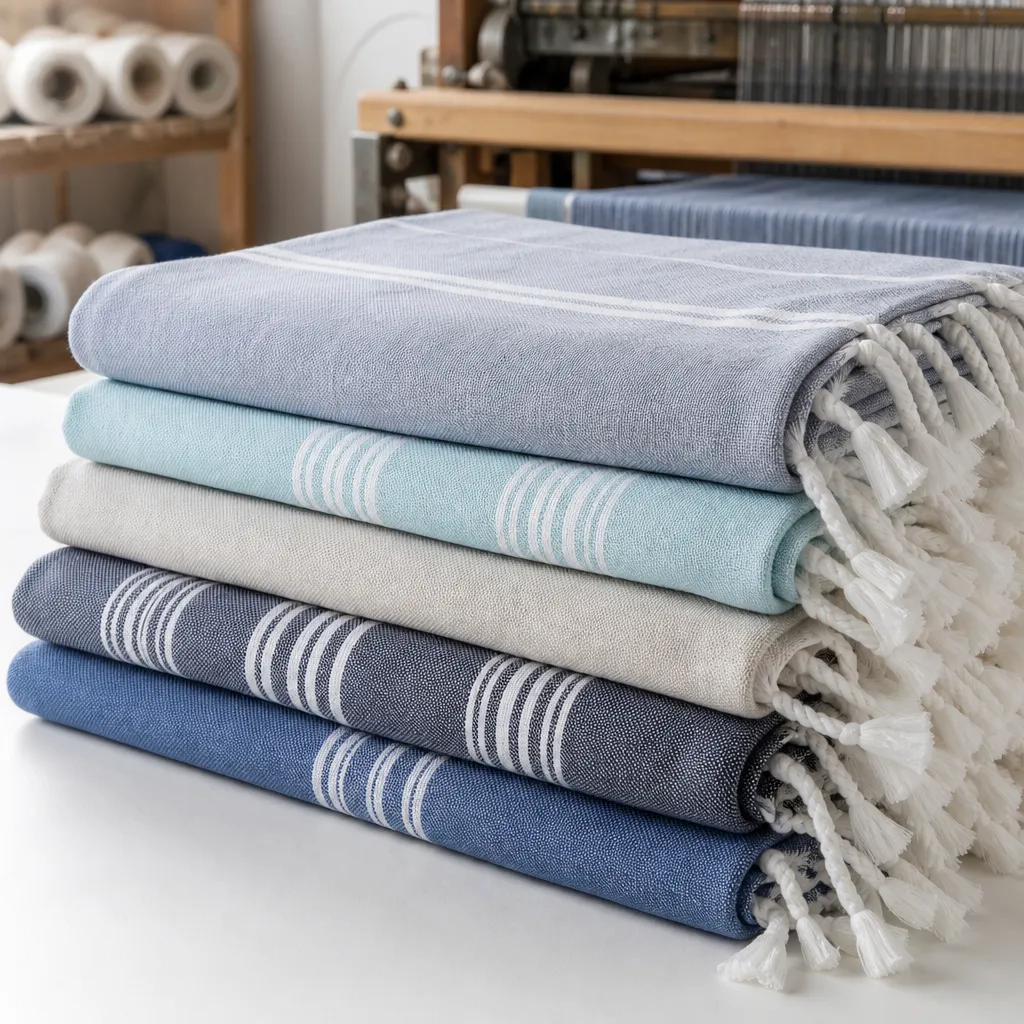
What Makes the Best Turkish Towels in Bulk Orders
For wholesale programs, we treat Turkish-style towels as a construction category, not a country label. The buyer usually wants a flat woven towel with low bulk, fast drying, visible stripe or jacquard design, and optional hand-tied fringe. In our mill, that usually means 220-420 GSM for beach and spa use, with yarn, weave density, and finishing chosen around the laundry environment.
The best turkish towels for a beach club are not always the softest samples. A 240 GSM towel can dry quickly and fit well in a retail pouch, but it may feel too light on a hotel lounger. A 390 GSM version has better hand feel and perceived value, but it costs more to ship and takes longer to dry in humid coastal storage. We decide the spec from use case first, then decoration, then price.
| Use case | Typical size | GSM range | Construction note |
|---|---|---|---|
| Beach retail | 90 x 170 cm | 240-320 GSM | Flat weave with twisted or knotted fringe |
| Resort pool deck | 100 x 180 cm | 320-420 GSM | Denser weft, reinforced hems, lower fringe length |
| Spa or hammam | 80 x 160 cm | 260-360 GSM | Soft washed finish, lower lint target |
| Gym or travel | 70 x 140 cm | 220-300 GSM | Compact fold, quick-dry cotton blend option |
| Gift or promo | 75 x 150 cm | 230-300 GSM | Lower GSM, woven stripe or small embroidery |
Start With the Laundry Route, Not the Photo
Most failed peshtemal towel programs begin with an image: thin stripes, relaxed fringe, washed color. Then the towels go into a 60 C commercial wash with alkaline detergent and tumble drying, and the edges tighten unevenly. If the towel is for a hotel group, cruise operator, spa chain, or beach club, the laundry route decides the spec.
We test production samples after pre-wash and after repeated wash cycles using ISO 6330 as the reference method for domestic-style wash simulation. For commercial clients, we often add a harsher internal check at 60 C with tumble drying because real laundries are rarely gentle. A flat weave towel can pass a visual inspection before washing and still fail because warp and weft shrink at different rates.
- Ask for warp and weft shrinkage separately. A total shrinkage number hides twisting risk.
- Keep fringe shorter than 7 cm for hotel laundry. Long loose fringe tangles, especially in mixed towel loads.
- Specify colorfastness to washing under ISO 105-C06 when dark navy, black, terracotta, or saturated green is used.
- For retail beach towels, confirm carton packing after pre-wash. A soft-washed towel takes more carton volume than a loom-state towel.
- If embroidery is added, test after washing because dense stitches can pucker flat weave fabric.
For a 90 x 170 cm towel at 300 GSM, the finished towel weighs about 459 g before fringe allowance. After soft washing, we may see 3-6% dimensional shrinkage depending on yarn and weave density. If a buyer wants exact shelf dimensions, we build the greige size larger so the final washed size lands within tolerance.
Yarn, Weave, and Fringe Details Buyers Miss
A Turkish-style towel may look simple, but small construction decisions change the result. For most cotton peshtemal towels, we use ring-spun cotton in Ne 20/2, Ne 16/1, or similar counts depending on target weight. Finer yarn gives a smoother hand and sharper stripe detail, but it needs enough picks per centimeter to avoid a loose, gauze-like towel that pulls easily.
Selvedge control matters more than buyers expect. If the side selvedge tension is too tight, the towel cups after washing. If it is too loose, the edge waves and the piece looks cheap even if the cotton is good. On striped programs, we also check whether the colored yarn crosses cleanly into the fringe area. A poor transition can leave dark yarn floats near the first knot.
| Spec point | Lower-cost choice | Better bulk-order choice | Risk if ignored |
|---|---|---|---|
| Yarn count | Coarse single yarn | Balanced single or plied yarn by GSM target | Rough hand, uneven stripe edges |
| Fringe | Loose machine cut | Twisted or hand-knotted, 5-7 cm | Tangling, unraveling, uneven retail look |
| Selvedge | Basic edge tension | Set tension by washed shrinkage test | Cupping or wavy long sides |
| Pre-wash | No pre-wash | Garment wash or controlled soft wash | Unexpected shrinkage after first customer wash |
| Stripe color | Stock yarn only | Lab dip plus bulk yarn approval | Shade drift between lots |
For fringe, hand-knotting adds labor but reduces customer complaints in retail and spa use. Machine twisted fringe is faster and works for many beach programs, but the knot firmness should be checked after wash. We reject lots where fringe loss exceeds our approved sample standard or where the end hem frays more than 3 mm after test washing.
GSM Is Only Half the Feel
GSM gives a useful starting point, but it does not tell the full story. A 300 GSM flat weave cotton towel can feel firm and dry, or soft and drapey, depending on yarn twist, finishing, and wash. Buyers comparing the best turkish towels across suppliers should ask for physical weight, size after wash, and construction notes instead of only a GSM claim.
- 220-260 GSM: light travel, promo, compact retail sets. Good for packing efficiency, not ideal for luxury pool service.
- 270-330 GSM: common beach retail and resort gift-shop range. Balanced dry speed and hand feel.
- 340-420 GSM: stronger choice for beach clubs, lounger service, and higher-price retail. More absorbent but slower to dry.
- 430 GSM and above: possible, but it begins to behave less like a classic peshtemal and more like a dense hybrid towel.
A useful cost-per-use view can prevent false savings. For example, a 260 GSM striped towel at USD 2.95 may last about 45 commercial wash cycles before edge distortion becomes visible, giving a textile cost near USD 0.066 per use. A 360 GSM version at USD 4.35 may run 85 cycles in the same laundry route, landing near USD 0.051 per use. The heavier towel costs more on the invoice, but not always in operation.
For buyers still deciding between terry and flat weave, our towel GSM decision framework and microfiber vs cotton towel comparison are useful companion reads.
Decoration Choices for Flat Weave Towels
Decoration needs to respect the fabric. Flat weave towels are excellent for yarn-dyed stripes, jacquard borders, woven-in logos, embroidery, and some reactive printing. They are less forgiving than terry when a buyer wants a large dense embroidery across the center because the stitch field can pull the fabric and create ripples.
For custom turkish towels, we usually place embroidery near a corner, short end, or border area. A 7 x 4 cm logo with 6,000-9,000 stitches is usually manageable on 300-360 GSM fabric. A 15 cm filled logo can work, but we will ask for a wash test before approving bulk production. For woven stripes, Pantone matching is handled through yarn dyeing, and dark colors need lab-dip approval under D65 and TL84 light sources.
| Decoration method | Best for | Typical MOQ | Notes |
|---|---|---|---|
| Yarn-dyed stripe | Beach, spa, retail | 500 pcs per design/color | Stable look, good wash performance |
| Jacquard border | Resort logo, club mark | 800-1,000 pcs | Needs repeat planning and loom setup |
| Embroidery | Monogram, small logo | 500 pcs | Best below 10,000 stitches on flat weave |
| Reactive print | Graphic retail towel | 1,000 pcs | Requires colorfastness and hand-feel check |
| Woven label | Private label branding | 500 pcs | Low risk, good for multi-color logos |
For color-heavy projects, read Pantone color matching for custom towels. For buyers comparing logo methods, embroidery vs sublimation vs jacquard explains where each technique fits.
Price Bands We See in 2026
Prices move with cotton, yarn dyeing, size, exchange rate, carton packing, and finishing. Still, buyers need realistic bands before building a budget. The ranges below are FOB China reference prices for standard cotton flat weave towels, excluding complex packaging, special hangtags, and unusually large jacquard setups.
| Order volume | Light 240-280 GSM | Mid 300-360 GSM | Heavy 380-420 GSM |
|---|---|---|---|
| 500-999 pcs | USD 3.10-4.25 | USD 4.05-5.65 | USD 5.35-7.20 |
| 1,000-2,999 pcs | USD 2.70-3.75 | USD 3.55-5.05 | USD 4.80-6.45 |
| 3,000-7,999 pcs | USD 2.35-3.30 | USD 3.15-4.55 | USD 4.25-5.90 |
| 8,000+ pcs | USD 2.10-2.95 | USD 2.85-4.15 | USD 3.90-5.35 |
Our MOQ is 500 pcs per design per color. Below that, yarn dyeing and loom setup become inefficient, and the unit price rises sharply. For buyers building peshtemal towels bulk assortments, one practical structure is 500 pcs each across 3 colors using the same weave and size. That keeps the program manageable while giving retail or resort teams enough variety.
Cheap options can be useful when the towel is a one-week event item, but they are a poor fit for beach clubs and hospitality. A towel that loses shape after 20 washes ties up staff time, increases replacement orders, and damages the brand surface guests touch every day.
Certifications and Compliance for Export Orders
For brand-side buyers, certification should be checked before sample approval, not after bulk goods are ready. LUMA & CO. TEXTILE operates with OEKO-TEX Standard 100 Class I, BSCI, and ISO 9001 systems. For towels touching skin, OEKO-TEX is especially important because yarn dyeing, softeners, and finishing auxiliaries all need control.
- OEKO-TEX Standard 100 Class I: chemical safety benchmark suitable for baby and skin-contact textile categories.
- BSCI: social compliance framework many European and international retailers request during vendor onboarding.
- ISO 9001: quality management system for process control, corrective action, and production traceability.
- ISO 105-C06: colorfastness to domestic and commercial laundering, useful for dark yarn-dyed towels.
- ISO 6330: textile washing and drying procedure used as a baseline for shrinkage and appearance checks.
We attach test references to the approved sample file, including finished size, GSM, color standard, carton packing, and wash result. Buyers who are new to certificate review can use how to read an OEKO-TEX certificate before supplier qualification.
Sampling and Production Timeline
A realistic timeline protects both sides. If the buyer has a fixed resort opening, campaign launch, or summer retail drop, we work backward from vessel departure, not from the desired delivery date. Flat weave towels are not complicated, but yarn dyeing, fringe finishing, and pre-wash capacity all need scheduling.
- Tech pack and target review: 1-2 days. We confirm size, GSM, yarn color, fringe, logo, packaging, and required certification.
- Lab dip or yarn color approval: 5-8 days for custom colors. Stock yarn can shorten this stage.
- Prototype sample: 7-12 days for standard stripes, 12-18 days for jacquard or special finishing.
- Sample wash and measurement report: 2-4 days. We record shrinkage, twist, colorfastness notes, and hand feel.
- Bulk production: 25-38 days after approval and deposit for most 500-5,000 pc orders.
- Inspection, packing, and export documents: 3-6 days depending on carton labels and destination requirements.
For sea freight, add 18-35 days depending on destination port. Air freight is possible for launch emergencies, but flat weave cotton towels are still bulky enough that air cost can erase the savings from a lighter construction. The freight tradeoff is covered in container vs air freight towel orders.
QC Points Before You Approve Bulk
The most important inspection points are simple, but they must be written. We use AQL inspection for bulk lots and add towel-specific checks: size after wash, GSM tolerance, fringe length, edge straightness, color shade, odor, visible slubs, and carton count. For most programs, we hold finished size tolerance around +/-3% unless the product has a very tight retail packaging requirement.
- Measure at least 5 washed samples from the pilot lot before full production continues.
- Check diagonal twist by laying the towel flat after drying; corner drift should be within the approved standard.
- Rub dark stripes against a white cotton cloth to screen obvious crocking risk before formal testing.
- Confirm carton compression. Over-compressed soft-washed towels arrive flat and recover slowly on shelf.
- Keep one sealed golden sample at the mill and one with the buyer so shade and hand feel disputes have a reference.
For a complete RFQ package, our tech pack guide for mills helps buyers avoid vague requests like "make it soft and luxury." Size planning is also easier with the complete towel dimensions guide, especially when the same program includes bath, beach, and hand towel sizes.
A Practical Spec We Would Quote
If a beach club asked us for the best turkish towels for paid lounger service and retail resale, we would likely start with a 95 x 175 cm cotton flat weave towel at 340-360 GSM, yarn-dyed stripe, 5.5 cm knotted fringe, pre-washed finish, and woven label. For 2,000 pcs across two colors, a realistic FOB price would sit around USD 3.95-4.85 depending on stripe complexity and packaging.
For a lower-cost retail bundle, we might move to 85 x 165 cm at 280-300 GSM, keep the stripe design simple, and use a printed belly band instead of a box. For 3,000 pcs, that could land around USD 2.75-3.60 FOB. The towel would dry faster and ship more efficiently, but it would not have the same lounger presence as the heavier version.
Related reads: for beach-specific buying decisions, see our beach towels in bulk buyer guide, Turkish hammam beach towels, and beach club resort towel program.
Related reads: for nearby hospitality programs, review hotel towel sourcing guide 2026 and setting up a hotel linen program. These help when the same buyer is sourcing both flat weave beach towels and terry bath towels.
Quote Turkish-Style Towels With Mill Specs
Send size, GSM target, color direction, decoration method, and estimated quantity. We will return a practical FOB quote, MOQ confirmation, and sample timeline. WhatsApp: +86 13205717266. Email: [email protected].
Request a Quote →