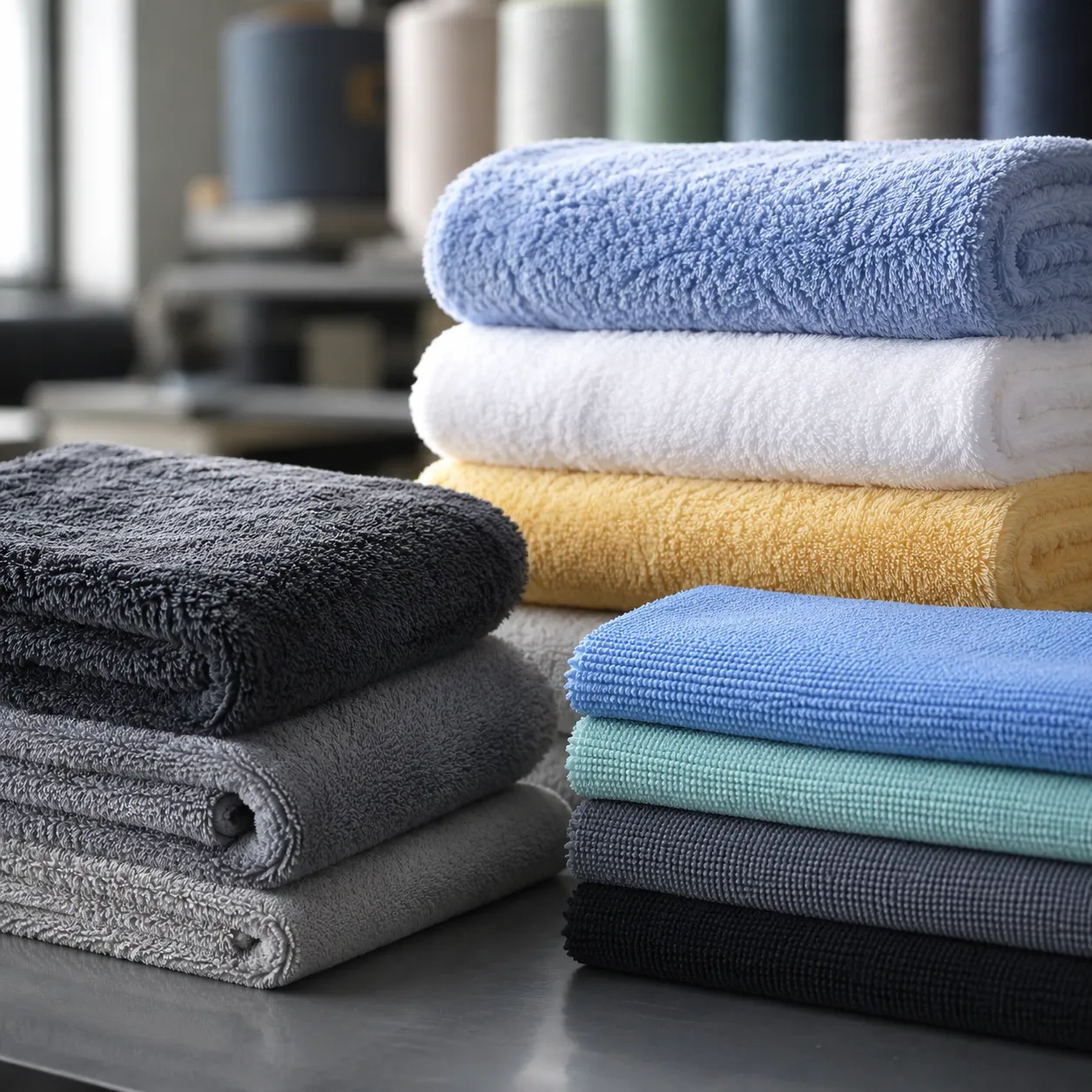
Start with the task, not the towel name
On Amazon and in detailing forums, almost every SKU gets called a drying towel, buffing towel, wash towel, or polishing towel interchangeably. At factory level, those are different constructions. If you are sourcing the best car wash towels for a brand program, first separate the use case: rinse drying, quick detailer wipe-off, coating leveling, interior dusting, or glass. The pile height, blend ratio, edge finish, and cloth weight should change with that job.
For most private-label car care lines, we suggest building a compact range around three roles: a high-absorbency drying towel at 900-1200 GSM, an all-purpose plush towel at 320-420 GSM, and a short-pile or pearl-weave towel for glass and final wipe at 260-320 GSM. Buyers who try to collapse all three into one SKU usually end up with a towel that feels thick in hand but performs poorly in at least one step.
- Drying needs capillary absorption and low drag on clear coat
- Compound or spray wax wipe-off needs controlled bite so residue does not smear
- Glass cleaning needs short pile or tight knit to reduce lint and streaking
- Ceramic coating leveling needs ultrasonic cut or suede-like surface rather than a bulky plush body
What fabric construction actually works for the best car wash towels
The most common detailing towels we make are microfiber, not cotton. For car care, the useful variables are polyester/polyamide ratio, knitting structure, pile length, and finishing chemistry. A 80/20 blend is the mainstream choice for retail because it balances cost and softness. A 70/30 blend feels fuller and usually absorbs faster, but the price moves up because polyamide costs more and availability is tighter.
Construction matters as much as blend. A warp knit body is stable and durable. Coral fleece gives bulk and water pickup for drying. Terry microfiber is versatile for all-purpose detailing. Pearl weave performs better on glass than plush loops because it leaves less lint. We also watch for GSM inflation in the market. Some suppliers quote very high cloth weight, but that can come from over-softener finishing rather than actual useful fiber density.
| Use case | Recommended construction | Typical GSM | Common size |
|---|---|---|---|
| Vehicle drying | Coral fleece or twisted microfiber loop | 900-1200 | 50x80 cm or 60x90 cm |
| All-purpose exterior wipe | Plush terry microfiber | 320-420 | 40x40 cm |
| Interior and dash | Short plush or warp knit terry | 280-350 | 30x30 cm or 40x40 cm |
| Glass and mirror | Pearl weave or low-pile knit | 260-320 | 40x40 cm |
| Coating or sealant leveling | Suede microfiber or edgeless short pile | 200-260 | 20x20 cm or 30x30 cm |
The blend ratio buyers ask about most: 80/20 vs 70/30
If your target channel is retail kits, automotive chains, or value-led DTC bundles, 80/20 is usually the practical answer. It gives good softness and enough absorbency for wash and maintenance work while keeping landed cost under control. If your channel is enthusiast detailing, pro installer distribution, or coating-specific bundles, 70/30 can be justified for drying towels and sensitive wipe-down towels.
We test both with water pickup, drag feel, and repeated laundering. A well-made 80/20 towel with the correct pile and edge can outperform a poorly built 70/30 towel. That is why we always ask for target use before quoting. The blend printed on a hangtag does not tell the full story if the knitting tension is inconsistent or the edges are too hard.
| Spec point | 80/20 microfiber | 70/30 microfiber |
|---|---|---|
| Relative softness | Good | Very good |
| Water absorption speed | Good | Higher |
| Typical retail positioning | Core line | Enthusiast or pro line |
| Lint control | Depends on finishing | Depends on finishing |
| Factory cost level | Lower | Higher by about 12-22% depending on construction |
Edge finish is where paint-safety claims usually fail
Many scratch complaints do not come from the microfiber face. They come from the border. If the towel has a stiff polyester binding, a thick overlock seam, or exposed trimming points at the corners, that edge becomes the first hard contact point on gloss black panels. For the best car wash towels, the edge spec should be written clearly in the tech pack rather than left as "soft edge" wording.
For detailing work, we usually recommend one of three options: hidden edge banding in matching microfiber, silk-banded edge for drying towels, or edgeless ultrasonic cut for sensitive buffing towels. Each has tradeoffs. Ultrasonic cut looks clean and removes the seam, but if the GSM is too high and the cut quality is unstable, edge waviness can appear after washes. Silk-banded edges feel smooth in use, but low-grade ribbon can wrinkle or pucker after tumble drying.
- Avoid coarse overlock seams on towels meant for painted exterior panels
- Ask for a corner pull test after wash to check seam distortion
- For edgeless towels, confirm the ultrasonic cutting line is even and not browned
- For banded towels, request a needle density check so ribbon puckering stays controlled
Two QC points that matter more than the catalog photo
The first is absorbency after the initial wash. Some towels feel impressive out of the carton because they carry a heavy softener finish. After one laundry cycle, water pickup drops to normal and the buyer realizes the sample handfeel was misleading. We run a simple internal absorbency check by timing full wet-out and then measuring retained water weight against dry weight. It is not a glamorous test, but it tells us more than handfeel alone.
The second is lint and debris release. A towel can pass a basic softness review and still fail in use if loose fiber, cut dust, or edge fuzz transfers onto black trim or glass. We check this with repeated shake-out, dark-panel wipe inspection, and wash-cycle observation. For export programs, we also recommend colorfastness and dimensional stability checks based on ISO methods where relevant.
| QC checkpoint | Why it matters | Typical method we use |
|---|---|---|
| Absorbency after wash | Prevents over-finished towels from disappointing after first use | Dry-to-wet retention comparison after 1 home-laundry cycle |
| Lint shedding | Reduces residue on paint and glass | Black acrylic panel wipe and visual grading |
| Colorfastness to washing | Important for dark towels sold in multi-pack | ISO 105-C06 reference check |
| Dimensional change | Prevents retail complaints on undersized packs | ISO 5077 wash shrinkage check |
| Seam integrity | Stops edge split at corners | Manual pull test plus laundering review |
GSM does not equal performance by itself
A common RFQ says only "please quote 1200 GSM best car wash towels." That number alone is not enough. A very dense towel can become heavy, slow to wring, and tiring to use on vertical surfaces. For example, a 60x90 cm drying towel at 1100 GSM can feel excellent on SUVs, but if the pile is too long and the base knit is loose, it may drag across waxed paint and become awkward once saturated.
For most private-label programs we quote these practical windows: 350-400 GSM for general detailing, 280-320 GSM for glass, and 900-1050 GSM for drying. We only move above that if the brand specifically wants a thick hero SKU. If your sales channel includes first-time consumers, too much bulk can actually increase misuse because customers start using one expensive drying towel for wheel grime, door jambs, and paintwork together.
- Set the cleaning step first
- Choose the construction before naming a GSM target
- Approve a washed sample, not only a fresh production swatch
- Write size tolerance and edge spec into the PO
- Keep dark and light towel colors separated by use to reduce stain complaints
Related reads: if you are comparing fibers rather than detailing tasks, see microfiber vs cotton towel comparison. For broader auto-care assortment planning, auto detailing microfiber towel program and microfiber cleaning towels OEM guide help frame the range.
Packaging and assortment strategy for retail and DTC
The towel itself is only part of the buy. Detailing brands often lose margin by overpacking low-cost towels or under-explaining high-cost ones. For a 3-pack all-purpose towel, a paper belly band or printed sleeve usually works. For a single drying towel above 800 GSM, a zip bag or boxed presentation can support the price point if the insert explains use, laundering, and blend ratio.
We often recommend color coding by task: dark gray for wheel or lower-body cleaning, bright blue for wash and dry, and light silver for interior or glass. This is not only visual merchandising. It reduces cross-contamination and lowers user-generated complaints about swirl marks. If you need private-label barcodes, wash icons, and multilingual inserts, build that into the sampling stage so the launch is not delayed by packaging revisions.
- 2-pack drying towel for enthusiast channel
- 3-pack 40x40 cm plush towel for starter detailing kits
- 5-pack mixed-color utility towel for e-commerce bundles
- Glass-specific add-on pack using pearl weave to raise average order value
Real OEM pricing bands buyers can budget around
Pricing depends on blend, GSM, edge, color count, packaging, and order size. Below are workable FOB China ranges for standard private-label programs at our MOQ of 500 pcs per design per color. These are not blanket market prices, but they are realistic quoting bands for current microfiber sourcing with stable QC.
| Product type | Spec example | 500-1,999 pcs | 2,000-4,999 pcs | 5,000+ pcs |
|---|---|---|---|---|
| All-purpose plush towel | 40x40 cm, 360 GSM, 80/20, microfiber edge | USD 0.56-0.74 | USD 0.43-0.58 | USD 0.37-0.49 |
| Glass towel | 40x40 cm, 300 GSM, pearl weave | USD 0.48-0.65 | USD 0.39-0.52 | USD 0.33-0.45 |
| Edgeless buffing towel | 40x40 cm, 380 GSM, ultrasonic cut | USD 0.69-0.92 | USD 0.56-0.75 | USD 0.49-0.66 |
| Drying towel | 50x80 cm, 950 GSM, coral fleece, silk edge | USD 3.10-4.05 | USD 2.62-3.38 | USD 2.24-2.95 |
| Twisted-loop drying towel | 50x80 cm, 1050 GSM, 70/30, hidden edge | USD 4.45-5.80 | USD 3.86-5.12 | USD 3.41-4.62 |
Cost-per-use is usually a better conversation than first cost. We have seen buyers reject a USD 3.86 drying towel and choose a USD 2.71 option, then replace the cheaper towel after repeated edge distortion and poor water pickup in review testing. If the stronger towel supports 80 wash cycles in enthusiast use and the cheaper one starts failing at 35-40 cycles, the more expensive SKU often lands at a lower actual use cost and produces fewer returns.
Lead times, MOQ, and certification questions
Our standard MOQ is 500 pieces per design per color. For stock yarn shades and standard packaging, lab dip and sample approval usually takes 5-8 days. Bulk production for microfiber detailing towels typically runs 20-30 days after confirmation, depending on edge style and packaging complexity. If you are adding custom hangtags, barcode stickers, PDQ cartons, or mixed pack collation, allow another 4-6 days in final packing.
For compliance, buyers usually ask first about substance safety rather than performance standard. We hold OEKO-TEX Standard 100 Class I, BSCI, and ISO 9001. Those do not prove a towel is suitable for paint correction work, but they are important for supply-chain compliance and restricted substance review. If your customer is selling into Europe, we suggest keeping the technical file tidy from the start, especially for packaging inks and accessory materials.
- MOQ: 500 pcs per design per color
- Sample time: 5-8 days for standard constructions
- Bulk production: 20-30 days after approval
- Certifications: OEKO-TEX Standard 100 Class I, BSCI, ISO 9001
- Shipping planning: add vessel booking time separately if moving full cartons by sea
Related reads: for quote-ready spec sheets, use build towel tech pack that mills can quote. If your order mix pushes against minimums, negotiate towel MOQ without killing margin is useful, and for freight timing see container vs air freight towel orders.
A practical spec set for first-time buyers
If you are launching a new detailing line and need a clean starting point, we would not begin with ten SKUs. We would start with three. That gives enough task separation without overcomplicating inventory. For the best car wash towels in a starter private-label range, this combination covers most retail demand while keeping purchasing and quality control manageable.
| SKU | Recommended starting spec | Why it works |
|---|---|---|
| Core detailing towel | 40x40 cm, 360 GSM, 80/20 plush terry, microfiber edge | Versatile for interior and exterior wipe-down |
| Glass towel | 40x40 cm, 300 GSM, pearl weave, overlock kept soft and tight | Lower lint and better streak control |
| Drying towel | 50x80 cm, 950-1000 GSM coral fleece, silk edge | High absorption without becoming too bulky for broad retail use |
Once that base line is selling, add a fourth towel only if there is a clear use-based reason: edgeless buffing for wax removal, twisted-loop for faster drying, or suede for coating application. Expansion should follow product education and channel response, not just trend pressure.
What to send us if you want accurate quoting
The fastest quotes come from detailed requests. Send target size, GSM range, blend preference, edge finish, intended use, pack quantity, and your target market. If you already have a benchmark towel, send photos of front, back, edge, care label, and a weight reading on a scale. That saves several rounds of assumptions and gives you pricing that matches real production rather than a generic catalog estimate.
- Target application: drying, buffing, glass, interior, coating
- Size and tolerance requirement
- GSM range rather than one fixed number if you are still testing
- Blend preference: 80/20 or 70/30
- Edge type: edgeless, silk band, hidden microfiber edge, soft overlock
- Packaging details: belly band, hangtag, barcode, insert, zip bag, display carton
Quote your best car wash towels program
Send your target spec, benchmark photos, and volume plan. We will reply with workable construction options, FOB pricing bands, sampling timing, and QC points to lock before production. WhatsApp: +86 13384590853 | Email: [email protected]
Request OEM quote →