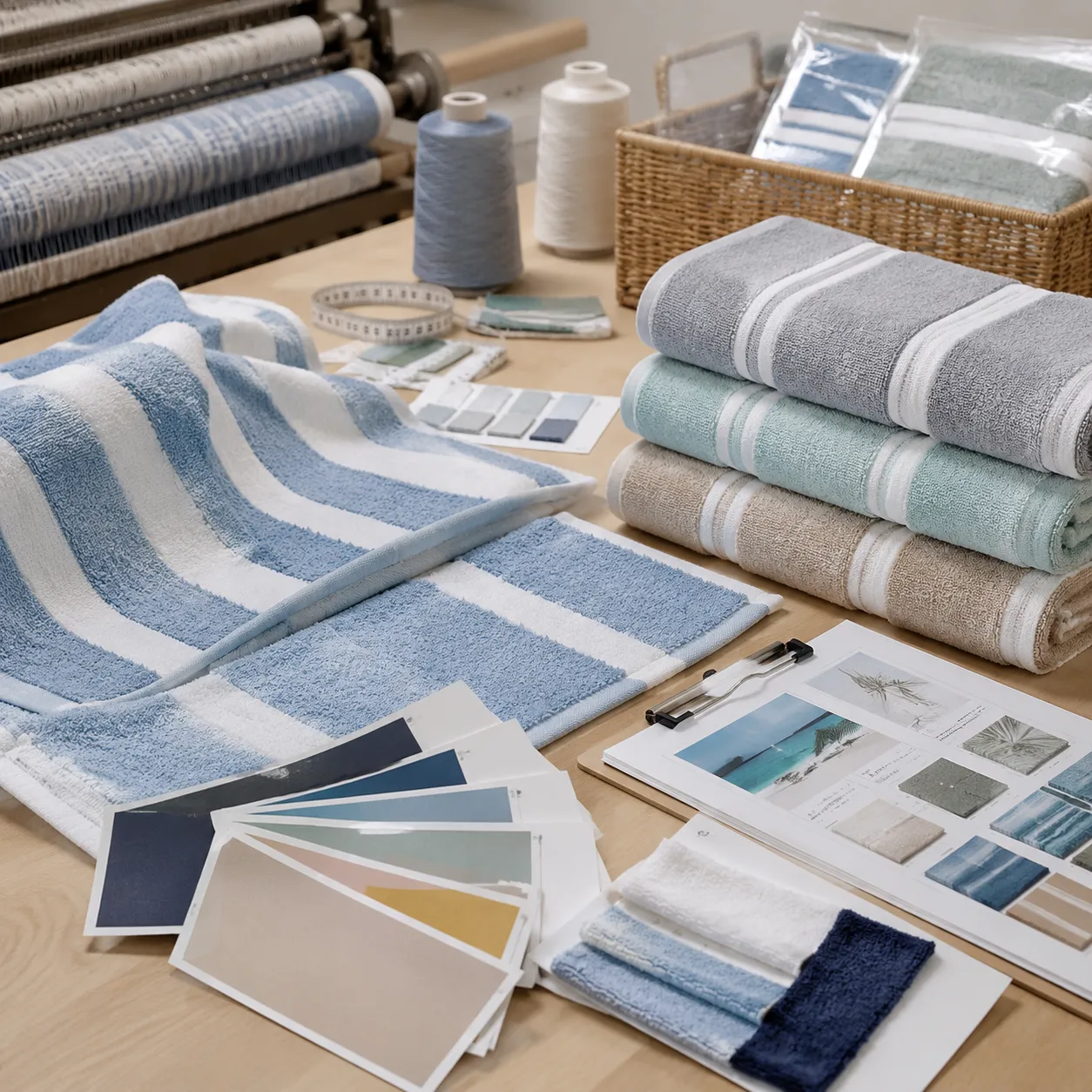
Start With the Signoff Record, Not the Towel
For beach programs, the most useful approval tool is not a pretty sample photo. It is a signoff record that fixes what the sample represents. If the record says only “approved,” the production team still has to guess whether the buyer approved the color, the hand feel, the edge stitch, the label, the polybag, or only the logo position.
Our sampling file normally has one page for specifications, one page for artwork, one page for test notes, and dated photos of the physical sample. The approved sample is sealed in a clear bag with the buyer name, design code, Pantone references, yarn lot, GSM target, measured size after finishing, and approval date. That bag stays beside the production worksheet when bulk dyeing, weaving, printing, embroidery, cutting, and packing begin.
This is where many beach towel projects go wrong. A buyer approves a front-view image by email, but the factory later discovers that the reverse side, selvedge color, hanging loop, belly band, or barcode label was never confirmed. The custom beach towel sample approval workflow must prevent those small gaps from becoming bulk-order arguments.
| Approval document | What it controls | Typical tolerance or note |
|---|---|---|
| Tech pack page | Size, GSM, yarn, construction, edge finish | Size tolerance usually ±3% after finishing |
| Artwork sheet | Logo, repeat pattern, stripe width, Pantone targets | Pantone TCX/TPX noted; lab dip or print strike-off attached |
| Physical golden sample | Hand feel, pile height, color relationship, trim placement | Signed and dated by buyer or authorized merchandiser |
| Wash note | Shrinkage, linting, color migration, distortion | 3-cycle or 5-cycle internal check before bulk release |
| Packout sheet | Folding, insert card, polybag, carton mark, barcode | Carton dimensions and gross weight confirmed before shipment |
What the custom beach towel sample approval workflow must prove
A beach towel has to survive heavier abuse than a decorative bath towel. It sits on wet timber decking, gets dragged over sand, absorbs sunscreen, and may be laundered with chlorine residue from pool towels. The sample approval process should prove function first, then decoration.
For cotton terry beach towels, our common OEM range is 380-520 GSM for retail and resort programs. Lightweight promotional pieces may sit at 300-360 GSM, while oversized club towels can reach 550-620 GSM if laundry capacity allows. For velour printed beach towels, the face is sheared before reactive print or pigment print, so the approved sample must show whether the printed face still feels smooth after washing and whether the loop back remains absorbent.
For microfiber beach towels, the sample record is different. GSM may be 200-320, print detail can be much sharper, and drying speed is better. But the buyer must accept a different hand feel and lower plushness. If the end use is a beach club daybed, cotton usually photographs and drapes better. If the end use is travel retail or surf school rental, microfiber may reduce freight and storage volume. We cover that trade-off more broadly in microfiber vs cotton towel comparison.
- Absorbency: cotton terry should wet out cleanly after softener is controlled; a hydrophobic hand feel is a warning sign.
- Sand release: dense velour prints can hold fine sand differently from loop terry, so we check shake-out after drying.
- Edge stability: long beach sizes need reinforced hemming; loose corners become the first visible defect.
- Decoration durability: printed, jacquard, and embroidered logos fail in different ways, so approval photos alone are not enough.
- Pack presentation: resort and retail orders often require belly bands, hang tags, or carton sequencing that must be approved with the sample.
Three Samples Buyers Confuse With Each Other
Sampling language causes avoidable delay. A color lab dip is not a production sample. A print strike-off is not a sewn towel. A salesman sample is not always a bulk reference. We label each sample type clearly because each one answers a different question.
For a printed beach towel, a strike-off is usually a small fabric panel showing print color and line detail. It cannot prove final size or hem behavior. For a jacquard beach towel, the equivalent is often a loom trial or yarn-dyed handloom swatch. It shows weave interpretation and color placement, but not full towel weight unless a full-size sample is made. For embroidery, the stitch-out may be done on matching towel fabric before committing to the full piece. Marco explains the decoration trade-offs in embroidery vs sublimation vs jacquard.
| Sample type | Best used for | What it cannot approve | Typical timing |
|---|---|---|---|
| Lab dip | Solid dyed cotton, yarn-dyed stripe, trim color | Logo scale, towel weight, packaging | 4-7 days after Pantone target |
| Print strike-off | Reactive or pigment print color, line thickness, registration | Final size, GSM, hem finish | 6-10 days after artwork lock |
| Embroidery stitch-out | Thread color, stitch density, backing choice | Full towel shrinkage, carton packout | 3-6 days after logo digitizing |
| Full pre-production sample | Construction, decoration, label, packaging, measured spec | Bulk shade consistency across all dye lots | 10-18 days for cotton terry; 8-14 days for microfiber |
| Sealed golden sample | Final reference for inspection and dispute control | Future reorder shade unless yarn or dye lot is repeated | Signed after all comments are closed |
Approval Evidence We Ask Buyers to Send Back
Verbal approval is not enough for custom beach towels because decoration choices are visual and subjective. A buyer may say the navy is “too flat,” but production needs to know whether to adjust the ground shade, the logo thread, the printed shadow, or the label color.
The cleanest approval package is a marked PDF plus photos of the physical sample under neutral light. For color-critical programs, we ask buyers to place the sample beside their Pantone chip or previous towel and photograph both. It is not a laboratory reading, but it catches many misunderstandings before bulk. If the brand has strict color control, we can use a spectrophotometer reading and set a ΔE target, usually ΔE 1.5-2.5 for solid dyed cotton depending on shade and yarn absorbency. Dark teal, coral, and warm beige are less forgiving than white or charcoal.
- Mark the artwork PDF with final scale, orientation, and approved Pantone references.
- Measure the towel flat after one home wash or laundry test, then record length and width in centimeters.
- Confirm which side is the display side if the towel has velour, jacquard, or one-sided print.
- Approve or reject each trim item separately: woven label, care label, hang loop, belly band, polybag warning, barcode.
- Return one signed sample or give written permission for our sealed duplicate to become the golden sample.
If the buyer cannot return the physical sample, we ask for approval by design code and sample photo number. For example, “Approve BT-26-041, photo set 3, navy option B, 450 GSM, woven label at lower right.” That wording is much safer than “approved, go ahead.”
Tolerances That Need Written Agreement
Beach towel buyers often expect apparel-level exactness, but terry fabric moves during dyeing, washing, tumbling, shearing, printing, and sewing. The approval record should state realistic tolerances before the purchase order is placed. If a retail sleeve says 100 × 180 cm, the buyer should know whether that is pre-wash, finished, or nominal selling size.
For cotton beach towels, a practical finished-size tolerance is usually ±3% for length and width. GSM tolerance is commonly ±5%, because yarn count, loop height, and finishing moisture all affect measured weight. For printed velour, shearing depth can change appearance even if GSM is on target. For jacquard, fine lettering below about 8-10 mm height may fill in because terry loops cannot behave like flat woven fabric.
A specific construction quirk matters here: border draw-in. On long striped beach towels, the dobby border and body terry do not always shrink at the same rate. If the border yarn tension is too tight, the towel can cup at both ends after washing. During sampling, we check the towel on a flat table after tumble drying. If the corners lift more than about 15 mm on a 90 cm width, we adjust border tension or hem sewing before bulk.
| Spec line | Normal approval range | Risk if left vague |
|---|---|---|
| Finished size | 70 × 140 cm to 100 × 180 cm common; tolerance ±3% | Retail sleeve mismatch or resort shelf fit issue |
| GSM | 300-360 promo, 380-520 resort/retail, 550-620 heavy club | Unexpected freight cost or slow drying |
| Hem width | 1.5-3.0 cm depending on towel weight | Curling, weak corners, uneven retail appearance |
| Logo position | Usually ±10 mm on embroidery or woven label | Logo appears off-center after folding |
| Color shade | Lab dip or strike-off approved under D65 or buyer light box | Dispute between sample photo and actual fabric |
Wash Checks Before Bulk Release
A beach towel sample should not be approved straight from the finishing line. Fresh towels can feel softer than they will after laundry because residual softener masks pile stiffness. Printed towels can also show good color before washing and then reveal crocking, back staining, or edge puckering.
Our standard internal check for custom beach programs uses domestic wash simulation before production release. For larger hotel or resort orders, buyers may request third-party testing. Common references include ISO 105-C06 for color fastness to washing, ISO 105-X12 for rubbing fastness, and ISO 6330 for domestic washing and drying procedures. OEKO-TEX Standard 100 Class I is available for materials and dyestuffs, and our factory also holds BSCI and ISO 9001 certification. Certifications do not replace sample approval; they confirm the control system and chemical safety baseline.
- Shrinkage: measure before wash and after 3 cycles; many cotton beach towels target under 5% length shrinkage after controlled finishing.
- Linting: check dark swimwear contact and dryer filter load; high loose fiber can trigger resort laundry complaints.
- Color migration: place light and dark areas in contact while damp to catch bleeding on striped or two-tone towels.
- Print cracking or dulling: inspect velour print face after tumble drying, especially around heavy ink coverage.
- Hem distortion: compare both long sides; twisting is often caused by uneven tension during sewing or finishing.
For resorts that already run high-temperature laundry, we recommend testing with their actual wash formula before bulk. A 60°C wash with alkali detergent and oxygen bleach tells a different story than a gentle home cycle. Buyers sourcing pool and beach stock together may also want to review beach club resort towel program and chair towels lounger pool deck guide.
Sample Costs, Credits, and MOQ Without Guesswork
Sampling is not free labor hidden inside bulk price. The cost depends on whether we are using stock yarn, dyeing a new shade, engraving a print screen, digitizing embroidery, or setting up a jacquard loom. We quote the sample line separately so the buyer can decide which evidence is worth paying for.
For 2026 beach towel sampling, a plain dyed cotton terry full sample is usually USD 55-95 per design when stock yarn and standard trims are available. A velour printed full sample is more often USD 110-230 because print strike-off, shearing, and setup waste are involved. A jacquard beach towel sample can run USD 160-380 if yarn-dyed color setup and loom trial are needed. Courier freight is separate, often USD 35-85 for one to three towels depending on destination and service level.
Sample fee credit is possible, but it must be written into the quotation. For example, on a confirmed order above 1,200 pieces per design and color, we may credit one basic pre-production sample fee against the bulk invoice. Setup-heavy items such as custom jacquard loom trials or several rounds of print color changes may be partly credited or not credited, because the cost is already spent before bulk fabric exists. Our normal MOQ remains 500 pieces per design per color, but efficient pricing usually starts above 800-1,000 pieces for cotton beach towels because dyeing and cutting losses spread better.
| Order quantity per design/color | Indicative FOB unit price | Sampling and approval note |
|---|---|---|
| 500-799 pcs | USD 4.85-7.20 for 380-450 GSM cotton beach towel | MOQ workable, but sample revisions should be limited to avoid cost creep |
| 800-1,499 pcs | USD 4.35-6.60 for 400-500 GSM cotton or velour | Better dyeing efficiency; one approved sample fee may be credited if agreed |
| 1,500-2,999 pcs | USD 3.95-5.85 for standard resort sizes | More room for custom label, belly band, and carton sequencing |
| 3,000+ pcs | USD 3.55-5.20 depending on size, GSM, and decoration | Best for multi-property rollouts or retail replenishment programs |
| Microfiber 1,000+ pcs | USD 2.10-4.40 for 200-320 GSM printed towel | Lower freight volume, but different hand feel must be approved clearly |
A Realistic Calendar for First-Time Beach Programs
A first-time buyer sometimes asks for a custom towel sample in three days and bulk shipment two weeks later. That can work only for stock blanks with simple embroidery. For a true custom beach towel with dyed cotton, woven label, artwork approval, and export packing, the calendar needs more room.
A realistic custom beach towel sample approval workflow usually takes 18-32 days before bulk production starts. Lab dip or artwork correction is the main variable. Bulk production then adds about 28-45 days for cotton terry after deposit and approval, depending on quantity, decoration, and dyehouse schedule. Microfiber printed towels can be faster, often 22-35 days in bulk, but artwork proofing still needs discipline.
- Day 1-3: confirm tech pack, size, GSM, artwork file, Pantone targets, packaging needs, and compliance requirements.
- Day 4-10: prepare lab dip, print strike-off, embroidery stitch-out, or jacquard trial depending on construction.
- Day 11-20: make full sample after the key visual element is approved.
- Day 21-26: wash check, measurement, photo record, and buyer review.
- Day 27-32: close comments, seal golden sample, issue final proforma invoice, and release bulk material booking.
Rushing the sample stage usually moves the delay into bulk production, where it is more expensive. If the buyer changes label placement after cutting starts, we may need to open cartons, resew labels, or downgrade finished pieces. For programs with a launch deadline, it is better to freeze the towel body first and let retail packaging follow one week later if necessary.
Defects a Good Approval File Prevents
The approval file is useful because it gives QC inspectors something exact to inspect against. Without it, inspectors can only judge general workmanship. With it, they can reject the wrong thread shade, misplaced woven label, incorrect folding direction, or carton mark error before the goods leave Gaoyang.
Two beach-towel-specific defect modes deserve attention. The first is velour print haloing, where the sheared pile bends around dense artwork and creates a fuzzy light edge. It is more visible on high-contrast navy-white or black-yellow prints. The second is sunscreen-related yellowing, especially on white or pale pastel towels. We cannot control every sunscreen formula in the market, but buyers should avoid optical-bright white if the towel will be used heavily at pools with oil-based lotions.
- Approve fold direction if the logo must face outward on a resort shelf or retail display.
- Ask for a close-up of corner stitching; skipped stitches at the miter are common early-failure points.
- Confirm barcode readability on the actual polybag, not only on the PDF label file.
- Specify whether towels ship piece-packed, bundle-packed, or loose in cartons for laundry intake.
- Keep one buyer-approved sample unwashed and one washed reference if the towel will be reordered seasonally.
Related reads: for spec drafting before sampling, use build towel tech pack that mills can quote, towel sizes dimensions complete guide, and towel GSM decision framework. For beach-specific sourcing context, see beach towels in bulk buyers guide and turkish hammam beach towels.
What We Need Before Making the First Sample
The fastest sample approvals come from buyers who send fewer but clearer inputs. A mood board is useful at the beginning, but the sample room needs files and numbers. For printed towels, vector artwork in AI, PDF, or EPS is preferred. For embroidery, DST can help, but we still need the original logo file because stitch direction may need adjustment for terry pile. For jacquard, simple flat-color artwork works better than gradients or tiny type.
Before sample invoicing, we ask buyers to confirm end use, target retail or resort price point, GSM, size, decoration method, packaging, and compliance needs. If OEKO-TEX Standard 100 Class I is required, say it before yarn, dye, thread, label, and packaging are selected. If the order ships to the EU, UK, US, or Australia with specific retail labeling rules, those labels should be included in the sample packout review.
LUMA & CO. TEXTILE has operated since 2007 with 220 employees, annual towel output around 2.4 million pieces, and 80+ brand clients across 47 countries. That capacity does not remove the need for a disciplined approval file. It makes the file more important, because a 2,000-piece beach order and a 40,000-piece resort rollout both depend on the same first signed reference.
- Target size and GSM, such as 80 × 160 cm at 420 GSM or 90 × 170 cm at 500 GSM.
- Decoration choice: yarn-dyed jacquard, velour print, reactive print, pigment print, embroidery, woven patch, or label only.
- Pantone references and acceptable color tolerance, especially for brand colors used across swimwear or resort signage.
- Packaging plan: no polybag, individual polybag, belly band, hang tag, retail barcode, master carton mark, or property code.
- Required certificates or audits, including OEKO-TEX 100 Class I, BSCI, ISO 9001, or buyer-specific restricted substance lists.
For sample requests, send the brief to [email protected] or WhatsApp +86 13205717266. Include quantity by design and color, because MOQ and price depend on the actual split. Our standard MOQ is 500 pieces per design per color, and we will tell you if a lower split is technically possible but commercially weak.
Build a Sample File Before Bulk
Send us your beach towel artwork, GSM target, size, decoration method, and packaging notes. We will quote sampling, MOQ, unit price bands, and a realistic approval calendar.
Request sample quote →