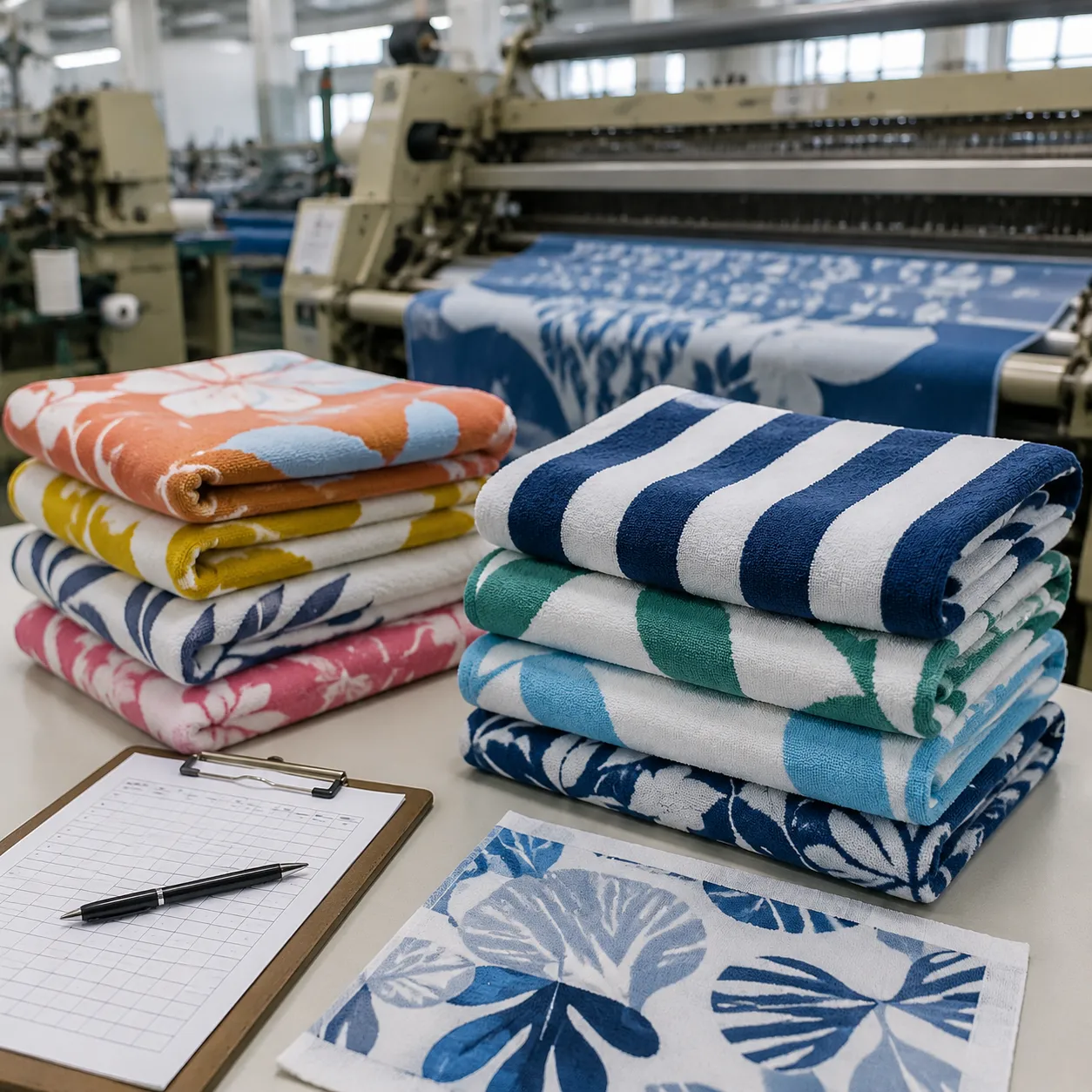
Start With the Audit Outcome, Not the Tour
A factory walk-through can look organized and still miss the risks that matter to beach towel programs. For resort, beach club, cruise, and retail buyers, the audit should answer four questions: can the supplier make the construction you approved, can they repeat color across lots, can they document compliance, and can they pack the order so it arrives usable after ocean freight.
We manufacture custom cotton and microfiber beach towels in-house, so we prefer audits that look at process evidence rather than office claims. A real audit should include machine lists, production records, lab test reports, carton drop-test records, shade band controls, and rejected-piece logs. If the supplier only shows finished samples, the buyer is auditing the showroom, not the mill.
| Audit area | What to verify | Why beach towels are different |
|---|---|---|
| Capacity | Loom count, dyeing slots, printing tables, sewing lines, monthly towel output | Large 80 x 160 cm and 100 x 180 cm towels consume more loom and drying capacity than hand towels |
| Decoration | Reactive print, yarn-dyed jacquard, embroidery, sublimation, label application records | Beach towels often carry full-surface artwork where color drift is visible from several meters away |
| QC lab | GSM cutter, color cabinet, wash tester, rubbing tester, moisture meter | Salt, sunscreen, chlorine, and sun exposure reveal weak dyeing faster than hotel bath use |
| Packing | Polybag thickness, carton ply, barcode placement, pallet plan, carton compression practice | Oversized towels create heavy cartons that deform if packout is not engineered |
- Good audit objective: confirm that bulk production can match the approved sample within agreed tolerance.
- Weak audit objective: collect supplier certificates without checking whether the certified factory is the one making the goods.
- Good evidence: daily inspection sheets showing defect categories and actual AQL results.
- Weak evidence: a single clean sample with no yarn lot, dye lot, or production date marked.
Custom Beach Towel Factory Audit Checklist
This custom beach towel factory audit checklist is the version we would want a buyer to use before placing a deposit with any OEM mill. It is practical, not decorative. It focuses on the parts of production that create commercial problems: unstable GSM, weak colorfastness, poor edge sewing, unclear compliance scope, carton failures, and late shipment risk.
- Confirm the legal factory name, export license, address, and whether the audited site matches the proforma invoice.
- Check whether weaving, dyeing, printing, cutting, sewing, inspection, and packing are in-house or subcontracted.
- Review the last three similar beach towel orders by quantity, GSM, size, destination market, and ship date.
- Verify certification scope for OEKO-TEX Standard 100 Class I, BSCI, and ISO 9001 rather than accepting logo images.
- Select one bulk order in production and trace it from yarn lot to packing list.
- Pull random finished towels for weight, size, color, lint, seam, and carton checks.
- Ask for corrective-action records from the last customer complaint and confirm whether the fix reached production.
For custom beach towels, we also recommend asking the supplier to show rejected panels before trimming. Printing defects often disappear from the final packing area because bad pieces are already removed. Looking only at finished cartons hides whether the process is stable or whether the factory is saving the order through heavy sorting.
Verify Real Production Capacity
Beach towel capacity is not just annual turnover. A mill may claim 200,000 pieces per month, but that number can depend on plain 70 x 140 cm towels at 350 GSM. Your 90 x 170 cm velour reactive-printed towel at 430 GSM will occupy more dyeing, printing, drying, and sewing time.
At LUMA & CO. TEXTILE, our annual output is around 2.4 million towels with 220 employees. We quote custom beach towel projects from a minimum of 500 pieces per design per color, but the production plan changes sharply above 5,000 pieces because yarn booking, dyeing batch size, and carton space become more efficient. During an OEM towel factory inspection, buyers should ask for current production load by week, not a generic lead time.
| Beach towel construction | Usual GSM range | Factory capacity question to ask |
|---|---|---|
| Printed cotton terry beach towel | 360-480 GSM | How many reactive print and after-wash batches can run per day for this size? |
| Yarn-dyed jacquard beach towel | 400-550 GSM | Can the jacquard loom plan reserve the exact design repeat and border width? |
| Velour front, terry back | 420-580 GSM | Is shearing done in-house, and how is pile height checked after shearing? |
| Flat woven hammam style | 220-330 GSM | Can the mill control shrinkage and twisted fringe length after wash? |
| Microfiber printed beach towel | 200-320 GSM | Is sublimation printing in-house, and what calendar width is available? |
- Ask for loom allocation by order number, not only a factory-wide machine count.
- Check whether the mill can hold shade continuity when the order needs two or more dye lots.
- Confirm maximum fabric width before approving oversized art for 100 x 180 cm towels.
- Review the sewing line daily output for your towel size, because hemming large towels slows the line.
Check Fabric, GSM, and Size Controls
A beach towel supplier audit should include physical measurement, not only document review. We use GSM cutters, calibrated digital scales, steel rulers, and post-wash shrinkage checks. For export orders, we normally set tolerance at plus or minus 5 percent for weight and plus or minus 3 percent for finished dimensions unless the buyer's tech pack states tighter limits.
One common defect in velour beach towels is uneven shearing, where one side catches the light differently because pile height varies across the width. Another is border tunneling, where the dobby or jacquard border shrinks differently from the terry field after washing. These are not random cosmetic issues; they usually point to tension imbalance, yarn count mismatch, or insufficient relaxation before cutting.
For cotton beach towels, useful yarn choices include 21s/2 or 16s/1 ring-spun cotton for durability, while softer retail towels may use combed cotton in the pile. Zero-twist can feel soft at first touch, but for beach clubs with industrial laundry we usually push buyers toward stronger twist because sand abrasion and high extractor speeds punish weak pile.
| QC checkpoint | Factory-floor method | Suggested tolerance |
|---|---|---|
| Finished GSM | Cut 100 cm² sample, weigh on calibrated scale, multiply by 100 | Within ±5% of approved sample |
| Finished size | Measure after conditioning fabric for at least 4 hours | Within ±3% unless retail packaging requires exact fold |
| Pile height | Compare sheared velour surface under D65 light cabinet | No visible lane difference across towel width |
| Hem seam | Check stitch density and skipped stitches after stretch | 8-11 stitches per inch, no open hem over 10 mm |
| Shrinkage | Wash according to ISO 6330 or buyer laundry method | Typically below 6% length and width for cotton terry |
Related reads: if the audit reveals a weak specification, rebuild the tech pack before deposit using build a towel tech pack that mills can quote. For construction trade-offs, compare towel GSM decision framework and towel sizes dimensions complete guide.
Audit Printing and Colorfastness Evidence
Decoration is where many beach towel programs fail. A lab dip may look correct, but bulk towels can show streaking, white edge exposure, unstable navy, or color transfer onto white lounge cushions. For a printed cotton towel, the audit should follow the actual process: pretreatment, printing, steaming, washing-off, softening, drying, cutting, and sewing.
For reactive print beach towels, steaming time and washing-off are critical. Under-steamed fabric can pass a quick visual check but fail rubbing and laundering. In our QC room, we reference ISO 105-X12 for rubbing colorfastness and ISO 105-C06 for domestic and commercial laundering colorfastness. For chlorine-adjacent resort use, buyers should also discuss ISO 105-E03 for chlorinated water if the towel is used around pools.
- Check whether the supplier uses a D65 light source for shade approval instead of office lighting.
- Ask for a signed shade band with approved top, middle, and bottom limits for bulk production.
- Review rubbing results separately for dry and wet crocking, especially on red, navy, black, and green.
- Confirm whether yarn-dyed jacquard colors are matched by dyed yarn lot, not only finished towel appearance.
- For sublimation microfiber towels, inspect edge blur and color migration after heat calendar transfer.
Pantone matching is not a promise unless the substrate is defined. Pantone 299 C on paper will not equal the same blue on cotton terry loops. We normally ask buyers to approve a physical strike-off and keep one sealed master sample at the mill and one with the buyer. More detail on this topic is covered in Pantone color matching custom towels and embroidery vs sublimation vs jacquard.
Confirm Compliance Scope and Traceability
Certificates matter, but the scope matters more. A BSCI towel factory audit should identify the exact production address, audit date, validity period, and business license name. The same logic applies to ISO 9001 and OEKO-TEX Standard 100. If the certificate belongs to a dye house or another related company, ask how your purchase order is covered.
LUMA & CO. TEXTILE operates with OEKO-TEX Standard 100 Class I, BSCI, and ISO 9001 certification. For baby, family resort, and cruise programs, Class I is useful because it is the strictest OEKO-TEX product class. Buyers should still request the certificate number and verify it through the issuing body, especially when skin-contact towels are sold under a retail brand.
| Document | What the buyer should inspect | Audit warning sign |
|---|---|---|
| OEKO-TEX Standard 100 | Product class, certificate number, expiry date, covered materials | Certificate only covers yarn, not finished towels or accessories |
| BSCI audit | Factory name, address, audit rating, corrective-action status | Supplier refuses to show the full audit summary |
| ISO 9001 | Quality management scope and certificate validity | Certificate applies to trading office only |
| Chemical inventory | Dyes, softeners, fixing agents, detergent records | No lot number link between chemical batch and production batch |
| Production traceability | Yarn lot, dye lot, print batch, sewing line, carton number | Finished cartons cannot be traced back to inspection records |
Traceability does not need to be complicated, but it must survive a complaint. If a beach club reports navy towels bleeding after 12 washes, the factory should identify the dye lot, production date, wash-off record, and carton numbers shipped to that location. Without this chain, every reorder becomes a guessing exercise.
Inspect Packing Before You Approve Mass Production
Packing is often treated as an afterthought, but it affects landed cost and customer complaints. A 90 x 170 cm cotton beach towel at 460 GSM weighs roughly 704 g before allowance for label and moisture. Put 24 pieces in a carton and the gross weight can move above 18 kg after polybags and carton board. If the carton is weak, it will bulge in the container and arrive with crushed corners.
For resort beach towels, we usually see export cartons built from five-ply corrugate with moisture-resistant tape. For retail programs, fold accuracy becomes more important because the towel must fit a belly band, paper wrap, or shelf carton. During the audit, ask the supplier to pack a pilot carton and measure it, not estimate from a spreadsheet.
- Confirm individual packaging: no bag, recyclable polybag, paper band, cotton ribbon, or retail box.
- Check carton dimensions against forwarder limits and destination warehouse handling rules.
- Run a carton shake check for heavy beach towel cartons before sealing the packaging spec.
- Verify barcode readability on curved or textured retail bands if the towel is roll-packed.
- Ask whether silica gel or moisture-control paper is needed for long ocean transit in humid months.
If the order ships mixed designs, carton marking must show design code, color code, size, quantity, net weight, gross weight, and PO number. We recommend one carton label format before production starts. Re-labeling 600 cartons after final inspection is slow, and it increases the risk of mixed-color delivery.
Price Bands Should Match the Audit Findings
A factory audit should change how you read a price. A quote that is 12 percent lower may be reasonable if the construction is simpler or the supplier has unused capacity. It is a risk if the audit shows outsourced dyeing, no colorfastness testing, weak carton records, and no final AQL documentation.
For a custom cotton beach towel in the 380-520 GSM range, FOB China pricing usually sits in these bands when the artwork, size, and packaging are commercially normal. Oversized towels, complex reactive print, jacquard borders, embroidered patches, or retail-ready packaging can move the price outside the range.
| Order quantity | Typical FOB price range | What usually drives the price |
|---|---|---|
| 500-999 pcs | USD 4.60-7.80 per pc | Sampling, setup loss, small dye lot, manual packing |
| 1,000-2,999 pcs | USD 3.95-6.70 per pc | Better fabric utilization and more efficient sewing line planning |
| 3,000-7,999 pcs | USD 3.45-5.85 per pc | Improved yarn booking and carton purchasing efficiency |
| 8,000-19,999 pcs | USD 3.10-5.35 per pc | Stable dye lots, optimized cutting, longer line runs |
| 20,000+ pcs | USD 2.85-4.95 per pc | Negotiated yarn, full-batch dyeing, container-level logistics |
For cost-per-use, a cheaper towel is not automatically better. A 400 GSM printed beach towel at USD 3.35 that survives 38 commercial washes costs about USD 0.088 per wash. A 470 GSM towel at USD 4.25 that survives 72 washes costs about USD 0.059 per wash. The second towel ties up more purchase budget, but it can reduce replacement orders for clubs that launder daily in peak season.
Timeline Questions That Expose Weak Planning
Lead time promises should be broken into steps. A normal custom beach towel program needs 5-9 days for artwork review and quotation, 7-14 days for lab dip or strike-off, 4-7 days for sample approval after buyer feedback, 25-38 days for bulk production, and 4-6 days for final inspection and export documents. Ocean freight then depends on destination, while air freight is usually reserved for launch shortages because towels are bulky.
The audit should check whether the supplier can name the critical path. For printed cotton beach towels, printing and wash-off capacity often control the schedule. For jacquard, loom booking and yarn dyeing come first. For embroidered resort towels, logo file digitizing and stitch-count approval can hold the order even when greige towels are ready.
- Ask which production step is the current bottleneck and how many days of buffer are in the schedule.
- Confirm whether raw yarn is already available or must be booked after deposit.
- Request the inspection date and vessel cut-off date before approving the purchase order.
- Check whether the supplier can split urgent sizes by air without disrupting carton numbering.
- For seasonal resort openings, place sample approval at least 60-75 days before the needed warehouse date.
Related reads: for freight decisions, see container vs air freight towel orders. For resort programs that need replenishment planning, compare beach club resort towel program and beach towels in bulk buyers guide.
How We Handle Buyer Audits at Our Mill
We are comfortable with structured audits because they reduce confusion later. Before a visit or remote review, we ask buyers to send the expected towel size, GSM, material, decoration method, destination country, target quantity, packaging requirement, and any restricted substance standard beyond OEKO-TEX. That lets our merchandising, production, decoration, and QC teams prepare evidence that matches the project.
For remote audits, we can share live video of key areas, recent inspection formats, certification copies, carton examples, and sample traceability. For on-site audits, buyers or third-party inspectors can review production flow, warehouse separation, QC equipment, approved sample control, and packing practice. Our MOQ remains 500 pieces per design per color, and we will say no to specifications that cannot pass the buyer's use case at the requested price.
A useful audit is not about catching the factory. It is about finding the weak point before 10,000 towels are already printed, sewn, and packed.
If you are preparing a custom beach towel factory audit checklist for our team, include your target price band and expected laundry life. Those two numbers help us recommend a construction that fits the real operating cost instead of only the first purchase order.
Need a Beach Towel Factory Audit File?
Send your towel size, GSM target, artwork method, quantity, and destination. We can prepare a project-specific audit pack, quotation, and sample plan. WhatsApp: +86 13205717266. Email: [email protected].
Request Audit Pack →