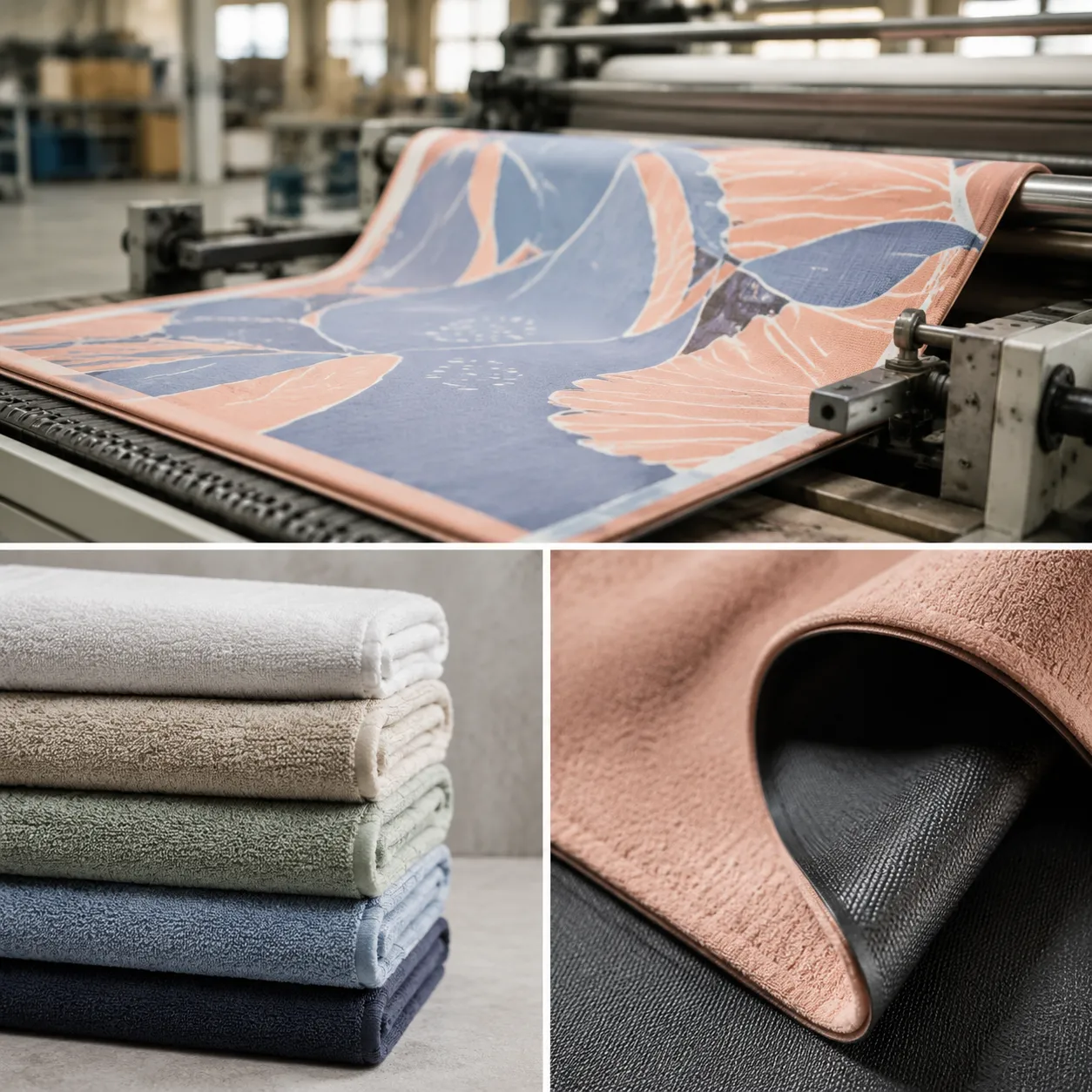
Start with the job, not the word microfiber
We see many RFQs that ask for "microfiber cleaning cloth" without naming the surface, chemical environment, or expected wash life. That leaves too much room for substitution. A cloth for optical lenses, a cloth for household glass, and a cloth for automotive interior trim can all be polyester-polyamide microfiber, but the knit, pile height, edge method, and finishing target should be different. If the brief stays generic, the sample room will fill the gap with whatever machine and yarn are easiest to book that week.
| Use case | Construction we would quote first | Typical GSM | Main risk if mis-specified |
|---|---|---|---|
| Glass and mirror | Short-pile warp knit or low-loop weft knit | 220-280 | Streaking from too much pile or softener residue |
| Consumer electronics | Suede / tricot microfiber | 170-230 | Drag marks if cloth is too dry or edge too hard |
| Auto interior plastics | Short-pile split microfiber, edgeless | 240-320 | Marring from bound edge or trapped debris |
| General household cleaning | Dual-use knit with moderate absorbency | 250-330 | Weak cleaning if blend is too polyester-heavy |
| Hospitality amenity or giveaway | Economy knit with simple overlock | 180-240 | Short service life and edge unraveling |
- Ask what surface the cloth touches first: glass, coated screen, chrome, lacquered plastic, stainless, or ceramic.
- State whether the cloth is meant for dry polishing, damp wiping, or chemical-assisted cleaning.
- Add a wash target: for example 30, 50, or 100 home-laundry cycles before downgrade to secondary use.
The four failure modes that decide whether the cloth stays in the program
In bulk orders, failures cluster around four points: drag, lint, edge abrasion, and absorbency drift. These do not show up equally in every construction. A plush cloth can feel soft in hand yet leave lint on black glass. A laser-cut edge can look clean yet become stiff after heat setting if the line speed is wrong. That is why we prefer a failure-mode review before discussing only color or private-label packaging.
1) Drag on delicate surfaces
Drag usually comes from one of three causes: yarn denier too coarse for the job, finishing chemistry left on the fabric, or an edge that hardens after cutting. For screen and optics work, a suede or tricot face in the 170-210 GSM band usually gives a smoother glide than a fluffy terry-like knit. We also watch tenter temperature after dyeing; if the edge gets over-baked, the hand changes even if the center panel still feels soft.
2) Lint or fuzz release
The usual culprit is not always low quality yarn. More often, the split ratio and brushing are mismatched. Aggressive raising can increase initial handfeel but create a fuzzy surface that breaks down in wash. For lint-sensitive orders we check the cloth after a dark-panel wipe and after a 5-cycle wash trial, not only straight off the loom.
3) Edge scratching
This one is specific and easy to miss. Satin binding on cotton towels is familiar, but on microfiber cleaning cloths the equivalent mistake is a bulky overlock or hard woven label placed too near the working face. On piano-black trim and mirror finishes, the edge does the damage before the pile does. For scratch-sensitive programs we normally keep labels off the cloth body and move branding to a belly band, polybag insert, or wash tag sewn only on one corner outside the active wipe zone.
4) Absorbency drift after repeated laundering
A first sample can absorb well and still decline sharply after ten washes if the finishing package is unstable or if the polyamide share is too low for the intended task. We test this with a simple repeated-wash absorbency comparison, then confirm with weight consistency and drying time. A cloth that cleans well but stays wet too long can sour in closed kits or housekeeping carts.
Blend ratio matters more than many buyers expect
For this category, the most common conversation is 80/20 versus 85/15 versus 70/30 polyester/polyamide. There is no universal winner. Higher polyamide usually helps absorption and cleaning efficiency, but it also pushes material cost upward and can tighten the hand if the knit is not balanced. In June 2026, for FOB China programs at practical OEM volumes, moving from an 80/20 to a 70/30 blend can raise cloth cost by roughly USD 0.03-0.09 per piece depending on size, GSM, dye shade, and edge method.
| Blend | Where we use it most | Relative cleaning feel | June 2026 FOB China note |
|---|---|---|---|
| 85/15 | Promo, basic household, low-cost packs | Acceptable for non-sensitive surfaces | Lowest common cost band but weaker absorbency retention |
| 80/20 | Most commercial cleaning cloth programs | Balanced glide and uptake | Most stable sourcing base across dyehouses |
| 75/25 | Higher-performance glass and interior care | Noticeably better wipe pickup | Used when buyer wants a step up without going too niche |
| 70/30 | Sensitive detailing and specialty kits | Best absorption and finer hand when knit is correct | Available, but MOQ discipline matters because yarn sourcing is less broad |
If a buyer asks us for the best microfiber cleaning cloths sourcing playbook in one sentence, we would say this: specify the blend only after you specify the surface and wash target. A cheap 85/15 cloth can be perfectly serviceable in a giveaway pack. It is the wrong answer for coated screens or black automotive trim where rework costs exceed the cloth cost almost immediately.
- For value packs, we often quote 85/15 or 80/20 around 200-240 GSM.
- For bulk janitorial and hospitality use, 80/20 at 230-300 GSM is the safer baseline.
- For optics, glossy plastics, and premium kits, ask to sample 75/25 or 70/30 side by side before price signoff.
Edge finish is a bigger QC issue than logo decoration
Buyers tend to focus on printing or embossing, but the edge finish usually decides claims. We regularly compare four approaches: overlock, hidden edge, ultrasonic cut, and laser cut. The right choice depends on whether the cloth is folded many times, washed often, or used on scratch-sensitive surfaces. Ultrasonic cut is popular because it removes bulky stitching, but it is not magic; poor settings can leave a brittle rim. Laser cut can be neat on thin suede constructions, though on thicker knits we often prefer a properly controlled ultrasonic cut or a very fine hidden edge.
| Edge finish | Best use | Common defect | Cost effect at OEM scale |
|---|---|---|---|
| 3-thread overlock | Economy packs, general use | Edge drag and visible seam bulk | Base cost |
| Hidden turned edge | Retail-oriented cloths | Corner thickness inconsistency | + USD 0.02-0.05/pc |
| Ultrasonic cut | Edgeless auto and screen cloths | Heat-hardened rim if calibration drifts | + USD 0.01-0.04/pc |
| Laser cut | Thin suede, small-format lens cloths | Fray risk if knit is not suitable | + USD 0.02-0.06/pc |
Two factory-floor details matter here. First, knife cleanliness on ultrasonic machines affects seal consistency more than some buyers realize; residue buildup can create a ragged bead that catches dust. Second, cloth orientation on stretch-sensitive knits changes the edge hand. We mark machine direction during pilot runs when the order is for high-gloss surface cleaning.
What to test before approving bulk
We recommend moving away from purely visual sample approval. For these cloths, a small lab and use-test pack gives better protection than a larger salesman sample set. The exact methods depend on the end use, but a workable approval package for B2B sourcing should include textile tests plus a practical wipe trial.
- Colorfastness to washing: ISO 105-C06, especially for dark navy, red, and black cloths packed wet or used with detergent.
- Colorfastness to rubbing: ISO 105-X12, because a cloth can transfer shade onto white gloss panels even when wash fastness looks fine.
- Dimensional stability after washing: ISO 5077, useful for folded retail packs and refill systems where fit matters.
- Mass per unit area: ISO 3801, to verify actual GSM against the quoted fabric.
- Water absorbency comparison after repeated laundering: mill method with fixed-dose wash cycles and timed uptake, because no buyer wants a cloth that starts strong and then repels water.
On scratch-sensitive programs, we add a controlled panel-wipe check using black acrylic or piano-finish ABS. This is not a global standard like ISO 105, but it is often more relevant than another certificate page. We wipe a cleaned panel with a conditioned cloth, then review under angled light. If the edge is too hard or contamination too high, the problem appears quickly.
Price bands only make sense with volume and scope attached
The editor was right to reject vague tables. A cloth price without date, Incoterm, size, blend, and packaging scope is not verifiable. The ranges below are June 2026 FOB China indications for custom OEM programs from our side of the market. They assume solid-dyed cloths, OEKO-TEX Standard 100 Class I compliant material input, export carton packing, and no unusually complex retail box assembly. Freight, duty, destination inland transport, and special compliance testing are excluded.
| Spec scope | MOQ | Indicative FOB China price, June 2026 | Lead-time after sample approval |
|---|---|---|---|
| 30x30 cm, 200-220 GSM, 85/15, overlock edge, 1-color logo print on pack | 10,000 pcs | USD 0.18-0.27/pc | 22-30 days |
| 30x30 cm, 230-260 GSM, 80/20, ultrasonic cut, bulk polybag pack | 8,000 pcs | USD 0.24-0.35/pc | 24-32 days |
| 40x40 cm, 260-300 GSM, 80/20, edgeless, care label off-body | 5,000 pcs | USD 0.39-0.55/pc | 26-35 days |
| 40x40 cm, 220-250 GSM suede, 75/25, laser cut, retail insert card | 5,000 pcs | USD 0.34-0.49/pc | 25-34 days |
| 40x60 cm, 300-320 GSM, 70/30, premium detailing cloth, paired color carton sticker | 3,000 pcs | USD 0.68-0.92/pc | 28-38 days |
Our standard MOQ is 500 pcs per design per color, but for microfiber cleaning cloths that threshold only works cleanly on existing yarn routes, simple packout, and flexible size nesting. If you want custom blend, uncommon shade tolerance, or multiple edge methods in one PO, practical pricing usually starts at a higher working quantity.
Why the sample that wins the meeting can still lose in production
Sampling bias is common in this product. The hand-picked submission often comes from a narrow, carefully monitored pilot run. Bulk fabric may come off a wider machine, a different lot of grey fabric, or a later finishing shift. That is not misconduct by itself; it is normal production reality. The control point is making sure your approval file captures the details that can drift.
- Record actual finished size with tolerance after first wash, not only before wash.
- Keep a sealed edge reference swatch signed from the approved sample.
- Note whether the approved sample was washed after finishing; unwashed samples can feel falsely slick.
- State carton packout method and moisture barrier if goods may cross humid lanes.
- Approve shade on production-relevant light source, especially for dark graphite, navy, and black.
If your team is building a spec from scratch, build-towel-tech-pack-that-mills-can-quote.html is useful for structuring the RFQ, even though that article covers towels more broadly. For decoration trade-offs, embroidery-vs-sublimation-vs-jacquard.html helps explain when branding should stay off the wipe surface entirely.
Compliance is straightforward, but certificate reading still matters
For most brand-side buyers, the baseline compliance set here is not exotic: OEKO-TEX Standard 100 Class I for chemical safety suitability, BSCI for social compliance, and ISO 9001 for quality management process control. We hold those certifications at mill level, but buyers should still read the scope and validity dates rather than treating a logo on a PDF as a conclusion.
A practical point: with microfiber articles, buyers sometimes assume OEKO-TEX solves all performance questions. It does not. It addresses restricted substances, not whether an edge will scratch or whether a cloth will lint after repeated washes. If your team needs a refresher on what that certificate actually covers, how-to-read-oeko-tex-certificate.html is the better reference than asking a sales rep for a one-line summary.
- Ask for the certificate number and expiry date, not only the badge artwork.
- Check whether the certificate scope matches the product category and material family being quoted.
- Separate compliance approval from performance approval in your supplier signoff sheet.
A workable buying route for mixed-surface programs
If you are sourcing for a brand that sells one cloth into several channels, do not force one fabric to do every job. We usually recommend a two-spec route rather than a single compromise cloth. For example, pair a short-pile 80/20 edgeless cloth for household glass or interiors with a thinner suede cloth for screens and optics. The unit complexity is lower than dealing with returns from customers who expected opposite performance traits.
| Program type | Recommended route | Why it works |
|---|---|---|
| Retail home-care line | One general-use cloth plus one glass cloth | Clear positioning and fewer performance complaints |
| Automotive accessory brand | Interior edgeless cloth plus drying/support accessory | Reduces scratch-risk claims on glossy trim |
| Hospitality housekeeping | Single durable 80/20 cloth in coded colors | Simpler training and reorder planning |
| Promotional campaign | One economical cloth with honest use positioning | Protects margin where wash-life is not central |
Related reads: microfiber-vs-cotton-towel-comparison.html is useful if your assortment mixes cleaning and bath categories, and container-vs-air-freight-towel-orders.html helps when replenishment timing becomes the bigger risk than unit cost.
What we would want in the RFQ before quoting
The cleanest quotes come from brief documents that answer the production variables directly. If we receive only a target price and a reference photo, we can still quote, but it will carry more assumptions and more room for post-sample correction.
- Finished size and tolerance, both before and after wash if relevant
- Target blend and acceptable alternatives for sampling
- Fabric style: suede, short-pile warp knit, coral-like plush, or other named construction
- Target GSM range rather than one impossible exact figure
- Edge method and whether labels are allowed on the working face
- Color requirement with Pantone reference if shade matters
- Packout scope: bulk, polybag, insert card, barcode sticker, carton marking
- Use case and expected laundry life
For procurement teams comparing mills, negotiate-towel-moq-without-killing-margin.html helps frame quantity splits in a way factories can actually price, and pantone-color-matching-custom-towels.html is worth reading if your cloth line depends on exact brand shades.
Need a microfiber cloth quote with real spec assumptions?
Send size, blend target, GSM range, edge method, packout, and use case. We will quote against those assumptions, note what is excluded, and flag any weak points before sampling.
Request OEM quote →