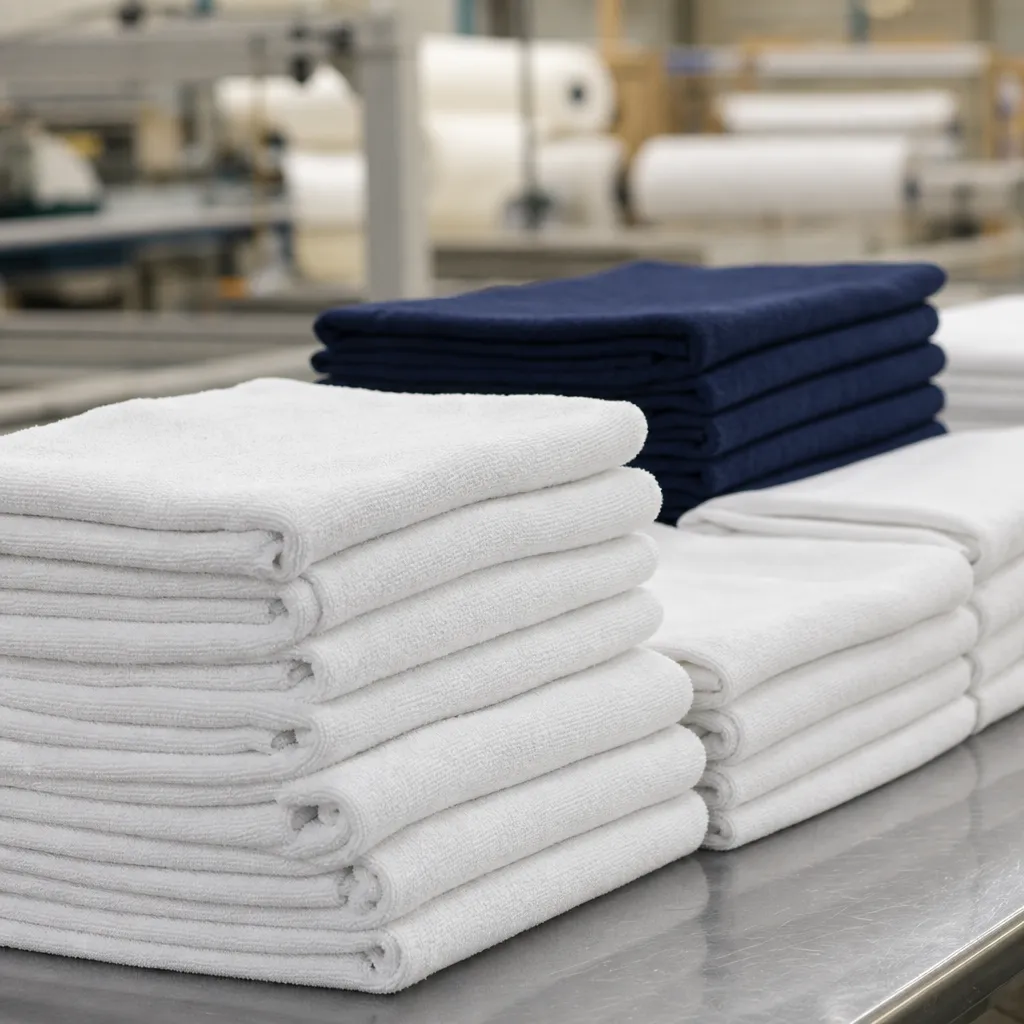
Start with the surface, not the cloth
If your team writes an RFQ that says only "microfiber cloth, 300 GSM, custom logo," the mill will fill in too many blanks for you. We sort programs by what the fabric touches: glass, painted car panels, stainless equipment, eyewear, gym machines, kitchen counters, or electronics packaging. Each surface changes the acceptable pile height, friction level, edge treatment, and wash expectation.
For example, a cloth meant for display-screen wipe packs usually needs a tighter warp knit and lower lint risk than a car-drying cloth. A gym disinfecting towel program often values chemical tolerance and cost control over plush handfeel. On polished chrome, edge construction matters as much as body fabric because overlocked seams can leave drag lines on the final wipe.
- For glass and screens, specify low-lint warp knit, short pile, and edge method before color.
- For auto detailing, ask whether the cloth is for coating removal, drying, interior wipe, or glass. One spec does not cover all four.
- For industrial janitorial, define chemical exposure: neutral detergent only, quat sanitizer, bleach contact, or degreaser.
- For retail branded packs, packaging format can affect cloth dimensions and fold memory more than buyers expect.
The four spec lines that change performance first
In most programs, we can predict 80% of the cloth behavior from four lines on the tech pack: fiber blend, construction, GSM, and edge finish. These are more decisive than color, logo method, or carton count.
| Spec line | What it changes | Typical commercial range |
|---|---|---|
| Fiber blend | Absorbency, softness, drag, cost | 70/30 to 90/10 polyester/polyamide |
| Construction | Lift, linting risk, wipe behavior | warp knit, weft knit, terry microfiber, suede |
| GSM | Body, absorbency, fold bulk, price | 180-420 GSM for most cloth programs |
| Edge finish | Scratch risk, wash stability, look | ultrasonic cut, laser cut, hidden edge, overlock |
Blend deserves more attention than many buying teams give it. A 80/20 split microfiber usually gives a good balance for general cleaning. If you move to 85/15 or 90/10 to reduce cost, the cloth often loses softness and absorbency first. If you move toward 70/30, you usually gain wipe feel and pickup, but your FOB cost rises and your yarn sourcing window can narrow during peak demand.
Construction is the second major lever. Warp knit is common for lint-sensitive wiping because the structure is stable and the surface stays flatter. Terry microfiber can hold more water and debris, but the pile needs careful control if the cloth will touch piano black trim, mirror-finish metal, or coated display surfaces.
Use-case map: the same GSM can still be wrong
We see too many sourcing sheets anchored on GSM alone. That creates expensive sample rounds because a 260 GSM cloth can be right for one channel and wrong for another. The table below is how we frame first-pass decisions with buyers before we discuss decoration or packaging.
| End use | Typical build | What to watch |
|---|---|---|
| Optical / screen cloth | 180-230 GSM warp knit, fine denier, ultrasonic cut | low lint, print migration, edge stiffness |
| General promo cleaning cloth | 200-250 GSM suede or light knit | logo clarity, folded pack size, handfeel consistency |
| Gym equipment wipe cloth | 220-280 GSM knit, 80/20 blend | chemical exposure, odor retention, shrink after hot wash |
| Auto interior / glass | 230-300 GSM tight knit | drag on glass, seam marks, silicone contamination |
| Auto drying / buffing | 320-420 GSM terry or dual pile | pile distortion, absorbency drop after wash, carton volume |
Notice that the decision line is not simply thicker versus thinner. For screen or lens work, lower bulk with clean edges often outperforms a heavier cloth. For auto drying, a heavier terry build can make sense, but only if the edge does not become the weak point during laundry testing.
- Write the actual cleaning task in the RFQ.
- List the surface material the cloth will contact.
- State whether the cloth must survive consumer washing, commercial laundry, or be treated as a semi-disposable item.
- Approve edge finish and packaging format at the same time, because fold style can expose cut edges.
Edge finish is where a lot of complaints begin
This is one of the most overlooked details in any microfiber cloth 2026 buyer guide. A buyer may approve the face fabric but reject the bulk order because the border drags, curls, or sheds. We review edge finish against the target surface before we quote final volume.
Ultrasonic cutting works well on many low-lint wiping cloths because it seals the synthetic edge and avoids thread overlock. But it is not automatic insurance. If the machine setting is too hot, the perimeter hardens and the handfeel becomes sharp on fine glass. Laser cut can give a neat finish on some thin constructions, though heat mark visibility must be checked on light shades. Overlock still has a place for thicker utility cloths where wash stability matters more than a seam-free edge.
| Edge type | Best fit | Common failure mode |
|---|---|---|
| Ultrasonic cut | optical, glass, promo packs | stiff sealed rim if temperature is too high |
| Laser cut | thin suede, precision retail packs | visible melt line on pale colors |
| Hidden edge / turned edge | higher-end retail cloths | bulk at corners if fabric is too heavy |
| Overlock | utility and janitorial cloths | drag or scratch concern on delicate surfaces |
A topic-specific point that often gets missed: on warp knit lens cloths below about 220 GSM, corner shape stability matters during die-fold packing. If the cut is not square and cooling time after ultrasonic sealing is rushed, corners can lift inside the pouch and the cloth presents wrinkled at retail. That is not a weaving problem; it is a cutting-and-pack step problem.
Ask for tests that match the claim you plan to make
Unsupported performance claims are one reason microfiber quotations can feel invented. We prefer to tie every performance discussion to a test or inspection point. If a buyer wants "lint free," we ask how that will be checked. If they want wash durability, we define the laundry method before sample approval.
- ISO 6330 for domestic washing procedure when the program expects consumer wash-and-reuse.
- ISO 5077 for dimensional change after washing, especially on cut-edge cloths packed flat.
- ISO 105-C06 for colorfastness to domestic and commercial laundering.
- AATCC 8 or ISO 105-X12 for crocking when dark shades may transfer during aggressive wipe use.
- Internal lint-drop bench test on black glass or acrylic panel after 3 and 10 wash cycles for low-lint claims.
There is no single universal ISO test for "cleaning better," so we usually build a comparison bench. On auto-glass programs, we wipe a standard diluted cleaning fluid across a dark glass panel under fixed stroke count and inspect for residual streaking, drag, and edge marks. On electronics cloths, we also watch static cling and particulate release under side light. Those are practical acceptance checks, not brochure language.
Another specific checkpoint: if you are buying split microfiber, confirm whether the supplier is testing split quality indirectly through absorbency and handfeel or whether the yarn source documentation already defines the split process. Poorly split yarn often shows up first as reduced pickup and a waxy wipe sensation, even when GSM is on target.
What pricing usually follows from the spec
We quote by exact construction, but buyers still need budget markers early. The ranges below reflect ordinary FOB China custom production for 2026 planning, assuming standard export packing, one- to two-color packaging print where applicable, and no unusual compliance add-ons. Prices move with blend, knit complexity, pack format, and order consolidation.
| Program type | MOQ baseline | Indicative FOB China range |
|---|---|---|
| 200-230 GSM promo / optical cloth, 20x20 to 30x30 cm | 5,000 pcs | USD 0.16-0.29/pc |
| 230-280 GSM general cleaning cloth, 30x30 to 40x40 cm | 3,000 pcs | USD 0.34-0.58/pc |
| 260-320 GSM glass / interior detailing cloth | 3,000 pcs | USD 0.46-0.72/pc |
| 320-420 GSM drying or buffing cloth | 2,000 pcs | USD 0.88-1.65/pc |
Those bands assume our standard MOQ logic: 500 pcs per design per color is our factory floor minimum for some towel programs, but microfiber cloth programs usually become economical at higher counts because cutting, edge finishing, and packing are labor-sensitive. For custom cloths with printed pouch, barcode label, and insert card, the practical starting point is often 3,000 to 5,000 pcs per SKU.
If a buyer asks us to remove USD 0.05 from a 40x40 cm cloth, we do not jump straight to lower GSM. We first review edge method, packaging layers, color count on insert card, and carton assortment. In one recent utility-cloth quote, moving from individual polybag plus paper card to a banded 3-pack reduced total landed-ready cost more than changing the fabric blend would have done, while keeping wipe performance intact.
Lead time depends more on finishing and packout than many expect
For repeat microfiber programs using approved yarn, stable shade, and standard cut size, production is usually faster than cotton towel programs. The delays tend to appear in printed pouch approval, barcode sequencing, or last-minute fold changes.
- RFQ review and quotation: 2-4 days
- Lab dip or shade approval if dyed cloth is required: 4-7 days
- Sample making with chosen edge finish: 5-9 days
- Bulk fabric knitting, dyeing, cutting, and finishing: 18-28 days
- Custom packout, metal detect if required by retailer, and final inspection: 4-7 days
A realistic total is 28-42 days after sample signoff for straightforward programs. If the cloth includes retail-ready pouch sets, multilingual inserts, or Amazon-style FNSKU labeling, plan the upper end. If shipment is urgent, see our notes on container-vs-air-freight-towel-orders.html, though most cloth programs move by sea unless the SKU is tiny and high margin.
Related reads: If your team is still writing vague spec sheets, start with build-towel-tech-pack-that-mills-can-quote.html. For fiber-level trade-offs, microfiber-vs-cotton-towel-comparison.html helps. If you need color approval discipline on dark branded packs, use pantone-color-matching-custom-towels.html.
A simple approval flow that prevents expensive sample loops
The cleanest buyer programs usually approve in this order: fabric handfeel, wipe result, edge finish, then packaging. Teams that start with artwork placement often end up redoing all four.
- Approve unprinted greige or dyed cloth swatches first for wipe feel and drag.
- Approve finished sample with exact edge second.
- Run a wash-and-wipe retest on the approved sample, not just a visual signoff.
- Only then lock logo print, pouch, insert, barcode, and carton assortment.
If the program is for retail or DTC, request one folded packed sample and one loose sample from the same batch. We sometimes see good loose samples and disappointing packed samples because the fold line sits across the logo or because the cloth picks up static dust inside the pouch.
Common sourcing mistakes we would fix before placing the PO
The most preventable problems show up before deposit, not during inspection. They come from missing commercial details rather than poor intent.
- Specifying only GSM and size, with no note on surface or cleaning task.
- Using overlock edges on delicate-surface cloths because the first sample looked tidy.
- Requesting very dark colors without defining crocking limits or wash test method.
- Treating a low-lint retail cloth and a utility janitorial cloth as if they can share one spec.
- Ignoring packout details such as fold direction, pouch opening width, and barcode placement.
For buyers comparing multiple suppliers, ask each mill to quote against the same test and pack assumptions. Otherwise one quote may include ISO 6330 wash validation and retail insert collation while another is pricing only fabric and a master carton. That is where fake savings usually hide.
Related reads: For MOQ planning, negotiate-towel-moq-without-killing-margin.html is useful even outside cotton towels. If you are buying into auto care channels, compare with auto-detailing-microfiber-towel-program.html. For broader custom program setup, see custom-microfiber-towels-wholesale-guide.html.
What we need in the RFQ to quote it cleanly
A good RFQ for this category fits on one page. We need end use, target size tolerance, blend target if any, construction reference, GSM range, edge finish, color, logo method, packing format, test expectations, and destination market. OEKO-TEX 100 Class I, BSCI, and ISO 9001 requests should be stated upfront so the paperwork packet matches the buyer's onboarding process.
If you are sourcing for regulated or sensitive channels, mention that in the first email. It changes raw material document flow and sometimes packaging ink choice. We can work from a full tech pack or help translate your use case into a production-ready spec, but the earlier we define the wipe task, the fewer rounds you will spend on samples that looked right and performed wrong.
Need a microfiber cloth spec review?
Send us your target use case, sample photos, and packaging plan. We will mark the risk points, quote realistic MOQ and FOB bands, and suggest the shortest approval path.
Request a quote →