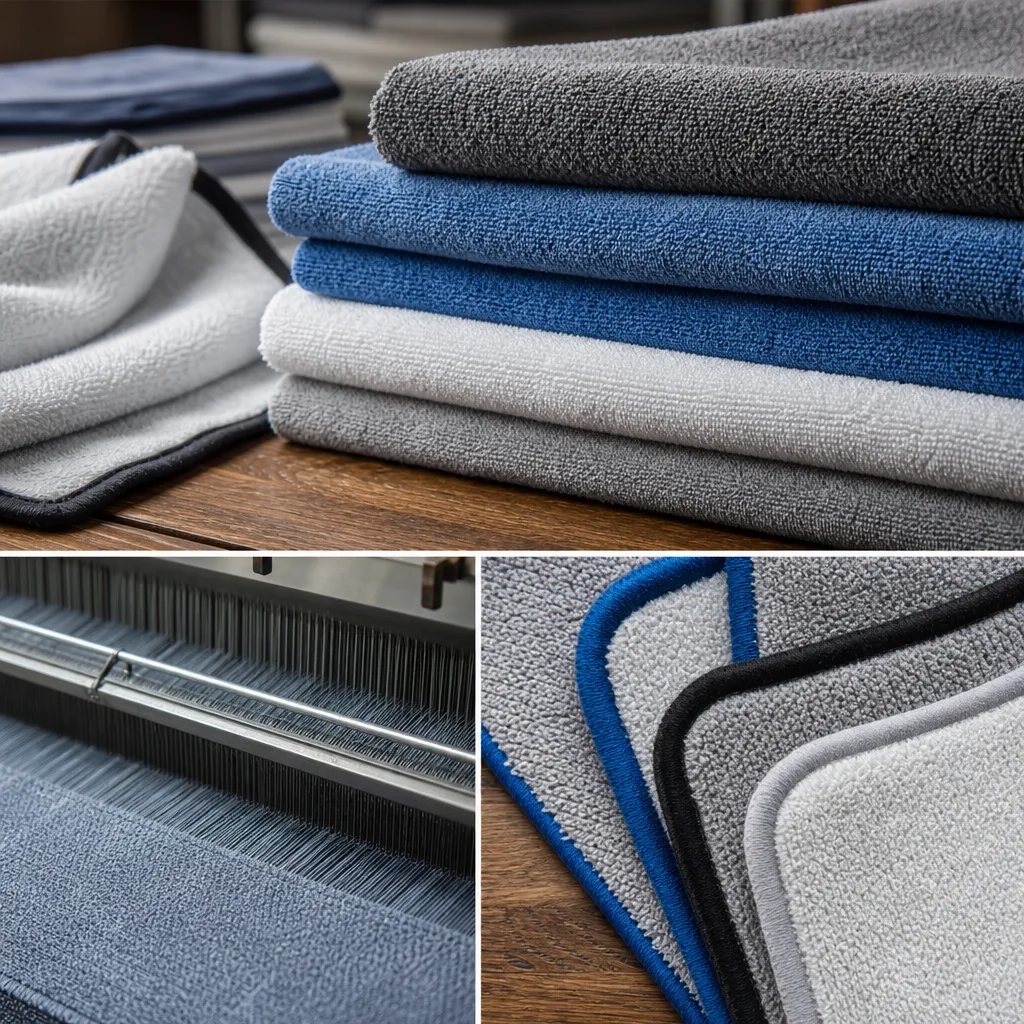
Start with the cabin-use case, not the towel swatch
The first approval mistake we see is treating this item like a miniature hotel hand towel. It is not. An airline program has a fixed tray, galley cart, service sequence, and disposal or collection logic. Before we make the first counter-sample, we ask buyers to define whether the towel is for welcome service, hot towel presentation, amenity kit inclusion, lavatory backup, or premium cabin refresh. Those use cases change fabric choice, folded dimensions, packaging film, and whether the towel must survive one wash cycle, ten wash cycles, or no laundry at all.
For most airline amenity towel sample approval workflow projects, the working spec begins with four lines only: finished size, finished weight, fold format, and pack type. A typical amenity-kit insert might be 25 x 25 cm in a 190-240 GSM microfiber or low-bulk cotton blend, while a warm service towel may sit closer to 30 x 30 cm in 260-320 GSM ring-spun cotton with a tight tolerance on fold thickness. If those four lines are still moving, every later approval becomes noisy because the buyer is reviewing the wrong object.
| Use Case | Typical Construction | Key Approval Point | Common Failure |
|---|---|---|---|
| Amenity kit insert | 190-240 GSM microfiber or cotton blend | Folded bulk in pouch | Pouch looks overfilled or distorted |
| Warm service towel | 260-320 GSM cotton terry | Heat retention and hand feel | Edges stiffen after warming |
| Lavatory backup towel | 220-280 GSM dobby or plain terry | Absorbency per gram | Too bulky for dispenser space |
| Premium refresh towel | 240-300 GSM soft terry | Skin feel after wetting | Surface becomes harsh after wash test |
Freeze the approval sequence before any lab dips go out
Buyers move faster when each gate has one owner and one decision. We normally map the sequence as RFQ spec sheet, material swatch confirmation, color standard or whiteness target, prototype sample, packaging dummy, functional test sample, pre-production sample, then sealed counter-sample for bulk reference. That order sounds simple, but many delayed programs skip straight from prototype to PP approval and discover too late that the pouch machine cracks film at the fold corner or that the towel shrinks enough to loosen the band wrap.
- Approve the technical data sheet with size tolerance, GSM tolerance, fiber content, edge finish, label method, and pack format.
- Approve either Pantone reference, CIE whiteness range, or buyer-supplied retained standard before dyeing.
- Review a prototype for touch, fold logic, and visual layout only; do not treat this as bulk standard.
- Run functional tests on the corrected sample, including absorbency, shrinkage, seam integrity, and packaging rub resistance.
- Approve the pre-production sample made from bulk-intended yarn, dye lot, and real packaging materials.
- Seal one signed reference sample that stays with the PO file and inspection team.
For a straightforward order of 30,000 to 80,000 pieces, this path usually takes 18-27 calendar days before bulk weaving or cutting is released. Prototype sewing can be done in 3-5 days. If a custom pouch mold, printed sachet film, or multilingual warning copy is involved, add another 6-9 days. We prefer to tell buyers that early, rather than promise a short sampling window and then compress the wrong stage.
What the first prototype must prove
The first prototype is not there to prove everything. It should answer only the questions that affect the next engineering step. On airline towels, those questions are usually folded thickness, edge construction, opening experience, and whether the towel feels dry, slick, limp, or papery in hand. If the buyer asks for absorbency judgments from a prototype made with substitute greige or temporary pouch film, the team is scoring a sample that was never built to be final.
We usually recommend one of three edge constructions at this stage: 8-10 mm hem for cotton terry, ultrasonic cut with perimeter sealing for fine denier microfiber, or overlock plus fold for low-cost utility pieces. Each has a different failure mode. A narrow hem can torque the square after washing if stitch tension is high. Ultrasonic edges can become sharp if the knife temperature is set too aggressively. Overlock edges are forgiving on cost but look too utilitarian for premium cabin kits.
- For cotton towels, check diagonal skew after one wet-out and dry cycle; over 3% skew is already visible on small squares.
- For microfiber inserts, measure folded thickness with the real pouch. A difference of 1.5 mm can decide whether the seal line stays flat.
- For warm-service towels, verify how the hem feels after heating; a hard resin finish on sewing thread is a frequent complaint source.
- For sachet-packed items, perform a simple hand-tear test at the notch so cabin crew can open the pack without stretching the towel edge.
The lab tests that matter for this category
Small towels used in airline service are tested differently from decorative retail textiles. We care less about dramatic showroom softness and more about controlled behavior in a compact format. The most useful lab package includes dimensional change after washing, colorfastness to rubbing if dyed, water absorbency time, pH, formaldehyde under OEKO-TEX expectations, and where relevant, microbial cleanliness for the packed state handled under the buyer's QA protocol.
Two practical tests are especially relevant here. First is absorbency timing: we often run a drop test and immersion comparison because some microfiber blends feel smooth but delay initial uptake by several seconds, which passengers perceive immediately. Second is package compression recovery: after 48 hours under carton stacking pressure, some low-loft towels unfold with visible set marks, which can look like creases or contamination in premium service.
| Test Item | Method Reference | Typical Target | Why Buyer Cares |
|---|---|---|---|
| Dimensional change | ISO 5077 | Within ±5% after agreed cycle | Folded fit and pouch tolerance stay stable |
| Colorfastness to rubbing | ISO 105-X12 | Dry 4 min, wet 3-4 min | Prevents transfer to hands or white pouch interiors |
| Water absorbency | Mill internal drop and sink test | Initial wetting within 4-8 sec depending on fabric | Passengers notice delay immediately |
| pH of aqueous extract | ISO 3071 | Typically 4.0-7.5 | Relevant for skin-contact articles |
| Restricted substances screening | OEKO-TEX aligned input control | Pass buyer compliance threshold | Avoids late compliance holds |
If the article is linked to an amenity kit program, we also ask for a pouch abrasion check using the actual printed film. Some matte coatings scuff badly during line packing, making a fresh item look dusty before it even reaches the airline warehouse.
Packaging approval causes more delays than the fabric
On this product, packaging is often the true critical path. The towel may be acceptable, but the folded geometry, sticker placement, barcode area, and film gauge are not. We have seen buyers spend ten days debating hand feel and only one day on pouch dimensions, even though the pouch is what fails at inbound inspection. For airline use, packout needs to survive manual counting, carton compression, climate shifts, and fast handling at fulfillment sites.
A clean approval set for packaging includes the empty pouch, the packed towel, the master carton layout, and one photo or drawing of barcode position. If the towel goes into a larger amenity kit, we also need the cavity dimensions of that kit insert, not just the finished towel size. A folded 25 x 25 cm towel can fit the spec on paper yet still bridge at the corners inside a narrow EVA pouch because the hem stack creates a thicker diagonal than expected.
| Packaging Checkpoint | Preferred Tolerance or Rule | What We Watch |
|---|---|---|
| Folded size | Usually ±5 mm | Consistency across packing line |
| Pouch film thickness | Commonly 5-8 c for small sachets | Seal strength vs. cloudiness |
| Carton drop resistance | Buyer standard or ISTA-style internal check | Burst corners and pouch splits |
| Barcode zone | Clear, scannable, non-curved panel | No read failure at warehouse intake |
- Ask for the real carton count early. A 500-piece carton and a 1,000-piece carton create different compression on the bottom layer.
- If the pouch has a tear notch, keep it away from the towel hem bulk or seals can start opening during transit.
- For white towels in clear film, request anti-dust handling notes in the packout SOP; tiny dark fibers become visible immediately.
- If inserts are bundled for kit assembly, approve the banding pressure. Too tight leaves permanent fold memory.
Where buyers should push back before PP approval
Pre-production approval is the point where the buyer needs to be strict. Once bulk yarn is booked and printed packaging is cut, flexibility drops quickly. We encourage buyers to reject PP samples for precise reasons, not general discomfort. Instead of saying the towel feels slightly off, mark whether loft is lower, hem draw is higher, folded edges are uneven, or whiteness has shifted outside the retained standard. Specific feedback shortens correction time by days.
One common issue in airline amenity towel sample approval workflow projects is substitution drift. The prototype may have used a softer sewing thread, a different pouch film, or a lighter care label because those were available in sampling stock. The PP sample must be checked against the approved bill of materials line by line. If the BOM says 75D/144F microfiber, 0.05 mm frosted PE pouch, and 1C black print, that is what should be on the PP table.
A pre-production sample is not a nicer prototype. It is the last proof that the factory can repeat the approved sample with the real materials, on the real packing route, at bulk speed.
Lead times and pricing bands buyers can actually plan around
Airline teams usually ask for timing and cost before the approval map is stable, so we frame both as ranges tied to complexity. For plain white or dyed solid amenity towels packed individually, FOB China pricing often lands around USD 0.26-0.44 per piece at 30,000-50,000 units for compact microfiber constructions, and around USD 0.39-0.68 for small cotton terry builds with simple pouch packing. Printed sachets, custom warning text, or carton-level relabeling can add USD 0.03-0.09 per piece depending on print coverage and handling.
Our MOQ remains 500 pieces per design per color for development logic, but practical airline production usually starts higher because packaging tooling, compliance review, and assembly setup are not efficient at very small runs. For a buyer testing one route or one premium-cabin service concept, we usually recommend keeping fabric identical and changing only pack print or outer labeling if volumes are below 5,000 pieces.
| Order Volume | Typical FOB Range | Sampling to Bulk Window | Notes |
|---|---|---|---|
| 5,000-10,000 pcs | USD 0.41-0.76 | 24-33 days | Best for trial launches; packaging cost share is high |
| 30,000-50,000 pcs | USD 0.26-0.68 | 21-30 days | Most balanced cost and approval control |
| 80,000-150,000 pcs | USD 0.22-0.59 | 23-32 days | Requires early carton planning and warehouse labeling clarity |
These ranges assume standard export packing, OEKO-TEX 100 Class I aligned material control, BSCI and ISO 9001 production systems, and no extraordinary sterilization requirement. If the airline or its kit integrator needs additional batch traceability labels, tamper-evident pack features, or bilingual legal text changes late in the cycle, time slips more from packaging than from sewing.
A practical signoff file for procurement and QA
The best buyers leave the approval stage with one compact file that procurement, QA, and the forwarder can all use. It should contain the signed spec sheet, BOM, approved artwork, fold diagram, carton count, test report list, and photo references of the accepted packed sample. That sounds basic, but without it the same questions reopen at booking, inspection, and replenishment.
- Store one flat photo and one side-view photo of the approved packed sample with a ruler in frame.
- Record the exact washing or wetting method used during evaluation so later disputes are comparable.
- Attach the test references by name, such as ISO 5077 and ISO 105-X12, rather than saying 'standard wash test'.
- Note any accepted deviation, for example slight pouch haze or a 2 mm hem variation, so inspectors do not fail approved realities.
- List carton dimensions, gross weight, and inner count on the same approval page used by sourcing and logistics.
Related reads: if you are building the RFQ from scratch, start with build-towel-tech-pack-that-mills-can-quote and negotiate-towel-moq-without-killing-margin. For shipment planning after approval, container-vs-air-freight-towel-orders helps the logistics side.
What a finished approval workflow looks like when it runs well
A good program does not need endless sample rounds. It needs disciplined gates. In a clean run, the buyer confirms use case and fold target in week one, signs off the corrected prototype in week two, reviews test-backed functional samples in week three, and approves the PP set with real packaging before bulk launch. No one is guessing what changed between stages because each sample has a purpose and a retained reference.
That is the point of an airline amenity towel sample approval workflow: not paperwork for its own sake, but a way to stop minor dimensional, packaging, and compliance issues from reaching a cabin-service rollout where correction is expensive and visible. Small towels look simple. In airline supply, they are only simple after the sample path is controlled.
Related reads: for compliance review, see how-to-read-oeko-tex-certificate. For broader fiber decisions, microfiber-vs-cotton-towel-comparison and towel-sizes-dimensions-complete-guide are useful references. If this program sits inside a broader hospitality or travel kit strategy, the industry page airline amenity towels can also help frame assortment needs.
Need a tighter sample approval path?
Send us your target size, fold format, pack style, and expected order volume. We can map the sample stages, quote realistic FOB ranges, and flag the likely failure points before bulk. WhatsApp +86 13205717266 or email [email protected].
Request a Quote →