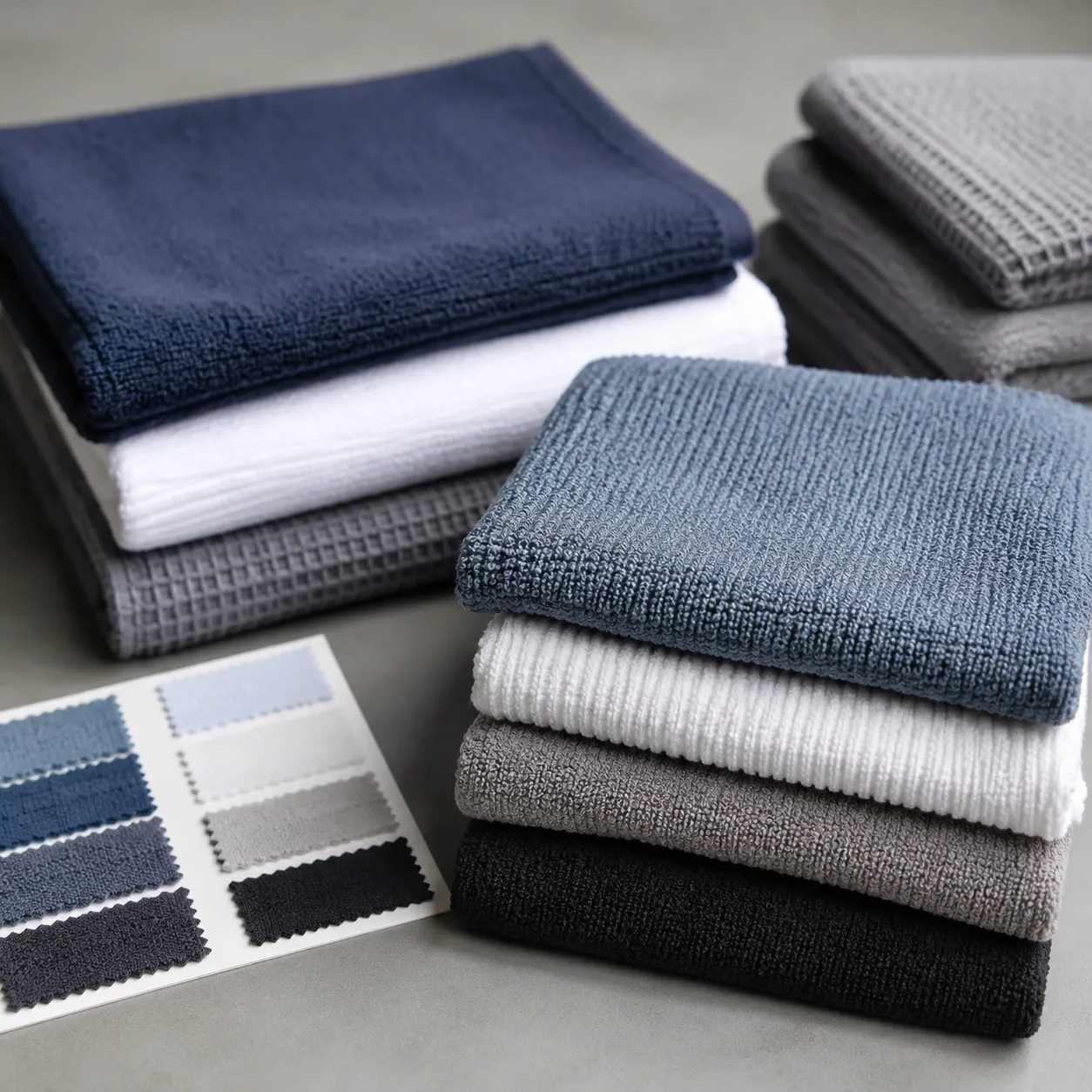
Why a short brief breaks faster on microfiber
Cotton bath towels can absorb some ambiguity because the market already understands common constructions. Microfiber is less forgiving. A 320 GSM coral fleece piece, a 360 GSM warp knit towel, and a 400 GSM double-sided knit can all feel soft in a sample room, then behave very differently in cutting, sewing, drying, and repeated washing. If the document only says "microfiber bath towel" plus size and color, the mill has to fill in the blanks, and those blanks usually become claims later.
The practical purpose of a microfiber bath towels specification sheet is simple: one document must let merchandising quote correctly, knitting plan yarn consumption, dyeing set tolerances, sewing lock the edge construction, QC inspect to the same limits, and your team approve against numbers instead of memory. We treat it as an operations file first and a design file second.
| Spec line | If missing, bulk risk |
|---|---|
| Knit type and pile face | Factory substitutes a softer or cheaper structure that changes absorbency and handfeel |
| Finished GSM tolerance | Large weight drift between sample and bulk, especially after heat setting |
| Edge construction | Wave edge, tunneling, or corner curl after wash |
| Absorbency and colorfastness method | Arguments after delivery because buyer and factory used different test conditions |
| Carton quantity and folding method | Compression marks, shade mix, or poor shelf presentation on arrival |
Start with construction, not color card
The first lines we look for are construction lines. On microfiber bath programs, these decide cost and performance more than the artwork does. For body-use towels, the most common base we quote is 80/20 polyester-polyamide. A 85/15 blend can reduce cost slightly, but it also changes water pickup and can feel more slick than plush. For most retail or hospitality bath use, we see workable GSM ranges between 280 and 420 GSM.
- Warp knit with short pile: more stable in dimension, lower snag risk, cleaner printed surface, usually 280-340 GSM
- Coral fleece knit: fuller handfeel and higher perceived loft, but edge control matters more, usually 300-380 GSM
- Double-face construction: one plush side and one tighter side for body and hair use split, usually 340-420 GSM
- Ultrasonic cut edge: only suitable for certain lightweight constructions; not our first choice for full-size bath towels
One construction quirk specific to microfiber bath towels: pile direction can shift the apparent shade by half a tone between panels, especially on dark navy, charcoal, and wine colors. That is not a dye-lot problem by itself. Your sheet should state whether shade is judged with pile brushed in one direction under D65 light, otherwise bulk inspection becomes subjective.
The seven lines that belong on the microfiber bath towels specification sheet
We see cleaner approvals when the document covers seven operational lines in clear order. This keeps the file usable across sourcing, lab, sampling, and bulk QC.
- Finished size in centimeters, plus tolerance after one home-laundry wash cycle
- Finished GSM with tolerance, and whether measured before or after wash
- Fiber content, usually 80/20 polyester-polyamide for bath use
- Construction description: warp knit, coral fleece, double-face, pile length if relevant
- Edge build: overlock width, folded hem width, thread color, corner finish
- Branding method and placement: embroidery, woven label, print, or plain
- Test methods and acceptance values for colorfastness, shrinkage, and absorbency
We do not mean long narrative notes. One line per variable is enough if it is measurable. "Soft, absorbent, luxury feel" is not measurable. "350 GSM finished weight, 76 x 152 cm after wash, 12 mm folded hem on two long sides" is measurable and quoteable.
| Core field | Recommended entry style |
|---|---|
| Size | 76 x 152 cm finished, tolerance +/- 3% after 1 wash |
| Weight | 350 GSM finished, tolerance +/- 5% |
| Blend | 80% polyester / 20% polyamide |
| Construction | Warp knit microfiber, single plush face, sheared pile |
| Hem | 12 mm folded hem, lockstitch, 8-10 SPI, matched sewing thread |
| Logo | Satin label in lower hem, 25 mm from side seam |
| Testing | Colorfastness ISO 105-C06, shrinkage AATCC 135, appearance after wash internally reviewed against approved sample |
Absorbency needs a test method, not a promise
Unsupported performance language is where microfiber files often go weak. Buyers ask for quick-dry or high absorbency, but the sheet does not say how to judge it. We avoid internal-only wording in the approval file. For dimensional change, we commonly reference AATCC 135. For colorfastness to laundering, ISO 105-C06 is standard and easy for third-party labs to run. For water absorbency, there is more variation across markets, so the key is to define the method you will accept before sampling starts.
For bath programs, one usable route is a simple soak-and-mass-gain protocol conducted on conditioned specimens, recorded in your approval notes and repeated on sealed sample retainers. Another route is a strike-through or sink test, but only if both sides agree on specimen size, water temperature, and conditioning time. Without that, two labs can give you two different stories on the same towel.
- Use AATCC 135 for shrinkage because it gives a recognized home-laundry basis
- Use ISO 105-C06 for laundering colorfastness and specify the grade required
- State whether absorbency is checked on greige-washed lab sample, bulk-finished sample, or post-wash sample
- Record the exact test water temperature and specimen dimensions in the approval file
A microfiber bath towel that feels dry in the hand can still perform adequately after the first wash, because finishing chemistry and pile alignment affect the initial impression. That is why we prefer post-wash evaluation for final approval whenever the launch calendar allows it.
Where claims usually start: edge build and sewing details
Microfiber bath towels do not fail only in the fabric body. A large share of complaints come from the perimeter. Thin hems can ripple after heat exposure. Over-tight needle tension can create roping. If the plush face is heavy and the hem allowance is too narrow, corners turn inward after laundering. These are sewing-setup issues, not random defects.
One defect mode specific to plush microfiber is hem grin: the folded edge opens slightly under stretch and shows the needle line because the pile collapses near the seam. We manage that by adjusting hem allowance and stitch density together, not by adding more thread alone. Another issue is side-to-side torque on lighter warp-knit towels after tentering if the heat-set balance is off; that can make the towel hang diagonally even when cut size is nominally correct.
| Edge option | Typical use and risk |
|---|---|
| Narrow overlock | Low-cost option for lightweight gym or travel use; not ideal for full bath towels above 300 GSM |
| Folded hem on 4 sides | Best all-round retail presentation and stronger edge stability; higher sewing time |
| Bound edge | Useful for contrast design programs, but bulky on plush constructions |
| Rounded corners with folded hem | Reduces corner dog-ears after wash, especially on 150 cm length formats |
Size and GSM tolerances that procurement can actually defend
Tolerance lines should be realistic enough for production and tight enough for claims control. For full-size microfiber bath formats, common cut sizes are 70 x 140 cm and 76 x 152 cm. Finished dimensions move with heat setting, pile direction, and wash method. If a buyer writes zero tolerance, the document looks strict but it is not operational. A better file states whether tolerance is checked before wash or after a defined wash cycle.
For a 76 x 152 cm towel at 350 GSM, our quoting model usually assumes a finished piece weight around 404 g before minor variance. At 5,000 pieces, FOB pricing typically lands around USD 3.10 to 3.85 per piece depending on construction, color depth, edge build, and branding method. At 20,000 pieces with one or two solid colors and a sewn label, we more often see USD 2.72 to 3.34 FOB. Those are workable bands, not promises detached from the spec.
| Volume | Typical FOB USD/pc | Assumptions |
|---|---|---|
| 500-1,000 pcs | 3.78-4.92 | 76 x 152 cm, 320-360 GSM, solid color, standard polybag |
| 3,000-5,000 pcs | 3.10-3.85 | 80/20 blend, folded hem, woven label or plain |
| 10,000-20,000 pcs | 2.72-3.34 | Color consolidated, stable spec, export carton optimized |
| 30,000+ pcs | 2.55-3.08 | Program order with repeat dyeing and fixed packout |
MOQ at our mill is 500 pieces per design per color. If the program asks for four shades at 150 pieces each, the issue is not only MOQ policy. It also disrupts dye lot control and makes shade approval harder on pile fabrics.
Packout belongs on the same file
A microfiber bath program can pass fabric and sewing inspection, then arrive with compression creases or carton scuff because packout was decided too late. Plush microfiber shows pressure marks more than many buyers expect. Vacuum compression can save cube, but it can also flatten pile enough to make first-open presentation look dull, especially in retail cartons.
- For e-commerce single units, specify fold board size, insert card position, barcode location, and poly thickness
- For hospitality replenishment, state carton quantity, inner bundle count, and whether mixed shade cartons are allowed
- For darker colors, require a white-paper rub check inside the packed fold to catch loose surface lint before sealing
- If shelf presentation matters, avoid over-compressed master cartons for plush constructions above 340 GSM
Carton data also affects freight planning. A 24-piece export carton for large bath towels may improve warehouse handling, while a 36-piece carton can push weight and crush risk too far depending on the fold. That choice belongs in the specification sheet because logistics will inherit it later. Related reads: container-vs-air-freight-towel-orders.html, build-towel-tech-pack-that-mills-can-quote.html, private-label-vs-white-label-towel-programs.html.
A buyer-side approval path that avoids resampling
The cleanest microfiber bath programs usually move through four gates. Each gate closes a different type of risk. Skipping one often saves three days early and costs three weeks later.
- RFQ file: confirm size, GSM, blend, construction, edge, logo, packout, target price, destination market
- Lab or strike-off stage: confirm shade under agreed light source and pile direction
- Pre-production sample: check handfeel, edge build, label placement, fold method, carton fit
- Washed approval sample: confirm dimensional change, appearance, and laundering colorfastness before bulk release
Sampling usually takes 5-7 days for plain developments if yarn is available, 8-12 days if custom shade lab dips are involved, and 25-35 days for bulk after final approval. Deep shades, embroidery, or custom retail packaging can add another 4-7 days. If third-party lab testing is required before bulk, add roughly one week depending on the lab queue.
What we redline most often on incoming spec files
Some buyer files are detailed but still incomplete in the wrong places. These are the points we mark up before we quote because they affect either liability or repeatability.
- "Microfiber" with no blend ratio
- "Large bath towel" with no finished dimension or tolerance basis
- "Absorbent" with no test method or comparison sample
- "Color match to website image" instead of a Pantone reference or approved physical standard
- "Luxury edge" or "hotel finish" with no sewing construction description
If you are moving from cotton into synthetic bath formats, it helps to treat this file as a technical data sheet, not a creative brief. Related reads: microfiber-vs-cotton-towel-comparison.html, pantone-color-matching-custom-towels.html, how-to-read-oeko-tex-certificate.html.
Compliance and contact lines to keep at the bottom
We keep compliance details on the same document footer so buyers do not have to chase them across email threads. For children-sensitive retail channels or stricter importer review, request the applicable certificate copies against the actual production site. Our standard credentials are OEKO-TEX Standard 100 Class I, BSCI, and ISO 9001. If your microfiber bath program has channel-specific chemical restrictions beyond OEKO-TEX, add that note before sample approval rather than after PO deposit.
A complete file does not need to be long. One page can be enough if every line is measurable. For quote review or redlines, contact us at [email protected] or WhatsApp +86 13205717266. You can also review our relevant categories at /products.html#hotel and /products.html#spa.
Send your spec sheet for a line-by-line review
If your current file is missing construction, test, or packout lines, we can mark it up before sampling so the quote matches bulk reality.
Request quote review →