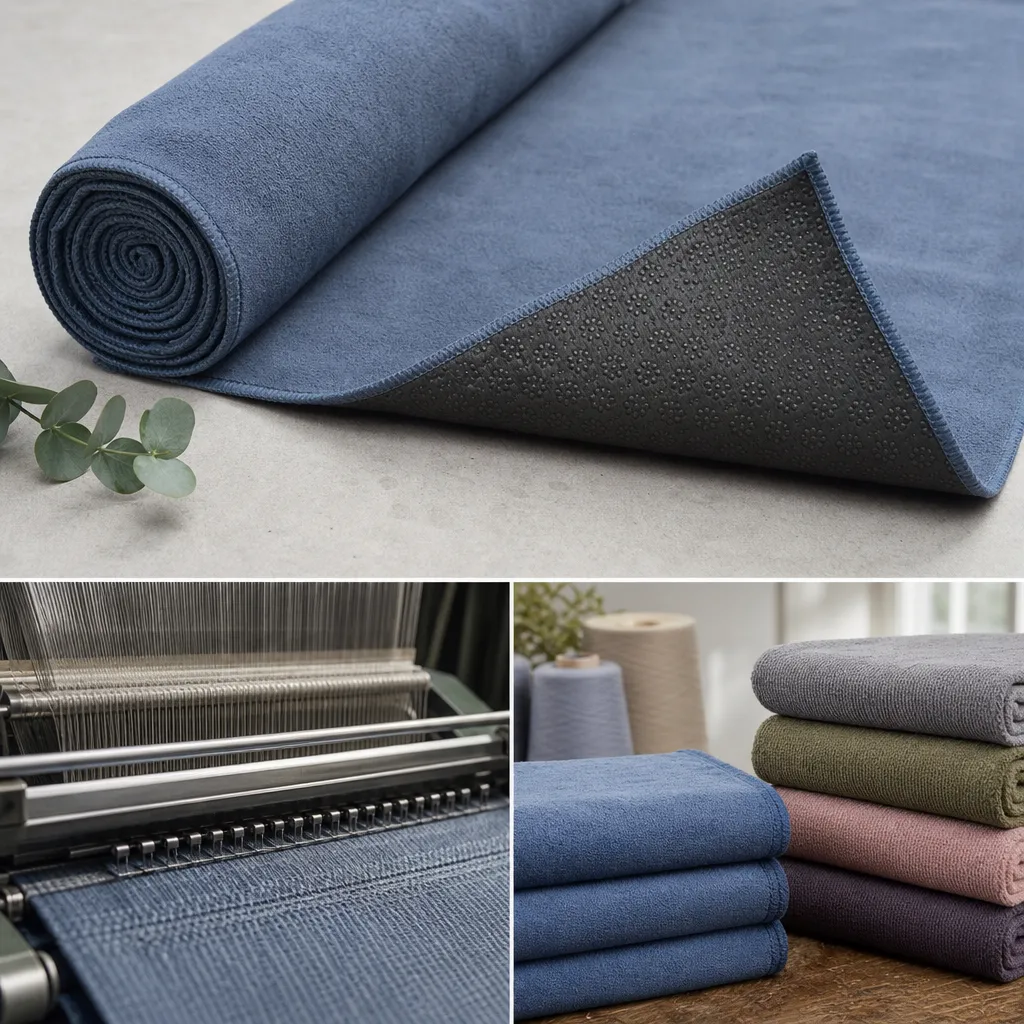
First, define the mat the towel must cover
We are not affiliated with Manduka, and buyers should treat the brand name as a sizing and use-case reference, not as a license to copy logos or product names. In factory quoting, a manduka yoga mat request usually means the towel must fit a dense 183 x 66 cm or 180 x 61 cm practice mat, stay flat during sweat-heavy movement, and survive frequent laundering without the corners twisting.
For OEM work, we ask for the exact mat width before we quote. A towel that is 61 cm wide can look tidy on a narrow mat, but it leaves exposed rubber on a 66 cm wide studio mat. A towel that is 68 cm wide gives better coverage, but if the edge binding is bulky it may interfere with hand placement in plank positions. These millimeter decisions matter more than the label name in the sourcing brief.
| Mat reference | Typical mat size | Recommended towel finished size | Why we use this tolerance |
|---|---|---|---|
| Standard narrow mat | 180-183 x 61 cm | 183 x 63 cm | Covers the edges after 3-5% washing shrinkage without excess overhang |
| Wide studio mat | 180-183 x 66 cm | 183 x 68 cm | Allows edge-to-edge coverage for hot yoga and Pilates flows |
| Travel mat | 173-180 x 61 cm | 178 x 63 cm | Lower packed weight and less fabric waste for retail bundles |
| Oversize practice mat | 200 x 66-70 cm | 200 x 72 cm | Useful for taller users, but MOQ dye yield must be checked first |
- Ask whether the buyer wants mat coverage or mat protection. Coverage is about width; protection also needs absorbency and backing grip.
- Specify finished size after washing, not only cut size before sewing. We normally allow 3-5% shrinkage for cotton blends and 1-2.5% for polyester microfiber.
- Avoid copying third-party branding. We can manufacture private label yoga towels, but registered marks need written authorization from the rights holder.
Manduka yoga mat sizing changes the towel pattern
A manduka yoga mat is often thicker and denser than the promotional mats used in low-cost gym kits. That density changes how a towel behaves. Thin microfiber without enough surface bite can slide because the mat underneath does not compress much under palm pressure. For this reason, we build most mat towels with a lighter face and a controlled grip back instead of simply increasing GSM.
Our usual finished-size tolerance for yoga towels is +/-1.5 cm on length and +/-1.0 cm on width after hemming. For a retail brand selling pairs of mats and towels, we tighten the width tolerance to +/-0.7 cm when the artwork includes border lines. Border misalignment is one of the most visible defects in online returns because customers photograph the towel laid flat on the mat.
| Construction | GSM range | Use case | Factory note |
|---|---|---|---|
| Polyester/polyamide microfiber suede | 220-280 GSM | Hot yoga towel, travel towel | Good print clarity; needs grip dots or textured back for dry starts |
| Microfiber terry | 260-340 GSM | Studio rental and sweat-heavy classes | Better absorbency but less sharp for fine-line printing |
| Cotton-rich terry blend | 360-460 GSM | Natural-feel towel for boutique studios | Heavier carton weight; longer drying time |
| Recycled polyester microfiber | 230-300 GSM | Sustainability-led DTC programs | Requires color fastness checks because recycled yarn lots can vary |
Grip is a construction choice, not a slogan
For a non slip yoga towel, buyers often ask for silicone dots because they have seen them on retail shelves. Silicone is useful, but the dot height, curing temperature, and spacing decide whether it works. We normally test 0.35-0.55 mm dot height. Below that, the grip wears down too quickly; above that, users can feel hard points under knees and elbows.
There is also a trade-off between dry grip and wet grip. A suede microfiber face may feel slightly slippery for the first three minutes of class, then improve once damp. A waffle microtexture gives better dry-hand bite but can distort fine sublimation artwork. Buyers should decide which complaint is more expensive for their channel: a towel that moves during the first sun salutation, or a print that looks less photographic.
- For hot yoga studios, we prefer silicone dot backing with 8-12 mm spacing and a cured weight of 18-26 g per towel.
- For retail printed towels, we often use micro-suede face + selective grip zones so artwork remains clean in the center panel.
- For rental programs, avoid very tall grip dots. They can catch lint and become harder to inspect after industrial laundering.
- For foldable travel packs, test corner lift after 24 hours in compressed packaging because heavy grip backing can create memory curl.
Absorbency targets for studio and retail use
A yoga mat towel does not need the same absorbency curve as a bath towel. The user is not drying skin once; they are managing sweat over 45-90 minutes while maintaining hand and foot traction. In our lab, we check water drop absorption time, total pickup after immersion, and color transfer after wet rubbing. A 260 GSM microfiber towel can absorb around 2.2-2.8 times its own weight if the yarn split and finishing are controlled.
For comparison, a 183 x 68 cm towel at 260 GSM weighs about 323 g before packaging. Move that same size to 340 GSM and the towel becomes about 423 g. The extra 100 g improves sweat buffering, but it also raises air freight cost, carton weight, drying time, and retail shelf bulk. For studio operators, we would rather raise wash durability than chase a heavier handfeel that complicates laundry.
| Performance item | Recommended test | Acceptable target for OEM yoga towels |
|---|---|---|
| Dimensional change | ISO 6330 washing, 5 cycles at 40 C | Within -3% length and -2.5% width for microfiber |
| Color fastness to rubbing | ISO 105-X12, dry and wet | Grade 4 dry, grade 3-4 wet minimum |
| Color fastness to washing | ISO 105-C06 | Grade 4 minimum for body color and print |
| Absorption speed | AATCC 79 drop test | Under 5 seconds for terry face, under 8 seconds for suede microfiber |
| Restricted substances | OEKO-TEX Standard 100 Class I | Valid certificate for yarn, dyeing, and finishing route |
Decoration options that do not damage traction
Most custom yoga towel programs use sublimation because it allows full-surface artwork at a stable cost. Sublimation works best on polyester microfiber and keeps the handfeel soft because the dye enters the fiber instead of sitting as a raised ink layer. The risk is edge bowing: if the fabric relaxes unevenly during heat pressing, straight artwork borders can curve by 3-6 mm.
Jacquard is possible, but it is less common for mat towels because the woven pattern changes surface texture and adds MOQ pressure. Embroidery is better for a corner logo or studio name, not for the center panel. A 70 mm embroidered mark can feel hard under a palm if placed near the top third of the towel. We usually keep embroidery below the lower corner zone or on a carry loop.
- Use sublimation for photographic graphics, gradient artwork, and seasonal retail drops. Read our comparison of embroidery vs sublimation vs jacquard before locking the artwork route.
- Use silicone transfer labels only outside the main hand-placement area. Raised labels can create pressure points.
- Use woven labels on the short edge if the towel will be rolled with a mat. Side labels can wrinkle when compressed by a carry strap.
- For color-controlled brand programs, provide Pantone TCX or TPX references and review our notes on Pantone color matching.
Pricing, MOQ, and what changes the quote
Our MOQ is 500 pcs per design per color. For sublimated microfiber, one full-panel artwork counts as one design even if the base fabric is the same. For yarn-dyed jacquard or solid-dyed cotton-rich towels, each body color is quoted separately because dye lot control and machine setup are different.
The cost drivers are fabric GSM, towel size, grip backing coverage, print method, packaging, and inspection level. A manduka yoga mat towel sized at 183 x 68 cm with grip dots costs more than a 173 x 61 cm travel towel even when both use the same fabric. The difference is not only fabric area; silicone consumption, pressing time, and carton volume all move together.
| Order volume | Typical FOB China price | Specification behind the band | Lead time after sample approval |
|---|---|---|---|
| 500-999 pcs | USD 4.35-6.10/pc | 230-280 GSM microfiber, sublimation, standard hem, simple polybag | 24-32 days |
| 1,000-2,999 pcs | USD 3.70-5.45/pc | 260-320 GSM microfiber, grip dot backing, custom label, insert card | 28-36 days |
| 3,000-7,999 pcs | USD 3.25-4.80/pc | Optimized fabric width, batch printing, carton marking, AQL inspection | 32-42 days |
| 8,000+ pcs | USD 2.95-4.35/pc | Dedicated dye/print lot, negotiated packing, container consolidation | 38-50 days |
Cheap specifications can look attractive at quotation stage. One recent yoga brand compared a 210 GSM no-grip towel at USD 2.85 with a 275 GSM grip-backed towel at USD 4.25 for a 2,000 pc launch. The cheaper towel saved USD 2,800 on the first PO, but if 9% of customers returned it for slipping and the brand paid USD 7.40 per return shipment and replacement handling, the return cost alone reached about USD 1,332, before review damage. For a product used under wet palms and bare feet, a small unit saving can become an expensive field test.
Sampling should reproduce laundering, not just color
A good first sample proves size, edge behavior, artwork scale, and grip. It does not prove durability. We recommend a pre-production sample after the first fit sample, then five wash cycles before approval. If the towel will be used by a studio, we also test how it dries when hung over a rail for 8 hours at normal room airflow because slow drying is a common source of odor complaints.
- Confirm mat size, finished towel size, GSM, face fabric, and backing type in a tech pack. Our guide to building a towel tech pack shows the level of detail that prevents re-quoting.
- Approve strike-off colors before full-panel sampling if the artwork uses skin tones, fine gradients, or brand-critical solids.
- Wash the approved sample 5 times using ISO 6330 conditions or the buyer's real laundry recipe, then measure length, width, corner twist, and edge wave.
- Run a wet-rub check on dark artwork before approving bulk. Dark navy, black, and deep burgundy are the colors that most often need extra control.
- Seal the sample with photos, weight, packing method, and label placement so production QC has a measurable reference.
Compliance documents buyers should request
For yoga products, skin contact is continuous and sweat is involved, so compliance should be part of the initial RFQ rather than a document chase before shipment. We hold OEKO-TEX Standard 100 Class I, BSCI, and ISO 9001 certification. For private label towels going into the EU, US, UK, or Australia, buyers should still confirm market-specific labeling rules, fiber composition wording, and care symbols.
The most useful documents are a current OEKO-TEX certificate covering the actual material route, a BSCI audit summary for social compliance, ISO 9001 documentation for quality management, and lab reports for color fastness. If a seller sends only a logo image instead of a certificate number, ask for the PDF and verify the scope. We explain that process in how to read an OEKO-TEX certificate.
- For microfiber, verify polyester/polyamide composition and whether recycled content is certified by a recognized chain-of-custody program.
- For silicone grip, request confirmation that the backing compound is included in restricted-substance control, not only the base fabric.
- For retail packaging, check carton drop requirements if the goods ship through e-commerce fulfillment centers.
- For studio rental towels, ask whether the construction has been tested against the detergent, temperature, and dryer cycle used by the laundry partner.
Production calendar and shipping choices
A realistic OEM calendar for a new custom yoga towel is 7-10 days for material and artwork confirmation, 7-12 days for sampling, 24-42 days for bulk production depending on volume, and 5-9 days for final inspection and export preparation. Air freight is practical for 500-1,000 pcs if a launch date is tight, but for 3,000 pcs and above, sea freight usually protects margin better.
Carton planning matters because yoga towels are long-format products. A 183 x 68 cm microfiber towel at 300 GSM with grip backing may pack 30-40 pcs per export carton depending on folding method and packaging. If each towel includes a paper belly band, mesh pouch, or retail box, the cube can increase by 12-28%. We discuss the freight math more broadly in container vs air freight towel orders.
Related reads: For adjacent sourcing decisions, see private label vs white label towel programs, microfiber vs cotton towel comparison, and towel GSM decision framework. Brands building gym or studio assortments may also find why gym towels fail after 50 washes useful.
Related reads: If your program extends into hot rooms, Pilates, or rental lockers, our sweat towels for gym spec guide and yoga and Pilates industry page cover laundering, shrinkage, and assortment planning from the buyer side.
What to send us for a clean quotation
The fastest RFQs are not the longest ones. They are the ones that separate must-have performance from optional packaging. If the towel must pair with a specific manduka yoga mat size, send the mat dimensions, expected towel coverage, artwork file, target retail price, country of sale, and launch date. We can then quote a practical specification instead of guessing between a low-cost travel towel and a studio-grade grip towel.
For a first production run, we usually recommend 1,000-2,000 pcs if the brand needs meaningful unit economics but still wants to test colorways. For a studio chain, 500 pcs per location group can work if the design is shared and only labels or carton marks change. Below MOQ, sample cost and setup time tend to dominate, so the landed unit cost becomes misleading.
Build a yoga towel spec that fits the mat
Send mat size, artwork, target GSM, grip preference, quantity, and destination. We will return a factory quote with MOQ, sampling plan, compliance route, and realistic production timing. WhatsApp: +86 13205717266. Email: [email protected].
Request a quote →