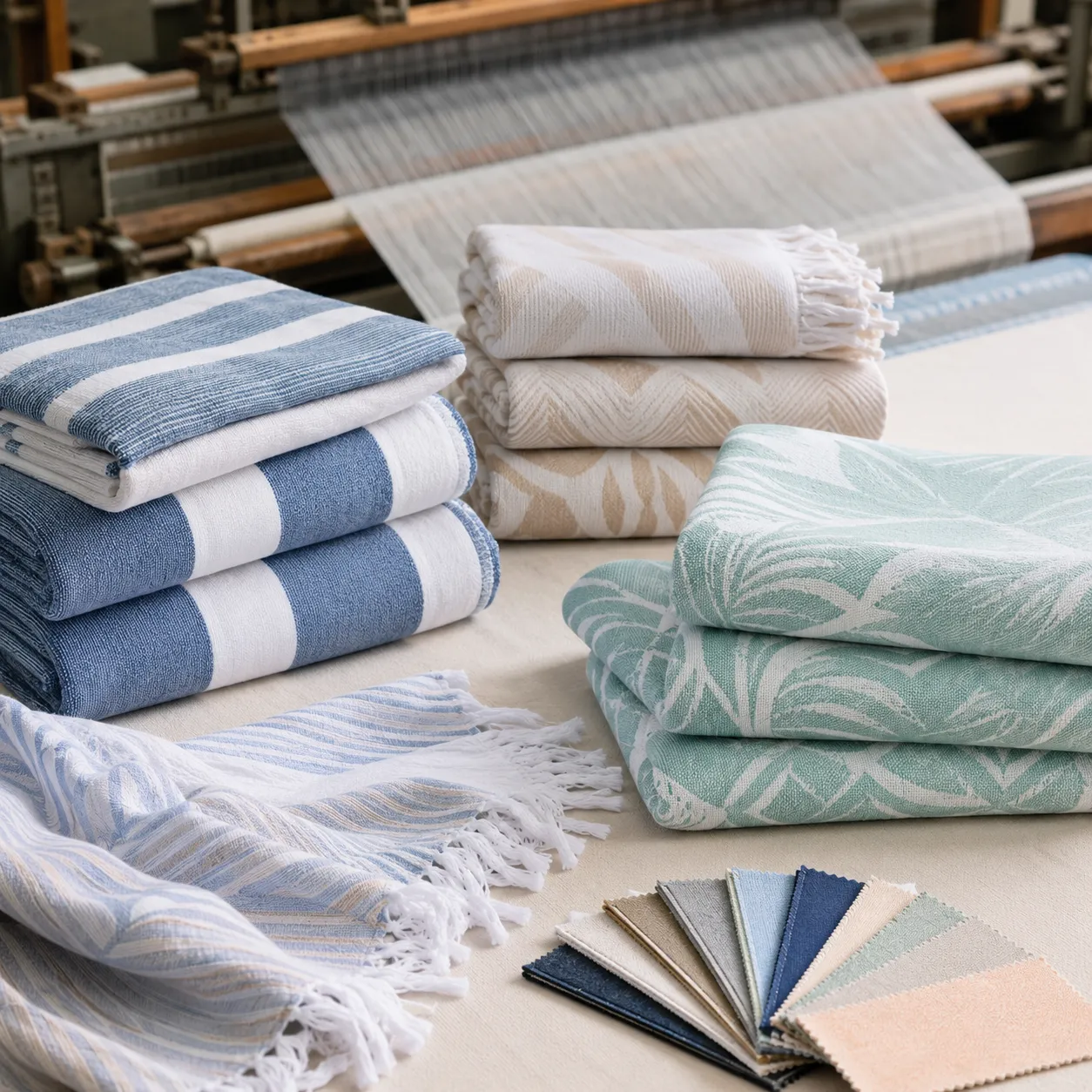
Start with the use case, not the catalog photo
Microfiber cloths are easy to under-spec because most photos show the same folded square. In the factory, the difference is in filament split, pile height, edge construction, dye stability, and packing compression. A 220 GSM suede cloth for eyewear and a 360 GSM terry cloth for auto interiors may both be called “microfiber,” but they behave very differently in cutting, sewing, lint testing, and carton loading.
For OEM buyers, we ask for the cleaning task before we quote: glass, kitchen grease, car paint, stainless steel, screens, salon surfaces, or general household dusting. The same 80/20 polyester-polyamide blend can be a good value or a poor choice depending on whether the cloth needs glide, absorbency, or particle pickup.
| Use case | Typical construction | GSM range we quote | Common size | Main risk if under-specified |
|---|---|---|---|---|
| Glass and mirrors | Flat weave or short-pile terry | 210-260 GSM | 30×30 cm or 40×40 cm | Lint streaks and edge drag |
| Auto detailing interior | Pearl or low-loop terry | 280-360 GSM | 40×40 cm | Scratch complaints from hard edge thread |
| Kitchen grease wiping | Medium terry, higher polyamide content | 300-380 GSM | 30×30 cm | Low oil pickup after 5-8 washes |
| Electronics and lenses | Suede or smooth knit | 170-230 GSM | 15×18 cm to 30×30 cm | Snagging and dust redeposit |
| Retail multipack cleaning | Terry, overlocked edge | 250-320 GSM | 30×30 cm | Color migration inside mixed-color pack |
These ranges are not quality grades by themselves. GSM is only the weight per square meter. A dense 260 GSM glass cloth can outperform a loose 330 GSM cloth on streaking because the loop geometry is different. For broader fabric comparisons, our microfiber vs cotton towel comparison explains why microfiber behaves differently from cotton in water pickup and drying.
Microfiber Cloth 2026 Buyer Guide: approval gates we use
The cleanest buying path is to approve the cloth in gates. Buyers who approve only a hand sample often discover problems after dyeing or after the edge sewing line changes speed during bulk production. Our approval sequence separates fabric behavior, color behavior, sewing behavior, and packing behavior.
- RFQ gate: confirm size, GSM, blend, weave, edge finish, color count, logo method, packing, test requirements, and ship term.
- Lab dip or yarn-dyed color gate: approve color under D65 and TL84 light. For bright colors we also check wet crocking before cutting bulk fabric.
- Pre-production sample gate: approve one full cloth with the exact edge thread, label, logo, washing instruction, and retail pack if used.
- Pilot wash gate: wash 3-5 cloths under the buyer's care label. We record shrinkage, pile change, lint, and color transfer.
- Bulk inline gate: check cut size, edge tension, skipped stitches, label alignment, and mixed-color pack accuracy before final packing.
- Final inspection gate: use AQL sampling before shipment, with carton weight and barcode checks when retail distribution requires it.
For AQL, most B2B microfiber cleaning cloth orders use ANSI/ASQ Z1.4 general inspection level II. A typical acceptance setting is AQL 2.5 for major defects and 4.0 for minor defects, unless the buyer's retailer manual requires tighter limits. We treat contamination, wrong blend, severe color bleeding, and sharp or melted edge points as major defects because those create claims in use.
Spec lines that change performance and cost
A buyer's tech pack should do more than say “lint-free microfiber cloth.” Lint is affected by cutting method, loop yarn, brushing, edge finish, and wash residue. We prefer to see each performance line stated with a test condition so the sample room, dye house, and final QC team all judge the same target.
| Spec line | Practical options | Cost or performance effect | How we verify |
|---|---|---|---|
| Blend | 80/20 or 70/30 polyester/polyamide | 70/30 usually improves absorbency and oil pickup but costs more because polyamide is higher priced | Supplier declaration plus burn/solubility spot check when required |
| GSM | 180-420 GSM for most cleaning cloths | Higher GSM increases yarn use and drying time; it does not automatically reduce lint | GSM cutter, calibrated scale, average of 5 readings |
| Edge | Ultrasonic cut, overlock, bound edge | Ultrasonic is flat but can feel hard if overheated; overlock is economical but may lint if thread is poor | Edge rub test on black glass and stitch count check |
| Weave | Suede, waffle, pearl, terry | Suede glides on screens; waffle improves drying channels; terry improves pickup | Use-case wipe trial with controlled soil |
| Logo | Heat transfer, woven label, print on pack | Direct print can stiffen small cloths; labels can scratch if placed on use face | Wash 5 cycles and inspect cracking, curl, or adhesive bleed |
For edge stitching, one small factory detail matters: overlock tension must be balanced after dyeing because microfiber fabric can stretch more across width than length. If the operator pulls too much at the corner, the cloth forms a curled “ear.” That defect does not show clearly in folded photos, but it catches on glass and looks cheap in retail multipacks.
- For glass cloths, specify soft overlock thread or a clean ultrasonic edge with no hard beads at corners.
- For auto paint or piano-black trim, avoid raised woven labels on the wiping surface.
- For mixed-color kitchen packs, run wet crocking checks before approving dark red, navy, and charcoal together.
- For screen cloths, approve fabric hand-feel after washing, not only from greige or first sample fabric.
Testing claims need conditions, not slogans
Buyers often ask whether a cloth lasts 100 washes. We can run that type of benchmark, but the number is meaningless unless the wash condition is stated. A 40°C home-laundry cycle without chlorine is not the same as a 75°C commercial laundry cycle with alkaline detergent and tumble drying.
For routine OEM approval, we use a practical short test before bulk release and reserve long-cycle testing for repeat programs. A typical short protocol is 5 wash cycles at 40°C, non-chlorine detergent, 600 rpm spin, line dry or low tumble dry as agreed. Under that condition, a well-made 300 GSM 80/20 terry cloth should show limited shrinkage, no severe edge distortion, and no visible dye transfer onto the adjacent white cotton witness fabric. If the buyer's real laundry uses disinfectant or high heat, we change the test.
| Test item | Reference or method basis | Our usual condition | Pass target for approval |
|---|---|---|---|
| Dimensional change | ISO 6330 wash procedure as the basis | 5 cycles at 40°C unless care label differs | Within ±5% length and width for most cleaning cloths |
| Colorfastness to washing | ISO 105-C06 as the basis | 40°C wash with adjacent fabric | Grade 4 or better for staining on light colors; grade 3-4 may be discussed for deep shades |
| Rubbing/crocking | ISO 105-X12 as the basis | Dry and wet rub on approved color | Dry grade 4, wet grade 3-4 minimum for most retail packs |
| Absorbency check | Internal drop and pickup test | 0.5 ml water drop plus wipe pickup on smooth tile | Water spread within agreed seconds; no oily residue after kitchen soil trial |
| Lint check | Internal black-glass wipe review | 10 straight wipes under side light | No obvious fiber trails visible at 50 cm viewing distance |
OEKO-TEX Standard 100 Class I can be specified when the cloth may contact skin or household surfaces. It does not prove absorbency, softness, or wash life. It confirms that the tested article meets the restricted substance limits under that OEKO-TEX certificate scope. For buyers new to the certificate format, we recommend reading how to read an OEKO-TEX certificate before using the logo in packaging artwork.
FOB pricing bands with stated assumptions
The prices below are not universal catalog prices. They are FOB China reference bands from our 2026 costing sheet for plain microfiber cleaning cloths, assuming solid dyed fabric, no individual polybag, carton bulk pack, standard overlock edge, and export carton suitable for ocean freight. Currency, yarn price, dye color, and packing method can move the quote.
| Spec assumption | 500 pcs/design/color | 3,000 pcs/design/color | 10,000 pcs/design/color | 30,000 pcs/design/color |
|---|---|---|---|---|
| 30×30 cm, 250 GSM, 80/20 terry | USD 0.46-0.62 | USD 0.31-0.43 | USD 0.24-0.34 | USD 0.21-0.30 |
| 40×40 cm, 300 GSM, 80/20 terry | USD 0.83-1.08 | USD 0.61-0.78 | USD 0.50-0.66 | USD 0.44-0.59 |
| 40×40 cm, 350 GSM, 70/30 terry | USD 1.06-1.34 | USD 0.82-1.02 | USD 0.69-0.86 | USD 0.62-0.78 |
| 30×30 cm, 220 GSM suede | USD 0.54-0.72 | USD 0.38-0.50 | USD 0.31-0.42 | USD 0.28-0.37 |
Our MOQ is 500 pcs per design per color, but microfiber cloth orders become more stable above 3,000 pcs per color because dyeing, cutting, and sewing loss are easier to absorb. If a buyer wants six colors at 500 pcs each, the cloth may be technically possible, but the dye-lot setup and packing control will take a larger share of cost than the fabric itself.
- Add USD 0.03-0.09 per piece for a simple woven label, depending on label size and sewing position.
- Add USD 0.05-0.16 per piece for a heat-transfer logo, assuming one position and artwork already separated.
- Add USD 0.04-0.12 per piece for individual retail polybag or paper band, depending on barcode and material thickness.
- Expect deeper shades to cost slightly more when extra wash-off is needed to reach the agreed crocking level.
A cost-per-use comparison should be built on the buyer's real use. For example, if a 40×40 cm 300 GSM cloth at USD 0.64 survives 35 approved home-laundry cycles under a 40°C non-chlorine protocol, the fabric cost is about USD 0.018 per cycle before freight and handling. A cheaper USD 0.48 cloth that curls after 18 cycles under the same protocol costs about USD 0.027 per cycle. That does not mean the cheaper cloth is always wrong; it may still fit a promotional kit. It does mean buyers should compare under the same wash condition.
Decoration and packaging choices that create hidden defects
Microfiber is sensitive to heat and pressure. A heat-transfer logo that looks sharp on day one can stiffen the wiping face or crack at the edge if the press temperature, dwell time, or adhesive film is wrong. For performance cloths, we usually move branding to a woven side label, header card, belly band, or outer pouch rather than printing across the main wiping zone.
For lint-free microfiber cloth programs, packaging can also create problems. Vacuum packing reduces carton volume but may crush high pile and leave creases that do not recover before retail display. Tight paper bands can mark suede cloths. Mixed-color multipacks need interleaving tests if dark and light shades touch during ocean freight in summer humidity.
- Use a side seam label for auto-detailing cloths if the end user may touch painted surfaces.
- Keep heat-transfer logos below 25% of cloth face area for cleaning cloths that must absorb or glide.
- Specify carton moisture protection when shipping during June-September from East China ports.
- For retail multipacks, request one packed sample after compression, not only loose cloth samples.
If a program needs a direct logo, compare methods before locking artwork. Our embroidery vs sublimation vs jacquard article covers towel decoration broadly; for microfiber cloths, we usually narrow the choice to heat transfer, woven label, printed paper band, or pouch printing.
Production timing and shipment planning
Lead time depends more on color count and packing than on square size. For a repeat 40×40 cm cloth in one existing color, production can be much faster than a first order with six lab dips, retail barcode testing, and a custom printed pouch. We give buyers a calendar with approval deadlines because a missed lab-dip signoff can push dyeing by several days.
- RFQ review and quote: 1-3 working days if the spec sheet includes GSM, size, blend, edge, packing, and target quantity.
- Lab dip or color strike-off: 4-7 days for normal solid colors; neon or very deep shades may need another round.
- Pre-production sample: 5-10 days after color and material details are approved.
- Bulk fabric knitting, dyeing, cutting, and sewing: 15-24 days for most 3,000-30,000 pc orders.
- Packing and final inspection: 2-5 days, longer for retail barcode sorting or multi-SKU cartons.
- Ocean freight booking and port handling: usually 7-12 days before vessel departure, depending on season and route.
Air freight is possible for urgent launches, but microfiber cloths are dense relative to their sales value. A 40×40 cm 300 GSM cloth weighs about 48 g before packing. A 10,000 pc order is around 480 kg net fabric weight, and carton volume rises quickly when the pile is not compressed. For larger programs, compare freight mode using the same carton dimensions, not just unit price. Our container vs air freight towel orders guide is useful when the buyer's launch date is fixed.
Factory compliance and documentation buyers should request
For microfiber cleaning cloths wholesale programs, compliance is usually a mix of factory system documents, material safety documents, and product test reports. LUMA & CO. TEXTILE operates under ISO 9001 quality management, BSCI social compliance, and OEKO-TEX Standard 100 Class I certified article scope. Buyers should confirm that the exact product, material, or production scope they plan to claim is covered before printing compliance language.
- Ask for the current OEKO-TEX certificate number and scope, not only a logo image.
- Request the BSCI audit summary if retailer onboarding requires social compliance documentation.
- Use ISO 9001 as evidence of a documented quality management system, not as a product performance guarantee.
- For EU or US retail, confirm labeling rules, fiber composition wording, country of origin, and any packaging recycling marks before mass printing.
- If the cloth is sold for baby, skin-care, or food-contact-adjacent use, state that use case during RFQ so the right testing path is chosen.
We also recommend a signed golden sample retained at the factory and by the buyer. It should include the cloth, carton mark, retail pack, label, and approved shade. During final inspection, the inspector can compare against that sample instead of interpreting a PDF alone.
RFQ checklist for a clean quote
A strong RFQ saves more time than a long negotiation after the wrong sample is made. For a microfiber cloth 2026 buyer guide, our main advice is simple: define the wipe task, then define the measurable cloth. If the RFQ only says “good quality microfiber,” every supplier will quote a different construction and the lowest unit price may be comparing a lighter cloth, cheaper edge, and weaker dye process.
- State size tolerance, for example 40×40 cm, ±1 cm after washing.
- State GSM and blend, such as 300 GSM, 80/20 polyester/polyamide, or ask the mill to propose options for the use case.
- Confirm weave type: suede, terry, waffle, pearl, or sample-match reference.
- Choose edge finish and thread color, including whether the edge may touch delicate surfaces.
- List color count, Pantone target, and whether mixed-color packs require color migration testing.
- Define logo and packaging separately from cloth construction.
- Name required tests, such as ISO 105-C06, ISO 105-X12, ISO 6330-based wash check, or buyer-specific protocols.
- Give annual forecast and first PO quantity so the mill can plan yarn, dyeing, and carton procurement.
Related reads: for buyers still building a formal spec file, see build a towel tech pack that mills can quote, custom microfiber towels wholesale guide, and microfiber vs cotton towel comparison. For quantity planning, negotiate towel MOQ without killing margin explains why low MOQ is possible but not always cheaper in real landed cost.
LUMA & CO. TEXTILE is a 220-employee towel mill in Gaoyang, Zhejiang, operating since 2007. We produce about 2.4M towels per year for 80+ brand clients in 47 countries. For microfiber cloth orders, our standard MOQ is 500 pcs per design per color, with cleaner pricing and QC flow from 3,000 pcs per color upward.
Send us your microfiber cloth spec
Share size, GSM, blend, use case, color count, logo method, packing, order quantity, and test requirements. We will return a practical FOB quote and approval timeline. WhatsApp: +86 13205717266. Email: [email protected].
Request a quote →