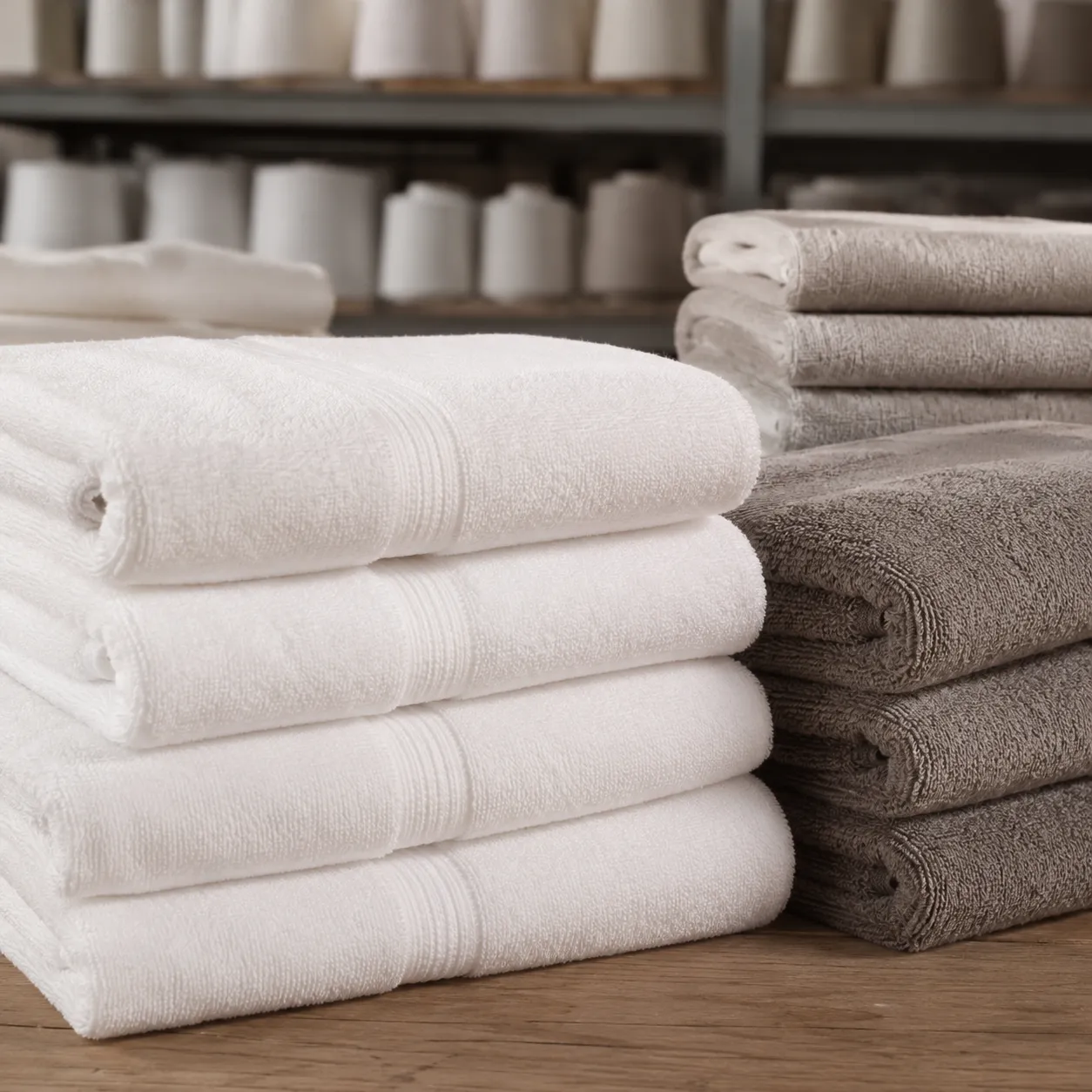
Why the best place to buy bath towels in bulk is rarely a trading company with the lowest quote
Buyers often compare towel offers as if they are comparing a finished commodity. They are not. A bath towel quote can hide differences in pile yarn count, ground warp density, hems, optical brightener level, shade tolerance, and even carton packing weight. We see this most often when an importer receives one quote at USD 2.74 and another at USD 3.31 for what appears to be the same 70 x 140 cm item in ring-spun cotton. Once we open the construction sheet, the cheaper one may be 420 GSM after washing tolerance, single-stitched on the long side, and packed 60 pcs per bale with higher compression marks.
That does not mean traders are automatically unsuitable. Some are useful if you need mixed categories or local service. But for stable reorders, private label programs, and hospitality supply, the stronger option is usually a factory or a tightly managed OEM partner that can show loom allocation, dye lot records, metal detection logs where required by customer policy, and final AQL reports. We recommend asking who owns the greige fabric process and who signs off on the absorbency and colorfastness release before shipment.
| Supplier type | Usually works best for | Common weakness | What to verify |
|---|---|---|---|
| Direct mill | Repeat programs above 3,000 pcs per style | Less flexible on very tiny runs | Loom capacity, dyehouse control, in-line QC |
| Trading company | Mixed SKU orders across categories | Spec drift between factories | Named production site, test ownership |
| Wholesaler with stock | Immediate replacement needs | Limited customization | Actual stock count, shade consistency |
| Brand distributor | Domestic replenishment | Highest unit cost | Origin, relabel history, carton specs |
Start with the usage model, not the catalog photo
The right source for a 5-star hotel towel is different from the right source for a discount retailer, student housing group, or spa chain. We build the sourcing path from wash frequency, hand feel target, replacement cycle, and decoration need. For example, a hotel using tunnel finishing and high-alkali laundry chemistry usually needs stronger selvage behavior than a DTC home brand selling giftable towel sets.
- Hotels and serviced apartments usually perform best at 500-650 GSM with ring-spun or combed cotton, depending on target ADR and laundry abuse.
- Retail private label lines often sit at 450-600 GSM, where shelf softness matters as much as wash life.
- Budget institutional programs can work at 380-450 GSM, but hemming, shrinkage, and shade control become more important than brochure softness.
- Spa and wellness sets may prefer lower visual density but fuller hand, which changes yarn choice and finishing route.
If your team has not fixed those basics yet, build a spec sheet before asking who the best supplier is. We covered that process in [build-towel-tech-pack-that-mills-can-quote.html] and sizing choices in [towel-sizes-dimensions-complete-guide.html].
The spec checkpoints that separate a dependable bulk bath towel supplier from a quote collector
There are two technical details we insist buyers check because they are difficult to recover after production starts. The first is pile pull resistance around the border transition. A towel can look fine in photos but start snagging where the pile field meets the dobby border if the binding is weak or the shearing is uneven. The second is skew after wash. On bath towels with broad borders or embroidery placement marks, skew becomes visible fast and makes folding inconsistent at retail.
On our side, we review finished dimensions after one home-laundry wash sequence and compare the data against the approved tolerance sheet. For colorfastness, many buyers ask only for a generic pass statement, but the useful detail is the method and grade. We normally reference ISO 105-C06 for washing fastness and ISO 105-X12 for rubbing fastness, then align acceptance grades to the customer program. Absorbency can be checked through sink-time style internal methods or customer-specific lab protocol, but if the finish is overloaded with softener, the towel may feel plush in the carton and underperform on first use.
| Checkpoint | Practical target | Why it matters in use |
|---|---|---|
| Finished GSM tolerance | Within about ±5% of approved spec | Stops silent light-weighting across repeat orders |
| Size after wash | Typically within agreed shrinkage band | Prevents undersized retail claims and hotel folding issues |
| Colorfastness to washing | Customer-approved grade by ISO 105-C06 | Reduces dye bleed and guest complaints |
| Seam and hem security | No skipped stitches or loose back-tacking | Improves laundry life at edges |
| Needle and contamination control | Recorded in final QC | Important for child-safe and compliance-sensitive programs |
Price bands: what you should expect by construction and order size
We avoid single magic numbers because towel pricing moves with cotton, energy, dye chemistry, and packing method. Still, buyers need realistic bands. For standard OEM production in China, a plain dyed bath towel in 100% cotton at 70 x 140 cm usually lands in a different range depending on yarn class and volume. At 500 pcs per color, factory planning is less efficient because loom setup, dye kettle loading, approval cuts, and carton print overhead are spread over fewer units. At 8,000 pcs and above, the same construction becomes much more stable on cost.
Recent workable bands we would treat as screening references, not blanket promises, look like this: a 450 GSM ring-spun item in white or a light solid may quote around USD 2.62-3.08 at 2,000-5,000 pcs. A 550 GSM combed cotton version with tighter sewing control and branded carton packing may sit around USD 3.34-4.18 at similar volume. If you add yarn-dyed dobby borders, woven labels, recycled polybags, and stricter carton drop standards, expect another step up.
| Example spec | MOQ context | Indicative FOB China range |
|---|---|---|
| 70 x 140 cm, 450 GSM, ring-spun cotton, plain dyed | 2,000-5,000 pcs per color | USD 2.62-3.08 |
| 70 x 140 cm, 550 GSM, combed cotton, plain dyed | 2,000-5,000 pcs per color | USD 3.34-4.18 |
| 76 x 152 cm, 600 GSM, combed cotton, retail band + insert | 3,000-8,000 pcs per color | USD 4.46-5.72 |
| Hotel white, 500 GSM, VAT-dyed, institutional pack | 5,000-12,000 pcs | USD 2.88-3.41 |
Those numbers need context. White hotel programs can price more sharply because shade matching is simpler and repeat runs are easier to consolidate. Deep navy, charcoal, and black often cost more not because the yarn is better, but because dyeing, wash-off, and reprocessing risk are higher. If a quote is far below the realistic band, ask where the reduction comes from: lower actual GSM, weaker yarn, shorter loops, cheaper sewing thread, looser shade tolerance, or less inspection.
MOQ, lead time, and reorder behavior matter more than a small unit-price win
Our normal MOQ is 500 pcs per design per color, but that is not the same as saying every project is efficient at 500 pcs. A bath towel with custom woven border, gift box, and exact Pantone target at 500 pcs may carry too much setup cost. On the other hand, a plain white institutional towel with stock sewing thread and simple carton marks can run smoothly close to MOQ.
- Sampling usually takes 7-12 days for a lab-dip and handloom or pilot sample, depending on dye approvals.
- Bulk production commonly takes 25-40 days after deposit, color approval, and packaging confirmation.
- Peak-season orders with multiple dark shades can stretch to 45-55 days if dyehouse loading is tight.
- Repeat orders on an unchanged construction often move faster because the loom settings and packing standard are already validated.
For buyers comparing suppliers, the useful question is whether the mill can hold the same hand feel and shade across reorder cycles six months apart. That is where process discipline shows. If your business is building a replenishment model, review [private-label-vs-white-label-towel-programs.html] and [negotiate-towel-moq-without-killing-margin.html].
A cheap towel becomes expensive fast when replacement cycles are short
We often run replacement-cost math with procurement teams because invoice price alone gives a false picture. One recent hospitality program compared a 430 GSM open-end style with a 520 GSM ring-spun style. The first landed at USD 2.49 FOB. The second landed at USD 3.06 FOB. On paper, the cheaper option saved USD 0.57 per towel. In laundry records, though, the lower-cost item started showing edge fray and body thinning around month 8 under three washes per week, while the stronger style stayed serviceable closer to month 14 in the same property group.
That moved cost-per-service in the opposite direction. The cheaper towel effectively cost about USD 0.024 per service cycle. The better-built item came closer to USD 0.017. The difference looks small until you multiply it across 18,000 towels in circulation. This is why the best place to buy bath towels in bulk is usually the supplier that can explain wash-life expectations with construction logic, not the one that only says 'same as your target sample'.
- Ask for wash-life assumptions by channel: hotel laundry, home laundry, spa laundry, or retail household use.
- Ask whether the quoted GSM is loom-state or finished-state. Confusion here causes many disputes.
- Ask how hems are sewn: lockstitch density and back-tack quality affect replacement rates.
- Ask for photos of towels after internal wash testing, not only pre-shipment photos.
Compliance and testing: what buyers should request before placing a PO
For mainstream export programs, OEKO-TEX 100 Class I, BSCI, and ISO 9001 are useful baseline checks, but they do not replace product-specific review. We hold OEKO-TEX 100 Class I, BSCI, and ISO 9001 because many clients need those frameworks to clear onboarding. Even so, the practical work is still in the towel data: colorfastness grades, dimensional stability, carton labeling, and final inspection records.
If you are new to certification screening, ask for certificate number, validity date, and scope. We have seen buyers receive a valid social audit from one site while the actual production happened somewhere else. For OEKO-TEX, verify whether the certificate scope covers the product group you are buying, then pair that with lab reports or in-house records tied to your specific style. Our article [how-to-read-oeko-tex-certificate.html] walks through that review.
| Document | What it tells you | What it does not tell you |
|---|---|---|
| OEKO-TEX 100 Class I | Restricted substance compliance for covered scope | No guarantee of wash life or absorbency |
| BSCI audit | Social compliance management snapshot | No confirmation of towel construction quality |
| ISO 9001 | Quality management framework | No promise that your exact style is correctly made |
| Final AQL report | Shipment lot inspection result | No visibility if inspection sample plan is weak |
Red flags we notice when buyers are still deciding where to place volume
There are warning signs that appear before production ever begins. One is a supplier who cannot explain whether the towel is reactive dyed, VAT dyed, or pigment printed for any colored element. Another is a quote that gives GSM and size but omits tolerances, border structure, or packing detail. A third is overpromising on lead time for dark shades during peak season without asking for shade approval windows.
- No mention of tolerance bands for size and weight
- No clarification on cotton yarn type such as ring-spun, combed, or zero-twist blend
- No record of shade approval or lab-dip sign-off
- No defined inspection standard such as AQL level at final packing
- No discussion of carton count and carton weight, which matters for warehouse handling
Buyers looking at hospitality replenishment should also review [hotel-towel-sourcing-guide-2026.html], while retail and brand teams may find [100-percent-cotton-bath-towels-oem-buying.html] and [combed-vs-zero-twist-cotton-explained.html] useful for narrowing material choices.
What a workable sourcing process looks like
A good bulk buying program is usually less dramatic than buyers expect. The stable path is to lock the construction first, then approve color, then validate packaging, then book production against a clear timeline. For new clients, we normally suggest one base style in two or three colors before scaling into larger assortments. That keeps wash testing and shade control manageable.
- Confirm target market: hotel, retail, spa, apartment, or promotional resale.
- Freeze the base spec: size, GSM, cotton type, border, hanging loop if needed, label placement, and pack count.
- Approve lab-dips or towel swatches against your target shade and hand feel.
- Review pre-production sample with measured weight, size, and sewing details.
- Run bulk production with in-line checks at weaving, dyeing, cutting, sewing, and packing.
- Issue final shipment against approved inspection and shipping marks.
Related reads: [build-towel-tech-pack-that-mills-can-quote.html], [towel-gsm-decision-framework.html], and [pantone-color-matching-custom-towels.html].
Related reads: [setting-up-hotel-linen-program-90-day-roadmap.html], [container-vs-air-freight-towel-orders.html], and [hotel-towels-wholesale-supplier-guide.html].
Our mill view on choosing a supplier
If a buyer asks us where the best place to buy bath towels in bulk is, we do not answer with a country or a marketplace. We answer with a checklist: can the supplier quote against a real spec, produce at your required MOQ, show OEKO-TEX 100 Class I, BSCI, and ISO 9001 credentials, keep color and weight stable over repeat orders, and give you a realistic production window of 25-40 days instead of a promise designed only to win the PO. Those points matter more than a polished PDF.
We are a vertically integrated OEM towel mill in Gaoyang, Zhejiang, producing around 2.4 million towels per year for more than 80 brand clients across 47 countries. Our MOQ is 500 pcs per design per color. If you need a bath towel program quoted properly, send the target size, GSM, cotton preference, colors, branding method, packaging requirement, and destination market so we can respond with a usable price rather than a placeholder.
Need a bulk bath towel quote that matches the real spec?
Send your size, GSM, color count, branding, packaging, and target quantity. We will quote against a workable construction and timeline. Email [email protected] or WhatsApp +86 13384590853.
Request a Quote →