Why Neck Use Changes the Specification
A towel worn around the neck sits against skin for 20 minutes to several hours. That makes the specification different from a standard sweat towel. The fabric has to absorb water, release moisture through evaporation, stay soft at the edges, and avoid dye transfer onto collars. In our sampling room, the most common failed prototypes are not the cheapest ones; they are the ones that copy a bath or gym towel construction without considering friction and water load.
For a reusable cooling towel, we normally work in a 145-220 GSM range. Below 140 GSM, the towel can feel flimsy after 15-20 wash cycles and may curl at the long edge. Above 230 GSM, the towel holds more water but becomes heavy around the neck, especially in 30 x 100 cm and larger sizes. Cotton terry can be comfortable, but it is not our first recommendation for an evaporative neck towel because cotton holds water inside the yarn instead of releasing it efficiently across a flat surface.
The best cooling towel for neck use is usually a polyester or polyester-nylon microfiber knit with a controlled capillary structure. That sounds technical, but the practical result is simple: wet it, wring it, snap it in the air, then wear it without water running down the shirt. The fabric should be thin enough to refresh quickly and dense enough that it does not feel like a disposable promotional cloth.
| Use case | Recommended size | GSM range | Why it works |
|---|---|---|---|
| Running, gym, tennis | 25 x 85 cm or 30 x 90 cm | 145-175 GSM | Light on the neck, dries fast between uses, low bulk in a pouch |
| Golf, hiking, resort staff | 30 x 100 cm | 165-195 GSM | Better coverage without feeling like a bath towel |
| Outdoor work crews | 32 x 110 cm | 180-220 GSM | More water reserve for longer heat exposure |
| Event giveaway | 25 x 80 cm or 30 x 90 cm | 140-165 GSM | Lower unit cost, still usable if edge sewing is controlled |
Best Cooling Towel for Neck: Fabric Options
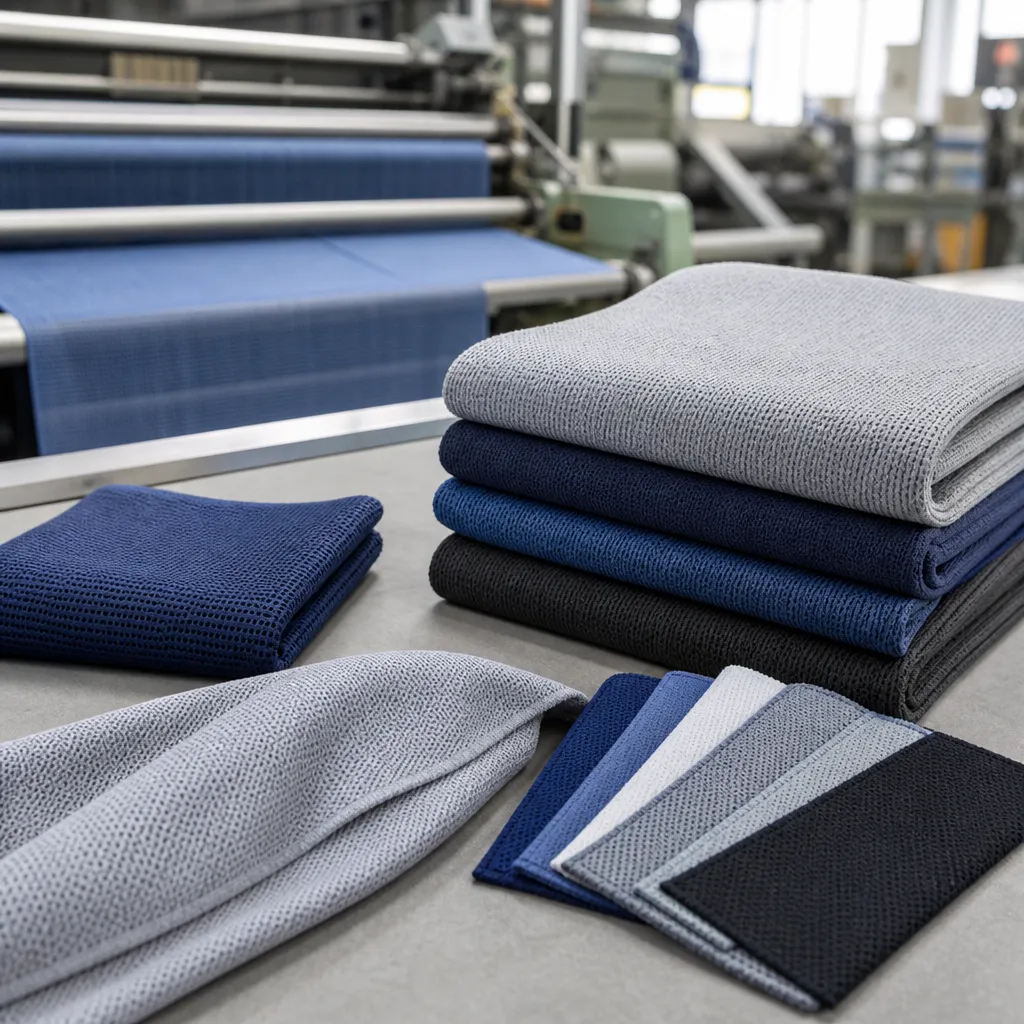
For the best cooling towel for neck projects, fabric choice decides more than the logo method. We manufacture cotton, microfiber, jacquard, waffle, and terry towels, but cooling neck wraps usually move through a different line than hotel bath towels. The fabric is knitted or woven for surface area and capillary movement, then dyed or printed, cut, edge-finished, inspected, and packed with humidity control.
The three fabrics buyers ask about most are microfiber knit, PVA sponge, and cotton terry. Each has a place, but they should not be quoted as interchangeable goods. PVA can feel cold when wet, yet it stiffens when dry and often needs tube packaging. Cotton terry feels familiar but becomes heavy. Microfiber knit is the most balanced choice for a custom cooling neck wrap because it folds small, prints cleanly, and remains flexible after drying.
| Material | Typical GSM | Main benefit | Main caution |
|---|---|---|---|
| Polyester microfiber knit | 145-200 GSM | Good evaporation, soft hand, strong sublimation color | Needs controlled heat setting to prevent edge curl |
| Polyester-nylon blend microfiber | 160-220 GSM | Softer touch and stronger water pickup than plain polyester | Higher yarn cost and more careful dye control |
| PVA sponge towel | 240-320 GSM equivalent | Strong initial cold feel when wet | Dries stiff, less comfortable for neckwear |
| Cotton terry mini towel | 300-420 GSM | Familiar towel feel and good sweat absorption | Heavier, slower evaporative cooling, bulkier packing |
A construction detail that matters here is the long-edge finish. If a cooling towel is cut with poor tension control, the two long sides can rope inward after washing. For neck use, that creates a narrow cord feeling instead of a flat wrap. On our line, we check edge curl after wash and tumble cycles, not only on the fresh sample. For polyester knit, we prefer a narrow overlock or soft binding rather than a hard stitched border. For sublimated goods, the edge thread should be chosen after the print artwork is approved, not before.
- For sports brands: 160-185 GSM polyester-nylon microfiber gives a softer hand and better repeat use.
- For race events: 145-165 GSM polyester microfiber keeps freight and packing cost lower.
- For hotel or resort staff: 175-205 GSM with a cleaner edge finish looks less promotional.
- For industrial heat programs: 190-220 GSM with darker soil-hiding colors is usually more practical than white.
Cooling Performance Needs a Defined Test
Cooling claims can become loose if nobody defines the test. We do not describe a towel as reducing body temperature by a fixed number of degrees because that depends on air flow, humidity, skin temperature, and how much water the user leaves in the cloth. What we can test consistently is water pickup, wring-out behavior, evaporation rate, colorfastness, dimensional change, and hand feel after washing.
For absorbency, we use an internal drop and sink-time screen based on the same principle as AATCC TM79. For wash colorfastness, we reference ISO 105-C06. For rubbing, especially when a wet towel may touch white shirts, we use ISO 105-X12 dry and wet crocking. Dimensional stability is checked after repeated laundering using an ISO 6330-style domestic wash condition. These references are not decoration on a quote sheet; they define how the sample is judged.
In a recent 30 x 100 cm neck towel development, a 168 GSM polyester knit held about 92-105 g of water after a firm hand wring. A 205 GSM polyester-nylon version held 128-145 g under the same method. The heavier fabric cooled longer in moving air, but some runners preferred the lighter version because it did not press on the collarbone. That is why we ask for the end use before confirming GSM.
- Condition the towel at standard room humidity before weighing.
- Immerse fully in water for 60 seconds so the fabric is saturated.
- Wring by hand or through a set roller gap, depending on the buyer's test protocol.
- Weigh the wet towel and record retained water per piece.
- Hang in controlled airflow and record weight loss at fixed intervals.
A microfiber cooling towel can look good in a catalog photo and still fail if wet crocking is poor. Dark navy, black, and bright red require more caution than pale blue or grey. For neck use, we normally require wet crocking to reach at least grade 3-4 on the grey scale for regular sports retail. If the towel will be worn with white uniforms, we push for stronger dye fixation or change the artwork coverage.
Size, Shape, and Edge Details Buyers Miss
A neck towel is not improved by making it wider every time. Once the width passes about 35 cm, many users fold it lengthwise, which traps moisture and reduces surface evaporation. Length is more forgiving. A 30 x 100 cm towel can hang securely around most adult necks, while 25 x 85 cm fits race kits and gym retail packs.
We cut microfiber knit with allowance for heat setting and shrinkage. A buyer may request 30 x 100 cm finished size, but the greige or printed panel is cut larger before finishing. If the artwork includes a border, the design file needs safe zones. For sublimation, keep logos and text at least 12-15 mm from the finished edge. For overlock edge goods, small text near the border can be eaten visually by thread.
| Specification point | Factory recommendation | Defect prevented |
|---|---|---|
| Finished size tolerance | +/- 2 cm length, +/- 1 cm width | Reject disputes caused by knit relaxation |
| Logo safe zone | 12-15 mm from finished edge | Cut-off text and uneven border appearance |
| Edge stitch density | 9-12 stitches per 3 cm for soft overlock | Scratchy edges and seam opening |
| Packed moisture level | Pack only after full drying and cooling | Odor, mildew risk, and cloudy pouch film |
If the towel needs a snap loop, carabiner, or pouch, we confirm the attachment position on a physical sample. A plastic snap placed too close to the end can hit the collarbone when the towel is worn. A metal clip may look stronger, but it can increase corrosion complaints in beach or pool environments. For most sports and event programs, a separate mesh or PET pouch is safer than hardware fixed to the towel.
Decoration: Print, Label, or Subtle Branding
Cooling neck towels are often sold as brand merchandise, race kit items, golf accessories, or staff issue products. Decoration needs to survive wet handling, skin contact, and repeated wringing. Embroidery is rarely our first choice on thin cooling fabric because thread adds stiffness and can irritate the neck. If embroidery is required, we limit the stitch area and place it near the lower end, not at the center back neck area.
Sublimation is the cleanest method for full-color designs on white polyester microfiber. It gives strong artwork detail without adding a raised hand. The limitation is base fabric: sublimation works best on polyester-rich cloth and cannot print true white ink. For darker solid towels, we use woven labels, heat-transfer marks tested for stretch, or tonal jacquard-style texture depending on order volume.
- All-over sublimation: best for race graphics, resort artwork, and retail packaging where visual impact matters.
- Corner woven label: lower risk for neck irritation if the label is soft and placed away from the center neck area.
- Heat-transfer logo: useful for dark towels, but must pass stretch and wash checks before bulk approval.
- Debossed pouch branding: keeps the towel surface clean and moves the logo to the accessory pack.
For artwork development, our decoration team asks for vector files for logos and at least 150-200 dpi at full size for raster patterns. Pantone targets are useful, but polyester sublimation can shift under heat, so we approve a printed strike-off rather than relying only on the screen. If you are comparing decoration routes, embroidery vs sublimation vs jacquard explains the trade-offs across towel categories. For color approval discipline, see our notes on Pantone color matching custom towels.
Compliance and Skin-Contact Requirements
A towel worn on the neck is a skin-contact textile, so certification is not a formality. LUMA & CO. TEXTILE operates with OEKO-TEX Standard 100 Class I, BSCI, and ISO 9001 systems. OEKO-TEX Class I is the strictest product class and is commonly requested for baby and high-skin-contact textiles. Even when the end product is for adults, Class I gives buyers a clearer safety baseline for dyes, auxiliaries, and finishing residues.
For cooling towels, compliance risk is usually found in three places: fluorescent brighteners on white base cloth, disperse dyes on polyester, and printed pouch materials. We keep towel fabric and packaging declarations separate because a compliant towel can still be delayed if the PVC pouch has the wrong documentation for the destination market. For EU and US buyers, we can prepare test reports, fiber content, care labels, carton marks, and commercial documents according to the purchase order.
- OEKO-TEX Standard 100 Class I: recommended for direct skin-contact cooling towels.
- ISO 9001: used for production control, inspection records, and corrective action tracking.
- BSCI: requested by many retail and hospitality buyers for social compliance review.
- ISO 105-C06 and ISO 105-X12: useful for wash and rubbing colorfastness decisions before bulk release.
If a buyer wants to market an item as a UPF cooling towel, we need to test the exact fabric color and construction. UPF is not automatically created by saying the towel is microfiber. Darker and denser fabrics usually perform better, but chemical finishing, yarn type, and stretch all affect the result. We prefer to quote UPF claims only after lab testing on the approved bulk fabric.
Price Bands and the Cost of Going Too Light
Cooling towel prices depend on GSM, size, print coverage, pouch type, carton packing, and test requirements. The bands below are realistic FOB China references for a 30 x 100 cm microfiber cooling towel with standard soft edge finish. They are not a fixed offer because yarn prices, exchange rates, and packaging choices move, but they help buyers compare specifications before sending a tech pack.
| Order quantity | Solid dyed, simple label | Full sublimation print | With reusable pouch |
|---|---|---|---|
| 500-999 pcs | USD 1.18-1.55 | USD 1.42-1.88 | Add USD 0.18-0.36 |
| 1,000-2,999 pcs | USD 0.92-1.28 | USD 1.10-1.48 | Add USD 0.14-0.28 |
| 3,000-7,999 pcs | USD 0.74-1.05 | USD 0.88-1.22 | Add USD 0.11-0.23 |
| 8,000+ pcs | USD 0.59-0.86 | USD 0.72-1.02 | Add USD 0.09-0.19 |
The temptation is to cut GSM until the unit price fits a giveaway budget. Sometimes that is acceptable. For a one-day race kit, a 145 GSM towel may be enough. For a retail reusable cooling towel sold through gyms or outdoor shops, dropping from 180 GSM to 135 GSM can create edge curl, weaker perceived value, and lower repeat use. If a customer uses the towel 35 times instead of 8 times because the cloth feels better, a USD 0.22 higher factory cost is usually easier to justify than a replacement complaint or weak review score.
Our standard MOQ is 500 pcs per design per color. For all-over sublimation, MOQ depends more on print setup and fabric booking than dye lot. For solid dyed towels, combining many colors at 500 pcs each can be less efficient than ordering fewer colors at higher volume because dyeing and shade approval add time.
Sampling and Bulk Production Timing
A cooling towel project moves faster when the buyer confirms the use case before artwork. We need to know whether the towel is for gym retail, marathon kits, hotel pool staff, construction heat safety, or a summer promotion. That answer changes GSM, size, packing, colorfastness level, and whether we should prioritize cooling duration or compact folding.
- Spec review and quotation: 1-2 working days after size, GSM, artwork direction, quantity, and packing are clear.
- Lab dip or sublimation strike-off: 4-7 days for normal colors and artwork.
- Physical sample: 7-12 days depending on fabric availability and decoration route.
- Bulk production: 18-28 days after sample approval and deposit for most 500-8,000 pc orders.
- Inspection, packing, and export documents: 2-4 days after bulk goods are finished.
For urgent events, air freight can save time but changes the cost structure. Cooling towels are compact, so air shipment is more realistic than it is for 600 GSM bath towels. Still, pouch packaging and individual polybags add volume. If the delivery date is fixed, we calculate both sea and air options early. The article on container vs air freight towel orders gives a broader view of freight trade-offs.
For new buyers, the cleanest way to avoid quotation delays is a simple tech pack. Include finished size, GSM target, material preference, decoration method, Pantone or artwork file, packing request, certification requirement, and delivery address. Our guide to building a towel tech pack that mills can quote covers the same structure for broader towel programs.
Choosing the Right Spec by Channel
A single cooling towel specification rarely fits every sales channel. A DTC fitness brand needs repeat-wash quality and clean packaging. A marathon sponsor may prioritize budget and fast delivery. A resort needs a towel that looks consistent with uniforms and does not bleed onto light shirts. We quote differently because the product fails differently in each channel.
- Fitness retail: 30 x 100 cm, 170-190 GSM microfiber knit, sublimated or tonal branding, reusable pouch.
- Race and charity events: 25 x 85 cm, 145-165 GSM, full-color print, compact individual bag with barcode if needed.
- Golf and outdoor clubs: 30 x 100 cm, 175-205 GSM, softer edge, corner label or controlled sublimation artwork.
- Workplace heat programs: 32 x 110 cm, 190-220 GSM, darker practical colors, stronger wet crocking requirement.
- Hotel or beach staff: 30 x 100 cm, 165-195 GSM, solid dyed shade, low-irritation label, wash-tested before rollout.
Related reads: For buyers comparing cooling towels with normal fitness towels, start with sweat towels for gym spec guide and why gym towels fail after 50 washes. If your assortment includes microfiber items beyond neck towels, microfiber vs cotton towel comparison will help align material choices across the range.
Related reads: For resort and outdoor programs, beach club resort towel program explains poolside durability decisions, while beach towels in bulk buyers guide covers larger-format towel sourcing. Brands serving yoga and fitness studios may also find the yoga and Pilates towel industry page useful when planning coordinated kits.
What We Need to Quote Accurately
To quote the best cooling towel for neck use without guesswork, we need six details: finished size, target GSM, material direction, decoration method, order quantity, and packing style. If you do not know the GSM, send the use case and price target; we can suggest two constructions and explain the trade-off. For repeat programs, we also recommend keeping an approved control sample at both the buyer side and our factory.
LUMA & CO. TEXTILE is a 220-employee towel mill operating since 2007. We supply more than 80 brand clients across 47 countries and produce about 2.4 million towels per year. Our certifications include OEKO-TEX Standard 100 Class I, BSCI, and ISO 9001. Standard MOQ is 500 pcs per design per color, with typical cooling towel bulk timing of 18-28 days after approval.
Send Us Your Cooling Towel Spec
For OEM neck cooling towels, share size, GSM target, artwork, quantity, packing, and test requirements. WhatsApp: +86 13205717266. Email: [email protected].
Request a Factory Quote →