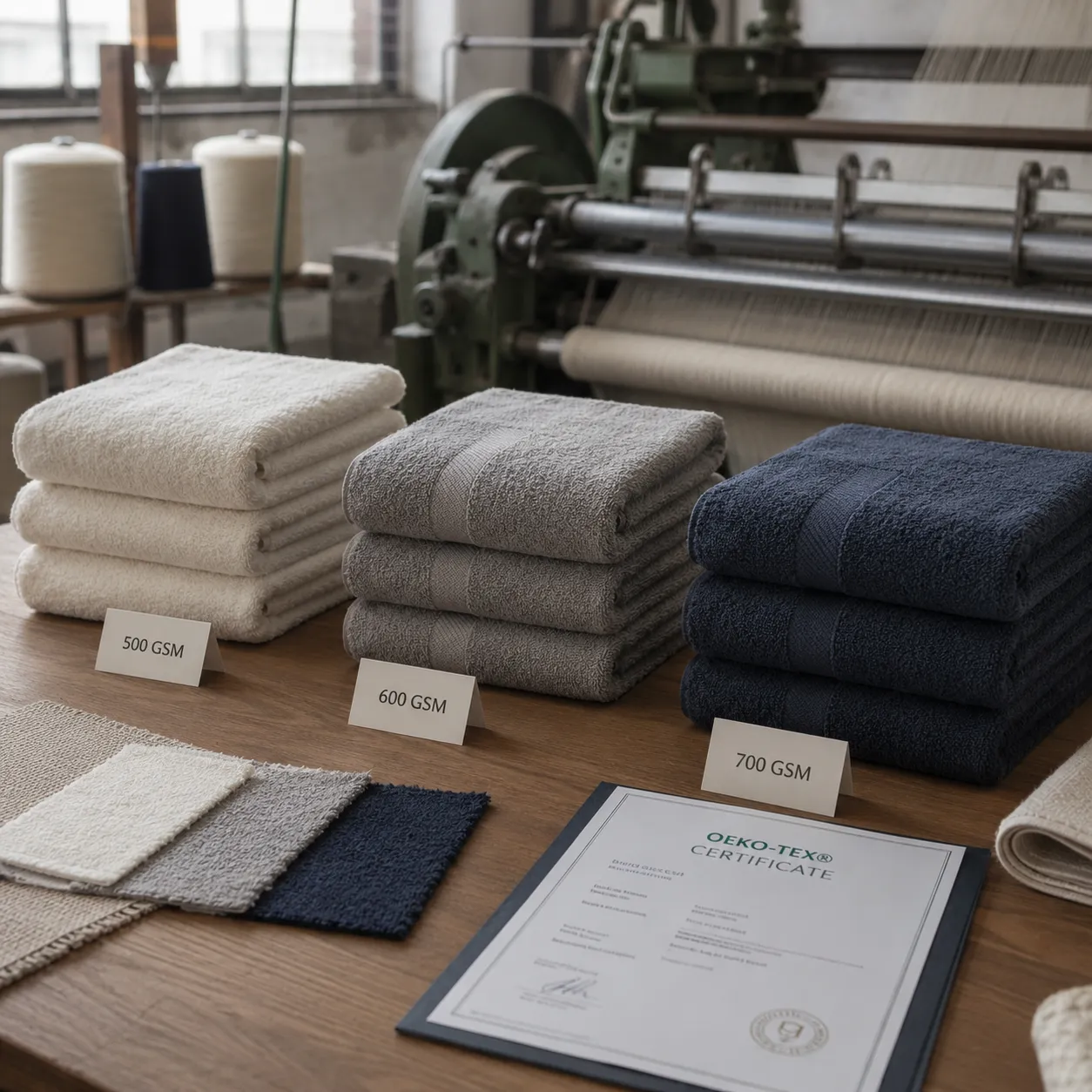
Start with the split buyers miss: chemical safety is not laundry life
We see this confusion in RFQs quite often: a brand asks for OEKO-TEX 100 Class I compliance and assumes that means the towel will also hold size, shade, and pile integrity for dozens of wash cycles. It does not. OEKO-TEX Standard 100 checks restricted substances in the finished article. Wash durability is a separate performance topic that has to be written into the spec, tested by method, and signed off against tolerances.
For towels, the practical control points are usually four things together: dimensional change after washing, color change and staining, seam and hem stability, and pile surface condition. If one of those is missing from the approval sheet, the result is usually a sample that looks correct on day one and a claim six weeks after launch.
| Control area | What OEKO-TEX covers | What durability testing must add |
|---|---|---|
| Chemical compliance | Restricted substances in the finished product | No extra wash-life conclusion by itself |
| Color performance | Not a wash-cycle durability guarantee | ISO 105-C06 color change and staining grades |
| Size retention | Not covered as a wear benchmark | ISO 6330 washing plus measured shrinkage tolerance |
| Construction integrity | Not a sewing durability standard | Loop pull, hem slippage, skew, torque, and appearance checks |
The working definition we use for an oeko tex certified towel wash durability standard
Inside our mill, we treat the phrase as a combined requirement: the towel must be made from inputs and dyes that support OEKO-TEX certification, then it must also meet an agreed laundry-performance benchmark after a fixed number of wash cycles under a named method. That benchmark changes by end use. A gym hand towel, a resort pool towel, and a baby washcloth should not carry the same pass line.
For most cotton terry programs we produce, we use ISO 6330 for domestic washing procedure selection, then assess dimensional change, appearance, edge stability, and colorfastness to washing using ISO 105-C06. If the buyer expects institutional laundry conditions, we note that separately because the chemistry, temperature, alkalinity, and mechanical action are harsher than home-care cycles.
- For retail bath towels, we commonly agree on evaluation after 5 wash cycles for sample signoff and 10 cycles for risk review.
- For hotel or gym programs, we often set a stronger benchmark around 15 to 25 cycles during development, depending on yarn construction and target price.
- For promotional towels below 350 GSM, we normally push back on aggressive cycle claims unless the buyer accepts a looser handfeel and simpler edge construction.
Which test methods matter, and what each one actually tells you
A durable towel standard becomes useful only when each claim is tied to a method. Otherwise one mill washes at 40°C, another at 60°C, one tumbles dry, another line dries, and the reports cannot be compared. The method names below are the ones we most often write into towel tech packs.
| Test item | Typical method | What we look for |
|---|---|---|
| Dimensional change after washing | ISO 6330 | Length and width shrinkage kept within agreed tolerance |
| Color change / staining | ISO 105-C06 | Usually grade 4 or above on color change, 3-4 to 4 on staining depending on shade |
| Mass per unit area | ISO 3801 or internal cut-square check | Confirms GSM drift after finishing is within spec band |
| Water absorbency timing | Internal drop test or customer protocol | No resin-heavy finish blocking absorbency |
| Seam strength / hem security | Internal pull and laundering review | No hem grin, seam opening, or label edge failure |
| Appearance retention | Visual rating after wash and tumble dry | No pile harshening, loop snag spread, or severe skew |
Two topic-specific details matter here. First, reactive-dyed dark terry often passes color change but still shows staining onto white multifiber strips if wash-off after dyeing was too short; this is why we check the staining panel, not only the face shade. Second, low-twist or zero-twist styles can lose visual fullness after repeated tumble drying even when shrinkage is acceptable, because the pile bloom changes; for those constructions, appearance grading is not optional.
A practical pass/fail sheet for cotton terry
Below is a benchmark format that works well for OEM sourcing because it is specific enough to quote against, but not so rigid that you eliminate all usable suppliers. The numbers have to match product type. We would not use the same sheet for a 650 GSM bath sheet and a 320 GSM event towel.
| Item | Typical retail bath towel target | Typical hospitality/gym target |
|---|---|---|
| Shrinkage after agreed wash method | Within 5% length, 5% width | Within 4% length, 4% width |
| Color change after washing | Grade 4 minimum | Grade 4 minimum |
| Staining to adjacent fabrics | Grade 3-4 minimum | Grade 4 preferred for white-ground programs |
| Skew / distortion | Within 3% | Within 2.5% |
| Hem appearance after laundering | No broken stitches, no rolling visible at arm's length | No seam opening, no corner twist affecting fold stack |
| Pile condition | No abnormal shedding or loop striping | No snag spread or surface barring after cycle review |
Notice that the table does not claim a universal '50 washes' promise. That kind of line reads neatly in a catalog but is not a reliable sourcing standard. A towel made with 16s ring-spun ground yarn and 21/2 pile yarn at 500 GSM will behave differently from a carded 21s/21s economy terry at 360 GSM, even if both are OEKO-TEX compliant.
Where towels actually fail in wash testing
Most rejected bulk lots do not fail in dramatic ways. They fail in small, repeatable ways that only show up after washing. Those are the defects we design around during sample development.
- Edge roping: one selvedge tightens more than the body after tumble drying, so the towel will not fold flat for retail packout or hotel shelf stacking.
- Pile lean and shading: the terry face shows directional light/dark bands after laundering because pile density and shearing are uneven.
- Lint release in first washes: common on loosely controlled singeing and brushing settings, especially on fuller-hand low-twist programs.
- Corner torque: the towel corners twist after laundering because fabric relaxation and sewing feed were not balanced.
- Embroidery puckering after wash: if a logo panel is added without enough backing support, the area around the decoration shrinks differently from the towel body.
One construction quirk that is easy to overlook is the relationship between pile height and hem turnback. If the hem fold is too narrow on a thick terry body, washing causes a rope effect at the end because the hem cannot settle at the same rate as the body. We usually correct that by widening the turnback by a few millimeters and changing needle density, not by simply increasing stitch count.
Why GSM alone cannot predict laundry performance
Buyers often ask for a GSM number as if it were the durability number. It is not. GSM tells you mass per area. It does not tell you whether the yarn is combed or carded, whether the pile is single or double loop, how strong the ground warp is, whether the reactive dyeing was properly soaped off, or how aggressive the drying cycle was during testing.
In development, we have seen a 430 GSM combed cotton hand towel outperform a 470 GSM economy carded towel in wash appearance because the lighter article had better loop anchoring and cleaner finishing. We have also seen a dense 600 GSM style shrink more than a 520 GSM style because the finishing tension was too high before cutting.
- Use GSM to frame absorbency, cover, and cost.
- Use yarn and construction to estimate structural durability.
- Use lab and laundry-cycle data to confirm the real result.
- Lock the final benchmark on the signed approval sheet, not in email shorthand.
If you need a refresher on how fabric weight interacts with use case, see towel-gsm-decision-framework.html and combed-vs-zero-twist-cotton-explained.html.
How we build the approval path before bulk
A credible durability program does not begin with final inspection. It begins before loom allocation. We normally move through yarn confirmation, loom sample or handloom swatch, lab dip, sewn proto, wash test, revised proto if needed, then sealed approval sample. For OEKO-TEX programs, we also keep the certified material chain aligned so the approved sample and bulk inputs match.
| Stage | What happens | Typical timing |
|---|---|---|
| Spec review | Confirm GSM band, yarn count, construction, color, and wash benchmark | 1-2 days |
| Lab dip / shade approval | Reactive dye shade submission and comments | 4-6 days |
| Prototype sewing | Make finished sample with correct hems, label, and pack details | 5-7 days |
| Wash test round | Run agreed method and record shrinkage, color, appearance | 3-5 days |
| Revision if needed | Adjust construction or finishing and retest | 5-9 days |
| Bulk booking | Reserve yarn, loom, dyeing, sewing, and packing capacity | After final signoff |
For standard custom terry, production after approval is usually around 25-38 days for 3,000-10,000 pieces, depending on color count and decoration. If the order includes embroidery, woven labels, recycled poly bags, or carton barcode compliance, add several days for trims coordination and packout checks.
Cost impact: what stronger wash benchmarks really add
The cost difference between a towel that merely looks acceptable on arrival and a towel that survives laundering predictably is usually smaller than buyers expect. The added cost tends to come from better yarn selection, more stable finishing, stronger sewing control, and extra development rounds. It is rarely just 'more GSM'.
| Program type | MOQ | Indicative FOB China price | Notes |
|---|---|---|---|
| Plain dyed hand towel, 380-430 GSM | 500 pcs/color | USD 0.76-1.08/pc | Economy retail or promo use |
| Plain dyed bath towel, 480-560 GSM | 500 pcs/color | USD 2.35-3.85/pc | Mainstream retail or hospitality |
| Combed cotton bath towel, 550-650 GSM | 1,000 pcs/color | USD 3.70-5.95/pc | Better handfeel, stronger appearance retention |
| Custom embroidered bath towel | 1,000 pcs/design | USD 4.25-6.90/pc | Decoration may require extra wash validation |
A recent example from our side: a buyer compared two 520 GSM bath towel options for a spa chain. The cheaper version saved USD 0.41 per piece on FOB cost, but its wash review showed 5.6% width shrinkage and visible edge roping after tumble drying. The revised version used combed pile yarn, a wider hem fold, and a longer soft-flow wash-off after dyeing. FOB moved up by USD 0.33 per piece, but the housekeeping team accepted it because stack presentation and shade retention stayed stable across trial laundering. That is the kind of trade-off that matters more than unit price alone.
What to write into the RFQ so mills can quote the same standard
If your RFQ says only 'OEKO-TEX towel, durable after wash,' each factory will fill in the gaps differently. To compare quotes fairly, write the benchmark as a test package, not a slogan.
- Product size, tolerance, and target finished weight or GSM band
- Fiber content and yarn note such as carded, combed, zero-twist, or low-twist
- Color requirement including Pantone reference if relevant
- Named wash method, cycle count, drying condition, and pass/fail tolerances
- Construction points such as border, dobby, hem width, embroidery area, or hanger loop
- Compliance requirement: OEKO-TEX 100 Class I or the exact class needed, plus BSCI and ISO 9001 if part of vendor approval
For teams building a cleaner brief, build-towel-tech-pack-that-mills-can-quote.html is the right companion piece. If you are comparing decoration methods that can influence wash appearance, review embroidery-vs-sublimation-vs-jacquard.html as well.
Certificates and factory systems still matter, just in the right place
Even though the certificate does not replace wash testing, we still recommend asking for current OEKO-TEX Standard 100, BSCI, and ISO 9001 documentation. Each one answers a different risk question. OEKO-TEX addresses chemical compliance at product level. BSCI helps screen social compliance. ISO 9001 tells you whether the mill has documented control systems for sampling, production, corrective action, and records.
Buyers who need to validate certification details should compare certificate scope, validity dates, product class, and the legal entity named on the document. how-to-read-oeko-tex-certificate.html explains the certificate side, while hotel-towel-sourcing-guide-2026.html and why-gym-towels-fail-after-50-washes.html show how those documents fit into broader sourcing control.
The shortest checklist before you sign the bulk towel
- Match the approved sample to the same yarn and construction planned for bulk.
- State the wash method by ISO reference or customer protocol, including drying condition.
- Set shrinkage, colorfastness, and appearance tolerances in writing.
- Confirm whether the use case is home laundry or institutional laundry.
- Keep OEKO-TEX, BSCI, and ISO 9001 records in the vendor file.
- Do not approve on handfeel alone; approve after wash data and a physical post-wash sample.
Related reads: pantone-color-matching-custom-towels.html, container-vs-air-freight-towel-orders.html, and private-label-vs-white-label-towel-programs.html.
Related reads: microfiber-vs-cotton-towel-comparison.html and negotiate-towel-moq-without-killing-margin.html.
Need a towel spec reviewed against a wash durability standard
Send us the target size, GSM, yarn note, end use, and desired wash benchmark. We can comment on whether the spec is realistic before sampling. MOQ starts at 500 pcs per design per color. WhatsApp: +86 13205717266 | Email: [email protected]
Request a spec review →