Start by separating chemical compliance from fastness performance
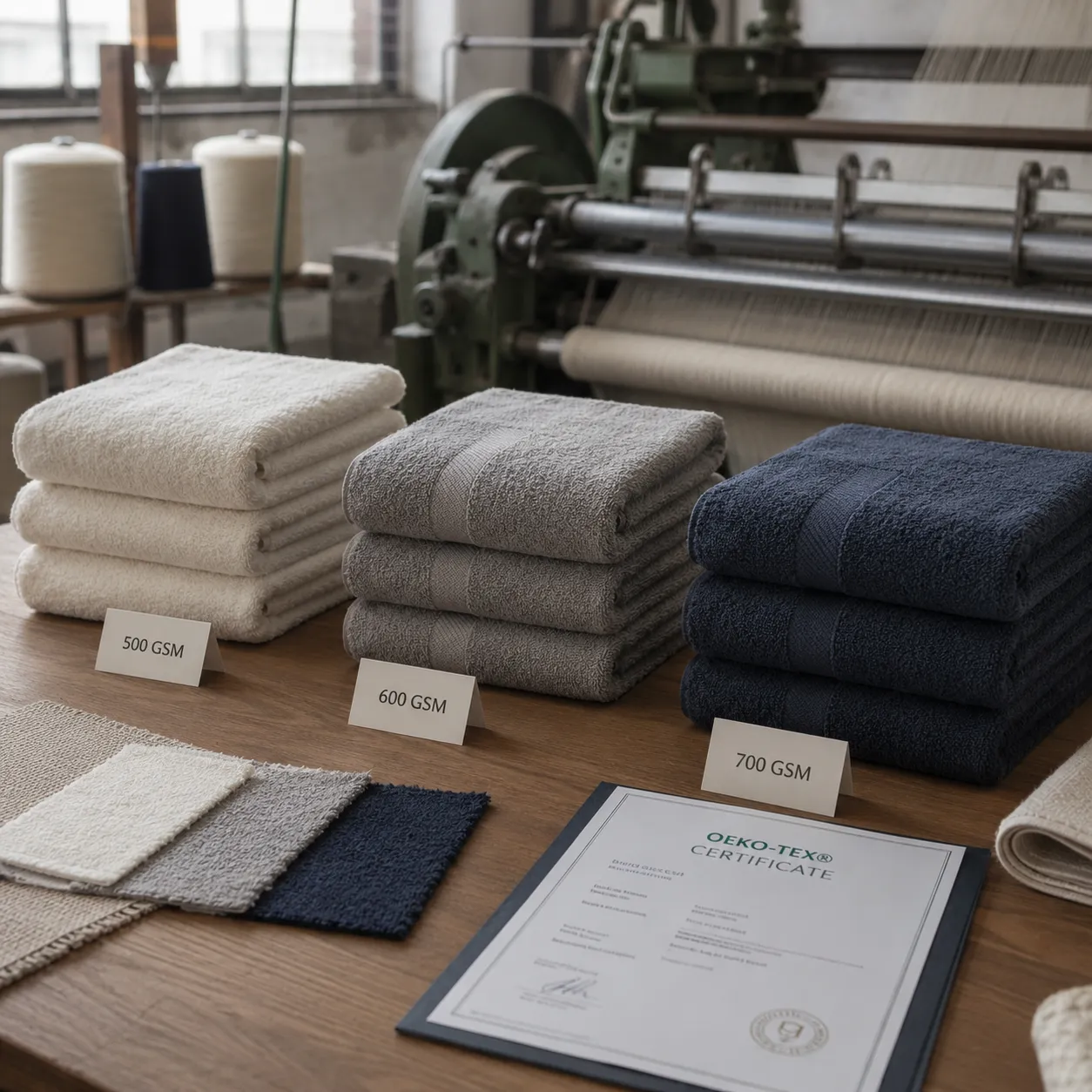
The first sourcing mistake is to treat an OEKO-TEX claim as if it automatically answers wash bleed, rubbing, or chlorine exposure. It does not. OEKO-TEX Standard 100 Class I tells the buyer that the finished towel has been checked against restricted substances within the scope of that certificate. Colorfastness is a different question: how the dyed textile behaves under defined use conditions such as domestic washing, wet rubbing, water spotting, or perspiration.
In our mill, the two tracks meet only after the construction and dye route are stable. We verify that dyestuff and auxiliaries are within the approved input route for the certified program, and we run performance tests under named methods with stated acceptance grades. That boundary matters in RFQ discussions. If a buyer writes only "OEKO-TEX towel" without listing performance methods, two suppliers can quote the same certification basis and deliver very different wash behavior.
- OEKO-TEX scope: restricted substance compliance under the certificate held by the factory or product class
- Colorfastness scope: performance under specific test methods such as ISO 105-C06, ISO 105-X12, or ISO 105-E01
- Sourcing implication: both need to be written into the tech pack, but they should not be merged into one vague pass/fail line
The oeko tex certified towel colorfastness test protocol we use before bulk
For cotton terry programs, we usually run the lab sequence in four gates: lab dip sign-off, pilot fabric check, pre-bulk confirmation, and shipment retention. The exact tests depend on end use. A salon towel exposed to bleach chemistry needs a different protocol from a resort pool towel, and both differ from a retail bath set packed for home laundering.
The core of the protocol is not a long list. It is the order. We clear the most failure-prone points first: laundering color change, staining to adjacent fabric, and wet rubbing. On dark navy, charcoal, bottle green, burgundy, and black shades, we add an extra rinse verification after soaping because the most common defect is not obvious shade drift. It is residual unfixed dye causing pale lint pickup on white trim, labels, or sewing thread during first washes.
- Approve substrate first: yarn count, pile construction, ground weave, and pretreatment route
- Approve lab dip against agreed light source and standard shade tolerance
- Run priority fastness methods on lab standard, not only on visual dip card
- Repeat critical methods on pilot fabric from actual machine settings
- Lock bulk only after pilot and pre-bulk results match the approved window
| Gate | Sample stage | What we check | Typical decision |
|---|---|---|---|
| 1 | Lab dip towel swatch | Shade, wash color change, multifiber staining, wet rubbing | Approve dye recipe or rework |
| 2 | Pilot terry fabric | Repeat laundering and rubbing on actual pile construction | Confirm production route |
| 3 | Pre-bulk cut from first dye lot | Spot check against approved standard and internal control lot | Release bulk continuation |
| 4 | Shipment retention | Archive sample and final lab record | Reference for claims or repeat orders |
Which test methods belong in the buyer spec
We prefer exact method notation in the PO or technical data sheet. "Good colorfastness" is not a test request. For most cotton towel programs, three methods cover the majority of real complaints. If the towel is for hotels, gyms, or spas, we often add one or two end-use methods depending on chemistry and use environment.
| Property | Method | What it measures | Common towel risk |
|---|---|---|---|
| Colorfastness to domestic and commercial laundering | ISO 105-C06 | Color change and staining after wash with specified detergent/alkalinity and temperature | Bleeding onto white headers, labels, or mixed sets |
| Colorfastness to rubbing | ISO 105-X12 | Dry and wet crocking transfer from dyed surface | Dye transfer to skin, robes, or adjacent white textiles |
| Colorfastness to water | ISO 105-E01 | Color change and staining after wet contact under pressure | Stacked damp towels causing migration |
| Colorfastness to perspiration | ISO 105-E04 | Acid and alkaline perspiration exposure | Relevant for gym and sport-use towels |
| Colorfastness to chlorinated water | ISO 105-E03 or buyer-specific pool chemistry benchmark | Response to chlorinated water exposure | Relevant for pool decks and resort programs |
For domestic/commercial wash checks on towels, we usually write the test in full on the approval sheet, for example: ISO 105-C06, method A2S, assessed for color change and staining using the grey scale and multifiber adjacent fabric. That level of notation avoids later arguments. A buyer may intend a 60°C wash with perborate activator conditions; a supplier may quote against a lighter wash severity if the method code is not fixed.
Grades, conditions, and why notation matters on dark terry
On towel sourcing, the grade number alone is not enough. You need the condition and the reading basis. We report color change and staining separately. For example, a dark indigo pile may hold color change at grade 4 after laundering but stain the cotton stripe on multifiber at grade 3-4. That is not the same result, and it matters if the towel has a white dobby border or white sewn hanger loop.
- For ISO 105-C06, specify the exact method code and report both color change and staining results
- For ISO 105-X12, specify separate minimums for dry rubbing and wet rubbing
- State whether acceptance is taken from lab dip, pilot fabric, or bulk lot sample, because pile density changes can affect results
A realistic towel acceptance window for mid-to-better programs might be: laundering color change minimum grade 4, staining minimum grade 3-4 on cotton and adjacent fibers, dry rubbing minimum grade 4, wet rubbing minimum grade 3. For very deep shades on 100% cotton terry, asking for wet rubbing grade 4 after strong reactive dye build can push cost up fast and still produce poor yield. In those cases, we would rather explain the risk early than accept an unrealistic target and miss it in bulk.
If the brief says charcoal, 650 GSM, zero-twist face feel, white woven label, and aggressive wash chemistry, we will challenge the rubbing target before sampling. That is not resistance from the mill. It is the shortest path to a stable program.
Failure modes we actually see in towel dye houses
The most useful protocol is built around likely defects, not only standard names. In towels, the fabric structure itself creates specific risks. Pile loops hold liquor differently from the ground warp. Dense borders dry at a different rate than the pile field. A decorative dobby frame can appear visually darker after finishing even when the dyestuff is the same, simply because of reflection and compaction.
Three failure modes show up repeatedly. First is surface crocking on dark pile, especially after shearing or aggressive softening. Second is border-to-body mismatch, where the border picks up shade differently and the buyer reads it as poor fastness after washing. Third is re-deposition in first wash, where residual unfixed dye appears on white sewing components rather than on the towel body itself.
- Dark pile with low-twist or zero-twist constructions can show stronger wet rubbing transfer because the surface is more open after finishing
- High-softener add-on can mask handle improvement while reducing initial rubbing performance if the wash-off is not fully controlled
- Piece-dyed towels with polyester sewing thread or bright white care labels often reveal staining sooner than solid self-color components
That is why we do not rely on one swatch from the lab bench. We test pilot fabric taken from real production conditions: actual pretreatment, actual liquor ratio, actual drying and finishing path. For some black and red tones, one extra soaping cycle and conductivity confirmation in rinse water can solve a problem that no amount of visual shade approval would catch.
How end use changes the protocol
A retail towel set packed in a gift box is usually judged on domestic wash and rubbing. A hotel towel is judged on repeat laundry chemistry, often with alkali, oxygen bleach systems, and tunnel or tumble finishing. A gym towel brings perspiration and damp stacking into the picture. So the same certified material route cannot use one universal fastness page.
| End use | Priority methods | Typical risk point | Spec note we add |
|---|---|---|---|
| Hotel bath towel | ISO 105-C06, ISO 105-X12, ISO 105-E01 | Repeated alkaline laundering and label staining | Ask buyer to disclose wash temperature and bleach system |
| Gym towel | ISO 105-C06, ISO 105-X12, ISO 105-E04 | Wet rubbing and perspiration migration | Test acid and alkaline perspiration |
| Pool or resort towel | ISO 105-C06, ISO 105-X12, chlorine-related exposure check | Shade drift after chlorinated water contact | Align pool chemistry benchmark before sample approval |
| DTC bath set | ISO 105-C06, ISO 105-X12 | First-wash complaint from consumer | Retain launch lot sample for claims comparison |
For buyers building a broader bath program, hotel-towel-sourcing-guide-2026.html and setting-up-hotel-linen-program-90-day-roadmap.html are useful companions because they show where wash testing belongs in the full sourcing calendar, not only in the lab.
What to request from the mill before you release the PO
We suggest buyers ask for one clean approval pack rather than scattered screenshots and verbal promises. The pack should tie the certified input route to the exact test results for the approved article. That keeps the sourcing boundary tight: OEKO-TEX on one side, performance evidence on the other, both linked to the same towel construction and color.
- Factory certificate reference for the applicable OEKO-TEX Standard 100 scope
- Approved towel specification: size, finished weight, GSM, fiber content, pile type, border construction
- Color standard reference, light source used for assessment, and acceptable shade tolerance
- Named fastness methods with code notation, test date, and reading results by property
- Statement of sample stage tested: lab dip fabric, pilot lot, or bulk lot retention
If the supplier cannot tell you whether the reported result came from a hand-made lab swatch or from pilot terry fabric, the report has limited buying value. On towel programs above 8,000 pieces per shade, we nearly always recommend a pilot lot gate. That adds around 3 to 5 days, but it is cheaper than sorting a 40-foot container after a white border staining complaint.
Lead times, MOQ, and cost impact of the testing sequence
Testing does not usually dominate towel cost, but it does affect calendar discipline. Our MOQ remains 500 pieces per design per color, yet small runs with multiple dark shades create the highest approval risk because each shade still needs its own lab control. For plain dyed cotton terry between 450 and 650 GSM, fastness-related lab work and pilot verification typically add USD 85 to USD 240 per shade depending on the number of methods and whether an outside lab report is required for buyer filing.
| Program type | Volume | Indicative FOB towel price | Testing/calendar effect |
|---|---|---|---|
| Guest towel, plain dyed cotton, 500-520 GSM | 3,000-5,000 pcs | USD 1.34-1.78/pc | Allow 6-8 days for dip and core fastness checks |
| Bath towel, plain dyed cotton, 550-600 GSM | 8,000-15,000 pcs | USD 2.62-3.48/pc | Pilot lot gate recommended for dark shades |
| Hotel bath towel with dobby border, 600-650 GSM | 20,000+ pcs | USD 3.05-4.12/pc | Pre-bulk confirmation adds 3-5 days but reduces claim risk |
Typical production timing for a program with approved artwork and standard packaging is 7-10 days for lab dips and first test round, 4-6 days for pilot dye/finish and confirmation, then 22-35 days for bulk production depending on loom loading, dye house queue, and carton requirement. If the order is split across several saturated dark colors, we would rather quote a slightly longer window than push dyeing too fast and lose wash-off control.
Related reads: if you are still writing the RFQ, use build-towel-tech-pack-that-mills-can-quote.html and towel-gsm-decision-framework.html. If the question is whether cotton is the right substrate for the use case, compare microfiber-vs-cotton-towel-comparison.html.
The short checklist we want buyers to send with the color brief
The cleanest sourcing files are often the shortest ones. For an OEKO-TEX towel program, we ask buyers to send the color target, the end-use laundry conditions, and the exact fastness methods they expect. That gives our lab room to make the right shade while keeping the test plan practical.
- Pantone or physical color reference, plus note if visual approval is under D65, TL84, or both
- Construction line: size, GSM, fiber content, pile type, border or jacquard details
- Required certification basis: OEKO-TEX Standard 100 Class I, plus any buyer document filing format
- Performance methods with notation, for example ISO 105-C06 A2S and ISO 105-X12
- Acceptance grades for color change, staining, dry rubbing, and wet rubbing
- End-use chemistry note such as hotel laundry, gym perspiration exposure, or poolside chlorine contact
Related reads: for certification document review, see how-to-read-oeko-tex-certificate.html. For shade control before strike-off approval, pantone-color-matching-custom-towels.html helps buyers avoid preventable back-and-forth.
Where we draw the pass/fail line
We will not promise laboratory grades that the construction and shade cannot realistically hold in bulk. If a buyer wants a very deep fashion shade on lofty cotton loops with a hand-soft finish, we will propose either a revised fastness target, a different construction, or a different color depth. That conversation is usually cheaper than chasing re-dye, rewash, or claim settlement later.
For most OEM towel programs, the best working model is simple: keep OEKO-TEX documentation clean, define colorfastness by named ISO methods, test in the right sequence, and approve bulk only after pilot fabric confirms the result. That is the protocol we use because it protects both sides of the PO.
Need a test-ready towel RFQ?
Send your towel construction, target shades, and required ISO methods. We can map the sampling and lab sequence, quote realistic FOB ranges, and flag risk points before bulk.
Request a quote →