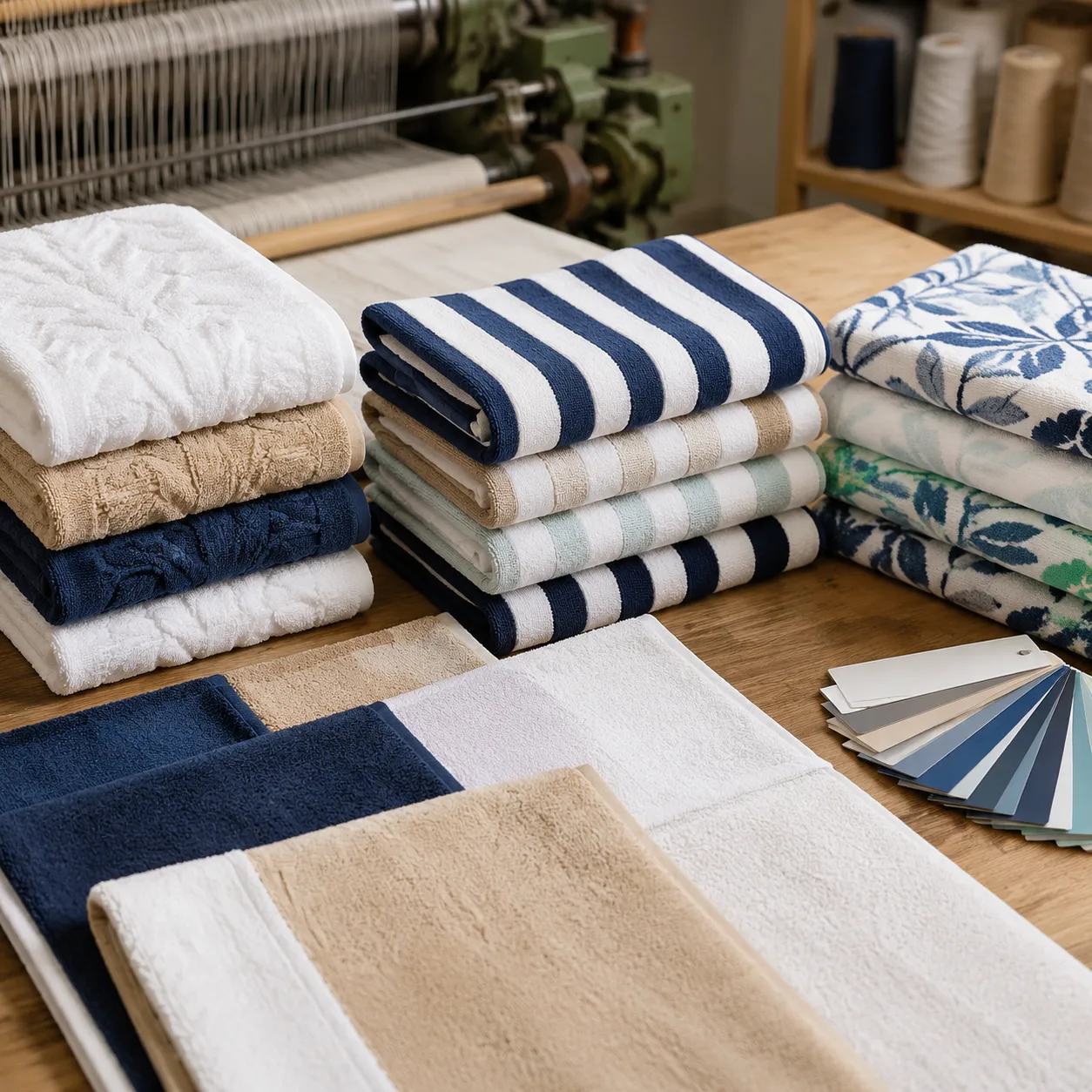
The Quote Line We Build First
Before we price any OEM beach towel, we reduce the request to a quote line that our weaving, dyeing, cutting, decoration, packing, and export teams can all read the same way. A complete line is not just size and GSM. It includes face construction, back construction, decoration method, color standard, hem type, label position, packaging, carton limit, inspection level, and target port.
For LUMA & CO. TEXTILE, the working MOQ is 500 pcs per design / per color. We can discuss color splits, but the price changes if the same artwork is divided into 250 navy, 150 sand, and 100 coral. Dyeing, screen setup, yarn planning, and carton marks do not shrink in a linear way just because the units are split.
| Quote item | What we need from buyer | Pricing impact |
|---|---|---|
| Size | For example 76×152 cm, 80×160 cm, 90×170 cm, or 100×180 cm | Directly changes fabric weight and carton CBM |
| GSM | Typical beach range: 360-620 GSM | Higher GSM increases yarn use, drying time, and freight weight |
| Construction | Terry/terry, velour/terry, jacquard, flat-woven hammam | Determines loom speed and decoration options |
| Decoration | Reactive print, yarn-dyed jacquard, embroidery, dobby border, woven label | Adds setup, approval, waste, and sometimes slower finishing |
| Packing | Bulk pack, belly band, OPP bag, recycled paper sleeve, retail carton | Changes labor minutes and export carton size |
| Compliance | OEKO-TEX 100 Class I, BSCI, ISO 9001 records, wash test reports | Adds document control and sometimes extra lab testing |
- If the towel is for resort pool use, we normally start at 430-520 GSM because thin velour looks good on day one but collapses faster in commercial laundry.
- If the towel is for retail or beach club merchandising, 360-450 GSM can work when the buyer needs lighter freight and shelf-friendly folding.
- If the design needs sharp all-over artwork, we price reactive print or digital pigment print differently from jacquard because the loss points are not the same.
- If the program includes private label beach towels, we quote label, hangtag, barcode sticker, and inner packing as separate lines so procurement can remove or add items cleanly.
Custom Beach Towel Bulk Pricing Model
Our custom beach towel bulk pricing model starts with fabric cost, then adds dyeing or printing, finishing loss, trimming, label and packing labor, quality control, export carton, and inland transport to the port. Buyers often compare only the finished unit price, but the hidden movement is usually in three places: GSM, decoration yield, and carton cube.
For example, an 80×160 cm towel at 420 GSM contains about 538 g of fabric before trimming and process loss. If the same towel moves to 520 GSM, the greige weight rises to about 666 g. That extra 128 g is not only cotton cost; it also increases drying energy, carton weight, and sometimes sea freight because fewer pieces fit per carton.
| Cost bucket | Typical share of FOB cost | What pushes it up |
|---|---|---|
| Yarn and weaving | 38-52% | Higher GSM, longer pile, combed cotton, jacquard complexity |
| Dyeing / printing | 12-24% | Dark shades, full-surface reactive print, extra washing, tighter color tolerance |
| Cutting, sewing, finishing | 7-13% | Rounded corners, double stitching, fringe, velour shearing |
| Decoration and branding | 4-18% | Embroidery stitch count, woven labels, retail sleeves, barcode handling |
| QC, packing, carton | 5-10% | AQL inspection level, polybagging, heavier cartons, carton inserts |
| Factory overhead and margin | 8-14% | Small runs, urgent production, split shipments, special documentation |
A useful pricing conversation starts with what the towel must survive. A giveaway towel for a music festival does not need the same yarn, pile height, or colorfastness target as a resort towel washed three times per week. We will push back if the requested price forces a construction that fails after 20-30 wash cycles, because the replacement cost usually lands back on the buyer.
Price Bands by Construction and Volume
The following FOB Ningbo / Shanghai bands are realistic for 2026 production from our mill, assuming cotton-rich construction, OEM artwork, export carton packing, and MOQ discipline. They are not public spot-market promises; they are planning ranges for buyers building a budget before tech-pack review.
| Beach towel type | 500 pcs | 1,500 pcs | 5,000 pcs | Best use case |
|---|---|---|---|---|
| 76×152 cm, 380-420 GSM terry/terry, yarn dyed stripe | USD 3.35-4.25 | USD 2.85-3.55 | USD 2.45-3.05 | Promo, club shop, midweight retail |
| 80×160 cm, 420-480 GSM velour/terry, reactive print | USD 4.80-6.15 | USD 4.05-5.20 | USD 3.55-4.45 | Resort gift shop, branded beach club |
| 90×170 cm, 500-560 GSM jacquard logo towel | USD 6.90-8.65 | USD 5.95-7.25 | USD 5.25-6.35 | Hotel pool, premium club program |
| 100×180 cm, 560-620 GSM oversized velour with border embroidery | USD 9.40-12.20 | USD 8.10-10.35 | USD 7.20-9.10 | VIP cabana, retail hero SKU |
| Flat-woven hammam, 260-340 GSM, yarn dyed | USD 3.15-4.60 | USD 2.70-3.85 | USD 2.35-3.20 | Travel, boutique resort, low-CBM programs |
For wholesale beach towel pricing, volume helps most when the order stays clean: one size, one construction, limited colorways, and the same packing method. A 5,000 pc order split across ten designs behaves more like ten small jobs than one large job. The loom does not care that the purchase order total is large if each beam, dye lot, and carton mark changes too often.
The fastest way to make a beach towel look cheaper is to lower GSM. The fastest way to make it actually cheaper per use is to remove unnecessary setup changes.
Why Decoration Changes the Price More Than Buyers Expect
Decoration is where many custom beach towels in bulk drift away from the first budget. A jacquard towel, a reactive printed velour towel, and an embroidered border towel can all show the same logo, but they move through the factory in different ways.
For reactive print, the artwork must be separated, printed on the velour face, steamed, washed, and dried. The first strike-off is checked against Pantone or buyer artwork under a D65 light booth. We normally allow a commercial tolerance close to ΔE 1.5-2.0 for key brand colors when the shade is feasible on cotton. Dark turquoise, neon coral, and very clean yellow are harder than buyers expect because cotton print chemistry and terry pile scatter light.
For jacquard, the pattern is woven into the towel. The cost sits in yarn-dyed colors, loom setup, and design repeat. Fine text below about 8-10 mm height can break at the loop level. We prefer bold marks, fewer colors, and border positions that do not fight the pile direction. For embroidery, cost is driven by stitch count and stabilizer handling. A 9,000-stitch chest-size logo on a corner costs very differently from a 38,000-stitch name across the bottom band.
| Decoration method | Setup concern | Typical add-on range | Factory caution |
|---|---|---|---|
| Reactive print on velour face | Screens or digital file proof, steaming and wash-off | USD 0.55-1.45 per pc | Pile crush and shade shift after wash must be approved on a towel strike-off |
| Yarn-dyed jacquard | CAD weave file, yarn color matching, loom change | USD 0.80-2.20 per pc | Small lettering can fill in or stair-step on terry loops |
| Embroidery on border or corner | Digitizing, thread selection, backing, trimming | USD 0.35-1.10 per pc for common logos | Dense stitching can pucker if the border fabric is too soft |
| Dobby woven border | Border design and loom setting | USD 0.20-0.65 per pc | Good for repeat identity, not detailed artwork |
| Woven label and hangtag | Label artwork, folding method, barcode data | USD 0.06-0.28 per pc | Low cost per piece but easy to delay approval |
- Use reactive print when the artwork needs gradients, illustrations, or large photographic areas.
- Use jacquard when the towel must look branded after heavy laundering and the artwork is bold enough for loops.
- Use embroidery when the logo is small, high-contrast, and placed on a stable border instead of deep pile.
- Use a woven label when the budget is tight and brand visibility at the fold is enough.
GSM, Size, and the Freight Penalty
A towel is a bulky product. Freight cost does not follow unit price neatly because cartons hit both weight and volume limits. For beach towels, carton cube often matters before gross weight. A 100×180 cm 600 GSM towel can force a larger carton and reduce container loading efficiency, even when the FOB price looks acceptable.
As a working rule, our packing team keeps export cartons between 15-24 kg gross weight where possible. For large retail towels, we may pack 12 pcs per carton. For thinner hammam towels, 40-60 pcs per carton is possible. The carton choice affects warehouse handling, palletization, and landed cost.
| Spec example | Approx. finished weight | Common carton pack | Approx. carton size | Freight note |
|---|---|---|---|---|
| 76×152 cm, 400 GSM terry | 460-500 g | 30 pcs | 58×40×42 cm | Efficient for LCL and mixed SKU orders |
| 80×160 cm, 460 GSM velour print | 610-660 g | 24 pcs | 62×43×46 cm | Print face needs careful folding to avoid crease marks |
| 90×170 cm, 540 GSM jacquard | 840-910 g | 18 pcs | 66×46×50 cm | Often cube-sensitive in sea freight |
| 100×180 cm, 600 GSM oversized | 1,080-1,180 g | 12 pcs | 68×48×44 cm | Air freight is usually hard to justify |
| Flat hammam, 300 GSM | 340-420 g | 50 pcs | 60×42×38 cm | Good for travel retail and low-storage programs |
For buyers comparing container versus air options, freight can change the apparent winner. A lower FOB towel that ships in inefficient cartons may land higher than a slightly better constructed towel with compact folding. We discuss this in more detail in container vs air freight towel orders, especially for seasonal beach programs with fixed opening dates.
MOQ and Color Splits Without Breaking the Budget
The MOQ of 500 pcs per design / per color exists because yarn preparation, dye lots, decoration setup, QC sampling, labels, and carton marks all need a minimum batch to run cleanly. We understand that resort groups and DTC brands want color variety, but too many small colorways create a hidden tax.
A practical approach is to protect the hero SKU first. If the beach club expects navy to account for 55% of sales, we would rather make 1,000 navy, 500 white, and 500 sand than five colors at 400 pcs each. The second plan looks more colorful in a deck, but it creates more approval work and weaker reorder reliability.
- Lock the towel body first: size, GSM, construction, and border position.
- Limit first-order colorways to the shades with real sell-through or room allocation data.
- Keep the same label, hangtag, and carton layout across colors whenever possible.
- Use one approved strike-off standard per shade and keep it on file for reorder matching.
- Plan reorder timing before launch, not after the laundry or retail team reports shortages.
For more MOQ mechanics, our article on negotiating towel MOQ without killing margin explains where mills can bend and where the cost simply moves to another line. If your team is still preparing specs, build a towel tech pack that mills can quote will save several days of back-and-forth.
Quality Tests We Price Into Serious Programs
Low quoted prices often remove testing without saying so. For resort beach towel cost planning, we prefer to name the tests at the RFQ stage. Our internal QC follows ISO 9001 procedures, and buyer-facing compliance can include OEKO-TEX Standard 100 Class I, BSCI audit records, and shipment inspection under AQL 2.5 for major defects / 4.0 for minor defects unless the buyer specifies another level.
For colored cotton towels, we commonly reference ISO 105-C06 for colorfastness to domestic and commercial laundering, ISO 105-X12 for rubbing colorfastness, and dimensional change after washing using controlled wash and tumble-dry conditions. For pool and beach environments, we also run practical chlorine exposure checks on selected dark shades because turquoise, black, and red can behave differently after contact with pool water and sunscreen residue.
- Loop pull defects: long loops can snag on loungers, rings, or laundry cage edges if pile height is not controlled.
- Print back-staining: reactive print towels need proper wash-off so loose dye does not contaminate the white reverse side.
- Border wave: heavy embroidery or wrong tension can cause the lower border to curl after tumble drying.
- Shade paneling: yarn-dyed jacquard can show side-to-side shade difference if yarn lots are mixed carelessly.
- Hem abrasion: beach towels dragged on pool deck need secure lockstitch and clean corner turning.
A cheap towel that fails crocking or sheds lint in the first ten washes is not cheap for a hotel group. If a 480 GSM towel at USD 5.10 lasts 95 commercial washes, the fabric cost is about USD 0.054 per wash before freight and laundry. If a lighter USD 3.95 towel needs replacement after 42 washes, the fabric cost rises to USD 0.094 per wash. That is why we ask about laundry method before we agree to a price target.
Sample and Bulk Timeline in Days
Beach towel timing depends on decoration. A blank yarn-dyed stripe sample moves faster than a full reactive print strike-off or jacquard loom sample. Seasonal buyers should not approve artwork in late April and expect a fully custom beach towel bulk pricing model to land goods before June without paying for air freight or accepting higher risk.
| Stage | Typical days | What can delay it |
|---|---|---|
| Tech-pack review and quote | 2-4 days | Missing GSM, artwork scale, packing method, or target test standard |
| Lab dip or yarn color approval | 5-8 days | Pantone shades that do not translate cleanly to cotton |
| Print strike-off / jacquard sample | 8-16 days | Artwork revision, small text, border placement changes |
| Pre-production sample approval | 4-7 days after sample receipt | Buyer approval routing across merchandising, brand, and hotel operations |
| Bulk weaving, dyeing, finishing | 18-30 days | High GSM, multiple colorways, peak season capacity |
| Decoration, packing, final inspection | 5-10 days | Barcode data, hangtag delay, failed carton drop check |
| Sea freight booking and export docs | 4-9 days before vessel | Late deposit, changed consignee details, inspection hold |
A clean repeat order can be much faster because the color standard, CAD, label position, and carton plan already exist. For new programs, we recommend allowing 40-60 days from approved sample to ex-factory for normal bulk production, then adding freight time. Rush production is possible in quiet weeks, but it is not a sourcing strategy.
Where Buyers Accidentally Add Cost
The most common pricing mistakes are not dramatic. They are small specification decisions that multiply across the order. Rounded corners look simple but slow sewing. Individual OPP bags look tidy but add material, labor, and carton volume. A 2 cm larger folded size can reduce carton quantity and raise landed cost.
- Changing artwork after strike-off approval can restart print screens, jacquard CAD, or embroidery digitizing.
- Requesting six carton assortments for one SKU adds warehouse handling and inspection time.
- Using very dark ground colors increases dyeing control work and can require extra wash-off.
- Approving a large towel without checking shelf depth or pool cabinet storage can create operational waste.
- Asking for a retail hangtag but delaying barcode data can hold finished goods in packing.
If your product team is still deciding between cotton and microfiber for travel or sand-resistant concepts, microfiber vs cotton towel comparison is a useful starting point. For size planning, towel sizes and dimensions complete guide gives common towel dimensions by use case.
RFQ Checklist for a Clean Price
A precise RFQ lets us quote once instead of sending three conditional prices. It also prevents the buyer from choosing a low number that later changes after sample approval. The more complete the first RFQ, the more useful the price comparison across suppliers becomes.
- State size in centimeters and confirm whether tolerance is before or after washing.
- Give target GSM range, not only finished weight, because shrinkage and trimming affect weight.
- Attach artwork at final scale with Pantone references and logo placement in centimeters from edges.
- Confirm decoration method preference or ask us to compare two methods side by side.
- Specify packing: bulk carton, belly band, OPP bag, hangtag, barcode, master carton marks.
- Name required certificates: OEKO-TEX 100 Class I, BSCI, ISO 9001, or buyer-specific restricted substance list.
- Share destination port and whether the quote should be FOB, CIF, DDP estimate, or only ex-factory.
Related reads: for resort operations, see beach club resort towel program and beach towels in bulk buyers guide. For decoration choices, compare embroidery vs sublimation vs jacquard before locking the artwork route.
We are LUMA & CO. TEXTILE, a 220-person towel mill operating since 2007 in Gaoyang, Zhejiang, China. We produce about 2.4M towels per year for 80+ brand clients across 47 countries, with MOQ starting at 500 pcs per design / per color. For a price build, send the spec sheet, artwork, quantity split, and target delivery window to [email protected] or WhatsApp +86 13205717266.
Build a Beach Towel Cost Sheet
Send us size, GSM, artwork, order quantity, packing plan, and delivery market. We will return a line-by-line OEM quote with decoration and carton assumptions stated clearly.
Request a Quote →