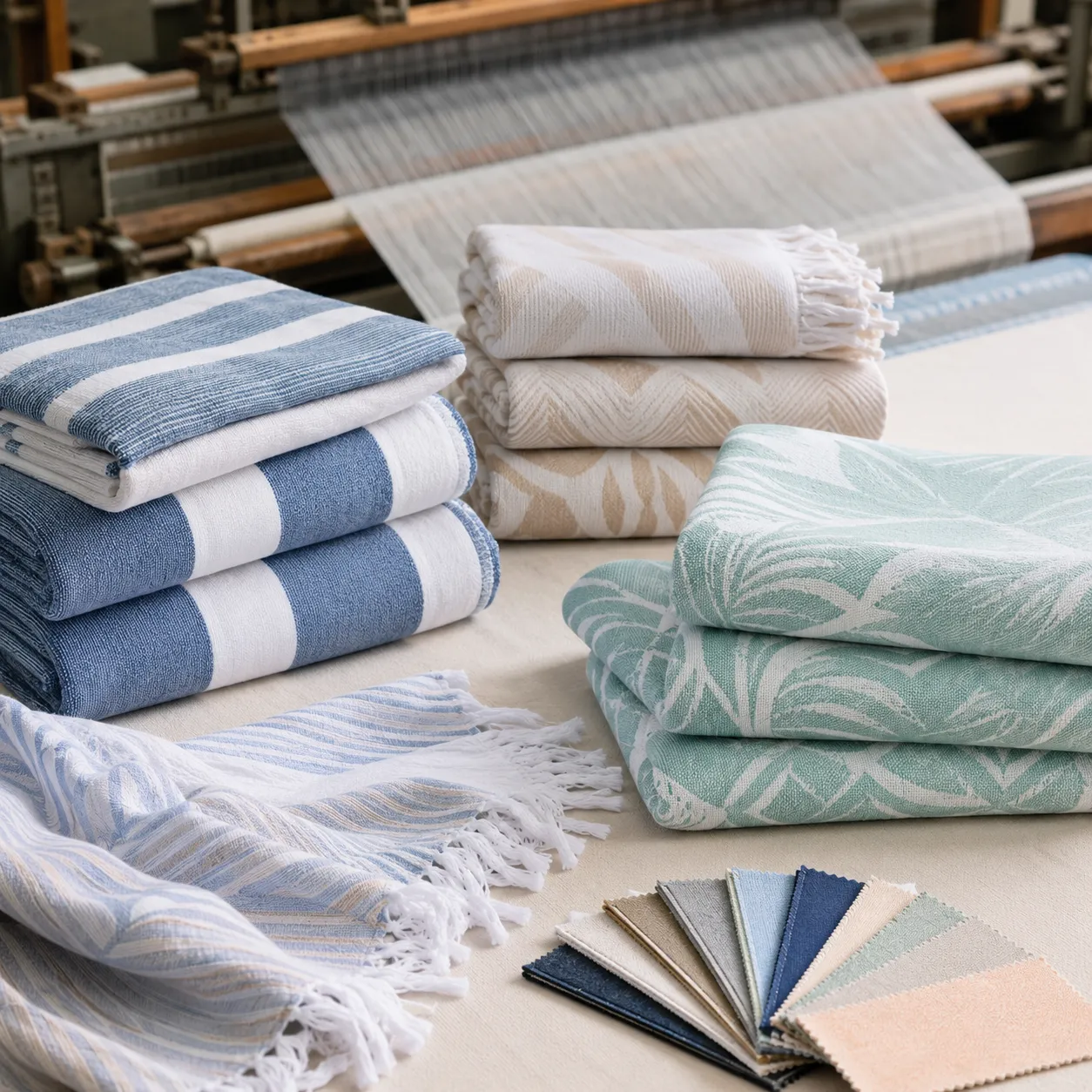
The Supplier Check Starts With the Towel Body
For monogrammed bath towels, the base towel matters before the embroidery machine is switched on. A 550 GSM towel with a tight terry loop reacts differently from a 700 GSM zero-twist towel under the same satin stitch. If the pile is too high and soft, the embroidery sinks unless we add topping film and adjust underlay. If the towel is too thin, the logo can pucker after washing because the stitches dominate the fabric.
In our Zhejiang towel workshop, base towel approval begins with a cut-and-weigh GSM check, size measurement before wash, and a 3-cycle wash record. We run embroidery trials only after the towel body is stable enough to hold the design. This is why a monogram bath towel supplier checklist should ask for base fabric test values, not only a photo of a stitched logo.
| Use case | Common size | Practical GSM range | Construction note | Shrinkage target after 3 washes |
|---|---|---|---|---|
| Hotel bath towel | 70 x 140 cm or 76 x 152 cm | 550-650 GSM | Ring-spun or combed cotton terry with medium pile height | Length -4% to -7%, width -3% to -6% |
| Spa or suite towel | 80 x 160 cm | 600-720 GSM | Softer handfeel, but embroidery area should avoid extra-loose pile | Length -5% to -8%, width -4% to -7% |
| Retail gift towel | 70 x 140 cm | 500-620 GSM | Balanced weight for shelf price and gift box freight | Length -4% to -7%, width -3% to -6% |
| Club locker towel | 68 x 137 cm | 480-580 GSM | Faster drying, lower laundry load, simpler monogram recommended | Length -4% to -6%, width -3% to -5% |
The shrinkage figures above are not universal promises. They are working acceptance ranges we use for cotton terry bulk lots after standard domestic wash simulation at 40 C with tumble drying. If a buyer uses industrial tunnel washing, chlorine bleach, or high-temperature drying, the approval test should be written around that laundry reality.
Monogram Bath Towel Supplier Checklist: Approval Points
The monogram bath towel supplier checklist below is the version we use with buyers who need repeat orders, not one-time photo approval. The goal is to lock the towel, the embroidery, and the packout as one system. A beautiful crest can still fail if the towel shrinks under it or if thread color shifts after peroxide washing.
- Base towel reference: yarn type, GSM, finished size, border width, pile height feel, and washed measurement tolerance.
- Embroidery file: DST file, stitch count, thread brand or color code, stitch type, underlay setting, and approved logo dimensions in millimeters.
- Placement rule: distance from bottom hem, side tolerance, and whether placement is measured before or after wash.
- Stabilizer setup: tear-away or cut-away backing weight, water-soluble topping for high pile, and whether backing residue is acceptable to the brand.
- Wash proof: 3 to 5 wash cycles with photos of edge curl, puckering, thread bleed, and pile crush around the logo.
- Carton identity: SKU, color, size, monogram version, polybag label, carton mark, and carton count tied to the purchase order.
Two technical details are often missed. First, embroidery on terry should include a knockdown or mesh underlay when the pile is high, otherwise loops show through the open areas of letters. Second, small serif letters under 7 mm height become inconsistent after laundering because terry pile movement hides the inner counters. We prefer to redraw tiny text rather than force a buyer's retail logo file into thread.
Embroidery Size, Stitch Count, and Pile Crush
Embroidery cost is driven less by the number of colors than by stitch count, machine time, and handling. A 9 cm single-letter monogram may run 5,500-7,500 stitches. A 12 cm hotel crest with border, crown detail, and small date text can pass 18,000 stitches. At that point, the towel needs firmer backing and slower machine speed to avoid needle deflection through thick terry.
Our Tajima multi-head embroidery line is normally set lower for heavy towels than for flat fabric. On dense bath towels, running too fast can cause thread breaks and inconsistent satin edges. During sampling, our decoration team records stitch count, thread tension notes, needle size, and backing type on the sample card. That card stays with the bulk order file so the night shift and day shift do not interpret the same logo differently.
| Logo type | Typical size | Approx. stitch count | Factory concern | Suggested control |
|---|---|---|---|---|
| Single initial | 65-90 mm high | 3,800-7,500 | Looks simple, but satin columns can pull terry inward | Limit column width and use light underlay |
| Three-letter monogram | 80-110 mm wide | 7,000-12,500 | Letter spacing changes visually after wash | Approve washed sample, not only fresh sample |
| Hotel crest | 90-130 mm wide | 12,000-22,000 | Small details may fill in on pile | Simplify fine lines below 1.2 mm thread width |
| Spa wordmark | 70-160 mm wide | 5,000-14,000 | Long horizontal logos can skew with towel grain | Mark placement from hem and center line before stitching |
For buyers comparing decoration methods, embroidery vs sublimation vs jacquard is useful background. For bath towels specifically, embroidery remains the most accepted choice for hotels and luxury retail because it survives repeated laundering better than surface print on cotton terry, but it needs disciplined setup.
Certification Coverage Must Match the Finished Towel
A supplier can show a cotton yarn certificate and still leave the finished monogram outside the certification scope. For bath towels sold into hotels, baby-adjacent retail, or spa programs, buyers should ask which components are covered: towel fabric, dyeing, embroidery thread, stabilizer, labels, and packaging inks. OEKO-TEX Standard 100 Class I is the strictest product class and is suitable for articles with direct skin contact, including baby products. BSCI covers social compliance at the facility level. ISO 9001 covers quality management procedures, not chemical safety by itself.
LUMA & CO. TEXTILE operates with OEKO-TEX Standard 100 Class I, BSCI, and ISO 9001 documentation. For each order, our compliance file includes certificate number, validity date, product scope, and the buyer's material list. When embroidery thread is nominated by the buyer, we ask for thread compliance documents before bulk production. If the buyer cannot supply them, we quote with thread from our approved supplier list.
- Check that the OEKO-TEX certificate is valid on the shipment date, not only at sample approval.
- Confirm whether embroidery thread is included in the certified article group or supported by a separate certificate.
- Ask for the BSCI audit date and rating if the order is for a retailer with social compliance review.
- Use ISO 9001 as evidence of process control, then still request order-level inspection reports.
- Keep certificate PDFs with the purchase order, commercial invoice, and packing list for customs or retailer review.
Buyers new to compliance review can use how to read an OEKO-TEX certificate before approving claims on packaging. If the towel will be part of a hotel linen standard, hotel towel sourcing guide 2026 gives broader context on cotton, laundering, and replacement cycles.
Price Bands With the Basis Stated
Price bands are useful only when the basis is visible. The figures below are FOB Ningbo or Shanghai working ranges for July 2026 inquiries, assuming cotton terry bath towels, one embroidery position, standard export carton packing, and no retail gift box. Cotton price, exchange rate, logo stitch count, towel weight, and order split can move the quote. Air freight, duty, and destination trucking are not included.
| Order volume per design/color | Typical FOB range per towel | What is included | Where cost changes fastest |
|---|---|---|---|
| 500-799 pcs | USD 5.20-8.10 | Custom dyed or stock color towel, one embroidery, polybag optional | Lab dip, machine setup, stitch count, small-lot dyeing |
| 800-1,499 pcs | USD 4.65-7.35 | Better absorption of setup cost, standard carton packing | GSM, towel size, thread count, color split |
| 1,500-2,999 pcs | USD 4.10-6.70 | More efficient embroidery scheduling and carton packing | Cotton grade, logo complexity, wash test requirement |
| 3,000-6,000 pcs | USD 3.75-6.25 | Stable bulk production with stronger material purchasing leverage | Exact GSM, carton cube, nominated packaging |
| 6,000+ pcs | USD 3.45-5.85 | Program pricing possible when colors and repeats are planned | Yarn market, annual call-off schedule, inspection level |
Our MOQ is 500 pcs per design per color. Below that, the towel and embroidery setup do not become impossible, but the unit cost rises sharply because dyeing, cutting, embroidery file setup, trims, inspection, and export documentation still require the same workflow. For a 300-piece order with a 16,000-stitch crest, the buyer may save only USD 620-900 on total order value versus 500 pieces, while losing useful replacement stock. That is usually poor cost-per-use for a hotel opening.
A clearer example: a boutique hotel using 420 bath towels in rooms may request exactly 420 pieces. If laundry loss and room expansion add 12% demand over the first year, the hotel buys an emergency top-up later at small-lot pricing and pays another freight minimum. Ordering 550 pieces at the start may add roughly USD 520-740 FOB, but it can avoid a second air shipment that costs more than the extra towels.
Sampling Should Prove Laundering, Not Photography
The first sample often looks acceptable because it has not been through water, detergent, heat, or folding pressure. We treat the approved sample as a lab record. For monogram bath towels, the buyer should approve one fresh sample and one washed sample. The washed sample shows whether the towel has pulled around the embroidery, whether the border twisted, and whether loose pile has trapped lint around the letters.
- Buyer sends artwork in vector format, Pantone target, towel size, GSM, and use case.
- We digitize the logo into DST and note stitch count, thread colors, backing, and topping film.
- A base towel is made or pulled from approved stock, then measured before decoration.
- Embroidery sample is stitched on production equipment, photographed, measured, and internally checked.
- One sample is washed 3 cycles, dried, and checked for shrinkage, pucker, color bleed, and thread breakage.
- Buyer signs the sample card with towel spec, logo file version, placement, packing method, and tolerance.
Normal sampling takes 7-12 days when the towel color is available. Custom dyed towel samples usually take 12-18 days because lab dip approval comes first. If the monogram uses metallic thread, very dense fill, or multiple towel colors, add 3-5 days for rework risk. Metallic thread can pass a visual sample and still fail abrasion or snag resistance, so we avoid it for hotel laundry unless the brand accepts shorter life.
Bulk Production Gates in Our Zhejiang Workflow
After deposit and sample signoff, our production file moves through yarn booking, weaving, dyeing, finishing, cutting, embroidery, trimming, inspection, and packing. The order is managed under ISO 9001 document control, with the approved sample card and purchase order spec used as the reference. We do not release embroidery bulk until the first 30-50 pieces are checked against placement and stitch quality.
| Stage | Typical days | Factory control record | Buyer decision needed |
|---|---|---|---|
| Lab dip or color confirmation | 3-7 days | D65 lightbox comparison and dye formula note | Approve color or request adjustment |
| Weaving and dyeing | 10-18 days | Greige weight, dye lot, finished GSM check | Confirm no late size or color change |
| Cutting and hemming | 3-6 days | Size tolerance sheet and border alignment check | Approve any revised tolerance before embroidery |
| Embroidery bulk | 5-12 days | First-piece report, thread lot, needle and backing notes | Approve first bulk photo if required |
| Final inspection and packing | 3-5 days | AQL report, carton count, metal detection record if required | Release shipment after documents |
A standard bulk order usually needs 28-45 days after approved sample and deposit. Large programs, custom yarn, retail box packing, or multiple monogram versions can move the window to 45-60 days. Sea freight should be planned separately; for many North America and Europe routes, port-to-port time can add 25-42 days depending on destination and sailing.
- Use one purchase order line per towel color and monogram version so carton marks stay clean.
- Freeze artwork before yarn dyeing starts if the logo placement affects border spacing.
- Reserve 2-3% extra embroidery thread from the same dye lot for replacement production.
- Request carton dimensions early if the buyer is comparing LCL, FCL, or air freight.
- For resort openings, build a 10-14 day buffer after final inspection before the required delivery date.
For logistics planning, container vs air freight towel orders explains the freight math. Buyers building a complete hotel program can also compare timing against setting up a hotel linen program 90-day roadmap.
Final Inspection: Defects That Matter on Monograms
A towel can pass weight and size checks while failing the brand standard at the monogram. Final inspection needs separate criteria for the towel body and the decoration. We use AQL sampling by order size, then add a focused embroidery review for visible logo defects because one bad crest on a guest-facing towel is not a minor issue to the hotel.
- Placement drift: logo center more than 5 mm off agreed center line, or height from hem outside signed tolerance.
- Thread tails: untrimmed thread longer than 3 mm on the face side, especially inside letters.
- Pile show-through: terry loops visible through dense logo areas where topping or underlay should have controlled the pile.
- Puckering: fabric distortion around satin stitches after wash or steam pressing.
- Color mismatch: embroidery thread outside approved shade under D65 light, or different thread lots mixed in one carton.
- Backing residue: stiff or visible backing left on a towel intended for retail gift or luxury guest use.
For bath towel quality beyond embroidery, buyers should review luxury bath towel QC inspection checkpoints and towel GSM decision framework. Those two checks help prevent a common problem: approving a good logo on a towel body that is too light, slow drying, or unstable in laundry.
Related Reads for Procurement Teams
If your team is still building the RFQ file, start with build a towel tech pack that mills can quote. For cotton selection, combed vs zero twist cotton explained helps buyers understand why soft showroom samples do not always survive commercial laundry.
For decoration method choice across towel types, use monogrammed bath towels luxury brand guide alongside pantone color matching custom towels. Those references are especially helpful when a hotel brand needs one visual standard across bath towels, hand towels, robes, and spa linens.
What We Need to Quote Cleanly
A clean quote does not need a long deck. It needs the information that changes production cost and risk. Send towel size, target GSM, cotton preference, towel color, logo artwork, monogram size, placement, quantity per design and color, packing method, destination port, and required delivery date. If the order must meet OEKO-TEX Standard 100 Class I, BSCI, or retailer compliance review, tell us before sampling so thread, label, and packaging choices are aligned from the start.
LUMA & CO. TEXTILE has produced custom towels since 2007 with a 220-person team and annual output around 2.4 million towels. Our standard MOQ is 500 pcs per design per color, and our merchandising team will flag when a requested cheap option is likely to fail in laundry. For monogrammed bath towels, that usually means avoiding over-dense small lettering, unstable towel bodies, and undocumented thread substitutions.
Send a Monogram Towel RFQ
Share artwork, towel size, GSM, quantity, color target, and delivery window. We will return a factory quote with MOQ, sampling time, bulk lead time, and QC checkpoints. WhatsApp: +86 13205717266. Email: [email protected].
Request Quote →