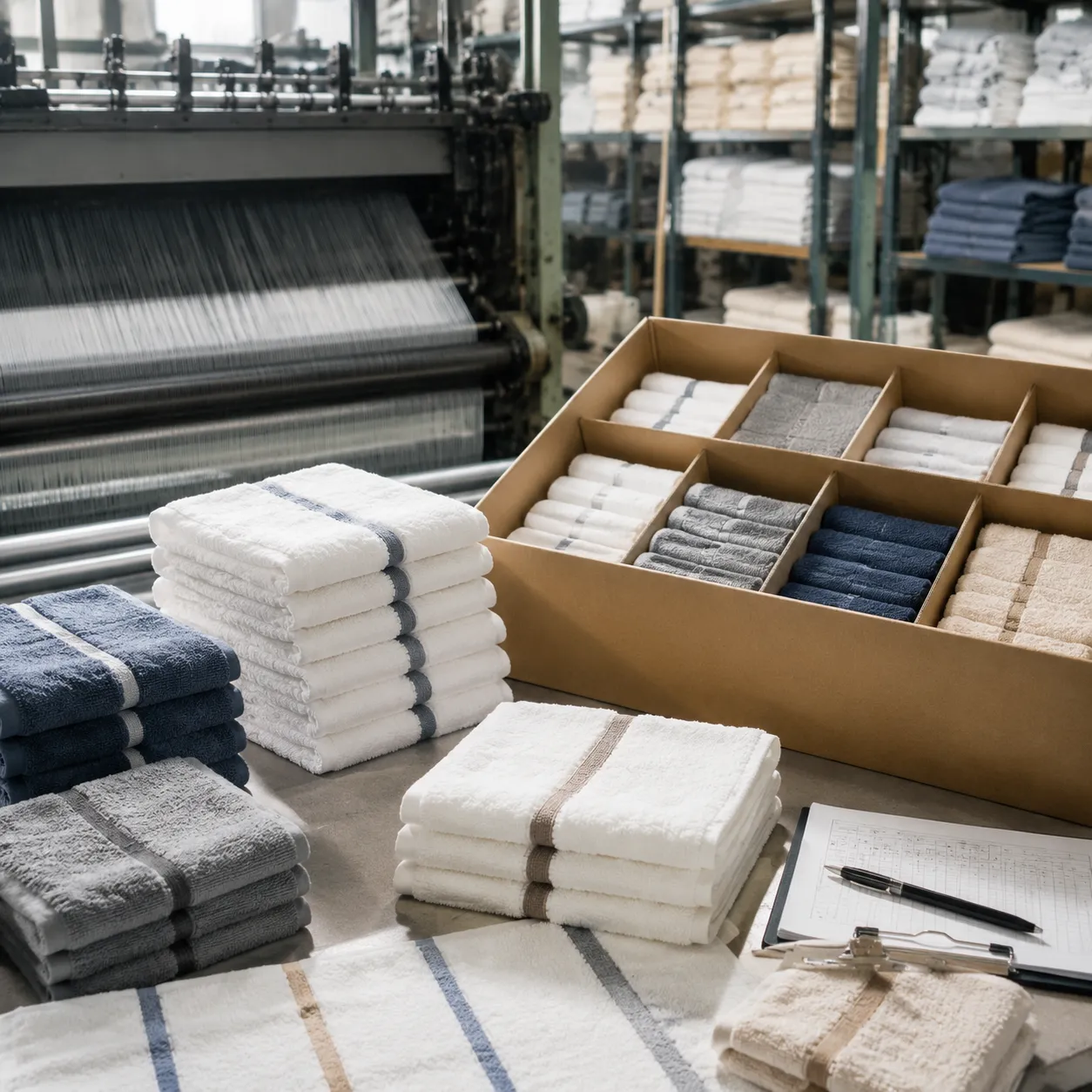
Start with the failure points buyers actually see
For upscale bath programs, rejection usually happens for a short list of reasons: the towel loses body after laundering, the shade drifts lot to lot, the side hems torque, or the hand feel in bulk does not match the approved sample. Those are not abstract quality topics. They come from construction choices that can be inspected early and measured again before shipment.
We treat a luxury bath towel as a wash-and-recovery product, not a showroom sample. In practical terms, that means checking loop density, hem balance, pile height consistency, and post-wash dimensional change with the same discipline as color and label compliance. If a towel passes only visual inspection and skips wash verification, it is still risky.
- A thick hand feel can hide low loop anchoring, which later causes pulled loops around the border.
- A bright white towel can still fail if optical brightener use creates uneven fluorescence under store lighting and hospitality bathroom lighting.
- A soft zero-twist face can still disappoint if the ground warp tension is unstable and the towel spreads after laundering.
What belongs in a best luxury bath towels QC inspection guide before production
The cleanest inspections start from a disciplined tech pack. For bath towels in the luxury tier, we want the PO to lock six lines before yarn booking: finished size, GSM tolerance, pile construction, border construction, wash test standard, and acceptance level. Without those, the factory can still produce a decent item, but your bulk approval becomes subjective.
| Spec line | Recommended control point | Typical acceptance |
|---|---|---|
| Finished size | Measured after one home-laundry cycle and tumble dry low | Within +/- 3% on length and width |
| GSM | Average of conditioned swatches from 5 cartons | Within +/- 5% of approved standard |
| Pile construction | Single-ply ring spun or combed cotton loop stability check | No visible bare ground on face at arm's length |
| Border | Cam border or dobby border straightness | Bow/skew not over 2.0 cm across towel width |
| Whiteness or shade | Against sealed approval standard under D65 light box | Grey scale minimum 4 for adjacent lot consistency |
| Sewing | Hem width and stitch density | Hem variance within 2 mm; no skipped stitches |
For a 600-piece boutique hotel order, we would still keep the MOQ at 500 pieces per design per color, but the approval discipline should be the same as a 12,000-piece chain program. The difference is that smaller orders need tighter sign-off because there is less room to average out variation across lots.
Sampling method: where inspectors should pull units, and how many
A reliable inspection plan is boring in a good way. We do not inspect only top cartons by the loading door. We pull from early, middle, and late packed cartons, and from more than one pallet position when the order is large enough. For final random inspection, many buyers use ANSI/ASQ Z1.4 single sampling. In towel programs, we usually align that to AQL 2.5 for major defects and AQL 4.0 for minor defects unless the brand manual requires tighter limits.
| Order quantity | Sample size code idea | Units to inspect | Practical note |
|---|---|---|---|
| 500-1,200 pcs | Small lot | 50 pcs | Take from at least 10 cartons |
| 1,201-3,200 pcs | Mid lot | 80 pcs | Split pulls across packed time blocks |
| 3,201-10,000 pcs | Larger lot | 125 pcs | Include top, middle, and bottom pallet layers |
For absorbency, shrinkage, and weight, we do not test all inspected units. We carve out a sub-sample with traceable carton numbers. Our usual floor rule is 5 towels for dimensional and GSM checks, 3 towels for wash performance, and 2 retained controls from sealed bulk. That sounds simple, but traceability matters. If towel No. 3 shrinks 4.6% after washing while the other two stay inside 2.8%, we need to know whether it came from the same loom batch or a repacked carton.
- Pull random units from distributed carton locations, not a single pallet face.
- Tag each tested piece with carton number, packed date, and color lot.
- Reserve one unwashed control towel from the same sample set.
- Repeat key measurements after conditioning, not immediately after hot unpacking from the container.
The three measurements that decide whether the towel still feels luxurious after washing
Luxury perception shifts fast after laundry. The first measurement is dimensional recovery. The second is mass retention. The third is surface coverage after drying. Buyers often ask for softness, but softness by itself is not measurable enough to approve bulk. These three are.
For shrinkage, we usually wash to ISO 6330 methodology and assess dimensional change with ISO 5077. On a dense combed-cotton bath towel, a reasonable target is under 3% in both directions after the agreed cycle. If you are buying a low-twist or zero-twist construction, we tell buyers to allow the mill to prove recovery with real wash data before approving the hand feel. Those towels can test beautifully on day one and open up too much after tumble drying if loop binding is weak.
For GSM, inspect the delivered towel after conditioning rather than relying only on loom target. A towel booked at 650 GSM that lands at an average of 621 GSM can still look acceptable folded, but in use it usually feels less full through the mid-panel. We generally accept within +/- 5%, though some retail programs ask for +/- 4%. Below that, disputes increase because moisture regain and finishing variation start to matter more.
- Shrinkage threshold we see most often: not over 3% after agreed wash cycle
- Bow/skew threshold for bath size: usually not over 2.0 cm across width
- Mass tolerance: commonly +/- 5% GSM against approved standard
- Pile appearance after wash: no patchy lean, no exposed ground, no hard edge curl on borders
Absorbency is where showroom towels get exposed
Some heavy towels feel expensive because they are bulky, not because they absorb well. If softener carryover or silicone finish is too high, water beading shows up immediately. That is why we include an absorbency checkpoint before final approval, especially on white and pale shades where soft hand finishes are often pushed hard.
There are different lab methods available, but for routine control we keep one practical floor test alongside formal lab work: place a measured water drop at the center panel after conditioning and record sink-in time. It is not a replacement for lab testing, but it catches finishing excess quickly. For luxury bath towels, we get uncomfortable when sink-in drifts beyond about 6 seconds on repeated pieces from the same lot. A towel can still technically absorb, but the user reads the delay as coated fabric.
| Absorbency checkpoint | What it reveals | Typical warning sign |
|---|---|---|
| Water drop sink-in time | Surface finish loading | Droplets sit visibly before penetration |
| First-wash absorbency retest | Whether softness finish is masking weak performance | Large change between unwashed and washed result |
| Panel-to-border comparison | Uneven finishing or density shifts | Center absorbs, border area resists |
One construction quirk we watch closely is border hardness. A towel with a decorative dobby border may pass absorbency in the field area but feel stiff at the shoulder end because finishing agents accumulate more heavily on the denser border structure. That is not a lab failure on paper, but guests notice it.
How we classify defects during final inspection
Not every flaw has the same commercial impact. A single loose thread tail can be trimmed. A shade split inside one carton cannot. We classify defects based on user visibility, safety, and wash performance. That keeps the inspection report useful instead of theatrical.
| Defect class | Examples | Typical action |
|---|---|---|
| Critical | Wrong fiber declaration, metal contamination, needle risk | Reject lot and investigate source |
| Major | Shade mismatch vs sealed sample, holes, severe skew, wrong size, broken hems | Fail inspection if over AQL allowance |
| Minor | Trim issue, slight sewing waviness, small soil mark removable in rework | Record and rework where practical |
- A major defect for luxury bath use is a border that ripples after wash because the sewing thread tension locks the hem tighter than the body.
- Another major defect is pile barriness: alternating lighter and darker horizontal bands caused by yarn or tension variation, visible under side light.
- A minor defect can be a short thread tail under 15 mm if the seam is secure and presentation can be corrected in repacking.
Pile barriness deserves more attention than many reports give it. On white towels it can hide under warehouse lighting and become obvious in guest bathrooms with angled LEDs. We often check under raking light from the side, not only under flat overhead light, because uneven loop height shows faster that way.
Lab tests worth paying for, and the ones buyers over-order
A useful lab panel for bath towels is not very long. We would prioritize fiber verification, colorfastness to washing, water absorbency, dimensional stability, and formaldehyde / restricted substances compliance if the market requires it. OEKO-TEX Standard 100 Class I is common in buyer requests, and we also see BSCI and ISO 9001 documents checked during vendor onboarding, but those are not substitutes for lot-level product inspection.
For colorfastness, ISO 105-C06 is the workhorse wash test most buyers recognize. For white programs, color transfer may not be the core concern, but whiteness drift and optical brightener inconsistency still matter lot to lot. For colored bath towels, a grey scale rating below 4 after the agreed cycle usually triggers claims later, especially in hospitality where mixed-linen laundering is common.
- Useful every program: ISO 6330 wash method, ISO 5077 dimensional change, ISO 105-C06 colorfastness to domestic washing
- Useful when claims are likely: fiber composition verification and pH check
- Useful for regulated markets: OEKO-TEX documentation review against the exact article and scope
- Often over-ordered on stable repeats: duplicative third-party tests on every color when the yarn, dye route, and finish are unchanged
Related reads: if you are still building the technical brief, start with build-towel-tech-pack-that-mills-can-quote.html and towel-gsm-decision-framework.html. If certification language on a supplier quote looks vague, how-to-read-oeko-tex-certificate.html helps separate real scope from marketing shorthand.
Price bands for inspection-resistant bath towels
The cheapest quote rarely survives the approval cycle cleanly. For an OEM bath towel in combed cotton, dyed solid, with a stable dobby border and export packing, our working FOB range for a true luxury-tier program usually sits higher because yarn quality, loop density, finishing control, and slower grading all cost real money.
| Order volume | Typical spec window | Indicative FOB China price |
|---|---|---|
| 500-1,000 pcs | 650-750 GSM, combed cotton, custom label and bag | USD 5.20-6.90 per piece |
| 1,001-3,000 pcs | 620-720 GSM, combed cotton, standard export pack | USD 4.55-6.10 per piece |
| 3,001-8,000 pcs | 600-700 GSM, combed cotton or better ring-spun program | USD 4.10-5.55 per piece |
Those bands assume normal white or piece-dyed shades, not intricate jacquard branding or gift-box retail presentation. If a buyer asks for a very low quote on a towel expected to pass strict inspections, we usually show the cost-per-use math. A towel landing at USD 4.22 and lasting 95 commercial wash cycles costs about USD 0.044 per use. Another landing at USD 3.48 but flattening out at 52 cycles costs roughly USD 0.067 per use before replacement labor and claim handling.
Lead times: where QC really adds days, and where it should not
A disciplined inspection process adds some time, but not much if the sequence is set before the deposit arrives. For a custom bath towel program, lab dips or white standard approval usually take 3-5 days. PP sample review takes around 5-7 days. Bulk weaving, dyeing, sewing, finishing, and packing for a mid-size order often lands in the 28-38 day range after approvals. Final random inspection should be booked inside that plan, not as a surprise after the truck is already waiting.
- 3-5 days for shade or whiteness standard confirmation
- 5-7 days for pre-production sample and comments closure
- 28-38 days for bulk production on standard bath towel programs
- 2 days for internal final inspection and rework buffer
- 3-7 days extra if a third-party lab retest is triggered by failed wash or absorbency results
The delay point buyers underestimate is not testing itself. It is rework after a late discovery. A bowing border found during inline sewing can be corrected cheaply. The same issue found after all towels are packed means reopening cartons, repressing, repacking, and sometimes relabeling.
What we would put on the buyer sign-off sheet
If we had to reduce this article to one approval page, we would ask the buyer to sign off against measured data, not descriptive language. "Luxury hand feel" does not survive disputes. Numbers do.
- Approved finished size after wash, with tolerance
- Approved GSM with tolerance and test condition
- Accepted shrinkage limit after named wash method
- Absorbency benchmark with a repeatable test note
- Shade or whiteness standard reference
- Defect classification and AQL level
- Packing method, carton count, and barcode placement
Related reads: for size and assortment planning, see towel-sizes-dimensions-complete-guide.html and hotel-towel-sourcing-guide-2026.html. If your end use is hospitality rather than retail, setting-up-hotel-linen-program-90-day-roadmap.html is the better operating framework.
The best inspection report is the one that makes the bulk towel boringly predictable after washing.
Need a bath towel QC brief before sampling?
We can review your towel spec, set practical tolerances, and quote against the same inspection standard we will use in bulk. MOQ is 500 pcs per design per color. Contact us at [email protected] or WhatsApp +86 13205717266.
Request a Quote →