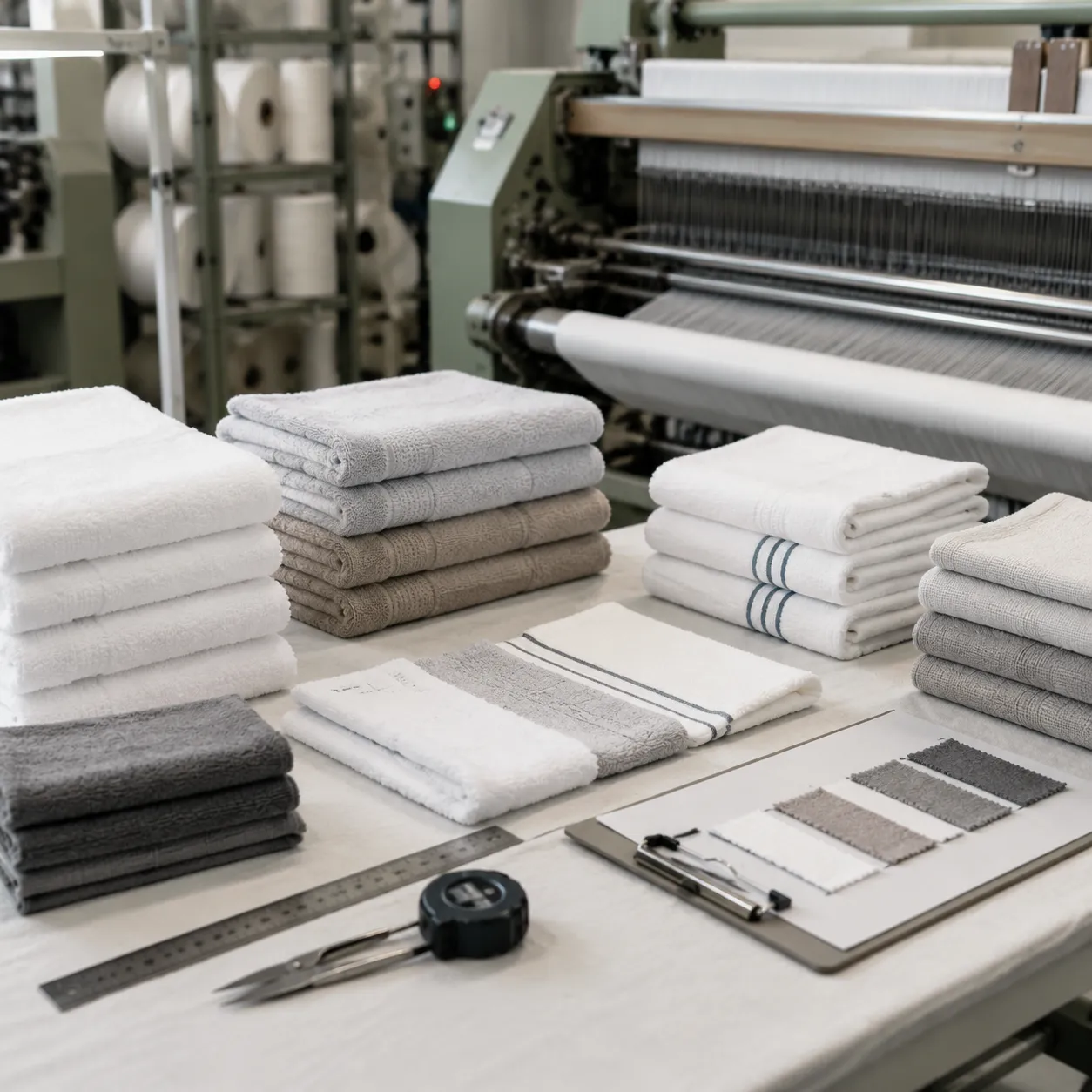
Start the audit with where the towel works, not the towel name
Most failed restaurant towel service programs begin with a generic item label: bar mop, kitchen towel, service cloth. That naming is too broad to control cost or laundry life. We audit by station and soil type first. Grill-line wiping takes high heat, carbon staining, fryer oil, and repeated alkali exposure. Front-of-house glass polishing needs low lint and soft hand but sees far less grease. Prep counters need absorbency and fast turnover. If one article is pushed across all three uses, either the line pays for softness it burns through in weeks, or the dining area gets a harsh, grey cloth that sheds lint onto glassware.
For restaurant towel service, every SKU should be assigned to a use code before quoting: hot line, cold prep, bar, general spill, or guest-contact backup. That single step tightens GSM, yarn count, color choice, and wash chemistry. It also makes loss tracking possible, because replacement can be tied to a station instead of an entire building.
| Use station | Recommended construction | Why it holds up better | Typical wash target |
|---|---|---|---|
| Hot line | 16s ring spun cotton, dobby border, 520-580 GSM | Thicker loop body tolerates grease loading and repeated alkali better than light service cloths | 80-120 industrial washes |
| Cold prep | 21s cotton, plain cam border, 430-500 GSM | Good absorbency without carrying excess weight into every wash load | 70-100 washes |
| Bar polishing | Cotton rich low-lint terry or flat rib, 340-420 GSM | Lower linting and faster drying after back-bar rinsing | 60-90 washes |
| General spill | Cotton terry 400-470 GSM with dark shade coding | Controls visible staining and separates workflow by area | 65-95 washes |
A mixed-load laundry program will destroy the wrong construction fast
Commercial kitchens rarely wash towels under ideal lab conditions. They run mixed loads with aprons, mats, and heavily soiled textiles. That matters because loop height, border structure, and yarn twist react differently to mechanical action. One recurring defect we see in failed restaurant towels wholesale programs is border roping: the body shrinks less than the border after aggressive extraction, creating a curled edge that will not fold flat. Another is loop snag opening around the first needle line where the towel catches on prep-table corners or wire racks.
These are specification problems, not random quality noise. A narrow decorative dobby may look clean on a sales sample, but on a line towel it can become the first distortion point under tunnel finishing. For restaurant towel service, we specify practical borders: 1.5-2.2 cm cam or simple dobby, with balanced weft density and lock stitching at both hems. Hem thread should be a stable polyester core spun count matched to the body weight; otherwise the seam puckers after chlorine exposure.
- Reject ornate borders on line towels; they trap grease and distort faster in high-alkali washing.
- Set shrinkage tolerance before bulk: warp and weft each under 6% after agreed laundry simulation.
- Ask for seam slippage testing on hems if the towel will be snagged on wire shelving.
- Specify folded pack dimensions, not only cut dimensions, if the towels go into dispensers or fixed bins.
Color coding saves more money than chasing the cheapest unit price
Buyers sometimes resist four-color programs because they see separate dye lots and separate inventory. In operation, color coding usually cuts misuse enough to pay back in one quarter. A 38-store casual dining group we quoted last year had one white towel SKU used everywhere. Their laundry contractor logged an average monthly replacement of 12.4% by piece count. After shifting the proposal to charcoal for grill, navy for bar, beige for prep, and white only for guest-visible backup, modeled replacement fell to 7.1% because towels stopped crossing into the most punishing stations. The method was simple: each station manager counted beginning stock, end stock, and rag-out by color for 28 days.
This is where firm guidance matters: do not put white terry on a grill line and expect a long life, even if your stain standard is strict. Carbon, paprika oil, tomato tannin, and chlorine carryover combine into a permanent grey cast. Once the towel looks dirty, staff demotes it early even if absorbency is still acceptable. The service life ends in perception before fabric failure.
| Color strategy | Unit FOB at 12,000 pcs | Observed rag-out driver | Estimated service life value |
|---|---|---|---|
| Single white SKU, 460 GSM | USD 0.59-0.68 | Visual staining causes early rejection | Weak despite lowest buy price |
| Two-color split, white + dark | USD 0.61-0.72 | Some misuse remains between prep and line | Moderate |
| Four-color station coding | USD 0.64-0.77 | Lower cross-use and clearer counting | Best total cost in multi-site operations |
Test for the chemistry your laundry actually uses
Pseudo-technical claims are common in this category: bleach safe, heavy duty, commercial grade. None of those tells you what was tested. For restaurant towel service, we ask buyers for the wash formula or, at minimum, the chemistry family: chlorine bleach, oxygen bleach, alkali level, neutralizer, and finishing temperature. Then we tie the spec to a method. Colorfastness to washing can be checked against ISO 105-C06. Dimensional change after domestic-style washing is not enough for foodservice; if the buyer uses industrial processing, we run a plant simulation with agreed bath chemistry, extraction speed, and tumble or tunnel finish notes. Absorbency should be checked by timed wet-out rather than hand feel.
Two very specific failure modes matter in kitchens. First, chlorine yellowing at the hem appears when residual bleach sits longer in the denser seam area than in the towel body. Second, fat redeposition greying appears when detergent load is insufficient for fryer oil and the wash bath cools before full suspension. Neither issue is solved by asking for better cotton alone. They are managed through shade selection, seam construction, and laundry chemistry discipline.
| Audit point | Method or control | Pass guidance for bulk approval |
|---|---|---|
| Colorfastness | ISO 105-C06 wash test | Shade change and staining acceptable to agreed grey scale |
| Harmful substances | OEKO-TEX 100 Class I | Valid certificate covering finished article or relevant product group |
| Factory system | ISO 9001 and BSCI review | Traceable QC records and social compliance in place |
| Shrinkage | Agreed industrial laundry simulation | Under target after 5-cycle verification run |
The right GSM band for foodservice is narrower than buyers think
In this category, more weight does not automatically mean better value. Once a towel gets too heavy for the task, it carries more water, takes longer to dry in circulation, and increases wash cost per usable wipe. For most restaurant towel service programs, the useful range is tighter than hospitality bath towels: 380-580 GSM depending on station. Below about 380 GSM, line towels lose body too quickly and feel thin after repeated alkali exposure. Above about 580 GSM, grill and prep towels become unnecessarily bulky and remain damp longer between uses, especially in humid kitchens.
A practical split works better. Use 520-580 GSM for line wiping where absorbency and heat buffering matter, 430-500 GSM for prep, and 340-420 GSM for polishing or light spill response. If a buyer insists on one universal towel, we cap the recommendation around 460-500 GSM because it is the least damaging compromise, not because it is ideal for every station.
- For fryer and grill positions, prioritize body retention after wash over showroom softness.
- For bar and glass zones, prioritize low lint and quick redry over very high pile.
- Avoid zero-twist constructions here; they feel plush at first but collapse too fast under foodservice chemistry.
- Prefer ring spun cotton with balanced loop density for repeat laundering.
Related reads: why-gym-towels-fail-after-50-washes, towel-gsm-decision-framework, and combed-vs-zero-twist-cotton-explained.
Count pieces by weekly turns, not by opening inventory
Restaurant groups underbuy towels because they count static stock instead of circulation. The correct planning unit is weekly turns per station. If one grill position consumes 22 towels per day across lunch and dinner, and the laundry returns every 48 hours, that station does not need 44 towels. It needs working stock, transit stock, soil hold, safety stock, and onboarding reserve for new staff or menu peaks.
- Measure actual daily issue by station for 14 consecutive days.
- Multiply by laundry turnaround days including weekends and missed pickups.
- Add 12-18% safety stock for spoilage, delayed return, and rag-out sorting.
- Add launch reserve separately if opening new sites within the same quarter.
Here is a real planning shape. A 9-site chain with 6 hot-line stations and 3 bar stations per site counted 1,836 towels issued over two normal weeks. Laundry turnaround averaged 2.5 days, not the 2.0 days stated in contract. Rag-out averaged 8.3% monthly. Their purchase assumption of 5,400 pieces looked safe on paper but left the line short on Friday and Saturday service. The corrected pool was 7,200 pieces, split into three color-coded SKUs. The result was lower emergency buying, fewer mixed substitutions, and more stable wash sorting.
| Program size | Recommended MOQ planning | Typical FOB range | Production lead time |
|---|---|---|---|
| Single SKU trial, 500-1,500 pcs | Use only for wash validation | USD 0.56-0.82 depending on GSM and size | 18-25 days |
| Multi-site starter, 3,000-8,000 pcs | 2-4 color-coded SKUs | USD 0.49-0.74 | 25-32 days |
| Chain rollout, 10,000-40,000 pcs | Station-coded replenishment pool | USD 0.44-0.69 | 30-40 days |
QC should focus on defects that matter in a kitchen, not showroom defects
A restaurant buyer does not need the same acceptance focus as a home-textile retailer. The serious rejects are not minor weaving bars that disappear after first wash. The serious rejects are defects that shorten use or contaminate workflow. We set final inspection around function: seam security, loop integrity, absorbency consistency, shade separation by carton, and pack count accuracy. Carton-by-carton shade mixing is especially harmful in color-coded systems because staff stop trusting the code.
- Check hem bite depth and back-tack security; loose ends open quickly in industrial wash.
- Check metal contamination with needle control records if towels go near food prep areas.
- Check carton labels against color code and station code, not only PO number.
- Check towel count by weight verification plus physical sample count on packed lots.
For restaurant towels wholesale orders, we also recommend pre-shipment wash panels pulled from bulk, not from lab dips or development samples. A five-cycle verification run on actual production fabric tells you more than a perfect salesman swatch. It catches loom-to-loom absorbency differences, seam tension drift, and shade movement after finishing.
Keep the commercial discussion tied to replacement math
The cheapest quote is frequently the most expensive service outcome. Consider two line-towel options at 15,000 pieces. Option A is a 410 GSM white towel at USD 0.48 FOB with an observed useful life of about 58 industrial washes before visible rejection and edge distortion. Option B is a 540 GSM charcoal towel at USD 0.66 FOB with an observed useful life of about 102 washes under the buyer's chlorine-and-alkali formula. Ignoring laundry cost, Option A buys roughly 870,000 usable cycles. Option B buys about 1,530,000 usable cycles. The first option costs about USD 8.28 per 10,000 uses. The second costs about USD 6.47 per 10,000 uses.
That is the level on which a restaurant towel service decision should be made. Unit price is only the entry number. Real comparison needs usable cycles, rag-out trigger, and whether visual staining removes the towel before structural failure. Buyers who model those three factors make better replenishment decisions and stop emergency buying from local distributors at much higher piece prices.
What to put in the RFQ so the quote is usable
A workable RFQ for this category is short but exact. State station use, finished size, target GSM range, color coding, laundry chemistry, pack ratio, and approval test. Without that information, the supplier can only guess, and guessed specs are why so many restaurant towel service programs drift into inconsistent replenishment. If the buyer has no full tech pack yet, a one-page matrix is enough to get comparable bids.
- Finished size tolerance and folded pack requirement
- GSM target by station, not one blanket weight for all towels
- Color coding by use area with Pantone reference where visible differentiation matters
- Laundry formula summary and whether chlorine bleach is present
- Approval method: bulk wash panel, shrinkage limit, and seam durability check
- MOQ by design and color: our standard is 500 pcs per design per color
Related reads: build-towel-tech-pack-that-mills-can-quote, pantone-color-matching-custom-towels, and negotiate-towel-moq-without-killing-margin.
The pass-fail standard for a stable program
A stable program is easy to recognize. Each towel SKU has one station, one color code, one wash profile, and one replacement logic. The approved sample is not judged by showroom softness but by post-wash function. Bulk production matches the tested construction. Cartons arrive sorted in the same logic the restaurant uses on the floor. If any of those links are missing, the problem shows up later as unexplained loss, shade confusion, early rag-out, or constant substitute buying.
For buyers evaluating restaurant towel service, the practical benchmark is straightforward: define the station, specify the chemistry, test the bulk fabric, and buy against usable cycles. That is how kitchen towels become a controlled operating item instead of a recurring purchasing fire.
Need a restaurant towel service quotation that matches your laundry reality?
Send station use, size, GSM target, and wash chemistry. We will quote by SKU, MOQ, lead time, and test plan. WhatsApp: +86 13384590853 | Email: [email protected]
Request a quote →