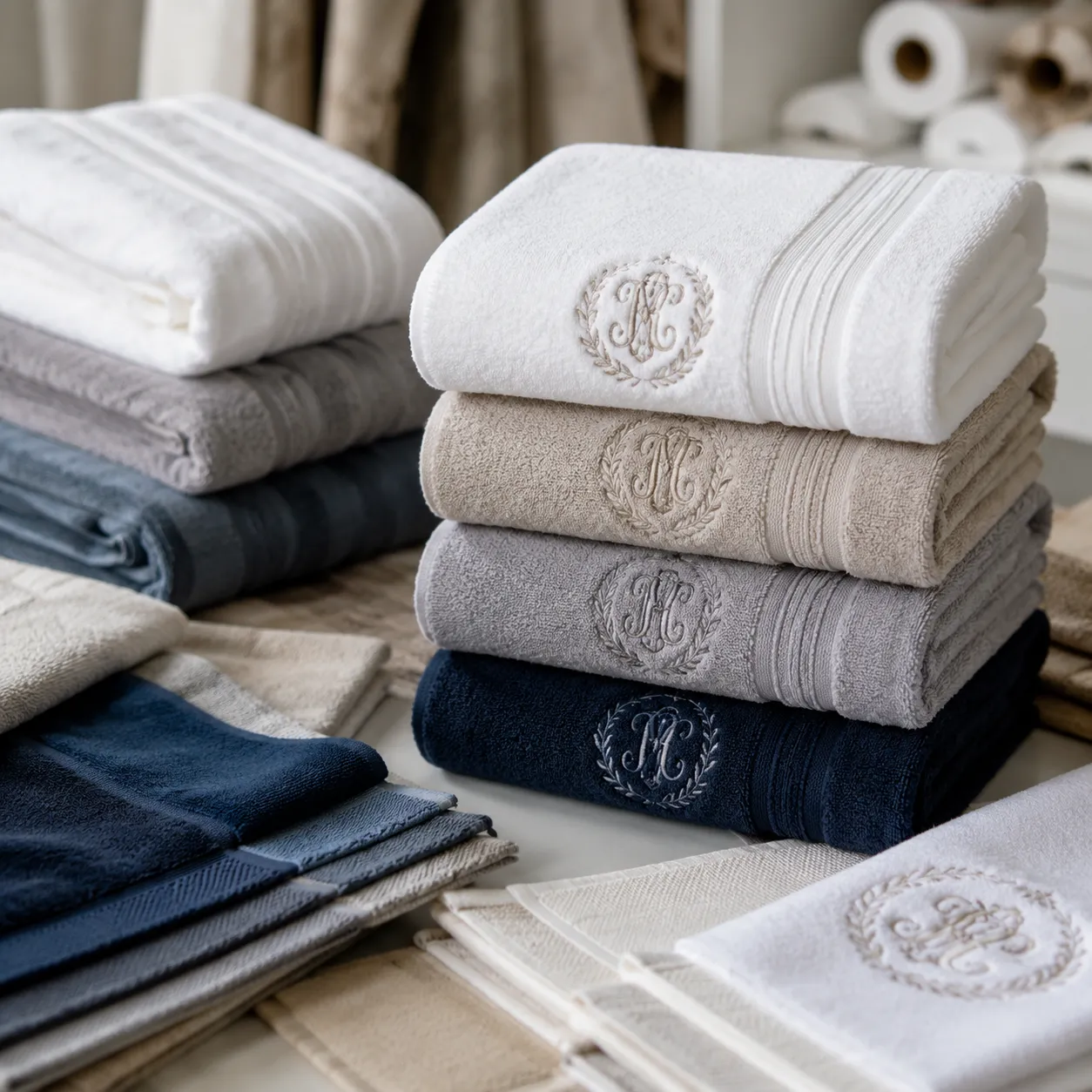
Start with the bath towel count, not the logo
For resort programs, the embroidery is visible to guests, but the reorder risk usually starts with a weak towel par level. If the opening order is calculated from room count only, the laundry room absorbs the mistake within the first month. We usually build the model from occupied rooms, towel issue per room, laundry cycle time, housekeeping buffer, and seasonal peak.
A 180-room resort that issues 2 bath towels per occupied room does not need only 360 towels. If average occupancy is 78%, daily issue is about 281 bath towels. With a 2.5-day laundry turnaround, 12% housekeeping buffer, and 7% unusable reserve, the working stock becomes roughly 840-880 bath towels before spa, pool villa, or VIP amenity usage is added.
| Planning input | Typical resort value | Factory comment |
|---|---|---|
| Guest room issue | 2 bath towels per occupied room | Higher for villas and family suites |
| Laundry turnaround | 2-3 days | Longer if towels leave property for outside laundry |
| Opening par | 3.2-4.0 par | Below 3 par creates emergency air-freight risk |
| Annual loss allowance | 14-22% | Embroidery makes replacement matching more important |
| Safety stock | 8-12% | Keep in plain stock or current monogram only |
We advise buyers to separate the base towel requirement from the decoration requirement. The towel body can be repeated across seasons, but the monogram may change by property, wing, year, club level, or retail package. That split is what keeps reorder planning practical.
Monogrammed bath towels resort reorder plan: the numbers we ask for
A workable monogrammed bath towels resort reorder plan needs more than a logo file. Before we quote, we ask for current room count, towel issue rules, average monthly occupancy, laundry method, expected annual loss, and whether the same embroidery appears on bath towels, hand towels, washcloths, or robes.
- Room mix: standard rooms, suites, villas, spa rooms, and staff changing rooms should be counted separately.
- Laundry route: in-house tunnel washer, outside commercial laundry, or mixed processing changes replacement timing.
- Embroidery placement: center border, lower right corner, or hem band affects speed and defect risk.
- Logo thread colors: 1-3 thread colors are normal; metallic thread is slower and less durable in commercial wash.
- Reorder trigger: set the trigger by usable stock, not by purchase history.
For embroidered resort towels, the reorder trigger usually sits at 68-72% of opening usable stock if the next order is moving by sea. For air freight, the trigger can be lower, but landed cost changes sharply. One 14-carton replenishment we shipped by air to a Caribbean property cost USD 2.46 per towel more than the sea-freight plan because the buyer waited until housekeeping was already short.
Our MOQ is 500 pcs per design per color. That does not mean every resort must buy 500 bath towels for each wing every month. It means the decoration and dye lot need to be planned so reorder quantities clear the embroidery setup cost and avoid small-lot shade problems.
Choose a towel body that survives repeat resort laundry
Monogramming adds value only if the base towel survives the laundry load. For resort bath towels, we normally see 550-680 GSM for guest rooms and 450-520 GSM for pool-adjacent bath or shower towels where dry time matters more. A 650 GSM towel feels substantial, but it also holds more water and may slow drying in humid properties.
For most hospitality linen reorder cycle plans, combed cotton with a 16s or 21s ring-spun pile is safer than very low-twist yarn if towels face high extractor force and alkaline detergent. Zero-twist can feel soft in the sample room, but we push back when a buyer expects it to pass 120 commercial washes with sharp embroidery and no edge distortion.
| Use case | Suggested GSM | Construction notes | Reorder risk |
|---|---|---|---|
| Guest room bath towel | 580-650 GSM | Combed cotton terry, double-stitched long edges | Moderate; stable if same dye lot is managed |
| Suite or VIP towel | 650-720 GSM | Higher pile, wider border, denser embroidery backing | Higher; slower drying and higher unit cost |
| Spa shower towel | 500-580 GSM | Softer hand, faster dry, lower border profile | Moderate; cosmetics and oils affect shade |
| Pool villa bath towel | 450-540 GSM | Lower weight for laundering and sun-drying | High loss rate if guests take towels off-property |
Two defects are specific to monogrammed bath towels. First, pile crush around the embroidery can create a flat halo if the stitch density is too high for the terry height. Second, border tunneling can appear after washing when the logo is stitched across a woven dobby band that shrinks differently from the terry field. We test both before bulk approval.
Embroidery specs that keep reorders matching
The artwork file is only the start. We convert logos into stitch files and then run a strike-off on the actual towel body, not on a flat cotton swatch. Terry pile hides small details, so thin serif letters, 2 mm gaps, and dense crests often need editing. If a resort insists on a 7-color crest at 55 mm wide, we usually recommend simplifying the internal line work instead of increasing stitch density.
- Confirm logo size in millimeters, not only as a PDF scale.
- Set placement from finished towel edge after washing, usually 80-120 mm above the bottom hem.
- Approve thread color against Pantone under D65 light and warm hotel-room light.
- Wash the strike-off before signing the embroidery sample.
- Archive the stitch file number so the reorder repeats the same path and density.
For commercial bath towels, we usually keep embroidery density around 0.38-0.48 mm stitch spacing depending on logo fill area. Dense satin columns on tall pile need water-soluble topping during embroidery, and we remove topping after stitching so it does not harden under heat pressing. Tear-away backing is common, but for larger resort crests we prefer a soft cut-away backing to reduce puckering after 50 washes.
Related reads: for decoration trade-offs, see embroidery vs sublimation vs jacquard. For logo color control across reorders, our Pantone color matching guide explains why thread, dyed cotton, and printed labels do not match the same way.
Pricing bands and why small emergency reorders cost more
Resort buyers sometimes compare a 240-piece emergency order against the opening PO and think the factory has raised prices. The cost structure is different. Embroidery setup, thread changeover, shade matching, packing line reset, and export documentation do not shrink in proportion to the towel quantity.
| Order volume per design/color | Typical FOB price, 600-650 GSM bath towel | What is included |
|---|---|---|
| 500-799 pcs | USD 5.95-7.40 | Custom woven label, 1-position embroidery up to 8,000 stitches, carton packing |
| 800-1,499 pcs | USD 5.45-6.85 | Better embroidery machine utilization and lower trim waste |
| 1,500-2,999 pcs | USD 4.95-6.30 | More efficient yarn purchase and dyeing allocation |
| 3,000+ pcs | USD 4.55-5.90 | Best suited for multi-property annual replenishment |
These are realistic FOB bands for OEKO-TEX 100 Class I compliant cotton towels with standard embroidery. Heavy 700 GSM towels, oversized 76 x 152 cm formats, metallic thread, individual belly bands, or RFID laundry chips move the price upward. Our standard MOQ remains 500 pcs per design per color.
A practical cost-per-use view often changes the decision. For example, a 610 GSM embroidered bath towel at USD 5.80 that reaches 95 wash cycles costs about USD 0.061 per use before freight and laundry. A lighter USD 4.85 version that drops out at 58 cycles costs USD 0.084 per use. The cheaper towel saves USD 0.95 at purchase and loses about USD 0.023 every time it is used.
Build the reorder calendar around embroidery capacity
Embroidery is not the slowest step every week, but it becomes the bottleneck when several properties reorder before high season. Our factory has multi-head embroidery lines, yet bath towels are bulky. Operators need more handling time than on flat apparel panels, and placement checks slow the first carton of each run.
| Production stage | Normal timing | Risk if skipped or compressed |
|---|---|---|
| Spec confirmation and proforma | 2-4 days | Wrong logo size, wrong towel count, or missing carton mark |
| Lab dip or yarn confirmation | 5-8 days | Shade drift against previous stock |
| Pre-production embroidery strike-off | 4-7 days | Puckering, poor thread contrast, or incorrect placement |
| Bulk weaving, dyeing, finishing | 18-26 days | Rushed finishing can cause shrinkage variance |
| Bulk embroidery and final QC | 6-12 days | Mixed placement and loose thread tails |
| Export packing and booking | 5-9 days | Missed vessel cutoff or incomplete documents |
For a repeat order with no color change and an archived stitch file, we can often finish production in 28-38 days after deposit and final approval. For a new towel color or new monogram, plan 42-55 days before vessel departure. Sea freight then adds roughly 18-32 days to many destinations, depending on port and season.
- Spring resort opening: place PO 90-110 days before first high-occupancy week.
- Holiday peak: approve repeat embroidery before factory holiday congestion, not after inventory is already low.
- Multi-property group: combine base towel production, then separate embroidery by property code.
- New logo rollout: keep old and new monogram stock segregated until housekeeping changes floor stock.
QC checks for reordered embroidered towels
For reorders, QC is mostly about consistency. The towel may have passed the first approval, but a different dye batch, different embroidery operator, or new carton packout can create mismatch. Under ISO 9001 procedures, we keep approved sample references, stitch files, and inspection records so the reorder can be compared against something measurable.
Our normal inspection uses AQL sampling based on ISO 2859-1. For hospitality bath towels, we commonly apply AQL 2.5 for major defects and AQL 4.0 for minor defects unless the buyer has a stricter manual. We also run absorbency checks based on internal drop-test timing, dimensional checks after washing, GSM verification, and seam strength checks on the long edges.
- Embroidery placement tolerance usually stays within ±8 mm on bath towels after finishing.
- Finished size tolerance is commonly ±3% after one wash, depending on construction.
- Shade is checked under D65 light; resort reorders should be compared to retained bulk sample, not only Pantone.
- Loose thread tails over 6 mm are trimmed before packing because they catch in laundry sorting.
- Carton marks should show property code, towel size, color, and PO number to prevent mixed receiving.
A named test we like for reorder approval is a 5-cycle commercial wash screen using ISO 6330 principles adapted to the buyer’s laundry chemistry. We review embroidery puckering, thread bleeding, pile distortion, and border skew. If a property uses chlorine or peroxide boosters, we ask for the laundry formula because thread colorfastness can fail even when the cotton body still looks acceptable.
Certifications and documents procurement should keep
Certifications do not replace inspection, but they reduce procurement risk. LUMA & CO. TEXTILE operates with OEKO-TEX Standard 100 Class I, BSCI, and ISO 9001 certification. For resort groups, OEKO-TEX matters for guest-contact textiles, BSCI supports social compliance review, and ISO 9001 gives structure to sample control, corrective action, and retained records.
For every monogrammed bath towels resort reorder plan, we suggest keeping a short document pack. It does not need to be complicated, but it should be stable enough that a new purchasing manager can reorder without rebuilding the program from memory.
- Approved towel spec sheet with GSM, size, yarn, color, and edge construction.
- Approved embroidery file name, stitch count, thread codes, and placement diagram.
- Current OEKO-TEX certificate and factory audit documents requested by the brand.
- Packing specification with carton quantity, polybag rule, barcode, and property code.
- Last inspection report and any laundry complaints from the operating property.
Related reads: if your team is still building the base towel standard, start with hotel towel sourcing guide 2026 and towel GSM decision framework. For procurement teams setting first par levels, setting up a hotel linen program is a useful companion.
How we structure a resort reorder PO
A good PO prevents production questions. We prefer one line per towel size, color, and embroidery design. If the resort group has several properties, each property should have its own embroidery code even when the base towel is the same. That keeps cartons clean at receiving and avoids sending a spa towel with the beach club monogram to guest rooms.
- Freeze the base towel spec and identify whether this is repeat production or a revised version.
- Confirm usable inventory at the property and calculate the reorder trigger against actual laundry loss rate.
- Approve embroidery strike-off or confirm use of archived approved sample.
- Lock carton packout, shipping marks, and any barcode or RFID requirement.
- Book freight based on required arrival date, not only factory completion date.
For carton packing, a 600-650 GSM bath towel is often packed 12-18 pcs per export carton depending on finished size and compression allowance. We avoid over-compressing embroidered towels because the logo area can hold creases. If towels need retail-style belly bands for suite presentation, pack quantity drops and carton CBM increases.
For product planning across categories, see our hotel towel wholesale supplier guide, monogrammed bath towels luxury brand guide, and the hotel towel options on /products.html#hotel.
A practical reorder rhythm for resort teams
For most resorts, we recommend a quarterly inventory check and two planned replenishment windows per year. A high-loss beach property may need three smaller replenishments, but those POs should still be planned above MOQ. If the resort runs several towel colors, consolidate the body towel production and stagger embroidery only when the monogram changes.
The cleanest system is simple: set an opening par, track monthly discards and guest loss, review usable stock at the same date each month, and trigger the PO before the laundry room starts rationing. Monogrammed programs punish late ordering because a plain white substitute is obvious to guests and a mismatched logo is obvious to brand managers.
We manufacture custom towels in Gaoyang, Zhejiang, China with 220 employees and annual production around 2.4M towels. For resort reorder planning, we can quote from 500 pcs per design per color and provide production timing, FOB price bands, packing data, and compliance documents before deposit.
Plan your resort towel reorder before stock drops
Send room count, current stock, towel size, GSM target, logo file, and required arrival date. We will return a reorder plan with MOQ, pricing, production days, and freight assumptions. WhatsApp +86 13205717266 or email [email protected].
Request reorder quote →