Start with the use case, not the silhouette
Curly-hair programs usually fail at quoting stage because buyers start with shape names like wrap, turban, or bonnet-style towel, while the factory needs performance decisions first. For this category, we ask four questions before we price anything: is the towel for post-shower plopping, travel, salon resale, or subscription-box gifting; what hair density and curl pattern is the brand targeting; does the user twist the towel tightly or just cup and blot; and is the product expected to survive 30 home washes or 80-plus salon turns. Those answers change fabric weight, panel count, loop placement, and labor minutes.
- Plopping-focused retail SKUs usually need lower surface drag, so we lean toward fine-denier warp knit or short-pile suede-touch microfiber around 220-280 GSM.
- Salon or spa resale often accepts a slightly fuller hand and better opacity, so 280-340 GSM coral fleece or double-faced knit becomes viable.
- Travel-oriented packs prioritize pack size and quick drying, which usually means thinner fabric and simpler one-button closure.
- Curly-hair gift or DTC branding often adds woven labels, belly bands, printed care cards, and color matching that cost more than buyers expect.
The biggest price driver in a microfiber hair towel for curly hair cost breakdown
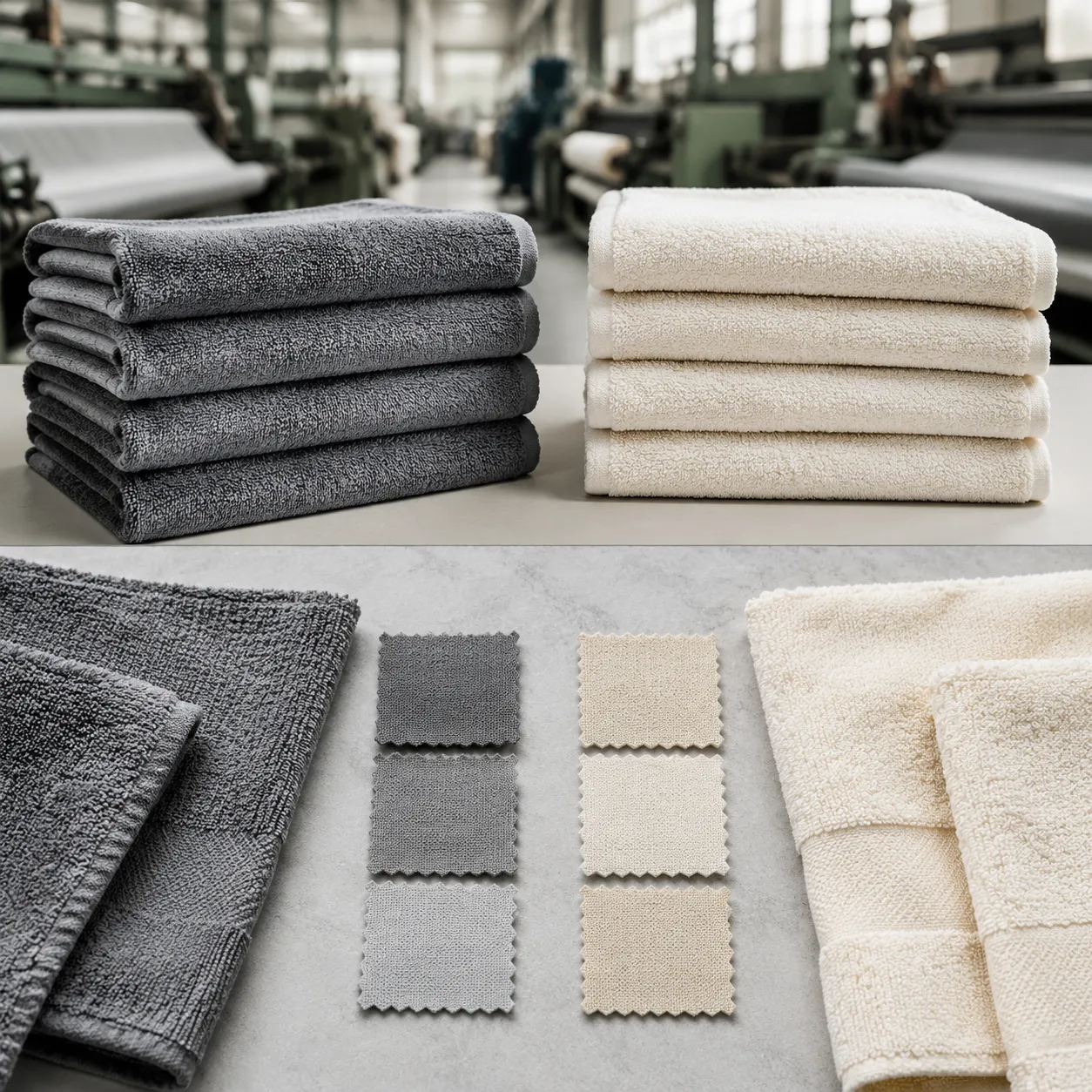
Fabric construction is the first line item because it controls both raw material cost and sewing behavior. In our mill, the most common options are warp knit microfiber, weft knit coral fleece, and suede-finished terry microfiber. Warp knit runs cleaner on snag resistance and keeps dimensional stability better after repeated washing, but it is less forgiving on very sharp fold lines during sewing. Coral fleece feels thicker at the same perceived hand but can trap heat and produce more pile distortion around the button tab if the stitch tension is not set correctly.
For curly-hair use, we also watch friction behavior. Buyers talk about frizz control, but in production terms we are managing surface pile direction, cut-end shedding, and how much drag appears when damp strands are pressed into the face fabric. We usually compare options with an internal wet-hand glide check and then confirm durability with AATCC 135 dimensional change and AATCC 61 colorfastness after laundering. A cheap fabric can pass the first feel test yet fail after five washes when the nap mats down and the towel loses absorbency speed.
| Fabric option | Typical GSM | Common use | FOB impact vs base |
|---|---|---|---|
| Warp knit microfiber, 80/20 PET/PA | 230-260 | Plopping and anti-frizz retail | Base to +USD 0.08/pc |
| Suede-touch microfiber terry | 240-290 | Balanced absorbency and lower drag | +USD 0.05-0.12/pc |
| Coral fleece microfiber | 280-340 | Softer hand, salon resale, gift sets | +USD 0.10-0.18/pc |
| Double-layer mixed construction | 300-380 combined | Higher absorbency claims, premium packouts | +USD 0.22-0.39/pc |
Pattern geometry adds more labor than most buyers expect
A rectangular towel with a sewn loop is the lowest-risk build. Once you move into contoured wraps for curly hair, sewing minutes go up because the operator handles curved seams, tab alignment, and more cut pieces. We see the biggest labor jump when a brand asks for a narrow tail section that twists easily plus a deep crown pocket for thicker curls. That shape improves fit for dense hair, but it increases cutting waste and requires better notch control during bundling.
One recurring defect mode here is tab skew after washing. If the closure loop is sewn off-grain or the reinforcement patch is too small, the loop pulls toward one side and the wrap stops sitting evenly on the head. Another issue is seam roping along the curved back edge, especially on coral fleece, where differential feed needs adjustment during overlock. These are not abstract QC points; they add rework minutes and therefore affect price.
| Shape/build | Cut pieces | Typical sewing minutes | Best fit |
|---|---|---|---|
| Rectangle + elastic loop | 1 body + 1 loop | 1.6-2.1 min | Value retail and promo bundles |
| Classic twist wrap + button | 2 body panels + 1 tab | 2.8-3.6 min | Mainstream curly-hair DTC |
| Deep-pocket curly wrap | 3 body panels + 1 tab + 1 loop | 3.9-4.8 min | Thick or long hair positioning |
| Double-layer wrap with facing | 4-5 pieces | 5.2-6.7 min | Higher AOV boxed sets |
Cost stack by volume: what we are actually quoting
Below is a practical FOB China range for a custom private-label order using 240-300 GSM microfiber, sewn button closure, one woven label, one care label, and polybag packing. This is the range we would treat as normal in 2026 for compliant production in a certified facility with OEKO-TEX 100 Class I inputs, BSCI audited social compliance, and ISO 9001 process control. The price moves outside this band when buyers ask for specialty dyeing, printed cartons, retail inserts, or very small color splits.
| Order volume per color | Typical spec | FOB USD/pc | Notes |
|---|---|---|---|
| 500-999 pcs | Warp knit 240-250 GSM, standard wrap | 1.34-1.71 | MOQ floor, setup cost still heavy |
| 1,000-2,999 pcs | Warp knit or suede-touch, custom button | 1.08-1.46 | Best zone for pilot launches |
| 3,000-7,999 pcs | Curly-specific pattern, custom packaging | 0.92-1.29 | Material yield improves noticeably |
| 8,000+ pcs | Stable spec, repeated colors, packed by barcode | 0.84-1.15 | Best for reorder economics |
- Button choice matters more than it looks. Resin mushroom buttons cost less than wrapped buttons and reduce breakage claims in transit.
- Elastic loop length tolerance should be written into the tech pack. A loose loop makes the wrap look defective even when the fabric is fine.
- Color count per PO affects waste. Four colors at 500 pcs each can price worse than two colors at 1,000 pcs each because dye lot minimums do not scale down neatly.
- Packaging format can add USD 0.09-0.38 per piece if you move from bulk polybag to printed box with insert and barcode sticker set.
Where buyers overspend, and where cutting cost backfires
We usually push back on two requests. The first is using very high GSM to signal better absorbency. For curly hair, 360 GSM microfiber can feel substantial, but it often becomes too warm during plopping and lengthens drying time after home laundering. The second is demanding ultra-low FOB while still asking for shaped panels, custom hardware, and retail packaging. Those features are labor and trim driven; there is no honest way to remove cost without changing the spec.
If the target retail price is tight, simplify the silhouette before you downgrade the fabric. Users notice drag, drying speed, and fit long before they notice whether a closure button is custom molded.
A realistic cost-per-use example helps here. We recently modeled two curly-hair wraps for a buyer targeting specialty beauty stores. Option A used 230 GSM warp knit with a simple rectangular body and landed at about USD 1.12 FOB on 3,000 pieces. It kept acceptable shape for roughly 35 home wash cycles. Option B used 265 GSM suede-touch microfiber with a better-contoured wrap and reinforced closure tab at about USD 1.24 FOB. It held appearance for around 58 cycles in consumer simulation. That is roughly 3.2 cents per use versus 2.1 cents per use before packaging and freight. The cheaper towel was only cheaper at invoice stage.
Sample stage is where curly-hair towels win or lose
For this product, a lab dip alone is not enough. We recommend a two-round sample path: first a shape-and-fit proto in greige or available stock color, then a PPS with actual bulk fabric, labels, button, and packaging. Curly-hair wraps are body-fit products. A pattern that looks balanced flat on a table can ride up at the nape once wet hair weight is added.
- RFQ review and technical clarifications: 1-2 days
- Proto sample with fit comments: 5-7 days
- Revised PPS in bulk-intended fabric: 6-9 days
- Lab tests for wash, colorfastness, and shrinkage: 4-6 days
- Bulk fabric knitting, dyeing, cutting, sewing, inspection, packing: 18-28 days after approval
Two technical checks matter here. First, measure post-wash torque along the long edge after AATCC 135; excessive spirality makes the wrap twist awkwardly around the head. Second, run a closure fatigue check by cycling the loop over the button 80-100 times. We have seen low-cost elastic lose recovery before the fabric shows any problem. If your brand sells the product on fit security, that failure will come back as a product review, not a lab complaint.
Related reads: If you are still deciding between fiber families, compare microfiber vs cotton towel behavior and use our towel GSM decision framework to keep weight claims realistic.
Spec lines that should be written into the PO
A lot of curly-hair towel orders come in with only dimensions and color, then buyers wonder why reorders drift. We need a usable tech pack. If you want consistent replenishment, write the closure details, seam type, allowable shrinkage, and absorbency expectation into the PO or approved specification sheet.
- Fabric composition: 80/20 polyester-polyamide or other blend, plus knit type
- Finished GSM tolerance: for example 250 GSM plus or minus 5%
- Finished size after wash: state pre-wash and post-wash targets separately
- Edge construction: 3-thread or 4-thread overlock, fold width if binding is used
- Closure specification: loop material, loop cut length, button diameter, reinforcement patch yes/no
- Test standards: AATCC 61 for colorfastness, AATCC 135 for dimensional stability, internal absorbency time target
- Packing details: unit pack, carton count, barcode placement, carton gross weight cap
For buyers building a better quotation pack, our article on how to build a towel tech pack mills can quote is directly relevant. If the line may expand into custom microfiber towels wholesale across categories, keeping the format consistent saves time with future RFQs.
MOQ strategy for curly-hair brands
Our standard MOQ is 500 pieces per design per color, but that does not mean every MOQ split is efficient. For microfiber hair wraps, the bottleneck is usually not knitting capacity. It is trim setup, cutting efficiency, and packaging fragmentation. If you want three colorways, each with separate insert cards and barcode labels, the unit cost on a 500-piece split rises fast.
| MOQ approach | Factory view | Cost effect | Best use case |
|---|---|---|---|
| 500 pcs x 1 color | Cleanest pilot run | Lowest setup burden | New launch test |
| 500 pcs x 3 colors | Possible but inefficient | +USD 0.11-0.19/pc vs single color | Brand needs color validation |
| 1,500 pcs x 1 color, size split only | Efficient cutting and dyeing | Better than multi-color split | Core bestseller build |
| 3,000 pcs across 2 repeat colors | Strong reorder logic | Best freight and packaging economics | Established DTC or retail account |
If you are trying to keep variety without inflating the quote, negotiate fewer variables rather than lower price. We cover the mechanics in negotiate towel MOQ without killing margin.
Freight, carton density, and why volumetric weight can surprise you
Microfiber hair wraps are light, but retail packaging can make them freight-inefficient. A soft-fold wrap in a flat polybag packs tightly. The same towel in a kraft window box with tissue and insert card can cut carton density enough to raise landed cost by more than the fabric upgrade you spent time negotiating. For air freight this matters immediately; for sea freight it matters once the program scales.
Typical export cartons for this category run 48 x 38 x 42 cm or 60 x 40 x 40 cm depending on fold format. We try to keep master carton gross weight below 12 kg for easier handling and lower crush risk on boxed retail units. If your launch quantity is under 2,000 pieces and the ship date is close, compare freight modes early using container vs air freight for towel orders rather than after bulk packing is finished.
What a buyer should ask us before approving bulk
- Ask for the actual knit construction, not just "microfiber" on the quote sheet.
- Request post-wash measurements on the approved sample, especially length through the tail section.
- Confirm whether the closure tab includes hidden reinforcement fabric.
- State if the product will be home-use retail, salon resale, or part of a broader beauty kit.
- Approve the exact folding method before carton count is locked.
- Check whether labels, inserts, and barcode stickers are packed by SKU sequence or mixed in carton.
That last point sounds minor, but mixed-SKU cartons slow inbound handling for retailers and 3PLs. It is a logistics issue that starts at the sewing floor because packers need a stable sequence plan.
Related reads: For broader sourcing control, see why gym towels fail after 50 washes for a useful durability mindset and how to read an OEKO-TEX certificate if your compliance team needs document checks before deposit.
Need a quoted curly-hair towel spec
Send target size, fabric preference, closure type, packaging format, and volume by color. We will quote with realistic FOB bands, MOQ, and production timing. WhatsApp: +86 13205717266 | Email: [email protected]
Request Quote →