Start with the part suppliers understate: usable finished size
For large-format beach towels, buyers often approve artwork first and dimensions second. We would reverse that. On oversized styles, the width is usually the first thing to drift because selvage tension, pile density, and finishing relaxation do not behave evenly across a wide loom width. If your retail card says 100×180 cm or 120×180 cm, the PO should specify finished size after wash, plus the allowed tolerance, not just loom target size.
For most cotton velour beach towels, we suggest writing tolerance as length and width within ±3% after one home-laundry wash tested to ISO 6330. If the item is yarn-dyed jacquard with a denser pile ground, we are more comfortable with ±2.5% because the construction is usually more stable. If a supplier only gives you grey-fabric dimensions or says 'normal shrinkage,' that is not enough for an oversized order.
| Retail size claim | Construction | Recommended PO wording | Typical risk if omitted |
|---|---|---|---|
| 100×180 cm | sheared velour face, terry back | Finished size after wash: 97-103 × 175-185 cm | Customer complaints that towel feels shorter than advertised |
| 120×180 cm | velour reactive print | Finished size after wash: 116-124 × 175-185 cm | Artwork approved on paper but border depth looks unbalanced |
| 100×200 cm | yarn-dyed jacquard | Finished size after wash: 97.5-102.5 × 195-205 cm | Reorder cannot match first lot dimensions |
- Ask for pre-wash and post-wash measurements from the same lab sample.
- Require the supplier to state whether the quoted size is cut size or finished packed size.
- Confirm whether the towel is measured under relaxed lay-flat condition, not stretched on inspection table.
- For e-commerce programs, add a carton-level AQL note for dimension checks on packed bulk.
The construction choice changes what an oversized towel supplier can actually deliver
Not every mill that can make a standard 70×140 cm bath towel can run a stable oversized beach towel program. The reason is mechanical, not commercial. Once you move into wider widths, pile uniformity, edge straightness, and weight consistency become harder to hold, especially on printed velour. A supplier that is strong in hotel towels may still struggle here.
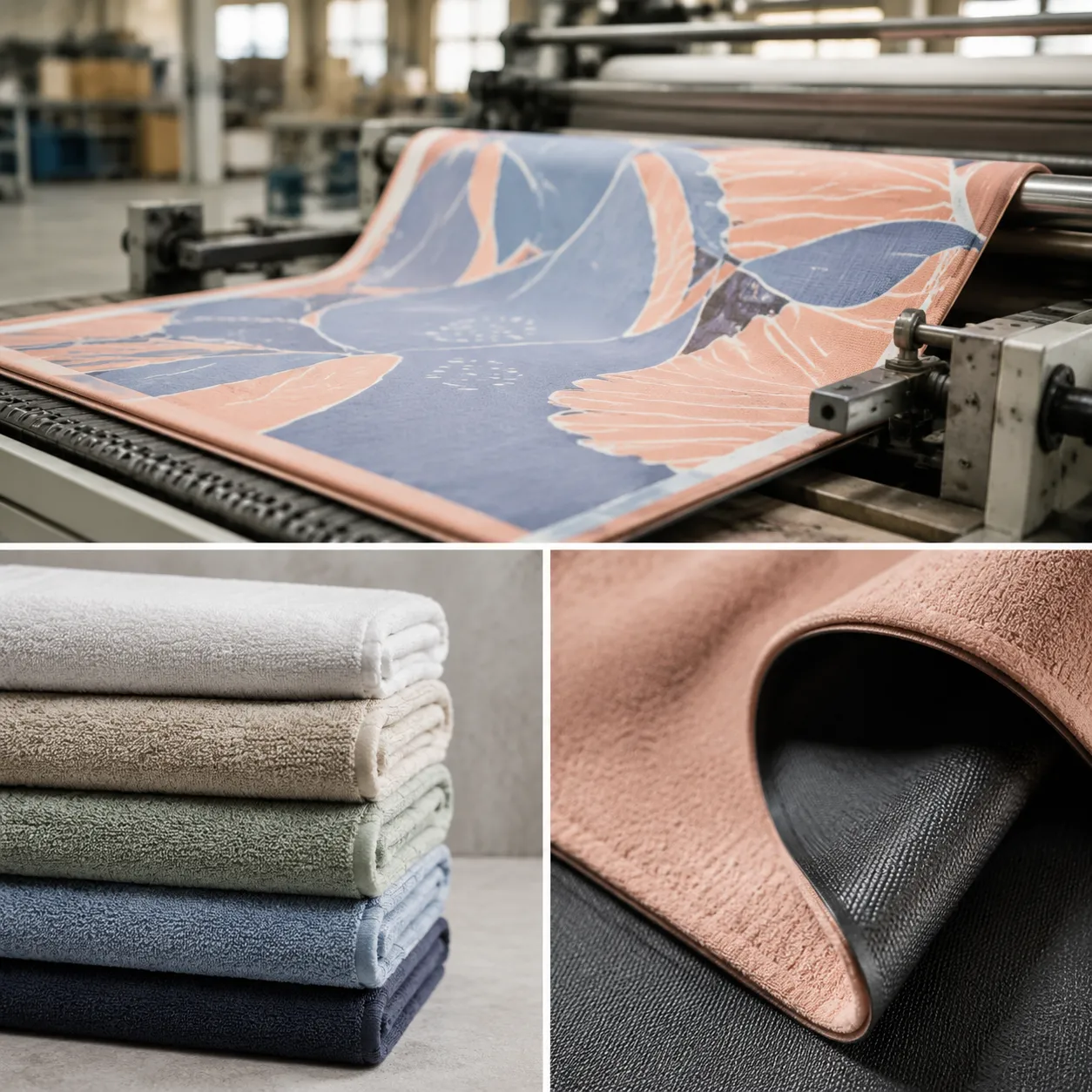
In this category, we usually see three workable constructions. Printed cotton velour is the most common for branded resort and retail programs because the face accepts artwork well. Yarn-dyed jacquard costs more but gives better pattern permanence and usually better dimensional stability. Flatwoven hammam-style oversized towels solve weight and freight issues, but they are a different user experience and should not be approved as a substitute just to hit a target price.
| Construction | Normal GSM range | Best use case | Common failure mode |
|---|---|---|---|
| Cotton velour with reactive print | 380-460 GSM | Retail graphics, beach clubs, branded pool programs | Uneven shearing causes light/dark paneling on face |
| Yarn-dyed jacquard terry | 420-550 GSM | Higher-end resort issue towels, club identity programs | Design edges soften if artwork has tiny text or thin lines |
| Flatwoven hammam with fringe | 240-320 GSM | Travel, beach boutiques, faster-dry concepts | Buyer expects terry absorbency and gets a flatter hand |
A reliable oversized beach towels supplier checklist should therefore ask the supplier which exact construction they run most often above 100 cm width, and what percentage of their output sits in that format. We would trust a factory more if it says 'about 18% of our beach line is above 100×180 cm' than if it simply says 'yes, no problem'.
Decoration limits are where oversized orders get approved too early
Large towels invite large artwork, but the decoration method still has limits. On cotton velour, reactive printing gives good penetration and wash performance, yet very dark ground shades can show slight white abrasion on the pile tips over time because the face is sheared. On jacquard, a bold logo works well, but fine script can get lost because the pattern is built by yarn float and loop contrast rather than ink resolution.
Two production details matter here. First, shearing depth on velour face affects color appearance: over-sheared panels look brighter and under-sheared areas look cloudy after printing. Second, on wide towels, bow and skew after continuous washing and drying can shift border alignment, so straight stripes near the hem need a tighter tolerance than all-over organic artwork.
- For reactive print, ask for a strike-off on actual towel base, not only paper artwork proof.
- For jacquard, request the design in repeat map view so you can judge line thickness before loom setup.
- Keep legal text, SKU text, or care icons off the towel body; place them on label or header card.
- If the artwork uses deep navy, black, or emerald fields, ask for crocking and wash data before signoff.
Related reads: if you are still choosing logo application, compare methods in embroidery-vs-sublimation-vs-jacquard.html and review color control in pantone-color-matching-custom-towels.html. For cleaner RFQs, our build-towel-tech-pack-that-mills-can-quote.html article helps buyers avoid vague artwork notes.
A fast supplier check: ask for these five lab and bulk records
If we had only one email exchange to judge whether a supplier understands oversized towels, we would ask for five records: finished-size report after wash, GSM tolerance record by lot, colorfastness to seawater, print penetration photo on cut section, and packing photos showing fold consistency for wide-format pieces. Those documents tell you much more than a generic factory profile.
- ISO 6330 wash test report showing size change after laundering.
- ISO 105-C06 colorfastness to domestic washing, especially for reactive printed dark shades.
- ISO 105-E02 colorfastness to seawater for resort and coastal programs.
- OEKO-TEX Standard 100 Class I certificate copy that is current and product-relevant.
- Recent BSCI or equivalent social compliance audit summary, plus ISO 9001 certification.
The seawater test is often skipped in generic beach towel discussions, but it matters for this category. Towels left damp after ocean use can show dye migration faster than pool-only towels, especially in saturated border bands. Another specific checkpoint is the cut-section photo of the printed pile. On weakly controlled velour, you may see good surface color and poor penetration underneath, which becomes obvious after several washes.
What we would inspect during sampling before any deposit lands
Sampling is where oversized programs are either saved or delayed. We prefer a sequence of lab dip or yarn color approval, then one proto for dimensions and handfeel, then one pre-production sample in final construction. Buyers who skip directly from artwork to bulk shade card usually save a week and lose a month later.
- Approve the base specification first: size, GSM, face construction, hem width, label position.
- Review a proto sample for handfeel, edge straightness, and fold bulk in packaging.
- Request a wash-tested pre-production sample with measured shrinkage and GSM result.
- Sign off carton packout for the large folded format so e-commerce or resort storage teams know what arrives.
On oversized towels, fold bulk is not a small matter. A 120×180 cm towel at 430 GSM can create a surprisingly thick retail fold, which changes header-card fit, carton count, and shelf presentation. We have seen buyers approve the towel and then reopen the order because the intended 24-piece master carton became impractical for hand loading. A safer range is often 12 to 18 pieces per carton depending on construction and insert packaging.
| Sample stage | What to confirm | Normal timing | Reject if you see |
|---|---|---|---|
| Proto sample | Handfeel, size balance, hem proportions | 7-10 days | Side hems roping or corners not square |
| Pre-production sample | Final color, print clarity, wash result | 10-14 days | More than agreed shrinkage or face shading |
| Packing approval sample | Fold size, barcode area, carton count | 3-5 days | Over-compressed fold causing crease marks or carton bulge |
Price bands make sense only after weight and carton math are clear
We are careful with early price comparisons in this category because one supplier may quote a 390 GSM 100×180 cm printed towel and another may quote a 450 GSM 100×180 cm jacquard towel. Both are 'oversized,' but they are not equivalent goods. The towel weight, pack count, and decoration route shift the FOB by more than most buyers expect.
For workable 2026 FOB China ranges, we see these bands as realistic for MOQ-level buying. A 100×180 cm cotton velour reactive print at 400-430 GSM often sits around USD 4.35-5.30/pc at 1,000-2,999 pieces per design. The same size in yarn-dyed jacquard around 450-500 GSM can sit around USD 5.60-6.95/pc. If the order reaches 5,000+ pieces per colorway with straightforward packout, each band can improve by roughly USD 0.28-0.55/pc depending on yarn market and artwork complexity.
| Spec scenario | MOQ | Indicative FOB China | Notes |
|---|---|---|---|
| 100×180 cm, 410 GSM, reactive print velour | 1,000 pcs/design | USD 4.35-5.30 | 2-4 colors visually, standard care label, export carton |
| 100×180 cm, 470 GSM, yarn-dyed jacquard | 1,000 pcs/design | USD 5.60-6.95 | Better stability, higher yarn and loom cost |
| 120×180 cm, 430 GSM, reactive print velour | 1,000 pcs/design | USD 5.45-6.70 | Freight and carton volume rise fast |
| 100×180 cm, flatwoven hammam, 280 GSM | 2,000 pcs/design | USD 2.85-3.95 | Different product feel; not a terry substitute |
Our MOQ is 500 pcs per design per color, but on oversized formats that low point only works cleanly when the construction is standard, the artwork is not overly fragmented, and packaging is simple. If a buyer wants 500 pieces split across several color grounds and custom belly bands, unit cost moves sharply because the towel itself is only one part of the setup.
Lead time usually slips in finishing, not weaving
Buyers often assume the loom schedule is the bottleneck. For oversized beach towels, delays are more likely in printing queue, shearing consistency checks, wash/finish stabilization, and packing of bulky folded goods. A realistic calendar should reflect that.
- Lab dips or yarn approvals: 3-5 days.
- Proto sample: 7-10 days.
- Pre-production sample with wash test: 10-14 days.
- Bulk production after approval: 25-38 days for standard orders.
- Peak-season extension: add 7-12 days if booking falls into spring beach-program rush.
If a supplier promises 18-day bulk completion on a customized oversized printed towel during peak season, we would ask what exactly is already booked: greige inventory, print line slot, and accessory stock. Without those answers, the date is probably a sales date, not an operations date. Freight then needs its own margin; see container-vs-air-freight-towel-orders.html if the launch window is tight.
The defects that show up most often on big beach towels
A useful oversized beach towels supplier checklist should include actual defect modes, not just 'check quality.' On this product, the repeat issues are quite specific. We see center shading on velour face, hem torque after wash, border mismatch from bow/skew, underweight panels across wide width, and carton compression marks if the fold is forced too tightly.
- Center shading is easier to spot on solid or dark-field designs; inspect under natural and white light.
- Hem torque appears after wash when side hems pull differently from body shrinkage.
- Bow/skew matters most on stripe layouts and framed-border artwork.
- Underweight zones often come from uneven pile density across width; random GSM checks should sample left, center, and right.
- Compression marks become retail returns when towels stay packed too long in humid transit.
For bulk QC, we recommend AQL inspection plus targeted checks on width and face appearance. If you already run structured acceptance procedures for hospitality towels, adapt them rather than starting over; hotel-towel-sourcing-guide-2026.html and beach-club-resort-towel-program.html show how program-level controls can carry across categories.
A short supplier screen before you send artwork
Before sharing design files, we would ask eight plain questions. The answers usually tell us whether the supplier is ready for oversized beach towels or only wants to quote them.
- What oversized sizes above 100 cm width did you ship in the last 12 months?
- Which construction was used on those runs: reactive print velour, jacquard, or flatwoven?
- What post-wash size tolerance do you commit to in writing?
- Can you share one recent ISO 6330 size-change record and one ISO 105-E02 seawater test result?
- What is the normal GSM tolerance across left, center, and right positions?
- How many pieces per export carton do you recommend for this exact size and GSM?
- What is your MOQ by design and by color for this construction?
- Which certificates are current: OEKO-TEX 100 Class I, BSCI, ISO 9001?
Related reads: buyers building a broader resort linen range usually pair this category with chair-towels-lounger-pool-deck-guide.html and beach-towels-in-bulk-buyers-guide.html. If you are still balancing cost against service life, towel-gsm-decision-framework.html is a useful cross-check.
What we need to quote cleanly
To quote an oversized beach towel accurately, we need fewer buzzwords and more hard inputs: target finished size, construction, GSM, artwork method, color count, packing method, quantity per design and color, destination market, and whether testing is required before shipment. With that, we can usually return a workable quote and construction recommendation quickly instead of trading revisions for a week.
We operate with 220 employees, have supplied 80+ brand clients across 47 countries since 2007, and produce about 2.4 million towels per year. Our standard MOQ is 500 pcs per design per color. We are certified to OEKO-TEX Standard 100 Class I, BSCI, and ISO 9001. If you want us to review a spec sheet or compare an oversized concept against a more freight-efficient alternative, contact us at [email protected] or WhatsApp +86 13205717266.
Need a workable oversized towel quote
Send size, GSM, artwork, quantity, and packout target. We will flag shrinkage, decoration, and carton risks before sampling.
Request a Quote →