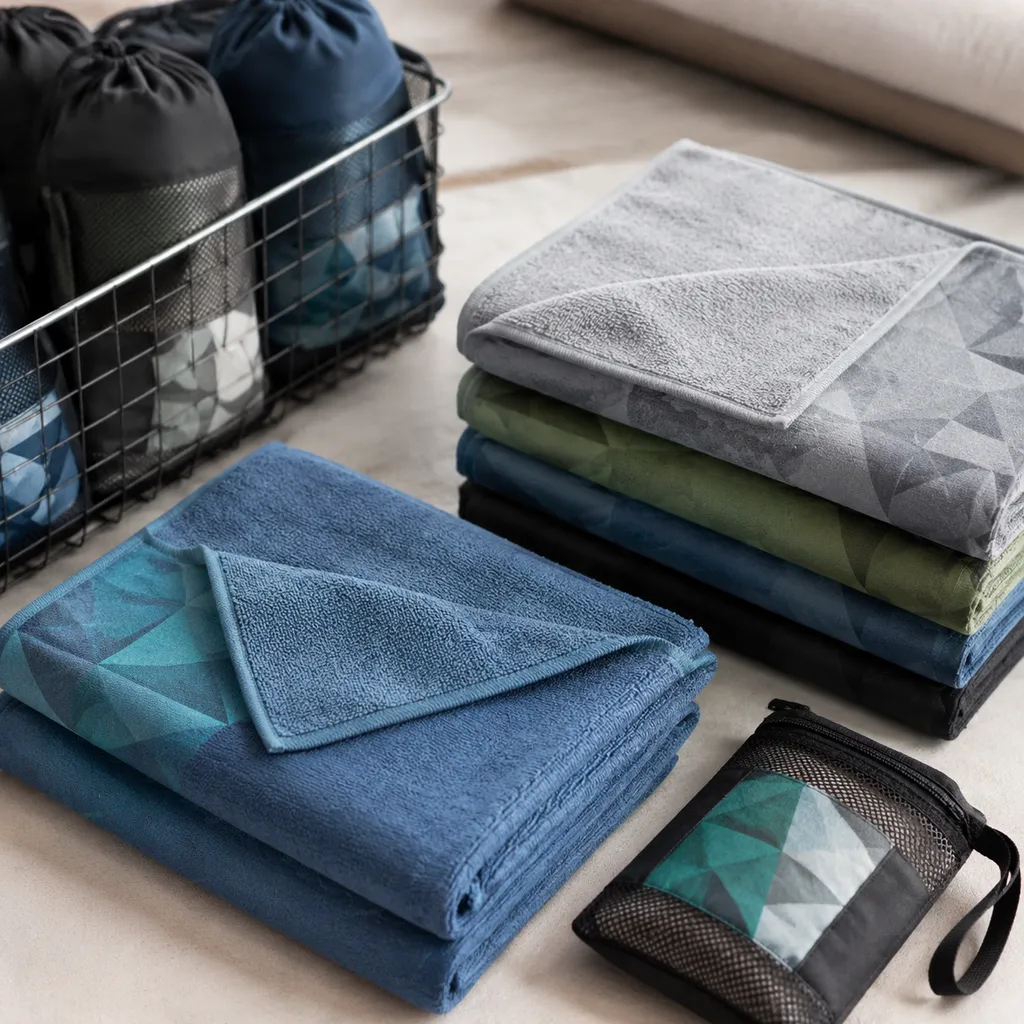
The price trap is usually not the fabric roll
For a compact travel towel OEM order, the base microfiber fabric is only one part of the quote. Buyers often compare two FOB prices and assume the lower one means the mill is more efficient. In many cases, the difference is hidden in edge finishing, pouch construction, absorbency after finishing, print method, or carton packout.
We make these towels on the same cutting, sewing, printing, and inspection floor used for gym, beach, spa, and automotive microfiber programs. A quick dry microfiber towel looks simple because it folds small, but it is sensitive to finishing chemistry and heat. Too much softener reduces water pickup. Too much heat during transfer printing can flatten the pile face and leave glossy panels. A cheap overlock seam can also curl after ISO 6330 wash cycles if the thread tension is not balanced.
Our standard MOQ remains 500 pcs per design / per color. For travel towels, that MOQ is workable if the buyer keeps one fabric, one edge color, and one pouch style. Once each towel size gets a different print, pouch, hangtag, and barcode, the same 500 pcs becomes several small factory setups rather than one efficient run.
| Cost line | What we measure | Typical risk if under-specified |
|---|---|---|
| Microfiber fabric | GSM, composition, split ratio, face texture | Towel dries fast but pushes water around instead of absorbing |
| Cutting yield | Marker layout, shrinkage allowance, tolerance | Finished size runs short by 2-4 cm after first wash |
| Edge finish | Overlock width, thread count, needle size | Curling corners, needle holes, seam abrasion |
| Logo method | Sublimation, heat transfer, woven label, silicone badge | Glazing, dye migration, stiff hand-feel |
| Pouch and retail pack | Mesh weight, zipper type, drawcord, barcode label | Pouch costs almost as much as the towel on small sizes |
Quick dry travel towel bulk pricing model: four quote scenarios
Below is how we usually separate a quick dry travel towel bulk pricing model before we quote a custom travel towel bulk order. These are FOB China reference bands, not promises for every artwork or destination. Cotton prices, polyester filament pricing, exchange rate, and carton cube can move the final number, but the ranges are realistic for 2026 factory discussions.
| Spec scenario | 500 pcs | 2,000 pcs | 5,000 pcs | 10,000 pcs |
|---|---|---|---|---|
| 40×80 cm, 160 GSM suede microfiber, overlock edge, no pouch | USD 0.96-1.24 | USD 0.74-0.92 | USD 0.63-0.78 | USD 0.58-0.70 |
| 60×120 cm, 180 GSM suede microfiber, mesh pouch, one woven label | USD 1.86-2.35 | USD 1.48-1.82 | USD 1.31-1.56 | USD 1.22-1.43 |
| 75×150 cm, 200 GSM suede microfiber, full sublimation, drawstring pouch | USD 3.42-4.18 | USD 2.76-3.28 | USD 2.46-2.88 | USD 2.29-2.66 |
| 80×160 cm, 220 GSM terry microfiber, snap loop, zipper pouch, retail insert | USD 4.35-5.25 | USD 3.58-4.18 | USD 3.16-3.68 | USD 2.98-3.42 |
The difference between 500 pcs and 5,000 pcs is not just fabric buying power. At 500 pcs, we still have artwork checking, sublimation paper setup, cutting table setup, sewing line balancing, pouch sourcing, packing instruction, and inspection reporting. At 5,000 pcs, those setup steps are spread across more units, and fabric marker efficiency improves because we can cut deeper lays.
For travel retail, the pouch can add USD 0.18-0.62 per set depending on zipper, mesh density, size, and label. That is why a buyer chasing a USD 1.50 FOB target for a 60×120 cm towel with full pouch packaging often has to choose between smaller size, lighter GSM, simpler branding, or higher volume.
Choose the drying hand-feel before choosing GSM
GSM alone does not tell us whether the towel will feel like a hiking towel, yoga towel, beach cover-up, or car drying cloth. For microfiber travel towel wholesale programs, we first ask how the end user will use it: backpacking, hotel amenity, water sports, camping retail, gym kit, airline kit, or festival merchandise.
Suede microfiber is smooth, compact, and prints cleanly. It folds small and works well from 150-200 GSM. Terry microfiber has loop structure, better perceived absorbency, and a softer hand, but it packs larger and usually sits at 200-280 GSM. Waffle microfiber is lighter and tactile, but print detail is less sharp because the surface is not flat.
| Construction | Usual GSM | Best use | Factory comment |
|---|---|---|---|
| Suede microfiber, 80/20 polyester-polyamide | 150-200 GSM | Backpacking, branded travel kits, quick-dry retail towels | Best for sublimation artwork and tight packing |
| Terry microfiber, 80/20 or 85/15 | 200-280 GSM | Gym showers, boat towels, resort excursion towels | Feels more towel-like but costs more in freight cube |
| Waffle microfiber | 180-240 GSM | Spa travel sets, yoga and camping accessories | Good grip; artwork should be simple |
| Cooling knit polyester | 120-170 GSM | Neck towel, outdoor event giveaway | Different product class; not a bath replacement |
- 150-160 GSM suede: lowest cube and fastest dry-down, but thinner hand; better for promo or ultralight travel.
- 180-200 GSM suede: our most common balance for compact retail travel towels with logo print and pouch.
- 220-240 GSM terry microfiber: stronger shower-towel feel; useful for fitness travel sets and cruise excursions.
- 260 GSM and above: absorbent but less compact; buyers should check carton volume before approving.
A common mistake is approving a soft hand sample that has been heavily treated, then discovering it performs poorly. We test absorbency before bulk approval because softener residue can add a pleasant touch while slowing water intake. For cotton comparisons, see our microfiber vs cotton towel comparison, but travel towels are usually microfiber because packed weight and drying time matter more than traditional terry loft.
Print, label, or border: the decoration choice changes more than appearance
Most travel towel branding is done by sublimation, woven label, heat-transfer logo, or printed pouch. Sublimation works best on polyester-rich suede microfiber. It can reproduce gradients and map-style artwork, but the artwork must be built to the towel size with bleed. A 2 mm white edge on the PDF can become a visible white line after cutting.
Heat transfer is useful for small chest-size marks or club logos, but large transfers make the towel less foldable and can create a plastic hand. Woven labels cost little per piece at volume, but labels need their own MOQ and lead time. If the label is placed on a corner used for hanging, we reinforce the stitch so the label does not tear out under wet load.
- Full sublimation: adds roughly USD 0.28-0.72 per towel depending on size and paper coverage.
- Woven side label: usually USD 0.035-0.09 per piece after label setup, but small logo text may blur.
- Silicone badge: stronger retail look, often USD 0.12-0.28 per piece, with extra stitching time.
- Printed pouch only: keeps towel cost lower and works well when the towel is a solid color.
- Snap loop or carabiner tab: useful for hiking; check pull strength, not only appearance.
For buyers deciding between sublimation and woven methods, the decision logic overlaps with our decoration article embroidery vs sublimation vs jacquard. We do not recommend embroidery directly onto suede microfiber travel towels for most bulk programs. The stitch area can pucker, and dense thread reduces flexibility when the towel is folded into a small pouch.
The tests we ask buyers to approve before bulk
A low quote is not useful if the towel fails in the first review cycle. For quick-dry travel towels, we use measurable checks instead of relying on hand-feel comments. The most important are absorbency, drying behavior, dimensional stability, colorfastness, seam strength, and print durability.
| Check | Method or factory procedure | Typical acceptance target |
|---|---|---|
| Initial absorbency | AATCC TM79 drop test on finished towel face | Water drop absorbed within 3 seconds for suede microfiber |
| Drying comparison | Controlled hang-dry at 21-23°C and 50-60% RH after 100% wet pickup | Target dry-down 35-70 minutes depending on GSM and size |
| Wash stability | ISO 6330, 5 cycles before measuring size and seam behavior | Shrinkage within ±3%; no seam twisting or corner curl beyond 8 mm |
| Colorfastness to washing | ISO 105-C06 | Grade 4 or above for color change and staining |
| Rubbing fastness | ISO 105-X12 dry and wet crocking | Dry grade 4; wet grade 3-4 or better for printed panels |
| Restricted substances | OEKO-TEX Standard 100 Class I applicable material and accessory review | Certificate scope must cover fabric, thread, print, and trims |
We are certified to OEKO-TEX Standard 100 Class I, BSCI, and ISO 9001. For a buyer importing into children’s travel kits or airline amenity packs, certificate scope matters. A fabric certificate alone does not automatically cover zipper paint, silicone badges, drawcord tips, or transfer film. If you need help reading the certificate scope, our article on how to read an OEKO-TEX certificate explains the fields buyers often miss.
Antimicrobial travel towel requests need extra caution. Some treatments add cost and can affect OEKO-TEX scope. We ask for the target claim language before sampling because “odor control,” “antibacterial,” and “silver ion treated” are not the same claim in retail compliance. If a buyer cannot support the claim on packaging, we would rather supply an untreated towel that washes cleanly and dries fast.
Pouch design can quietly break the margin
The pouch is where many quick dry travel towel bulk pricing model errors appear. Buyers see it as packaging, but the factory sees a second sewn product with its own material, cutting, labor, zipper or drawcord, inspection, and sometimes printed artwork. A simple mesh drawstring pouch may be fine for outdoor retail. A zipper pouch with transparent EVA window, hang loop, barcode, and insert card can add more labor than the towel edge seam.
For a 60×120 cm towel packed to about 17×12×4 cm, a tight pouch saves shelf space but increases packing time. If the towel must be rolled exactly, the line slows down. If it can be folded in thirds and inserted flat, output improves. We time this during pilot packing because a difference of 9 seconds per set becomes more than 12.5 production hours on a 5,000 pc order.
- Confirm folded size using the washed towel sample, not only the fresh sample.
- Decide whether the pouch is reusable product packaging or only transit packaging.
- Specify zipper, drawcord, mesh GSM, and label position in the tech pack.
- Run a carton drop check if the pouch has a rigid insert or window.
- Include barcode scanning during pre-shipment inspection if selling through retail channels.
If your internal team has not built a towel tech pack before, start with our guide on how to build a towel tech pack that mills can quote. A clear pack drawing saves more time than another round of price negotiation.
A realistic sampling and production calendar
We do not treat travel towels as a same-week product unless the buyer accepts existing fabric, existing pouch, and no printed artwork. For custom printed programs, the artwork proof and wash check need time. Rushing that stage is how white borders, off-size pouches, and poor absorbency reach bulk.
- Artwork and spec review: 1-3 days if the buyer supplies AI, PDF, Pantone references, size, GSM, pouch sketch, and packing method.
- Lab dip or print strike-off: 5-8 days for sublimation color approval; darker navy, forest green, and red need extra attention on microfiber.
- Proto sample with pouch: 7-12 days depending on pouch material and trims.
- Bulk production: 18-30 days after deposit and sample approval for most 500-10,000 pc orders.
- Final inspection and export packing: 2-4 days, including carton mark check and AQL report.
For shipping, compact towels are better than cotton bath towels, but carton cube still matters. A 75×150 cm 200 GSM suede microfiber towel with pouch often packs around 35-45 pcs per export carton depending on fold style. Terry microfiber at 240 GSM may drop below 30 pcs per carton. Air freight can work for launch quantities, but replenishment should move by sea or rail where possible. Our container vs air freight towel orders guide gives the wider freight trade-off.
We recommend placing production orders at least 45-60 days before the required warehouse date for new artwork. If the buyer needs retail photography, add another 7-10 days after approved samples. Reorders from approved fabric and artwork can be faster, often 20-25 production days, but only if the same pouch and trims remain available.
How to lower cost without making a disposable towel
There are responsible ways to reduce price. The weakest approach is cutting polyamide content too far, using poor finishing, and hoping the user will not notice. A towel that feels slick and barely absorbs water may still pass a visual inspection, but it will create bad reviews for a travel brand.
One outdoor retailer asked us to reduce a 70×140 cm program that included full sublimation, zipper pouch, silicone badge, and retail insert. Instead of dropping fabric quality, we moved from a zipper pouch to a printed mesh drawstring pouch, reduced the towel from 210 GSM to 190 GSM suede microfiber, and changed the silicone badge to a woven corner label. The FOB moved from roughly USD 3.38 to USD 2.71 at 3,000 pcs, while absorbency stayed within the approved AATCC TM79 target. That is a better saving than shaving yarn quality until the towel fails.
- Keep one towel size across several artwork designs so cutting remains efficient.
- Use pouch printing instead of full towel printing when the towel itself can be a stock color.
- Select 180-200 GSM suede microfiber before jumping to heavier terry for travel use.
- Limit individual polybagging if the reusable pouch already protects the towel.
- Avoid excessive colorways below 1,000 pcs each; dyeing and trim setup become inefficient.
Cost-per-use is also a better lens than FOB alone. If a USD 2.42 travel towel survives 60 real wash-and-dry uses, the towel cost is about USD 0.040 per use. A USD 1.76 version that loses absorbency or seam shape after 18 uses costs about USD 0.098 per use, before returns and brand damage. We use different numbers for every project because size, GSM, and usage are different, but the logic is consistent.
RFQ details that let us quote cleanly
A clean RFQ lets us separate real savings from missing information. If a buyer writes only “quick dry travel towel, logo, pouch, best price,” the quote will contain assumptions. Those assumptions often change after sampling, which makes the first price misleading.
- Finished size and tolerance, for example 60×120 cm with ±2 cm after washing.
- Target GSM and construction: suede, terry, waffle, or cooling knit.
- Composition preference such as 80/20 polyester-polyamide microfiber.
- Logo method, artwork file, Pantone references, and print coverage percentage.
- Pouch type, size target, mesh or polyester fabric, zipper or drawcord, and label details.
- Packing method: folded, rolled, individual pouch, hangtag, insert card, carton quantity.
- Required certification: OEKO-TEX 100 Class I, BSCI factory documentation, ISO 9001 process control.
- Order quantity by design and color, with reminder that our MOQ is 500 pcs per design / per color.
- Destination port or delivery term so we can flag carton cube and freight risk early.
Related reads: for microfiber construction trade-offs, review custom microfiber towels wholesale guide and microfiber vs cotton towel comparison. For towel size decisions before sampling, use our towel sizes dimensions complete guide.
Related reads: if your travel towel is part of a fitness or outdoor kit, our sweat towels for gym spec guide and pantone color matching custom towels are useful before artwork approval.
LUMA & CO. TEXTILE has operated since 2007 with about 220 employees in Gaoyang, Zhejiang, China. We produce roughly 2.4M towels annually for 80+ brand clients across 47 countries. For a quick dry travel towel bulk pricing model based on your exact size, GSM, decoration, pouch, and carton plan, send the RFQ to [email protected] or WhatsApp +86 13205717266.
Send us the travel towel spec
Share size, GSM, artwork, pouch style, quantity, and target ship date. We will return a factory-side quote with the cost drivers separated clearly.
Request a quote →