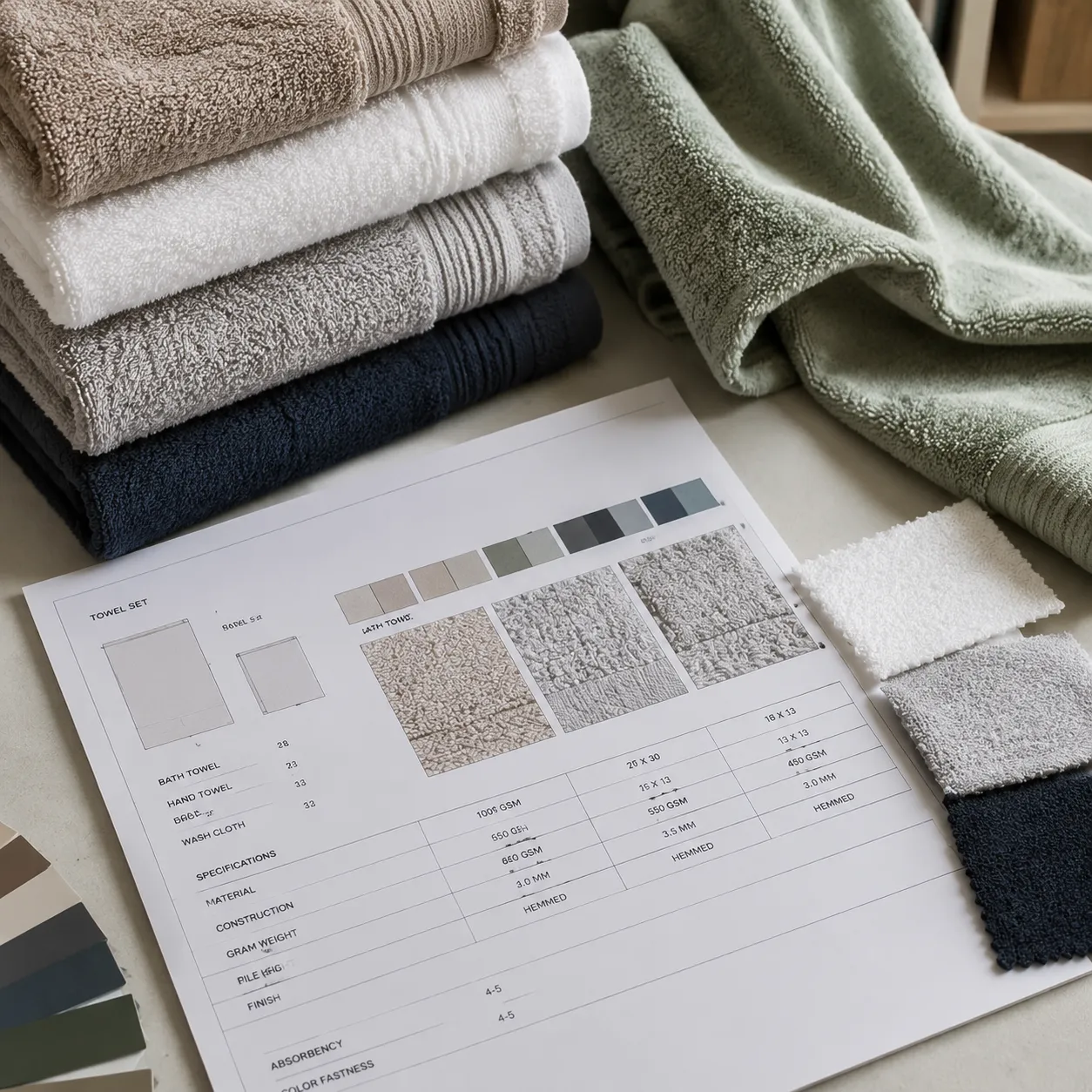
Why the TDS decides the quote
A towel set is not one product. It is usually three to five SKUs that must match in shade, yarn feel, border style, label placement, carton ratio, and wash behavior. If the bath towel is specified clearly but the hand towel and washcloth are left vague, the factory has to assume. Assumptions are where cost gaps, sample delays, and bulk disputes start.
For private label programs, we treat the technical data sheet as the commercial control document. It sits between the design file and the purchase order. Our merchandising team uses it for costing, our weaving team uses it for loom planning, our dyehouse uses it for shade and absorbency targets, and our QC team uses it for incoming, inline, and final inspection.
The private label towel set buyer technical data sheet should be specific enough that two factories quoting the same file would understand the same construction. It does not need to be complicated, but it must define the measurable points: size before and after wash, GSM, yarn count, pile height, border width, color standard, decoration method, packaging, test requirements, and allowed tolerances.
| TDS area | Factory question it answers | If missing |
|---|---|---|
| Set structure | Which SKUs and ratios are included? | Bath towels may be priced, while hand towels and washcloths are estimated too low. |
| Construction | What yarn, pile, ground, and GSM are required? | The sample may feel acceptable but bulk weight can drift by 6-10%. |
| Color and decoration | Which Pantone, lab dip, embroidery, or jacquard rule applies? | Shade bands and logo placement become subjective. |
| Testing and QC | Which wash, absorbency, shrinkage, and inspection standards apply? | Buyer and mill argue after shipment instead of before production. |
| Packaging | How is the set folded, banded, labeled, and cartoned? | Carton cube and retail presentation change after price approval. |
Private Label Towel Set Buyer Technical Data Sheet fields
We recommend building the first page of the TDS like a line sheet, not like a design mood board. A sourcing manager should be able to send this page to costing and receive a realistic FOB China quote without another five emails.
- Program name and season: for example, Resort Core White SS26 or DTC Bath Bundle Launch 01.
- Set contents: bath towel, bath sheet, hand towel, washcloth, face towel, or bath mat, with units per set.
- Target channel: hotel laundry, spa retail, gym membership kit, ecommerce gift box, or wholesale shelf pack.
- Material claim: 100% cotton, combed cotton, cotton-bamboo blend, microfiber, or Turkish cotton if substantiated.
- Certification need: OEKO-TEX Standard 100 Class I, BSCI factory audit, ISO 9001 quality system, or customer restricted substance list.
- Commercial frame: MOQ 500 pcs per design per color, target order quantity, ship window, and Incoterm such as FOB Ningbo or CIF destination port.
We are careful with material claims because they affect testing and labeling. If a buyer writes “Turkish cotton feel” but does not require Turkish origin, that should be stated as a hand-feel reference, not a fiber claim. If a towel is sold in a baby or family category, OEKO-TEX Standard 100 Class I is usually requested because it is stricter for skin-contact textile articles.
Set ratios and sizing before construction
The set ratio changes the cost more than many buyers expect. A 1 bath towel + 1 hand towel + 1 washcloth set uses a different carton cube and label plan than a 2 bath + 2 hand + 2 washcloth family pack. We ask buyers to define the set first, then the construction. Otherwise the factory may optimize the wrong SKU.
| SKU | Common finished size | Private label tolerance | Typical GSM range | Use note |
|---|---|---|---|---|
| Bath towel | 70 x 140 cm or 76 x 152 cm | +/-3 cm after wash | 500-680 GSM | Hotel and DTC core item; heavier GSM increases freight quickly. |
| Bath sheet | 90 x 160 cm or 100 x 180 cm | +/-4 cm after wash | 520-700 GSM | Good for resort retail, but carton cube can rise 25-35%. |
| Hand towel | 40 x 70 cm or 50 x 80 cm | +/-2 cm after wash | 450-620 GSM | Border alignment matters because it is often displayed folded. |
| Washcloth | 30 x 30 cm or 33 x 33 cm | +/-1.5 cm after wash | 420-580 GSM | Small size exposes sewing twist and corner squareness defects. |
| Bath mat | 50 x 80 cm | +/-2.5 cm after wash | 700-950 GSM | Needs separate loom and drying control; do not price as a normal towel. |
A useful towel set specification sheet includes both loom-state and finished-state sizes. Cotton terry usually shrinks during scouring, dyeing, tumble drying, and the buyer’s laundry trial. For a 76 x 152 cm bath towel at 620 GSM, the finished towel weight is about 716 g if measured by area. If the same towel is allowed to drift to 580 GSM, the finished weight drops to about 670 g. That 46 g difference is visible in hand feel and in carton weight.
For buyers still deciding the size ladder, our towel sizes and dimensions guide is a good reference. If the set is built for hotel replenishment rather than retail, the hotel towel sourcing guide explains how housekeeping teams evaluate bath, hand, and face towel counts.
Construction lines mills cannot guess
A private label towel set buyer technical data sheet should not stop at GSM. GSM tells us mass, but not how the towel is built. Two towels at 600 GSM can feel different if one uses longer pile loops, lower twist yarn, and a tighter ground while the other uses shorter loops and a heavier base.
The construction section should identify pile yarn, ground yarn, weft yarn, loop height target, hem style, border style, and whether the towel is yarn-dyed, piece-dyed, or white bleached. In our mill, we also record reed density and pick density internally, but most buyers do not need to specify those unless they are matching an existing sample.
| Construction line | Practical range | Factory note |
|---|---|---|
| Pile yarn | 16s/1, 21s/2, 32s/2 cotton depending on hand feel | Lower count gives bulk; finer yarn supports denser, smoother pile. |
| Ground yarn | 20s/2 or 21s/2 cotton common | Ground yarn controls stability and edge distortion after wash. |
| GSM tolerance | +/-5% for bulk production | Tighter than +/-3% raises sorting and rejection cost. |
| Pile height | 3.5-6.5 mm for most bath sets | High pile feels plush but snags more easily in commercial laundry. |
| Hem width | 1.5-3.0 cm typical | Narrow hems curl on heavy bath towels if stitch tension is not controlled. |
| Dobby border | 3-8 cm typical | Wide borders can shrink differently from terry body and create waving. |
One construction quirk we watch closely is border-to-body shrinkage. A dobby border has a different weave structure from terry loops, so after ISO 6330 domestic wash cycles or a buyer’s commercial laundry test, the border can contract more than the pile area. If the border is too wide on a high-GSM towel, it may ripple across the width. We normally run a pre-production wash check before bulk cutting when the border exceeds 6 cm.
Another defect mode is torque, where a towel looks rectangular before wash but twists after drying. This often comes from uneven yarn tension, sewing tension, or unbalanced ground construction. On washcloths and hand towels, even a 1.5 cm skew is obvious because the customer sees the folded edge on shelf.
Color, logo, and label control
Private label towel sets often fail visually before they fail physically. The bath towel may pass GSM and absorbency, but if the hand towel is half a shade warmer, the set looks mismatched in retail packaging. We require one approved color standard per colorway, plus a shade band approved under D65 light and, if needed, TL84 store light.
- Use Pantone TCX or TPX for design reference, but approve production by lab dip or physical standard, not screen color.
- Define shade tolerance using a signed A/B/C shade band if the brand accepts small variation across SKUs.
- State logo method: embroidery, jacquard, woven label, heat transfer, print, or no decoration.
- Lock logo placement from finished edge, not cut edge, because shrinkage changes the reference point.
- List label composition including fiber content, country of origin, wash symbols, batch code, and brand label position.
Decoration should be matched to the construction. Embroidery on a 500 GSM hand towel needs backing and stitch density control so the logo does not pucker after washing. Jacquard is cleaner for all-over pattern sets, but MOQ and loom setup are less flexible. For method selection, buyers can compare embroidery vs sublimation vs jacquard and our note on Pantone color matching for custom towels.
For logo towels, the TDS should include artwork file type, thread color, maximum stitch count, logo size, and location tolerance. For embroidery, we commonly allow +/-5 mm placement tolerance on bath towels and +/-3 mm on hand towels. If the buyer requests a logo 12 mm from a hem edge, that is too tight for terry because the pile compresses under the embroidery frame.
Testing standards to write into the TDS
Testing language should be written before the deposit, not added after bulk goods are ready. A clear OEM towel tech pack names the test method, wash cycle, pass level, and who pays for third-party testing. Without those details, a “washable” claim is too vague.
| Test item | Method we commonly reference | Typical pass level |
|---|---|---|
| Dimensional change | ISO 6330 wash procedure + ISO 5077 measurement | Within -5% to +2% after 3 washes, unless buyer specifies commercial laundry. |
| Colorfastness to washing | ISO 105-C06 | Grade 4 staining and 4 color change for white or light towel sets. |
| Colorfastness to rubbing | ISO 105-X12 dry/wet crocking | Dry grade 4, wet grade 3-4 for medium and dark shades. |
| Absorbency | AATCC 79 or internal drop test with timed wet-out | Water drop absorbed within 5 seconds after finishing wash. |
| Fiber content | ISO 1833 series, where applicable | Within declared composition tolerance for market labeling. |
| Inspection sampling | ANSI/ASQ Z1.4 or ISO 2859-1 | General Level II, AQL 2.5 major and 4.0 minor unless agreed otherwise. |
We also recommend a buyer-side laundry trial when towels will enter hotel, spa, or gym operations. For example, a 620 GSM cotton bath towel may look strong after three domestic washes but show edge abrasion after 20 commercial tunnel-wash cycles if the hem stitch density is too low. Our internal pre-shipment inspection checks open seams, oil marks, needle cuts, pile pulls over 10 mm, skew, shade variation, incorrect labels, and carton count.
For certification paperwork, the TDS should name the requirement exactly: OEKO-TEX Standard 100 Class I for skin-contact confidence, BSCI for social compliance audit status, and ISO 9001 for quality management. Buyers who need to verify certificate scope can use our guide on how to read an OEKO-TEX certificate.
Packaging, carton, and barcode details
Packaging looks like a small line item until the order reaches packing. A towel set can be packed loose, belly-banded, ribbon tied, packed in a kraft box, inserted in a reusable cotton bag, or vacuum compressed for ecommerce. Each choice changes labor time, carton size, moisture risk, and barcode control.
- Define the folding method with a photo or diagram for each SKU in the set.
- State whether towels are packed as a set or as individual SKUs with set assembly at destination.
- Provide barcode type, sticker size, placement, and scan requirement before bulk packaging materials are printed.
- Confirm whether polybags need suffocation warnings, recycling marks, or retailer carton labels.
- Set carton gross weight limits; we prefer 13-18 kg for towel export cartons to reduce crushing and handling damage.
Moisture control matters for dense cotton towels. We target finished goods moisture below 8% before carton sealing, and we avoid sealing hot towels directly after tumble drying. If cartons are loaded too soon, trapped humidity can create a stale odor during a 28-36 day sea transit. For long transit routes, buyers may request desiccant packs, but the better control is proper conditioning time before packing.
Carton packout also affects freight. A 6-piece family towel set in a rigid retail box may look good online, but it can reduce container loading efficiency by 18-24% versus belly-band packaging. If air freight is possible for a launch deadline, read container vs air freight for towel orders before approving bulky packaging.
Pricing bands tied to real specs
A technical data sheet should not force buyers to accept one construction. It can show an approved target and one or two controlled alternates. That lets procurement compare cost-per-use instead of asking for a cheaper towel with undefined compromises.
| Set example | MOQ and volume | FOB China price band | What drives the cost |
|---|---|---|---|
| 3-piece cotton set: 70 x 140 bath, 40 x 70 hand, 30 x 30 washcloth at 520 GSM | 500-1,200 sets | USD 6.40-7.85 per set | Combed cotton, piece dyeing, simple woven label, belly band. |
| 4-piece hotel-style set: 2 bath + 1 hand + 1 washcloth at 600 GSM | 1,500-3,000 sets | USD 13.90-16.20 per set | Higher yarn weight, tighter shade matching, larger carton cube. |
| 6-piece retail gift set: 2 bath + 2 hand + 2 washcloth at 560 GSM with embroidery | 2,000-5,000 sets | USD 18.70-22.40 per set | Embroidery stitch count, gift box, barcode labels, extra packing labor. |
| Jacquard private label set with bath, hand, washcloth logo pattern | 3,000-8,000 sets | USD 9.80-12.60 per 3-piece set | Loom setup, yarn-dyed color control, longer sampling approval. |
These are realistic 2026 bands for standard cotton towel sets, not binding quotes. Yarn market, exchange rate, dyeing complexity, and packaging can shift the final price. For most new private label towel programs, our MOQ is 500 pcs per design per color. If a set contains three SKUs, we need to clarify whether MOQ is counted per SKU/color or per assembled set, because production planning is not the same.
A cost-per-use check is useful. Suppose a 4-piece rental-villa set at 540 GSM costs USD 12.80 and survives 42 guest turnover washes before downgrade. The textile cost is about USD 0.30 per turnover. If reducing GSM and hem quality drops the landed set cost to USD 11.10 but downgrade happens at 27 turnovers, the textile cost becomes about USD 0.41 per turnover. The cheaper order costs more in use, before housekeeping labor is counted.
Sample approval and bulk timing
A clean TDS shortens the calendar because we can quote, sample, and test without reopening every detail. For a new private label towel set, the normal path is not one sample and then bulk. It is RFQ, lab dip or yarn color approval, proto sample, revised sample if needed, pre-production sample, bulk weaving, finishing, inspection, packing, and export.
- RFQ review and costing: 2-4 working days after we receive the TDS, artwork, quantity, and packaging brief.
- Lab dips for dyed cotton: 5-8 days, longer for dark navy, charcoal, and saturated green shades.
- Proto sample: 7-12 days for plain dyed towels, 12-18 days for embroidery or jacquard.
- Pre-production sample after approval: 5-7 days including label and packaging confirmation.
- Bulk production: 25-38 days for most cotton sets after deposit and sample signoff.
- Final inspection, packing, and export docs: 3-6 days depending on carton labeling and booking schedule.
For repeat orders using approved yarn, color, and packaging, production can be faster. For new colors and new packaging, do not compress lab dip approval. Rushing shade approval is one of the most expensive mistakes in towel sets because all SKUs must live together in the same package.
If your internal team has never built a mill-ready document, start with our towel tech pack guide. For MOQ trade-offs, the practical issues are covered in negotiate towel MOQ without killing margin.
Buyer checklist before sending the RFQ
Before sending a private label towel set buyer technical data sheet to any factory, check whether the file can answer production questions without a meeting. If it cannot, the quote will either be padded for risk or too low to survive sampling.
- Every SKU has a finished size, GSM target, tolerance, yarn direction, and hem or border description.
- The set ratio and packing method are clear enough to calculate carton quantity and freight cube.
- Color standards are physical or lab-dip based, not only RGB, CMYK, or website screenshots.
- Logo artwork includes size, placement, stitch or weave details, and approved thread or yarn color.
- Testing methods name ISO, AATCC, ANSI/ASQ, or customer methods with pass levels.
- Certification requirements list OEKO-TEX 100 Class I, BSCI, ISO 9001, or retailer RSL needs before quotation.
- MOQ, target volume, Incoterm, destination, and required ship date are included in the same RFQ email.
A good TDS does not make a towel expensive. It makes the cost visible before the buyer is locked into a sample that cannot pass bulk production.
We operate as a vertically integrated towel mill in Gaoyang, Zhejiang, with 220 employees, 2.4M towels annual output, and 80+ brand clients across 47 countries. For new private label towel sets, send the TDS, artwork, target volume, and packaging idea to [email protected] or WhatsApp +86 13205717266. We will mark unclear lines before quoting rather than hide the risk inside the price.
Build a mill-ready towel set TDS
Send your draft specification, set ratio, artwork, and target quantity. We will review the technical gaps before sampling.
Request TDS Review →