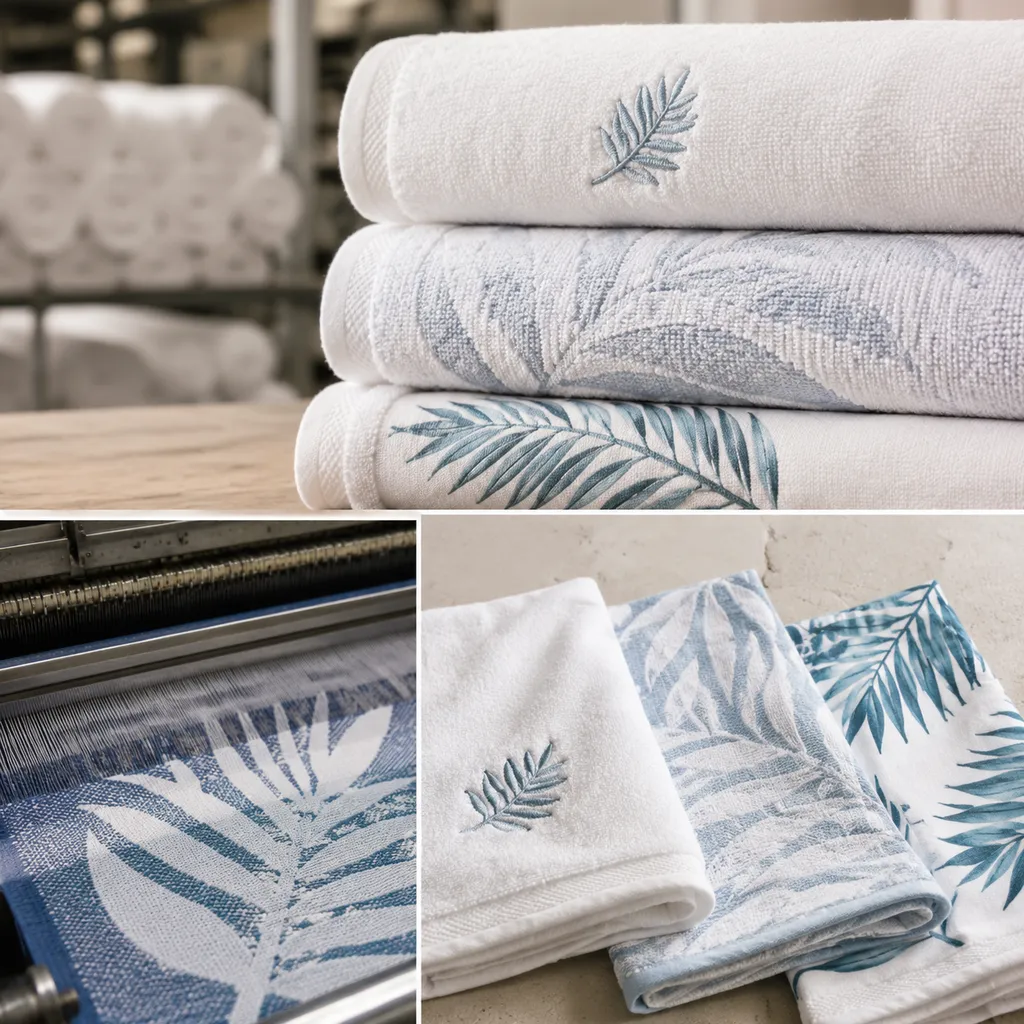
Resort pool towel logo decoration comparison by use zone
Pool towels live a harder life than in-room bath towels. They sit on sun loungers, touch sunscreen oil, move through chlorinated water, and are often washed in 60°C hotel laundry cycles with alkaline detergent. A logo method that works on a spa hand towel at 420 GSM may crack, fade, pucker, or feel rough on a 500-650 GSM pool towel.
In our decoration room, we normally separate resort pool logos into four working methods: embroidery, jacquard weaving, pigment printing, and reactive printing. Each one can be correct. The wrong choice usually comes from matching the decoration to the artwork but not to the operating use.
| Pool towel use | Typical towel spec | Logo method we usually shortlist | Main risk to control |
|---|---|---|---|
| Cabana or VIP pool deck | 550-700 GSM cotton terry, 70×150 cm or 80×160 cm | Embroidery or yarn-dyed jacquard | Logo bulk and drying time |
| High-turnover towel station | 450-550 GSM ring-spun cotton, 70×140 cm | Jacquard border or pigment print | Laundry abrasion and color loss |
| Retail resort towel | 360-480 GSM velour face / terry back | Reactive print or large jacquard | Artwork sharpness after washing |
| Event or seasonal pool program | 320-430 GSM cotton or cotton-poly blend | Pigment print | Hand feel and cracking on dark shades |
For buyers comparing pool towel embroidery, jacquard logo pool towels, and printed pool towels, the first filter should be the towel route after use. If the towel is rented, scanned, washed daily, and replaced after a fixed number of laundry cycles, durability matters more than a photographic logo. If the towel is sold in a resort boutique, shelf appeal and artwork detail matter more.
What pool conditions do to a logo
Logo decoration fails differently at poolside than in a guest bathroom. We see sunscreen oil soften some print binders. Chlorine residue shifts bright blues and greens. Industrial tumble drying can curl a heavy embroidered patch if the stitch density is too high for the towel pile. These are not theoretical problems; they show up during sample wash review when the towel construction and logo method are not balanced.
- Chlorine contact: even when guests rinse, pool towels may carry 1-3 ppm chlorine residue into laundry. This is enough to stress weak print fixation over repeated cycles.
- Sunscreen and body oil: oily residue reduces friction fastness on some surface prints unless curing temperature and binder selection are controlled.
- Pile movement: terry loops shift under embroidery frames. If the logo has tiny letters below 5 mm height, loops can partly hide the detail.
- Heat and compression: towels stored damp in carts can mark pigment-printed areas if stacking pressure is high before the print is fully cured.
For lab basis, we do not approve a pool towel decoration only by visual hand-feel. We reference ISO 105-C06 for domestic and commercial laundering colorfastness, ISO 105-X12 for rubbing fastness, and our internal 10-wash appearance review using the client's planned detergent temperature. For hotel groups, we often add a 20-cycle pilot wash before releasing the balance of a multi-property order.
Embroidery: good for restrained logos, risky for oversized marks
Embroidery gives the most dimensional logo and is still the safest answer for a small crest, initials, or property name. On pool towels, we usually keep embroidery on one corner, a border, or a hanging end. A 75×38 mm logo at 7,000-10,000 stitches behaves very differently from a 180×90 mm filled emblem above 35,000 stitches.
The construction detail buyers often miss is backing removal. For pool towels, we normally use tear-away backing for stable woven borders and water-soluble topping when the pile is high. The topping keeps terry loops from swallowing small satin stitches. If the operator skips topping to save a few cents, the approved logo may look fuzzy after the first wash.
| Embroidery variable | Factory control point | Our normal approval range |
|---|---|---|
| Letter height | Check after washing, not only after stitching | Minimum 5 mm for block letters, 7 mm for serif letters |
| Stitch density | Avoid hard patches on absorbent pool towels | 0.38-0.45 mm stitch spacing for most filled areas |
| Placement tolerance | Measured from hem edge after finishing | ±8 mm for corner logo, ±10 mm for end-border logo |
| Thread fastness | Polyester embroidery thread tested with towel shade | Grade 4 or better for dry rubbing under ISO 105-X12 |
Embroidery pricing changes quickly with stitch count. On a 520 GSM cotton pool towel, a small resort crest may add USD 0.18-0.42 per piece at 1,000-3,000 pcs. A large filled logo can add USD 0.75-1.60 per piece and slow the embroidery line because each head spends longer on one towel. Our MOQ remains 500 pcs per design per color, but embroidery is usually more economical once a logo/color combination reaches 800 pcs or more.
Jacquard: strongest for repeat laundering, less flexible for detail
Jacquard is woven into the towel, so there is no surface ink or thread patch to peel off. For resort towel branding that must survive centralized laundry, jacquard is often the most stable option. The trade-off is artwork simplification. Gradients, thin outlines, and photographic icons do not translate cleanly into terry weaving.
There are two common constructions. A dobby-style border logo sits in a flat woven band at the towel end. A full terry jacquard logo uses high-low pile or yarn color contrast across the body. The border logo is neater for text. The full terry jacquard is better for bold resort names, stripes, or large symbols visible from a distance.
- Best artwork: one-color or two-color block logos, resort names, geometric icons, stripe systems.
- Weak artwork: thin script, small registration marks, QR codes, watercolor-style graphics.
- GSM fit: 450-650 GSM is the practical range for most pool jacquard programs; above that, bulk and drying time rise.
- Color planning: yarn-dyed jacquard needs shade approval before weaving, so Pantone matching must happen earlier than for print.
Jacquard also affects MOQ. We can discuss 500 pcs per design per color for simple border programs, but custom yarn-dyed body jacquard is more efficient at 1,200-2,000 pcs because loom setup, yarn dyeing, and pattern card preparation are fixed costs. Sampling normally takes 10-16 days after artwork simplification and yarn color confirmation.
Pigment printing: economical, but binder control decides the result
Pigment printing sits on the fabric surface with a binder. It is attractive for seasonal resort pool towel programs because it handles larger artwork at a lower setup cost than jacquard. It can work on cotton terry or velour-face towels, but the print feel is very different depending on binder load, curing temperature, and pile height.
For a pool towel, we avoid heavy pigment coverage on the main drying area when absorbency matters. A large solid logo across the center can reduce water pickup and feel boardy. A better layout is a printed end panel, a stripe zone, or a graphic on a velour face with terry back left absorbent.
| Print issue | Likely cause | How we control it before bulk |
|---|---|---|
| Cracking after tumble drying | Binder film too thick or under-cured | Cure at controlled temperature and review after 5 and 10 wash cycles |
| Logo feels plastic | High pigment load on loop terry | Move artwork to velour face or reduce solid coverage |
| Color rubs onto white towel stack | Weak fixation or insufficient post-cure rest | ISO 105-X12 rubbing test plus 24-hour stacking check |
| Edges look broken | Terry pile too uneven for fine screens | Use bolder artwork or shear to velour face |
At 1,000 pcs, pigment printing usually adds USD 0.22-0.55 per towel for a moderate one-position logo. Large multi-color artwork can add USD 0.70-1.25 depending on screens and coverage. For buyers reading this resort pool towel logo decoration comparison because they need a lower unit price, pigment is often the first method we cost, but we will push back if the design covers too much of a towel expected to dry guests quickly.
Reactive printing: softer hand and better depth, with a longer process
Reactive printing is different from pigment printing because the dye reacts with cotton fiber rather than forming a binder film on top. On cotton velour pool towels, it gives a softer hand, stronger color depth, and better absorption in printed areas. It is the method we consider for retail resort towels, high-detail artwork, and designs where the towel must still feel like cotton rather than a printed sheet.
The process is less simple than placing ink on the towel. The fabric is usually pre-treated, printed, steamed to fix the reactive dye, washed to remove unfixed dye, then dried and finished. If washing is insufficient, loose hydrolyzed dye can bleed in the first laundry. If steaming is uneven, one side of a large logo may test darker than the other. Those are specific defects we check during strike-off review.
| Method | Hand feel | Artwork capability | Laundry durability | Typical best use |
|---|---|---|---|---|
| Embroidery | Raised and firm at logo area | Small to medium logos, limited fine detail | Strong if thread and backing are correct | Crests, monograms, VIP deck towels |
| Jacquard | Same structure as towel body or border | Bold shapes and text, low detail | Very strong because logo is woven | High-laundry resort pools |
| Pigment print | Can feel slightly coated | Good for flat graphics and seasonal artwork | Good if cured well, weaker on heavy coverage | Promotions, events, budget pool programs |
| Reactive print | Softest printed option on cotton | Good for detailed multi-color designs | Strong after proper steaming and wash-off | Retail resort towels and branded boutique programs |
Reactive printing costs more and takes longer because it uses more wet processing. As a realistic band, a 400-480 GSM cotton velour pool towel with reactive print may run USD 4.10-6.80 FOB China at 1,000-2,500 pcs, depending on size and coverage. Sampling is normally 12-18 days because we need strike-off print, steam, wash-off, and shade review. Bulk production usually needs 30-45 days after approval and deposit.
Cost and lead-time bands we quote before sampling
The base towel drives more cost than the logo method. A 360 GSM promotional pool towel is a different product from a 650 GSM resort lounger towel. Still, the decoration choice can move the landed cost enough to affect a multi-property program. Below are normal FOB China bands we would use for early budgeting before yarn price, artwork, and packing are confirmed.
| Order volume | Towel and logo scenario | Indicative FOB China band | Normal production timing |
|---|---|---|---|
| 500-799 pcs | 450-520 GSM cotton towel with small embroidery or one-color pigment logo | USD 3.35-5.40 per pc | 25-38 days after sample approval |
| 800-1,999 pcs | 500-600 GSM pool towel with jacquard border or medium embroidery | USD 4.20-6.95 per pc | 30-42 days after approval |
| 2,000-4,999 pcs | 420-520 GSM velour towel with pigment or reactive print | USD 3.85-6.60 per pc | 32-48 days depending on print route |
| 5,000+ pcs | Custom yarn-dyed jacquard or multi-property resort pool program | USD 3.55-6.25 per pc | 40-55 days including yarn dyeing |
Our standard MOQ is 500 pcs per design per color. Splitting one logo across four towel colors can create hidden inefficiency because each color needs setup, shade control, and QC records. If a resort group has three properties using the same towel size and GSM, we often suggest keeping the base towel common and changing only the logo thread or border color. That protects MOQ without forcing every property into the same visual identity.
QC evidence we attach to decoration approval
A good-looking counter sample is not enough evidence for a pool program. We attach measurable checkpoints to the approval file so the bulk inspection team can judge the shipment consistently. Our factory operates under ISO 9001 process control, BSCI social compliance, and OEKO-TEX Standard 100 Class I material certification where applicable to yarn, dye, thread, and accessories.
- Confirm towel GSM using a cut sample weight method and compare against the approved technical sheet. Our usual bulk tolerance is ±5% unless the buyer sets a tighter contract limit.
- Measure logo placement after finishing and washing, because hemming and tumble drying can shift the visual center.
- Run rubbing fastness checks based on ISO 105-X12 for printed areas and embroidery thread colors.
- Review washing colorfastness using ISO 105-C06 conditions matched as closely as possible to the buyer's laundry temperature.
- Photograph the logo after 1, 5, and 10 internal wash cycles for the sample approval record when the order is intended for resort laundry.
For rejection thresholds, we avoid vague wording like "logo must be good." A practical inspection sheet may state: no open embroidery thread longer than 3 mm, no visible print cracking at 50 cm viewing distance after the agreed wash review, no logo placement outside ±10 mm of the approved location, and no color staining on adjacent white cotton after the rubbing test. Those thresholds are commercial QC limits, not universal ISO pass/fail rules, so they need to be written into the purchase order.
How we choose when the artwork is not final
Resort buyers often ask for pricing before the logo file is ready. We can still build a useful decision path if we know towel size, GSM target, usage route, color count, and whether the logo is a small mark or a large design. For a 70×150 cm pool towel, we usually discuss 450-550 GSM for fast turnover and 580-700 GSM for a more substantial pool deck feel.
- Choose embroidery if the logo is under roughly 100×60 mm, the buyer wants a raised brand mark, and the towel is not priced for the lowest possible laundry cost.
- Choose jacquard if the logo is bold, reorder volume is stable, and the towel must tolerate heavy industrial washing.
- Choose pigment print if the program is seasonal, the budget is tight, and the artwork can avoid heavy coverage on the drying zone.
- Choose reactive print if the towel is cotton velour, artwork detail matters, and the buyer accepts longer sampling and higher wet-processing cost.
Related reads: for broader method trade-offs, see embroidery vs sublimation vs jacquard. If you are still defining towel weight before logo approval, our towel GSM decision framework helps connect GSM to drying speed and laundry cost. For color control, we also recommend Pantone color matching custom towels.
For resort and pool buyers building a complete program, the decoration decision should sit beside carton packing, reorder planning, and freight mode. Useful next steps include beach club resort towel program, chair towels lounger pool deck guide, container vs air freight towel orders, and our build a towel tech pack that mills can quote guide.
Final buying note
A resort pool towel logo decoration comparison should end with a sample that has been washed, rubbed, measured, and costed against the real order quantity. The cheapest logo on a quotation sheet can become expensive if it shortens towel life or creates sorting problems in the laundry. We would rather adjust artwork early than ship a decoration that looks good on day one and weak after the first operating month.
LUMA & CO. TEXTILE has manufactured custom towels since 2007 with 220 employees, about 2.4M towels annual output, and 80+ brand clients in 47 countries. For resort pool towel logo decoration comparison requests, send towel size, GSM target, artwork, Pantone references, expected wash route, and order quantity so we can quote the right method instead of the most convenient one.
Send us the logo and pool towel spec
For OEM quotation, contact WhatsApp +86 13205717266 or [email protected]. MOQ is 500 pcs per design per color, with sampling and bulk timing confirmed after artwork review.
Request a decoration quote →