Work backward from the gate opening, not from PO date
For stadium programs, the delivery target is rarely the match day itself. What matters is when the venue or 3PL will accept inward stock, sort by section, and clear the cartons. We usually ask buyers for four dates on day one: fan distribution date, warehouse receiving cutoff, final artwork approval date, and whether split delivery is allowed. Without those, any timeline is a guess.
For custom rally towels lead-time and logistics, the critical difference versus bath or beach programs is that the towel is tied to a fixed event window with almost no salvage value after the date passes. A delayed hotel towel can still be used next week. A delayed playoff giveaway often becomes dead inventory within 24 hours.
| Milestone | Typical working days | What actually happens |
|---|---|---|
| Artwork check and print separation | 1-2 days | We confirm logo size, ink coverage, bleed margins, and whether the design crosses the hem zone |
| Counter sample or strike-off | 3-5 days | For large logos we verify hand feel, strike-through, and edge clarity on the actual ground fabric |
| Bulk fabric prep and cutting | 2-4 days | Cotton terry loops need stable moisture regain before cutting or panel size can drift |
| Printing, drying, hemming, metal detect if required | 6-10 days | Print sequence depends on towel size and whether hem-after-print or print-after-hem is safer |
| Final inspection and carton marking | 2-3 days | We check carton count by bundle, barcode position, and shade continuity by lot |
- If the venue requires inbound labeling by gate, zone, or seat block, add 1 full day for carton remarking and pallet map verification.
- If the artwork includes fluorescent ink or metallic effect, add 2-3 days because drying and rub testing take longer.
- If the order needs individual polybags for rain protection at outdoor events, count extra packing time and higher carton cube.
The towel spec changes the calendar more than buyers expect
A simple 100% cotton velour-faced rally towel at 300-360 GSM moves differently from a full-terry piece. For event waving, most buyers do not need high pile. They need print clarity, low lint drop, and manageable carton volume. That is why we commonly steer orders toward terry back with sheared velour face, usually 320-350 GSM, in sizes such as 30x50 cm, 38x63 cm, or 40x66 cm.
Construction details also affect risk. If the print sits too close to the hem fold, we can see image nibbling after hemming because the fold eats 8-12 mm on each side depending on machine setting. On dark grounds with heavy white pigment, another failure mode is panel bowing after curing, especially when the print area covers more than 45% of the face. Those are rally-towel problems, not generic export problems, and they need to be handled in the layout stage.
| Common spec | Why buyers choose it | Lead-time effect |
|---|---|---|
| 30x50 cm, 320 GSM velour/terry | Lowest cube, good wave feel, economical giveaway unit | Fastest route; stable print and easy carton count |
| 38x63 cm, 340 GSM velour/terry | Better logo visibility for TV shots and club shops | Normal route; wider panels may reduce print table efficiency |
| 40x66 cm, 360 GSM full terry | Heavier hand and stronger souvenir feel | Adds drying time and raises freight weight |
| Hem label plus care label plus barcode sticker | Retail resale after event or shop stock | Adds 1-2 days depending on pack-out complexity |
If a buyer pushes the fabric too light, for example below 280 GSM on cotton, the unit cost drops a little but the waving effect becomes weak and the body feels papery after printing. For one recent promotional run, a 32x55 cm towel at 270 GSM saved about USD 0.06 per piece versus 325 GSM, but carton loss from edge distortion and fan complaints would have cost more than the saving. Event merch is visible product. Thin goods look cheap on camera.
Custom rally towels lead-time and logistics depend on the print method
Most stadium rally towels are screen printed on cotton. That is still the cleanest route for solid logos, mascots, sponsor marks, and one- or two-color slogans. We do not usually recommend embroidery because it stiffens the towel and slows output. Jacquard can work for season-long programs, but for a one-date campaign it often takes too long because loom setup and yarn-dyed preparation are front-loaded.
For print control, we pay attention to two points that matter specifically on rally towels. First, large solid areas can crack slightly on the fold line if the pigment film is too heavy. Second, low-grade print paste can transfer onto the reverse loops when towels are stacked warm after curing. We manage that with dwell-time control at the curing oven and by checking crocking under ISO 105-X12 before bulk release.
| Decoration method | Best use | Operational note |
|---|---|---|
| Screen print | Event giveaways, sponsor logos, playoff slogans | Best balance of speed and cost at 1,000-50,000 pcs |
| Reactive print on cotton | Full-face art with softer hand | Longer process and stricter wash control; rarely needed for one-game promotions |
| Jacquard woven logo | Season-ticket merchandise, club retail | Longer setup, better for recurring programs than urgent events |
| Embroidery | Small crest at corner only | Slowest output and not ideal for waving towels |
- For one-color cotton screen print, MOQ is usually 500 pcs per design per color.
- For two-color layouts with registration tolerance below 2 mm, we prefer a preproduction strike-off before full bulk.
- If logos sit across the center fold line used for retail packing, ask us to test fold memory after curing so the ink film does not white-mark.
Carton planning decides whether unloading is smooth or chaotic
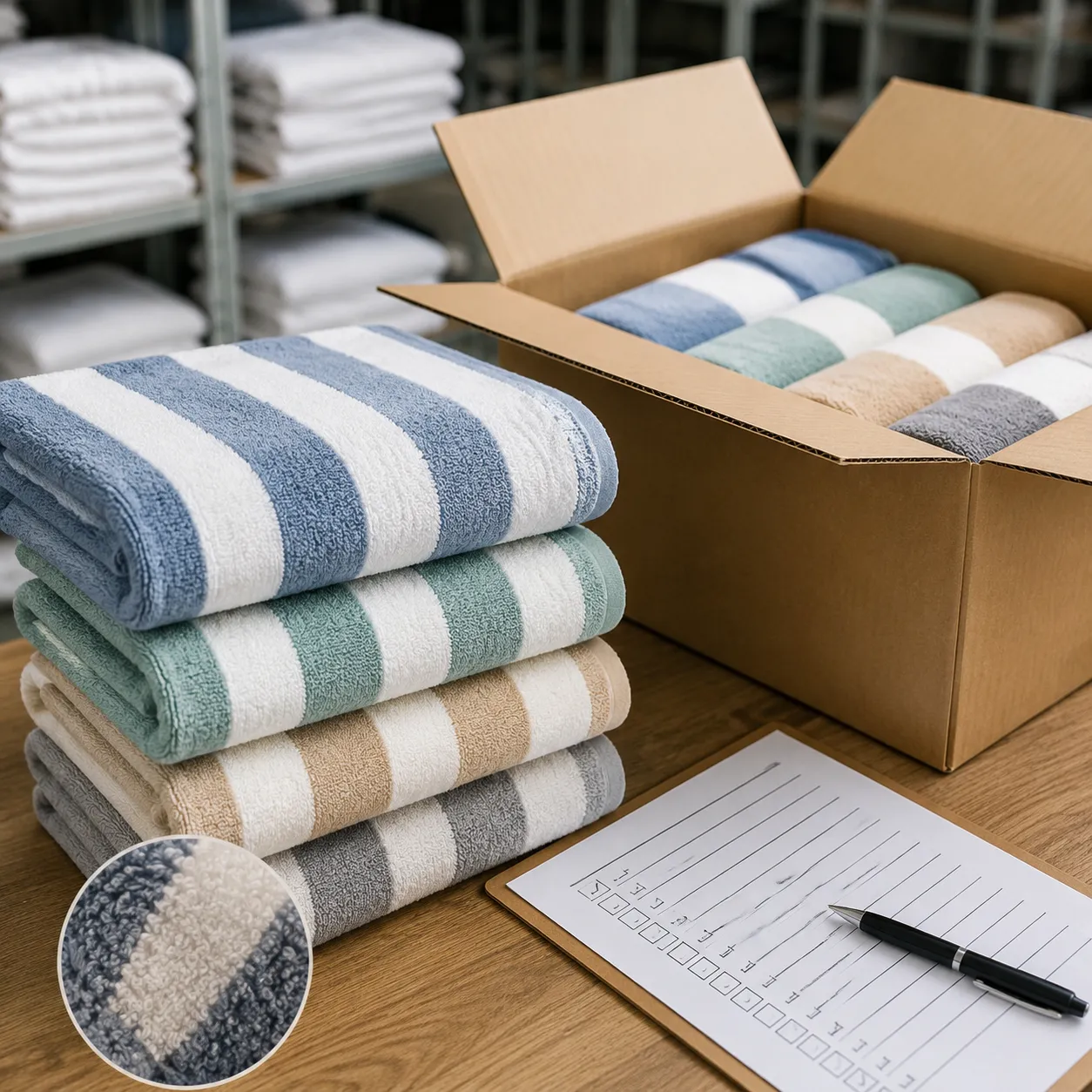
Buyers often focus on ex-factory date and ignore pack-out. For rally towels, carton discipline matters because the venue team may be unloading under time pressure with temporary labor. We therefore set the carton structure early: pieces per inner bundle, inners per carton, gross weight ceiling, and whether each carton must represent one seating block or one sponsor version.
A practical target is to keep export cartons below 14.5 kg gross for hand-carry receiving. Heavier cartons slow floor handling and increase crushed-corner claims if they are restacked quickly near tunnels or loading bays. For cotton rally towels around 320-350 GSM, we commonly pack 150-200 pcs per carton depending on finished size and whether there is a polybag.
| Pack-out format | Typical use | Risk if specified late |
|---|---|---|
| 50 pcs per bundle, 4 bundles per carton | Section-by-section stadium handout | Late change forces recount and carton remarking |
| Individual polybag, 100 pcs per carton | Outdoor events with resale or rain exposure | Higher cube and slower packing speed |
| Mixed sponsor versions on same pallet | Small regional activations | Easy mis-picks at destination |
| Single SKU per pallet with pallet label map | Large arena or playoff run | Lowest receiving confusion |
- Confirm the handout unit first: loose towel, folded loose, or individually bagged.
- Set the maximum carton weight the receiving crew will accept.
- Define barcode content and carton mark position before bulk packing starts.
- Decide whether cartons must be sorted by gate, stand, or promotional partner.
Price bands only make sense when the scope is fixed
We avoid broad planning numbers without a frozen spec because rally towel pricing moves with size, GSM, print colors, towel ground shade, packaging, and delivery term. Still, buyers need workable budgeting. The ranges below are realistic for FOB China on standard cotton velour/terry event towels with one-side screen print and export cartons, not including duty or destination delivery.
| Volume | Typical spec scope | FOB China unit price |
|---|---|---|
| 500-999 pcs | 30x50 cm, 320-330 GSM, 1-color print, care label, bulk pack | USD 0.78-0.96 |
| 1,000-2,999 pcs | 30x50 cm or 38x63 cm, 320-340 GSM, 1-2 color print | USD 0.61-0.84 |
| 3,000-9,999 pcs | 38x63 cm, 330-350 GSM, standard carton marks | USD 0.52-0.73 |
| 10,000-30,000 pcs | Event giveaway program, stable artwork, no polybag | USD 0.44-0.63 |
Costs rise quickly when the order adds dark ground dyeing, metallic ink, individual polybags, or split carton labeling for multiple venues. A two-color print on a black towel can cost more than a larger one-color print on white because opacity control, flash curing, and reject rate all move in the wrong direction. If the event needs strict landed-cost modeling, we usually break the quote into towel body, printing, special packing, and carton labeling so procurement can see where the extra cents actually come from.
What usually breaks the schedule
The late-stage problems are not mysterious. They repeat. On rally towels, the main schedule damage comes from artwork that ignores the hem allowance, sponsor logos changing after print screens are made, and destination teams asking for new carton breakdowns after packing has started. Each one sounds small; each one can eat several working days.
- Oversized print area: when the design runs too close to the selvage or hem fold, we must re-separate artwork or reduce image scale.
- Unstable red or navy approval: club colors often trigger multiple lab-dip rounds; pantone-color-matching-custom-towels.html covers why visual approval under stadium lighting can mislead teams.
- Changing venue rules: some arenas reject unlabeled mixed pallets or require ASN-style carton IDs even for promo goods.
- Moisture-packed goods: if printed cotton is packed before it fully cools, blocking and ink offset can appear inside the fold.
For event towels, the fastest order is usually the one with the fewest post-approval changes, not the one with the cheapest freight.
On the factory floor, we specifically watch for skewed hems after aggressive print curing, loose edge overlock hidden inside fold hems, and shade jumps between lots if top-up dyeing is used to rush replenishment. These are easy to miss in a generic approval photo but very visible when 10,000 fans hold the towel above their heads at the same time.
A cleaner approval path for fixed-date events
For custom rally towels lead-time and logistics, we prefer a short approval chain with hard stop points. That means one art file owner, one color approver, and one pack-out approver. If three departments comment in sequence, the order drifts. If they review together against the same strike-off and carton mockup, timing improves immediately.
- Send vector artwork with final sponsor lockup and exact finished size.
- Approve the print strike-off on the intended towel ground, not on paper only.
- Sign off one folded sample showing actual hem width, label placement, and carton ratio.
- Freeze ship marks before bulk packing begins.
- Allow one final AQL-based inspection report before dispatch.
For bulk inspection, we normally use ANSI/ASQ Z1.4 sampling logic alongside internal checks for towel-specific defects. On printed cotton we also verify colorfastness to rubbing under ISO 105-X12 and dimensional change after washing under ISO 6330. Rally towels are promotional goods, but they still need stable shrinkage and clean print adhesion or the venue receives visible rejects.
Related reads: if you are still deciding between logo methods, see embroidery-vs-sublimation-vs-jacquard.html. For better RFQs, use build-towel-tech-pack-that-mills-can-quote.html. If your volume is near MOQ and colors are fragmented by sponsor, negotiate-towel-moq-without-killing-margin.html is the useful reference.
Choosing the transport lane after the bulk date is real
Freight planning only becomes meaningful once the packed volume and ex-factory window are confirmed. For rally towels, we usually see three workable patterns. Courier suits urgent top-up cartons. Air freight suits moderate volume with a short deadline. Ocean freight suits preseason or recurring fan programs where the event date is far enough out to absorb destination handling.
We do not publish one broad transit promise because destination performance differs too much by port, airline uplift, customs broker response time, and final-mile appointment system. Instead, we quote against a specific lane and cutoff. For example, 40 cartons to one city arena behave very differently from 1,200 cartons split across three club warehouses.
- Use courier only for sample sets, replacement cartons, or under roughly 300 kg chargeable. Above that, the cost curve becomes hard to justify.
- Use air for fixed-date playoff runs when the production date is secure but ocean cutoff is already missed.
- Use ocean for season-launch programs, sponsor stock, or recurring supporter merchandise with stable forecasts.
For a few lane examples and the cost logic behind them, container-vs-air-freight-towel-orders.html gives the broader framework. Buyers handling venue programs can also borrow receiving discipline from beach-club-resort-towel-program.html, even though the usage setting is different.
What to send in the first inquiry so the quote is usable
A usable inquiry for rally towels is short but specific. We need event date, receiving location, target size, GSM range, print colors, towel ground color, packaging format, and whether the order is one venue or multi-drop. Without that, the price and schedule both come back too soft to support procurement approval.
- Finished towel size in cm and tolerance expectation
- Fabric construction: velour face/terry back or full terry
- Target GSM, usually within 320-350 GSM for most giveaway programs
- Artwork file and print count, including any sponsor variants
- Packing rule: loose, folded, banded, or individual polybag
- Delivery term: FOB, CIF, or delivered to local forwarder/3PL
If you have not built a formal towel spec before, towel-gsm-decision-framework.html and towel-sizes-dimensions-complete-guide.html help tighten the request. We can also quote directly against your event brief and suggest the simplest construction that still survives fan handling.
Minimum workable timeline we would actually stand behind
For a standard order of 3,000-8,000 cotton rally towels with one- or two-color screen print, no special retail pack, and one delivery point, a practical factory timeline is about 14-21 working days after final sample approval and deposit. Below that, it becomes a rush job and risk rises sharply. If the program needs club-color lab dips, sponsor variants, or split carton labeling, we prefer to hold 18-24 working days.
That is the level of certainty we are comfortable putting on paper because it is tied to a defined towel, defined print method, and defined pack-out. Custom rally towels lead-time and logistics are manageable when the spec is disciplined. They become unstable when buyers ask the factory to absorb unresolved art, unresolved carton rules, and a non-movable event date at the same time.
Related reads: for cost traps in aggressive promo programs, review hidden-cost-cheap-promotional-towels.html. If the order may extend into a broader branded merchandise range, private-label-vs-white-label-towel-programs.html is the better next step.
Need a realistic rally towel timeline
Send size, GSM target, artwork, event date, and pack-out rules. We will reply with a spec-based production window, MOQ, and FOB pricing scope.
Request Quote →MOQ is 500 pcs per design per color. Our mill operates with OEKO-TEX 100 Class I, BSCI, and ISO 9001 controls. For inquiries, contact [email protected] or WhatsApp +86 13205717266.