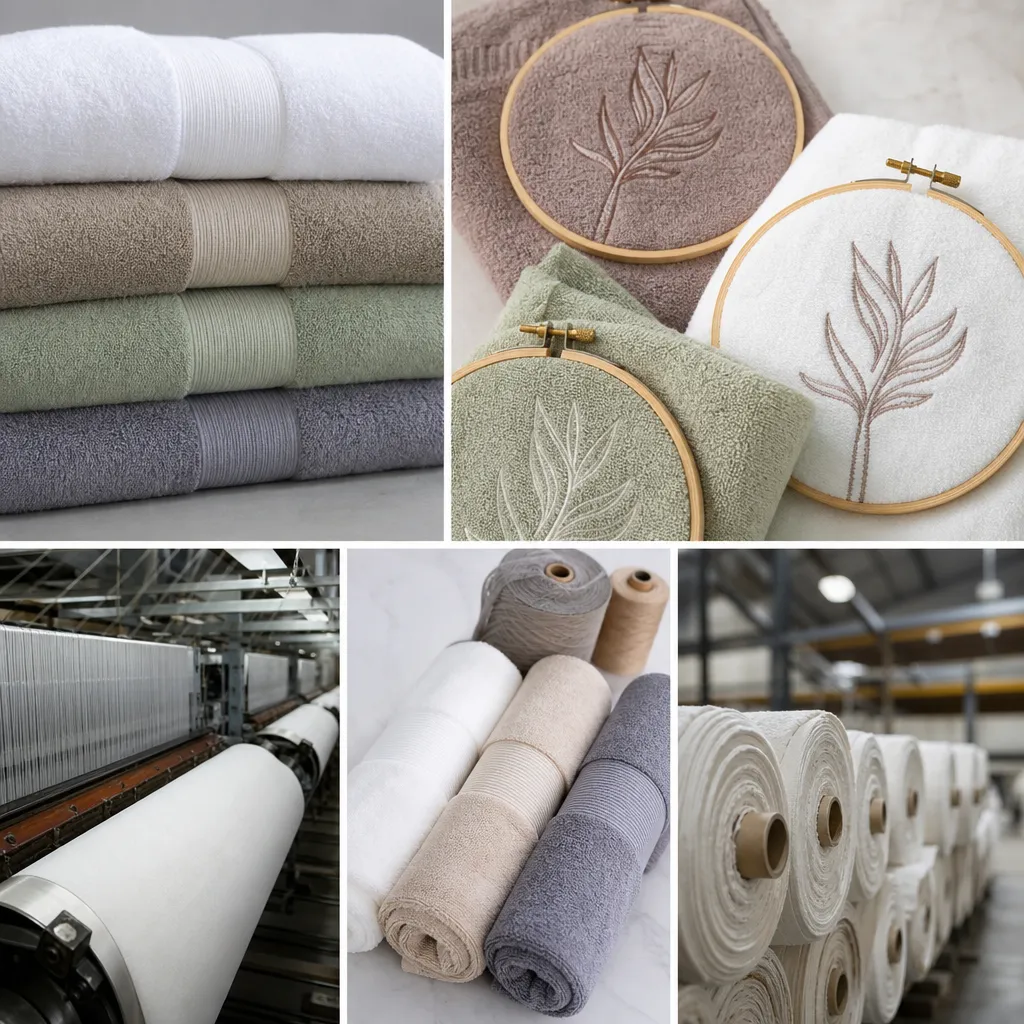
Why personalized bath towels fail first at the stitch edge
On a bath towel, embroidery sits on moving ground. Terry loops compress under the needle, rebound after washing, and can push through the satin edge if the digitizing is too light. A monogram that looks acceptable on a flat cotton swatch may show loop pop-through on 500-650 GSM terry because the pile is higher and less stable than woven fabric.
In our embroidery room, the first sample check is not color. We check whether the stitches are holding the pile down without making the towel stiff. For personalized bath towels, the biggest defects we see are edge fraying on satin columns below 2.2 mm, bobbin thread showing after tumble drying, and puckering where buyers place dense logos too close to a dobby border seam.
- Loop show-through: terry loops appear between satin stitches, especially on light thread over dark dyed towels.
- Hard badge effect: stitch density is too high, making a 70 mm logo feel like a plastic patch against the skin.
- Border distortion: embroidery crosses from terry into the woven dobby band, then shrinks unevenly after washing.
- Thread halo: loose rayon filaments fuzz after chlorine exposure or high-temperature drying.
- Name drift: placement is not jig-controlled, so a guest name appears 8-15 mm off center across a bulk order.
The decoration spec must be written together with the towel spec. If the base towel changes from 480 GSM carded cotton to 620 GSM combed cotton, we usually revise underlay stitches, backing, and sometimes the logo width. Decoration is not a final add-on; it is part of the engineering file.
Start with towel construction, not the logo file
For embroidered bath towel programs, we usually avoid very loose pile and very low GSM unless the client is making a one-time gift item. The lower the fabric weight, the easier it is for the embroidery to wrinkle the ground fabric. The higher the pile, the more underlay is needed to bury the loops before the visible top stitch is applied.
| Use case | Recommended size | GSM range | Yarn direction we prefer | Decoration note |
|---|---|---|---|---|
| Hotel guest room personalized program | 70 x 140 cm or 76 x 152 cm | 520-650 GSM | Combed cotton, 16s or 21s pile yarn | Embroidery on lower third, not across the dobby band |
| DTC gift towel set | 70 x 140 cm | 480-600 GSM | Combed cotton or cotton-bamboo blend | Works for names, initials, small crests |
| Spa or wellness membership towel | 80 x 160 cm | 450-560 GSM | Ring-spun cotton, lower pile height | Better hand feel after repeated laundering |
| Luxury retail boxed towel | 76 x 152 cm | 600-700 GSM | Long-staple combed cotton | Keep design under 90 x 90 mm to control stiffness |
| Promotional bath towel | 68 x 137 cm | 420-500 GSM | Carded or open-end cotton depending budget | Use simple lettering; avoid dense filled emblems |
A 76 x 152 cm towel at 620 GSM uses about 716 g of fabric before allowances. After hemming, embroidery backing, thread, labels, moisture variation, and packing, carton weight adds quickly. A 500-piece order of that spec can exceed 390 kg gross. This matters because some buyers approve a thick towel in sampling, then ask why air freight is expensive. For freight planning, we normally calculate finished towel weight plus 10-13% for cartons, polybags, and moisture regain.
For more base-towel decisions, we often send buyers to our towel GSM decision framework and complete towel size guide before final embroidery costing. Those two choices shape the decoration result more than most artwork revisions.
Embroidery specification: what we need before quoting
A useful bath towel embroidery request includes more than a logo image. We need the final towel size, towel color, artwork size, placement, thread type, backing requirement, wash standard, packaging format, and whether each towel has the same artwork or variable names. Variable personalization changes production flow because we must barcode or batch the name list and run additional verification before packing.
- Send vector artwork in AI, EPS, PDF, or high-resolution PNG for digitizing reference.
- Confirm exact embroidery size in millimeters, not only approximate placement on a mockup.
- Specify whether the artwork is fixed, mixed initials, or fully variable names.
- Confirm towel color by Pantone TCX, Pantone TPX, or approved lab dip, depending material and dye route.
- State the wash environment: home laundry, hotel OPL, outsourced commercial laundry, or spa chemical exposure.
- Decide whether the back of embroidery may show or must be covered with a patch, label, or soft backing.
For custom embroidered towels, digitizing is a manufacturing step, not just file conversion. We adjust stitch direction to control pull compensation. On a serif letter, the horizontal stroke may need different density from the vertical stroke because terry moves differently under the hoop. For a 65 mm initial, our typical satin density is around 0.38-0.46 mm between stitches, but the exact setting depends on thread, pile height, and whether we use zigzag or edge-run underlay.
We run Tajima-format stitch files on multi-head machines, but we do not treat the machine file as final until it has been sewn on the actual towel base. A logo that passes on white 500 GSM terry can fail on navy 640 GSM because dark pile shadow is less forgiving and higher pile lifts the thread surface.
Thread, backing, and needle choices that change wash life
Thread choice is usually the first cost argument. Rayon has a soft shine and is common for gift towels, but polyester embroidery thread holds color better under peroxide systems and repeated commercial drying. For hotel, spa, gym, and yacht programs, we usually recommend trilobal polyester 120D/2 because it resists abrasion and laundering more consistently than rayon.
| Component | Typical factory spec | Why it matters on bath towels |
|---|---|---|
| Top thread | 120D/2 polyester or rayon, 40 wt equivalent | Polyester is safer for commercial laundry; rayon is softer-looking for retail gift sets |
| Bobbin thread | 60s/2 spun polyester, white or matched when needed | Reduces back-side irritation and controls thread show-through |
| Needle | 75/11 or 80/12 ballpoint, changed by color lot and pile density | Ballpoint reduces cutting of terry loops during stitching |
| Backing | 40-70 g/m² tear-away or wash-away topping plus tear-away backing | Stabilizes pile and prevents loops from rising between stitches |
| Topping film | Water-soluble film on high pile towels | Keeps satin edges clean during sewing, then dissolves after washing |
One topic-specific detail buyers rarely ask about is topping removal. If water-soluble film is not fully removed before packing, it can leave a slightly crisp feel around the monogram. We normally use steam and light brushing after embroidery for high-pile towels, then inspect the face under angled light. For dark towels, the inspector also checks for backing dust trapped in the pile.
Another detail is hoop pressure. Too tight, and the towel shows a hoop mark or crushed pile ring. Too loose, and the design shifts, especially on long names. For larger bath towel embroidery above 100 mm wide, we prefer magnetic frames or clamp fixtures instead of standard hoops where possible. They reduce pile crushing and improve repeat placement.
Placement rules for names, initials, and hotel crests
Most monogrammed towels use a lower-third placement, centered horizontally and set above the bottom hem. The exact distance depends on towel size and border construction. If there is a dobby border, we usually place the design on terry, above the border, not inside the dense woven band. The woven band shrinks differently from pile terry and can make curves look uneven after laundering.
| Design type | Common finished size | Placement from bottom edge | Factory caution |
|---|---|---|---|
| Single initial | 55-85 mm tall | 90-130 mm above bottom hem | Use enough underlay to hold pile, but avoid excessive satin width |
| Three-letter monogram | 75-110 mm wide | 100-145 mm above bottom hem | Check letter order by market; US and EU conventions may differ |
| Guest name | 120-220 mm wide | 95-135 mm above bottom hem | Long names need reduced height or running stitch details become weak |
| Hotel crest | 60-95 mm wide | 110-160 mm above bottom hem | Avoid fine outlines under 0.8 mm on terry |
| Brand logo plus wordmark | 100-180 mm wide | 100-150 mm above bottom hem | Separate icon and text if the wordmark has thin strokes |
For name personalization, we ask for an Excel list with one towel per row, including name, thread color, towel color, and carton or recipient code. The risk is not only spelling. If packing is by room, member, or order ID, embroidery production and packing must follow the same sequence. We print an internal traveler sheet and scan each bundle before final folding. That adds time, but it prevents the common error where a correct towel goes into the wrong gift box.
If the program is for hotels, compare the decoration plan with our monogrammed bath towels guide and hotel towel sourcing guide. For retail gifting, the decoration logic is closer to embroidery versus sublimation versus jacquard, because the brand may be choosing between a sewn mark, woven pattern, or printed presentation.
Testing: how we check decoration before bulk approval
We do not approve personalized bath towels from a dry appearance check only. The sample must be washed. Our normal pre-production test includes dimensional change, appearance after laundering, colorfastness, embroidery abrasion, and inspection of the reverse side. If the towel is marketed for babies, children, or sensitive skin, we also confirm the applicable OEKO-TEX documentation before bulk purchasing thread and dyestuff.
- ISO 6330 domestic washing procedure: used as a reference for shrinkage and appearance checks on retail and home-laundry towels.
- ISO 105-C06 colorfastness to washing: useful when contrasting thread sits on a dark or reactive-dyed towel.
- ISO 105-X12 colorfastness to rubbing: checks whether towel dye or thread color transfers in dry and wet rubbing.
- AATCC TM61 accelerated laundering: often requested by North American buyers for repeated-wash simulation.
- OEKO-TEX Standard 100 Class I: our mill can supply compliant materials for baby and skin-contact towel programs when specified at the start.
The most useful internal test is simple: we wash the embroidered sample three times, tumble dry it, then brush the pile by hand and inspect the stitch edge. If the loops start pushing through after three cycles, the problem will not improve in a guest laundry. We revise underlay, reduce stitch density, enlarge the artwork, or choose a lower-pile towel base.
Our factory operates under ISO 9001 procedures, and we are BSCI audited. For chemical safety, OEKO-TEX Standard 100 Class I is available when the full material chain is controlled, including thread, backing, label, and packaging. Buyers should not assume that an OEKO-TEX towel base automatically covers embroidery thread unless the supplied certificate and scope are checked. We explain that process in how to read an OEKO-TEX certificate.
Pricing and MOQ for OEM embroidered towel orders
Our standard MOQ is 500 pcs per design per color. For personalized programs with variable names, we can still build the order from a 500-piece base, but the handling cost is different from one repeated logo. Every name change requires file management, machine sequencing, and packing verification. A low stitch count repeated logo is the cheapest decoration route; individual names are slower.
| Order volume | Towel spec example | Decoration type | Estimated FOB China price |
|---|---|---|---|
| 500-999 pcs | 70 x 140 cm, 520 GSM combed cotton | One fixed 75 mm monogram, 1 color | USD 4.35-5.80 / pc |
| 1,000-2,999 pcs | 70 x 140 cm, 560 GSM combed cotton | Fixed crest or initials, 2 colors | USD 3.95-5.25 / pc |
| 3,000-7,999 pcs | 76 x 152 cm, 600 GSM combed cotton | Fixed logo up to 10,000 stitches | USD 5.10-6.85 / pc |
| 500-1,999 pcs | 70 x 140 cm, 520-580 GSM | Variable names, single color thread | USD 5.20-7.10 / pc |
| 8,000+ pcs | 70 x 140 cm, 500-600 GSM | Repeated logo, retail folded pack | USD 3.55-5.40 / pc |
These are planning bands, not a blind quotation. Cotton price, towel color, reactive dye depth, stitch count, packaging, carton size, and inland freight all affect the final offer. A navy towel with ivory thread may cost more than a white towel with tonal stitching because dark reactive dyeing requires more process control and higher colorfastness checks.
A realistic cost-per-use view helps. Suppose a 560 GSM embroidered towel costs USD 4.70 FOB and survives 55 guest-room wash cycles before it is downgraded to pool or staff use. The FOB cost per primary cycle is about USD 0.085. A lighter 430 GSM towel with the same 8,000-stitch logo may quote at USD 3.15, but if it puckers and is pulled after 24 cycles, the primary-use cost is about USD 0.131. The cheaper towel also creates more replacement handling and more complaints about rough edges around the embroidery.
If budget is fixed, we would rather simplify the artwork than cut the towel base too far. Reducing a crest from 14,000 stitches to 7,500 stitches can save decoration time while keeping a 540-580 GSM towel that guests will still accept. Dropping to a thin towel often creates a poor result that no embroidery adjustment can fully hide. For margin planning, our guide on negotiating towel MOQ is useful before trimming specifications.
Production timeline from artwork to shipment
Personalized work needs more calendar discipline than plain dyed towels. The artwork approval may be fast, but name lists, spelling confirmation, packaging labels, and carton sorting can become bottlenecks. We normally separate the timeline into base towel production, embroidery sampling, bulk stitching, inspection, and export packing.
- Artwork and spec review: 1-2 working days after receiving size, color, placement, and file type.
- Digitizing and embroidery sample: 3-5 days for a fixed logo; 5-8 days if several name lengths must be tested.
- Lab dip or towel color approval: 5-9 days for reactive dyed cotton, longer for difficult dark shades.
- Bulk towel weaving, dyeing, sewing, and pre-shrink control: 18-28 days depending GSM and yarn availability.
- Bulk embroidery: 3-10 days depending stitch count, quantity, and whether names are variable.
- Final inspection, needle check, folding, labeling, and carton packing: 2-5 days.
- Export booking and China port handling: usually 4-8 days before vessel departure, depending season.
A normal OEM schedule is 32-48 days after final artwork, color, and deposit approval. Repeat orders can be shorter if yarn, color recipe, digitized file, and packaging are unchanged. For air orders, we still do not recommend skipping wash testing. A failed embroidered towel delivered quickly is still a failed towel.
For ocean shipment, embroidered bath towels pack with lower compression than plain towels if the buyer wants the monogram surface protected. We may use tissue interleaving or face-in folding for retail gift sets. If packing density is too high, the embroidery can leave pressure marks on adjacent towels, especially on plush 650 GSM cotton. Freight decisions should be made after carton trial, not from theoretical towel weight only. See container versus air freight towel orders for the logistics side.
Artwork choices we push back on
Some artwork is not suitable for terry embroidery at bath towel scale. We can sew very fine detail on twill patches or flat fabric, but terry is a looped surface. If the line is too thin, the pile will swallow it. If the filled area is too large, the towel becomes uncomfortable and slow to dry at that spot.
- Avoid hairline text below 5 mm letter height unless it is simplified or converted to a patch.
- Avoid large filled rectangles or badges above 120 x 120 mm on bath towels; they feel stiff after drying.
- Avoid metallic thread for commercial laundry unless the towel is mainly decorative.
- Avoid placing embroidery on the very bottom hem where folding, pressing, and laundry abrasion are highest.
- Avoid tonal thread with only one shade difference if the towel pile is high; the design may disappear after brushing.
We often redraw artwork for towel reality. A thin script name may be thickened by 8-12%, small counters opened, and sharp points rounded so the stitch can hold without thread buildup. For private label towels, we ask buyers to approve both the digital stitch simulation and a washed physical sample. The simulation shows proportions; the washed sample shows truth.
If a buyer wants full-surface branding, jacquard may be better than embroidery. If the towel is microfiber and the graphic is photographic, sublimation may be better. Embroidery is strongest for initials, crests, names, and controlled brand marks where tactile value matters. It is not the lowest-cost way to cover a large towel face.
Quality control checklist before cartons close
Our final QC for personalized bath towels combines towel inspection and decoration inspection. We check towel weight tolerance, size tolerance, shade lot, hem integrity, embroidery placement, thread trimming, needle contamination, packing accuracy, and carton labels. Variable-name orders receive a separate name-list reconciliation step.
- Finished size tolerance is normally controlled within +/-3% after washing, unless the buyer sets a tighter standard.
- GSM tolerance is normally +/-5%, measured from approved production lots, not from a single towel corner.
- Embroidery placement tolerance is usually +/-5 mm for fixed logos and +/-7 mm for long variable names.
- All embroidered pieces pass thread trimming and reverse-side backing check before folding.
- Metal detection or needle control logs are maintained for export programs that require them.
- Carton labels can include SKU, towel color, thread color, name range, PO number, and destination code.
For mixed towel sets, we recommend approving a packing mockup. A bath towel, hand towel, and washcloth may each carry a different monogram size, but the visual hierarchy should look intentional when stacked. If the bath towel mark is too small and the hand towel mark is too large, the set looks unbalanced even if each piece passed its individual inspection.
Related reads: for buyers still building the base specification, start with building a towel tech pack mills can quote, then compare fiber options in combed versus zero-twist cotton. For hospitality buyers, setting up a hotel linen program helps align towel replacement, laundry, and delivery timing.
How to brief us for a clean first sample
A clean brief saves more time than a long email chain. Send the towel size, GSM, yarn preference, towel color, embroidery artwork, placement drawing, thread color, packaging method, expected order quantity, and destination port. If the order includes names, send the name list early so we can check character count extremes before digitizing the full run.
LUMA & CO. TEXTILE has produced OEM towels since 2007 from our 220-person facility. We supply brand clients in 47 countries, with annual output around 2.4 million towels. Our normal MOQ is 500 pcs per design per color, and we can support ISO 9001 quality procedures, BSCI audit documentation, and OEKO-TEX Standard 100 Class I material control when required.
For personalized bath towels, the safest development route is one washed pre-production sample, one approved stitch file, one approved color standard, and one locked packing method before bulk begins. Changing any of those after embroidery starts usually costs more than doing the first sample properly.
Quote embroidered bath towels with factory specs
Send artwork, towel size, GSM target, order quantity, and delivery country. We will review stitch count, backing, MOQ, price band, and timeline. WhatsApp: +86 13205717266. Email: [email protected].
Request a quote →