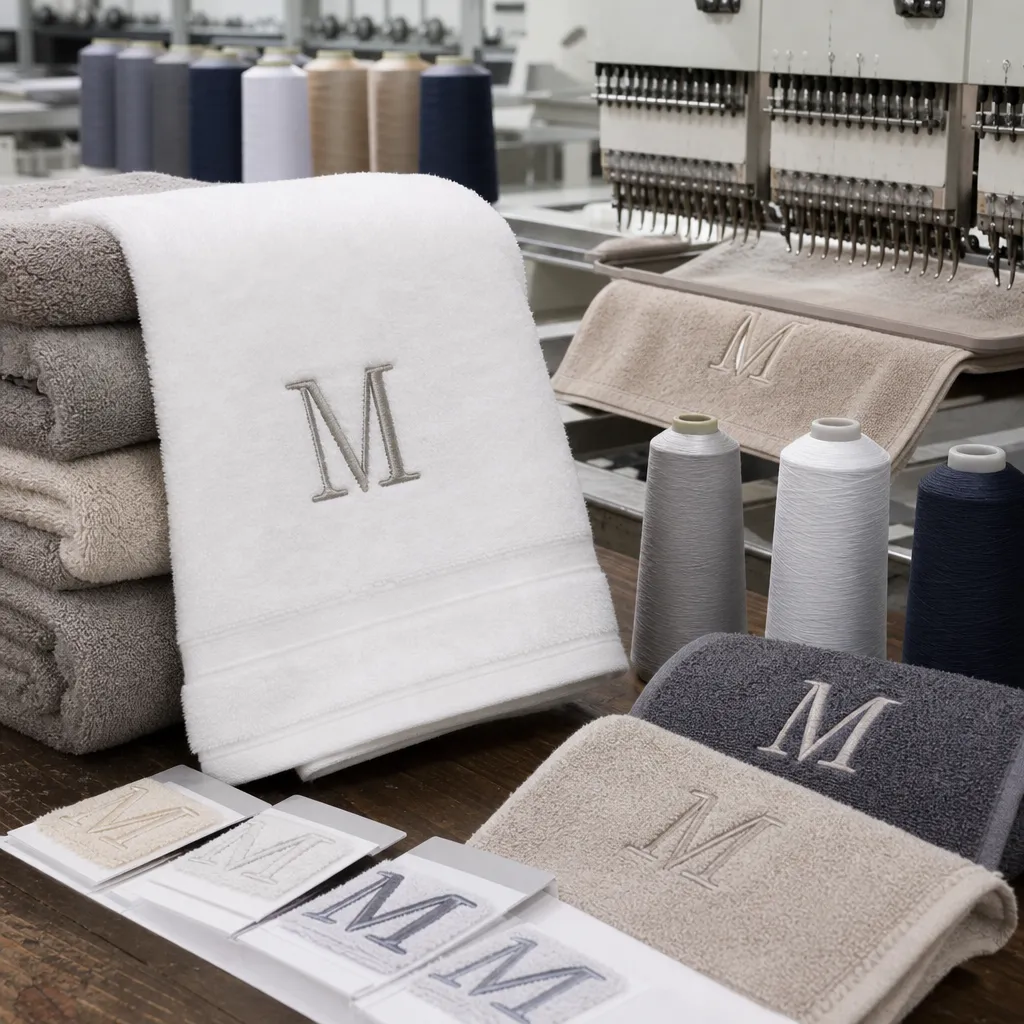
Why Terry Pile Changes The Monogram
Embroidery on flat woven fabric behaves politely. Embroidery on bath terry does not. The pile loops stand up around the needle, the ground fabric compresses under the hoop, and cotton shrinkage can pull small lettering out of shape after finishing. That is why we treat monogram bath towels as a construction project, not only a decoration request.
For most bath towel programs, we recommend 500-650 GSM if embroidery is part of the specification. Below 450 GSM, the towel may dry quickly but the ground can feel thin around a dense initial. Above 700 GSM, the pile height can swallow narrow strokes unless the design is digitized with stronger underlay and enough satin width. The sweet spot depends on the buyer: hotel rooms usually want 550-620 GSM, spa programs often sit at 500-580 GSM, and retail gift sets can go heavier if the fold presentation matters more than drying speed.
The first technical decision is where the monogram sits. A corner placement looks retail-friendly but creates more variation because sewing crosses the hem, border, or pile transition. A centered lower-third placement is more stable for bulk production. On our frames, a 70 x 140 cm bath towel usually gives the cleanest embroidery zone between 11 and 18 cm above the bottom hem, depending on dobby border height.
| Towel Base | Typical GSM | Best Monogram Size | Main Risk |
|---|---|---|---|
| Hotel bath towel | 550-620 GSM | 55-85 mm high | Loop pile covering thin serif strokes |
| Spa bath towel | 500-580 GSM | 45-75 mm high | Soft yarn compression under hoop pressure |
| Retail gift towel | 600-700 GSM | 65-95 mm high | High stitch count causing a stiff hand feel |
| Gym shower towel | 430-520 GSM | 40-65 mm high | Lower pile density showing backing shadow |
Monogram Bath Towels Need Digitizing, Not Just Artwork
A vector logo is not an embroidery file. For custom embroidered bath towels, we convert artwork into stitch instructions: stitch type, direction, density, underlay, pull compensation, trim points, and thread sequence. Two initials in a simple serif font may still need 4,000-7,500 stitches. A crest with a border, wreath, and small date can jump to 12,000-18,000 stitches, which changes both cost and production speed.
On terry, we usually add a knockdown stitch or low-density fill under the monogram when the towel pile is tall. This lightly secures the loops so the main satin stitches sit above the surface instead of disappearing between loops. The knockdown must be visible enough to work but subtle enough not to look like a patch. For white-on-white hotel monogram towels, we reduce contrast by using a slightly lower-density knockdown and matte polyester thread.
Small lettering is where many failed samples begin. We do not recommend letter strokes below 1.2 mm after digitizing, and satin columns above 7 mm often need a split satin or fill stitch to prevent snagging. If a buyer asks us to embroider a 22 mm guest name under a 35 mm crest on 620 GSM terry, we will push back. It may pass a photo review, then become illegible after industrial washing.
- Send AI, EPS, PDF, or SVG artwork when possible; JPG artwork is acceptable only for simple initials and must be redrawn.
- Specify the exact placement from towel edge, not only "bottom right" or "center".
- Approve thread color against a physical towel shade, because terry shadows change perceived color.
- Keep initials at least 40 mm high for bath towel readability after washing.
- Avoid ultra-thin scripts on high-pile terry unless the buyer accepts a larger monogram.
Thread, Backing, And Wash Stability
Most OEM programs use 120D/2 polyester embroidery thread because it holds color through repeated laundering and chlorine-free hotel wash formulas. Rayon has a softer luster but loses strength faster under high-temperature washing. For bath towels used in hotels, gyms, spas, or beach clubs, polyester is the safer default.
Backing is not a footnote. We use tear-away backing for lighter, open monograms and cut-away or wash-away combinations for dense crests. A water-soluble topping is common on pile fabrics because it stops stitches from sinking during sewing. After embroidery, the topping dissolves in washing, leaving the thread clean on the face of the towel. If topping is skipped on 600 GSM terry, small satin edges often look broken before the towel even reaches packing.
For validation, we normally run home-laundry and commercial-laundry checks depending on the use case. A retail program may use ISO 6330 domestic washing with dimensional checks before and after five cycles. Hospitality buyers often request a tougher internal protocol: 60 C wash, tumble dry, and visual grading at 20, 40, and 60 cycles. We inspect thread fray, puckering, backing residue, color migration, and distortion of the monogram outline.
| Component | Factory Default | When We Change It | Buyer Impact |
|---|---|---|---|
| Thread | 120D/2 polyester | Rayon only for low-wash retail gifting | Better wash durability for institutional use |
| Top Layer | Water-soluble film | Skipped only on flat-weave border embroidery | Cleaner edges on pile fabrics |
| Backing | Medium tear-away | Cut-away for dense crests above 10,000 stitches | Less distortion, slightly firmer hand |
| Needle | 75/11 or 80/12 sharp | Ball point for selected soft yarn bases | Fewer yarn breaks and cleaner penetration |
Placement Rules Buyers Should Lock Early
Placement looks simple on a mockup and becomes expensive when changed after sampling. Bath towels are not perfectly flat panels; they have hems, dobby borders, pile zones, and sometimes a hanging loop. Each feature affects hooping. If the monogram crosses a thick border, the frame pressure changes and the needle can deflect. If the artwork is too close to the hem, trimming becomes slow and uneven.
For personalized bath towels bulk orders, we prefer a placement tolerance of +/- 8 mm for standard terry and +/- 12 mm for very plush towels. Tighter tolerance is possible, but it requires slower hooping and more in-line checks. That adds labor cost without always improving the user experience. On a 5-star hotel towel, guests notice whether the monogram is straight and balanced. They rarely notice a 4 mm difference from the approved placement sheet.
- Confirm towel size, GSM, border height, and shrinkage target before finalizing artwork position.
- Mark placement from the finished towel edge, not the cut panel edge before hemming.
- Approve a stitched sample after washing, because placement can visually shift when pile relaxes.
- Use one placement standard across bath towel, hand towel, and washcloth only if proportions still look balanced.
- Freeze placement before bulk dyeing if the embroidery thread must match a dyed towel shade.
Cost Bands For OEM Embroidery Programs
Pricing for monogram bath towels depends on towel weight, cotton yarn, dyeing method, stitch count, thread changes, and packing. MOQ at our mill is 500 pcs per design per color. Below that, machine setup, digitizing, and dyeing loss take too much of the order value, especially when the towel base is custom dyed.
As a working range, a 60 x 120 cm bath towel at 500-550 GSM with a 5,000-stitch monogram is usually in the lower band. A 70 x 140 cm towel at 600-650 GSM with a 9,000-stitch crest and individual polybag packing sits in the middle. A heavyweight gift towel with combed cotton, custom dyed shade, dense embroidery, woven label, belly band, and carton assortment reaches the top band. We quote after weighing the exact construction because a 35 g difference per towel becomes 350 kg on a 10,000 pc order.
| Order Volume | Typical FOB Unit Price | Best Fit | Notes |
|---|---|---|---|
| 500-999 pcs | USD 4.35-6.80 | Pilot, boutique hotel, gift set test | Highest unit cost because setup is spread over fewer towels |
| 1,000-2,999 pcs | USD 3.85-5.95 | Resort rooms, spa retail, club program | Good band for custom color plus embroidery |
| 3,000-7,999 pcs | USD 3.40-5.20 | Hotel group rollout, DTC replenishment | More efficient dyeing and sewing line planning |
| 8,000+ pcs | USD 3.05-4.75 | Annual contract or multi-property program | Best for scheduled shipments and stable specs |
A cheap towel can still be expensive if it fails early. For example, one buyer compared a 470 GSM towel at USD 3.28 with a 590 GSM towel at USD 4.46. The lower-cost option showed edge curl and monogram puckering after 32 commercial wash cycles. The heavier towel remained presentable past 75 cycles. On a room program replacing 4,800 towels, the lower invoice saved USD 5,664 at purchase but required a second order four months earlier. The cost-per-service day was worse, even before counting freight and housekeeping handling.
Sampling And Bulk Timeline
A realistic timeline prevents rushed approvals. Digitizing usually takes 1-2 working days after clean artwork arrives. A lab dip for towel shade takes 3-5 days, and a stitched sample on available fabric takes 4-7 days. If the buyer needs the exact dyed towel base before embroidery approval, add weaving, dyeing, drying, and finishing time.
Bulk production for embroidered initials towels normally runs 25-40 days after sample approval and deposit. The lower end applies when yarn, color, and towel size are already in our routine production plan. Custom dyed towels with high stitch counts, gift packaging, or multiple initials can take 38-50 days. Sea freight then adds roughly 18-35 days depending on port pair; air freight is possible for urgent replenishment but can exceed the towel value on heavy bath items.
| Stage | Typical Days | Factory Checkpoint |
|---|---|---|
| Artwork review and digitizing | 1-2 days | Stitch count, stroke width, thread sequence |
| Sample embroidery | 4-7 days | Hooping stability, topping removal, edge clarity |
| Custom towel base sample | 10-16 days | GSM, shade, shrinkage, hand feel |
| Bulk production | 25-40 days | In-line inspection, wash test, needle detection if required |
| Final QC and packing | 2-4 days | AQL inspection, carton marks, barcode or assortment check |
Quality Checks Before Cartons Close
Our embroidery inspection is separate from towel inspection. Towel QC covers size, GSM, absorbency, color shade, sewing, loose threads, and stains. Embroidery QC checks registration, thread tension, skipped stitches, trimming, backing residue, placement, and hand feel. A towel can pass base inspection and still fail decoration inspection if the monogram is crooked or too dense.
For absorbency, buyers sometimes forget that embroidery adds thread and backing to the towel face. A monogram in one corner will not ruin performance, but a dense 140 mm emblem in the center of the towel can create a stiff area. We test wet-out behavior using an internal drop test based on AATCC-style absorbency observation, and we compare embroidered and non-embroidered zones after laundering. For formal third-party testing, buyers may request ISO 9073-based absorbency references for textile behavior, though towel programs more often rely on agreed factory wash and appearance standards.
- Placement: measured from finished towel edge against the approved spec sheet.
- Stitch integrity: no skipped stitches, thread nests, broken satin borders, or visible needle damage.
- Appearance after wash: no puckering beyond agreed tolerance, no color bleeding, no backing residue on the face.
- Hand feel: embroidery should not create a hard patch unless the buyer intentionally approves a dense crest.
- Packing accuracy: monogram direction, size assortment, carton marks, and barcode labels checked before sealing.
Certification should also match the channel. LUMA & CO. TEXTILE holds OEKO-TEX Standard 100 Class I, BSCI, and ISO 9001 certification. For baby, spa, and hotel buyers, OEKO-TEX Class I is helpful because it covers stricter chemical limits than many general textile declarations. For chain stores and hospitality groups, BSCI and ISO 9001 support social compliance and documented production control, but they do not replace product-specific testing.
Design Choices That Survive Real Laundry
The most durable monograms are not always the most decorative. Bold serif initials, clean block letters, and simple line crests age better than fine script on terry. Metallic thread is possible for low-wash gift towels, but we do not recommend it for hotel or spa circulation because it can feel scratchy and lose brightness under repeated drying.
Thread contrast should be chosen with the towel environment in mind. White embroidery on navy towels looks sharp in retail photography, but lint and thread ends show more clearly after washing. Tonal embroidery on white or ivory towels looks quieter and hides small variation, which is why many luxury hotel monogram towels use ivory-on-ivory or warm gray-on-white instead of strong contrast.
- Use satin stitch for initials with enough stroke width; use fill stitch for large crests or wide monogram blocks.
- Keep the design under 10,000 stitches when towel softness is more important than decorative density.
- Avoid placing embroidery exactly on the dobby border unless the border was designed for decoration.
- Choose polyester thread for high-laundry environments and reserve rayon for low-cycle retail sets.
- Request a washed sample, not only a fresh stitched sample, before signing bulk approval.
Related reads: for base towel decisions, see our towel GSM guide and bath towel dimensions guide. For decoration trade-offs, compare embroidery vs sublimation and the practical limits in monogrammed bath towels for luxury brands.
What To Put In The RFQ
A clear RFQ saves several days of back-and-forth. The most common missing items are finished towel size, target GSM, thread color, artwork size, and packaging. Buyers often send a beautiful mockup without saying whether the towel is 60 x 120 cm, 70 x 140 cm, or 76 x 152 cm. That difference changes yarn consumption, carton weight, embroidery proportion, and freight cost.
For an OEM bath towel program, we prefer to receive the tech pack before quoting final price. If the program is still early, we can quote two or three practical options, but those should be real alternatives: for example 550 GSM combed cotton with 6,000 stitches, 600 GSM ring-spun cotton with 8,500 stitches, and 500 GSM quick-dry hotel construction with tonal initials. Random quoting only creates a false low anchor.
- Finished towel size and target GSM range.
- Cotton type, yarn preference, and whether zero-twist softness is required.
- Artwork file, embroidery size, thread color, and placement measurement.
- Order quantity by design and towel color; our MOQ is 500 pcs per design per color.
- Packing method, carton labeling, barcode needs, and shipping term.
- Certification or audit documents required: OEKO-TEX 100 Class I, BSCI, ISO 9001, or buyer-specific forms.
Related reads: buyers building a complete specification can use how to build a towel tech pack, then check MOQ trade-offs in negotiate towel MOQ without killing margin. If the towels are for hotel circulation, the hotel towel sourcing guide gives a broader procurement view.
Quote Monogrammed Towel Specs
Send towel size, GSM target, artwork, quantity, and placement notes. We will check stitch count, suggest a stable construction, and quote within the MOQ of 500 pcs per design per color. WhatsApp: +86 13205717266. Email: [email protected].
Request OEM Quote →