Start with the usable size, not the catalog size
Large-format beach programs fail early when the PO only states a flat size and not the usable size after washing. For oversized towels, we ask buyers to define three numbers: loom-state size, finished ex-factory size, and acceptable size after one standard wash. A towel quoted at 100 x 180 cm may leave the loom at roughly 104 x 186 cm, then relax and shrink during bleaching, dyeing, and tumble finishing. If the supplier is not building that allowance into the construction, you can receive cartons that technically match the quote sheet before wash but miss deck-chair coverage after wash.
For this category, we usually see finished commercial sizes of 90 x 170 cm, 100 x 180 cm, and 100 x 200 cm. A realistic tolerance for cut-and-sewn terry after finishing is often +/- 3% on length and width, but we prefer to lock an after-wash benchmark into the tech pack. We normally verify this through an internal dimensional stability check aligned to ISO 5077 principles, using a marked specimen and controlled wash/dry cycle.
| Nominal Retail Spec | Typical Loom-State Build | Commercial After-Wash Target |
|---|---|---|
| 90 x 170 cm | 93.5 x 175.5 cm | 88.5-91.5 x 167-172 cm |
| 100 x 180 cm | 104 x 186 cm | 98-102 x 176-184 cm |
| 100 x 200 cm | 104 x 206.5 cm | 98-102 x 196-204 cm |
- Ask the supplier to state finished ex-factory size and after-one-wash size separately.
- Confirm whether size is measured before or after fringe twisting if you are buying hammam-style hybrids.
- Require hem width on all four sides, because a 2 cm hem and a 4 cm hem change usable face area.
Use this oversized beach towels supplier checklist to eliminate weak quotes
The fastest way to compare mills is to force the same disclosure points across every RFQ. Buyers often receive three quotes that look similar on GSM and artwork, but one factory is pricing ring-spun yarn, another is pricing open-end ground yarn, and the third is assuming a lighter finished weight after aggressive shearing. Those are not equivalent offers.
- Confirm MOQ: our baseline is 500 pcs per design per color. Ask whether stripe direction or reverse-face color counts as a separate colorway.
- Request fabric construction: full terry, velour face with terry back, yarn-dyed dobby border, or reactive printed velour.
- Lock yarn composition: 100% cotton is common for resort programs, while cotton-poly blends are usually a cost play with weaker handfeel.
- State finished GSM range and commercial tolerance. For beach towels, we commonly quote 380-480 GSM; oversized programs often work best around 400-450 GSM.
- Ask for colorfastness test targets under ISO 105 methods, especially seawater, perspiration, rubbing, and washing.
- Require carton dimensions, pieces per carton, and carton gross weight before PO approval.
- Ask how the factory controls bowing and skewing on stripe layouts. This is a frequent defect in wide towels.
- Confirm whether final inspection includes a 100% visual pass on print panels or only AQL sampling.
Two technical details matter here. First, oversized velour towels are more likely to show side-to-side shade variation across the sheared face, especially on dark navy and saturated coral grounds. Second, long stripe layouts can drift if the finishing line tension is inconsistent, causing the header border to sit slightly diagonal to the hem. Those are category-specific problems, and a real beach towel supplier should be able to discuss both without hesitation.
Construction choices change performance more than buyers expect
We usually narrow oversized beach towel constructions into three commercial builds. Full terry gives the best absorbency and a more traditional resort handfeel. Velour face with terry back gives a cleaner print surface and softer top hand, but the sheared face can show crush marks in packing if the towel is over-compressed. Flat-woven peshtemal styles pack lighter, though they behave very differently on sunbeds and do not suit every pool program.
| Construction | Typical GSM | Best Use | Main Risk |
|---|---|---|---|
| Full terry cotton | 400-460 GSM | High-turn resort pool and rental | Bulkier freight and longer dry time |
| Velour face / terry back | 380-430 GSM | Printed branding and retail resort shops | Pile crush and face shading |
| Flat weave or hybrid | 240-330 GSM | Packable beach retail and travel | Lower cushion and lower perceived heft |
If a buyer asks us for a very cheap oversized towel below about 360 GSM in cotton terry, we usually push back. At 100 x 180 cm, that weight band often feels too lean for a resort deck program and edges fatigue sooner under commercial laundering. A towel that saves USD 0.38-0.54 per piece on the FOB can become more expensive per guest use if replacement moves from one peak season to mid-season replenishment.
- For resort beach towel sourcing, 420-440 GSM full terry is a stable starting point.
- For retail print-driven programs, velour face at 390-410 GSM usually balances print clarity and absorbency.
- If the order will ship by air for an event opening, consider whether a lighter construction reduces freight enough to justify the handfeel trade-off.
Decoration limits are wider on paper than on the machine
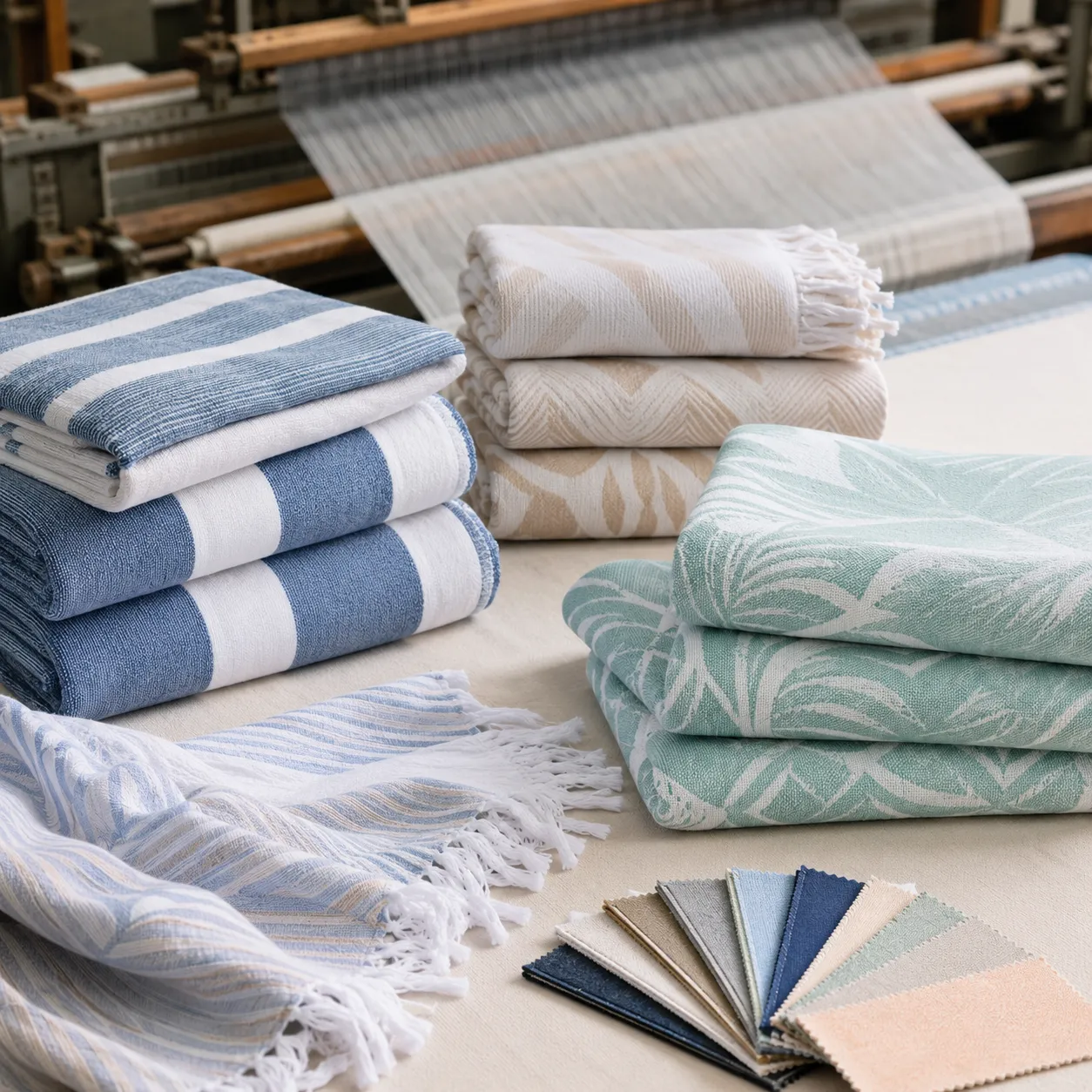
Beach graphics sell programs, but oversized formats make decoration control harder. Reactive printing on cotton velour can deliver sharp branding, yet very large flood areas increase the chance of back-staining and heavier hand on the printed zone. Yarn-dyed stripe programs are operationally cleaner, though they lock you into dye lot planning earlier. Jacquard works well when the brand wants woven identity without a print film feel, but it needs disciplined artwork simplification and a realistic repeat.
For large towels, we pay close attention to pile lay before print. If the sheared face is not brushed consistently, the print head can produce a slightly hazy edge on narrow lettering. We also check for grin-through on dark backgrounds, where the terry loops or sheared pile base show through the surface tone when the towel bends.
| Logo Method | Good For | MOQ Reality | QC Watchpoint |
|---|---|---|---|
| Reactive print on velour | Full artwork and multi-color branding | Usually 800-1,200 pcs/design for best pricing | Edge sharpness, back-staining, shade repeat |
| Yarn-dyed stripes with woven header | Resort identity and classic deck look | 500 pcs/colorway can work | Stripe skew, header alignment |
| Jacquard woven pattern | Integrated branding without surface print | 1,000 pcs/design is more common | Design readability, float control |
Related reads: beach-towels-in-bulk-buyers-guide, embroidery-vs-sublimation-vs-jacquard, and pantone-color-matching-custom-towels.
QC on oversized towels needs category-specific checkpoints
A standard towel AQL inspection is not enough if the factory does not inspect the right failure modes. On oversized pieces, we see more issues with panel squareness, edge waviness, and packing compression because the fabric area is larger and the towel carries more weight during finishing. We recommend combining inline checks with final random inspection rather than relying only on end-of-line carton opening.
- Check mass per unit area according to ISO 3801 or an equivalent internal method from conditioned samples, not from unconditioned cutting-room pieces.
- Run wash colorfastness to ISO 105-C06 and rubbing to ISO 105-X12 for any dark navy, black, red, or strong turquoise program.
- Inspect seam security at hems after laundering. On wide towels, needle density that is too low can open corners after repeated tumbling.
- Measure bow and skew on stripe styles across the full width, not only at the center panel.
- Open at least one packed carton after 24 hours compression to check whether velour face marking recovers.
One construction quirk worth flagging: oversized towels with a velour face and deep dobby border sometimes show a slight torque difference between border and body after washing because the woven densities are not equal. If the supplier has never discussed border-body tension balance, they may not have enough experience in this category.
Price bands by volume: what buyers should expect
FOB pricing depends mostly on size, cotton market timing, construction, and decoration method. For a plain-dyed or yarn-dyed cotton oversized beach towel from China, current workable pricing is usually well above standard bath towel levels because of the larger yarn consumption and lower carton efficiency. Quotes that are far outside market often hide lighter actual GSM, smaller real size, or weaker finishing.
| Spec Example | 3,000 pcs | 10,000 pcs | 25,000 pcs |
|---|---|---|---|
| 100 x 180 cm, 100% cotton, full terry, 420 GSM, solid dyed | USD 5.15-5.78 | USD 4.72-5.29 | USD 4.46-4.98 |
| 100 x 180 cm, velour/terry, 400 GSM, reactive print | USD 5.58-6.34 | USD 5.18-5.92 | USD 4.86-5.55 |
| 100 x 200 cm, full terry, 440 GSM, yarn-dyed stripe | USD 6.22-7.08 | USD 5.79-6.63 | USD 5.44-6.19 |
For a custom beach towel supplier, price should always be reviewed against expected turns. A 420 GSM resort towel at USD 4.88 FOB that survives 85-95 commercial washes can easily outperform a USD 4.29 towel that loses edge shape and color by wash 40-50. That is the cost-per-use math we discuss with hotel and club buyers when they ask for the lowest opening quote.
Lead times are driven by dyeing and approval discipline
Oversized programs are not unusually slow, but they become slow when artwork, lab dips, or strike-offs are approved late. Plain-dyed full terry runs fastest. Printed velour and yarn-dyed stripe programs need more front-end discipline because shade approval and loom planning are tighter.
- RFQ and spec confirmation: 2-4 days
- Lab dips or yarn shade approval: 4-7 days
- Proto or counter sample: 7-12 days
- Bulk production after approval and deposit: 22-35 days
- Final inspection and packing: 2-4 days
- Sea freight ex-China to destination market: commonly 18-38 days depending on lane
If you are staging a resort opening, build extra time for print strike-off review and packout approval. We have seen buyers lose a week because the barcode label placement on polybags was not locked before mass packing. Related reads: container-vs-air-freight-towel-orders, beach-club-resort-towel-program, and build-towel-tech-pack-that-mills-can-quote.
Questions to ask before you approve a supplier
A supplier can look credible on certificates and still be weak on large-format execution. We are OEKO-TEX 100 Class I, BSCI, and ISO 9001 certified, but certification is only the entry point. Buyers still need proof that the mill can control wide-size terry consistently and pack it efficiently for export.
- Can you provide actual finished towel weight per piece for the quoted size and GSM, not just theoretical GSM?
- Do you weave and finish in-house, or do you subcontract dyeing or shearing?
- What is your standard claim window for size or shade issues after receipt?
- Can you share wash test records and colorfastness data from a recent oversized beach program?
- How many pieces fit in a 40HQ under the proposed carton size and gross weight limit?
- Will you send a pre-production sample cut from bulk fabric, or only an early prototype?
If the supplier struggles to answer those questions clearly, move cautiously. For broader due diligence, buyers in adjacent segments can also review chair-towels-lounger-pool-deck-guide and the resort category at beach products.
What a clean RFQ should include
The best oversized beach towel orders are easy to quote because the buyer has already reduced ambiguity. A short, disciplined RFQ gets you better numbers and fewer late-stage corrections.
- Finished size and after-wash target
- Construction: full terry, velour/terry, or flat weave
- Fiber content and yarn preference if required
- Finished GSM tolerance
- Artwork method and Pantone references
- Border style, hem width, and hanger loop requirement
- Packout: pieces per polybag, carton count, barcode label, master carton max weight
- Destination market, target ship window, and compliance requirements
That level of detail lets us quote faster and with fewer assumptions. It also helps buyers compare factories on equal footing instead of sorting through quotations built on hidden substitutions.
Need an oversized beach towel quote checked properly
Send your spec sheet or a competing quotation and we will mark the missing fields, realistic FOB bands, MOQ splits, and production timing. MOQ starts at 500 pcs per design per color. WhatsApp: +86 13205717266 | Email: [email protected]
Request Quote Review →