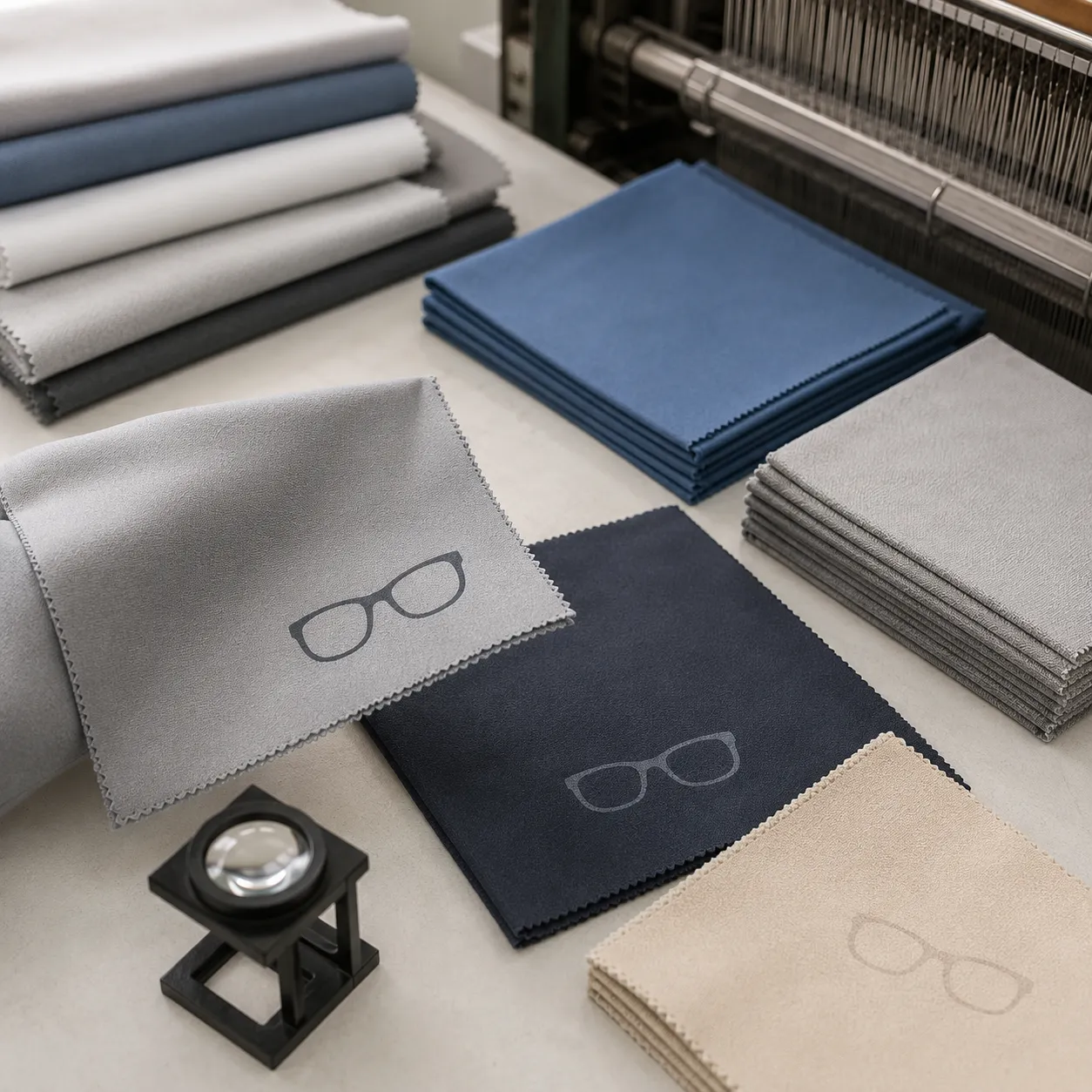
What Custom Microfiber Cloths for Glasses Must Do
For eyewear, the cloth is not a giveaway first. It is a contact surface for coated lenses, phone screens, camera filters, sunglasses, and sometimes medical optics. That changes the specification. A normal promotional microfiber towel can be acceptable for wiping a desk or car interior, but custom microfiber cloths for glasses need finer filament, lower lint, softer edges, and controlled print chemistry.
At our mill, we treat optical cloths separately from gym microfiber and auto-detailing microfiber. The cloth weight is lighter, usually 170-230 GSM. The weave is tighter. The hand feel is slick rather than plush. Most orders use 80/20 polyester-polyamide or 85/15 for price-sensitive programs. For higher-risk lenses, we prefer 80/20 because the polyamide component improves moisture pickup and gives a less harsh wiping feel.
The failure modes are also different. A bath towel buyer worries about loop pull. A gym towel buyer worries about odor after laundering. For lens cloths, we watch for pigment transfer, heat-cut ridges, loose lint, and trapped hard particles from cutting or sewing. One small fused bead on the edge can draw a visible line across a plastic demo lens.
- Lens contact safety: no hard edge beads, no abrasive glitter ink, no PVC coating on the wiping face.
- Low lint: brushed or suede-finish microfiber must be cleaned before packing, not only cut and folded.
- Print stability: sublimation or dispersed dye must be fixed enough that warm fingers and lens spray do not lift color.
- Pocket usability: the cloth must fold cleanly into a case without springing open or shedding at the corners.
Start With Yarn Split, Not the Logo
Most artwork discussions begin with Pantone color, but for optical cloths we first confirm yarn and finishing. The common construction is a warp-knitted microfiber with a suede finish. The yarn is split during finishing so each filament creates many fine wiping edges. A cloth that looks similar under showroom lighting may perform very differently if the filament is not split evenly.
For microfiber eyeglass cloth wholesale orders, we usually quote three levels. A 170-180 GSM cloth works for mass eyewear giveaways and lens inserts. A 200-210 GSM cloth feels more substantial and is our regular recommendation for opticians and sunglasses brands. A 220-230 GSM cloth is used when the cloth is sold as part of a kit or paired with a rigid case.
| Spec choice | Typical range | Where we use it | Risk if under-specified |
|---|---|---|---|
| Fiber blend | 80/20 or 85/15 polyester-polyamide | Optical, phone, camera, sunglass cloths | Lower polyamide content can feel drier and push oil instead of lifting it |
| GSM | 170-230 GSM | 15×15 cm to 20×20 cm cloths | Too light feels disposable; too heavy folds poorly into cases |
| Surface | Suede, fine brushed, or flat knit | Direct lens contact | Deep nap can trap dust if packing is not clean |
| Edge | Ultrasonic cut or micro-serged | Most logo lens cleaning cloths | Poor heat cutting leaves fused beads that can scratch soft lenses |
We do not recommend terry microfiber for glasses, even if the buyer wants a “soft towel feel.” Terry loops are good for drying hands, faces, or car panels, but they can trap small particles. For optical use, a flat suede or fine-knit face gives better control. If the product is closer to a face towel or sports towel, our article on microfiber vs cotton towel comparison explains why microfiber behaves differently from cotton in moisture pickup and surface drag.
Decoration Choices That Will Not Hurt Lenses
A printed optical cleaning cloth is usually decorated by sublimation, digital disperse print, or heat transfer. For full-color artwork, sublimation on white microfiber gives the cleanest result because the dye enters the polyester portion rather than sitting as a thick surface film. For a one-color logo, we can also use low-build transfer, but we keep it away from the wiping face whenever possible.
Screen print with plastisol is a common mistake on lens cloths. It may look sharp, but the ink film can create a raised area. That raised edge can drag across AR coating or leave a smudge line. Metallic, glitter, puff, rubberized, and silicone inks are not suitable for the cleaning surface. If a buyer needs a premium look, we suggest a border print, a repeated low-coverage pattern, or a separate paper sleeve instead of a heavy ink layer.
| Decoration method | Best use | MOQ and setup | Factory comment |
|---|---|---|---|
| Sublimation print | Full-face photo, pattern, retail artwork | 500 pcs per design/color; setup USD 35-75 | Best balance for color and lens-safe surface |
| Digital disperse print | Short runs with gradients or multiple SKUs | 500 pcs per design/color; artwork check 1-2 days | Good for sampling and DTC accessory kits |
| Heat transfer logo | Small logo on corner or pouch | 500 pcs; mold or film charge USD 25-60 | Keep print small and off the main wiping zone |
| Woven label or paper sleeve | Branding without ink on cloth face | Label MOQ 1,000 pcs often applies | Useful for optical chains that want a clean cloth surface |
For Pantone matching, microfiber is less forgiving than cotton terry because the base fabric is often bright white and the surface reflects more light. A dark navy logo can shift purple under LED store lighting if the ICC profile is not controlled. We normally ask for Pantone TCX or Solid Coated references and then approve by a 10×10 cm strike-off. For broader color process details, see Pantone color matching custom towels.
- Avoid heavy ink coverage if the cloth will be folded against lenses inside a case.
- Keep QR codes at least 22 mm wide on 200 GSM suede microfiber, or scanning becomes unreliable after print gain.
- Use vector logos for text below 6 pt; raster files often blur after heat and pressure.
- Specify print side when only one face is decorated, because cutting teams need a clear face-up instruction.
Lens-Safety Tests We Use Before Bulk
There is no single universal ISO standard that says one cloth is safe for every lens coating. So we combine textile tests with practical lens-contact checks. For export programs, we run fabric colorfastness and chemical compliance first, then do our internal abrasion and residue checks on clear lens blanks.
For colorfastness, we refer to ISO 105-X12 for rubbing and ISO 105-E04 when perspiration contact is relevant. For chemical safety, OEKO-TEX Standard 100 Class I is our default target when the cloth may touch the face, hands, or children’s eyewear. Our factory also operates under ISO 9001 procedures and BSCI social audit requirements. Certification does not replace a lens rub test, but it reduces risk in dye, finishing agent, and restricted substance control.
- Cut five cloths from pre-production fabric, including one corner and one center area from the printed panel.
- Shake and tape-lift each cloth to check loose fibers after cutting.
- Rub 50 cycles on CR-39 and polycarbonate lens blanks with a 300 g hand weight under dry conditions.
- Repeat with standard alcohol-free lens spray to check dye lift and streaking.
- Inspect under 5× magnification for visible hairline marks, colored residue, or fused-edge deposits.
A cheap anti scratch microfiber cloth can still fail if cutting is dirty. We once rejected a pre-production lot because the cloth face passed rubbing, but the ultrasonic blade left intermittent brown melt marks on the edge. The root cause was old residue on the horn, not the yarn. We changed the blade cleaning interval from every 6,000 cuts to every 2,500 cuts for that order. That kind of process note should appear in the QC file, not only in a chat message.
Sizing, Edge Finish, and Packaging Decisions
The most common sizes are 13×13 cm, 15×15 cm, 15×18 cm, 18×18 cm, and 20×20 cm. A 13×13 cm cloth fits small cases but feels stingy for sunglasses. A 20×20 cm cloth cleans tablets and camera lenses well, but it may not fit eyewear packaging. For optical retail, 15×18 cm at 200 GSM is a practical middle ground: enough hand coverage, still easy to fold.
| Finished size | Approx. unit weight at 200 GSM | Best application | Packing note |
|---|---|---|---|
| 13×13 cm | 3.4 g | Eyeglass case insert, mass promo | Can look too small if packed alone |
| 15×15 cm | 4.5 g | Optician counter cloth, lens insert | Efficient cutting yield from roll goods |
| 15×18 cm | 5.4 g | Sunglasses and optical chain programs | Good space for logo plus care instruction |
| 18×18 cm | 6.5 g | Retail lens kit or camera accessory | Needs larger sleeve to avoid tight folding |
| 20×20 cm | 8.0 g | Tablet, phone, ski goggle, camera lens | Better packed flat than rolled |
Edge finish depends on price and positioning. Ultrasonic cutting is fast and clean when controlled. Serrated ultrasonic edges reduce fraying but can feel rough if the tooth pitch is too large. Micro-serged edges look more finished but add cost and bulk, and the sewing thread can collect dust. For lens cloths, we normally prefer a smooth ultrasonic cut with a narrow sealed edge. For a gift set, micro-serging in matching thread can work if the thread is OEKO-TEX compliant and trimmed cleanly.
- Paper sleeve: lowest cost, good for optical chains and event distribution.
- OPP bag: protects from dust but may look less retail unless printed card is added.
- Microfiber pouch: useful for sunglasses, but the pouch fabric must follow the same lint control.
- Rigid case kit: higher freight volume; confirm carton cube before approving packaging.
If your program includes cloths plus face towels or gym towels, do not assume the same care label applies. Microfiber lens cloths often should avoid fabric softener because silicone residue reduces oil pickup and can create smearing. For broader towel size planning, we keep a separate reference in towel sizes dimensions complete guide, but optical cloths need tighter tolerances than bath items.
Pricing Bands and Cost-per-Use Reality
Custom microfiber cloths for glasses are often compared only by unit price. That is risky because a USD 0.18 cloth and a USD 0.34 cloth can look similar in a PDF quote. The difference may be GSM, fiber blend, edge control, packing cleanliness, or print fixation. If a customer reuses the cloth 45 times, a USD 0.31 unit costs less than USD 0.007 per use. If a USD 0.19 cloth starts smearing after 12 uses, the cost per clean is about USD 0.016, before counting customer complaints.
| Order volume | Basic 170-180 GSM, 1-color | 200-210 GSM sublimation | 220-230 GSM retail kit cloth |
|---|---|---|---|
| 500-999 pcs | USD 0.30-0.48/pc | USD 0.42-0.68/pc | USD 0.58-0.92/pc |
| 1,000-2,999 pcs | USD 0.22-0.36/pc | USD 0.31-0.52/pc | USD 0.45-0.74/pc |
| 3,000-9,999 pcs | USD 0.16-0.28/pc | USD 0.24-0.41/pc | USD 0.36-0.61/pc |
| 10,000+ pcs | USD 0.12-0.22/pc | USD 0.19-0.34/pc | USD 0.30-0.52/pc |
These are FOB China working bands, not fixed offers. Final cost changes with size, print coverage, sleeve type, barcode stickers, individual polybagging, carton mark requirements, and exchange rate. Our standard MOQ is 500 pcs per design and per color. For many small artwork versions, the MOQ problem is usually not cutting; it is print setup and packing line changeover. Our guide on negotiate towel MOQ without killing margin covers how to consolidate base fabric while keeping SKU flexibility.
Production Timeline From Artwork to Export
For custom lens cloth programs, the bottleneck is rarely weaving. It is artwork approval, strike-off correction, and packing specification. A clear tech pack saves days. We need finished size, GSM, fiber blend, print file, Pantone references, edge type, packing method, carton requirement, certification requirement, and shipping terms. If the buyer only sends a logo and says “standard microfiber,” we have to ask questions before quoting accurately.
- Artwork and spec review: 1-2 working days after we receive files.
- Lab dip or digital strike-off: 4-6 days for sublimation, longer if multiple color corrections are needed.
- Pre-production sample with final edge and packing: 5-8 days.
- Bulk fabric preparation, printing, cutting, inspection, and packing: 12-20 days for 1,000-10,000 pcs.
- Final inspection and export documentation: 2-4 days depending on carton marks and certificate copies.
A normal repeat order can ship in 15-22 days after approval. A new program with custom sleeve, barcode sticker, and multiple artwork files is usually 24-34 days before vessel or air departure. Air freight for small cloths is more realistic than for bath towels because the weight is low, but carton volume still matters if sleeves or cases are bulky. For freight planning logic, see container vs air freight towel orders.
Related reads: if you are building a complete accessory spec, start with build towel tech pack that mills can quote. For decoration trade-offs beyond microfiber cloths, compare embroidery vs sublimation vs jacquard and review custom microfiber towels wholesale guide.
QC Checkpoints We Put in the Order File
The QC plan for logo lens cleaning cloths is short but strict. We check incoming fabric GSM, surface cleanliness, print registration, edge sealing, dimensions after cutting, corner shape, lint, and packing contamination. Small cloths are easy to count incorrectly, so we use bundle counts and carton weighing together. A 20×20 cm cloth at 200 GSM should not have the same carton weight as a 15×15 cm cloth; this is a simple way to catch packing mistakes before shipment.
- GSM tolerance: normally ±5%, measured from fabric before cutting and confirmed on retained samples.
- Size tolerance: ±3 mm for small optical cloths, tighter than many bath towel tolerances.
- Print position: ±2 mm for centered logos; border artwork needs cutting marks in the file.
- Edge check: no sharp melt beads, no brown horn residue, no open fray longer than 1 mm.
- Packing cleanliness: random open-bag inspection for fiber dust, paper crumbs, and trapped thread.
We also keep retained samples from the first approved production run. For repeat orders, we compare hand feel and color against that retained sample, not only against a digital file. This matters because microfiber finishing can change the perceived shade. A blue print on a slightly more brushed surface may look lighter even when the dye formula is unchanged.
For compliance documents, we can provide OEKO-TEX Standard 100 Class I certificate copies where applicable, BSCI audit information, and ISO 9001 factory documentation. If your retailer requires restricted substance files, tell us before sampling so we select approved dyestuff and finishing auxiliaries from the start. The practical certificate reading process is explained in how to read OEKO-TEX certificate.
What to Send Us for a Clean Quote
A precise inquiry helps us quote custom microfiber cloths for glasses without padding the price for unknowns. The most common missing item is packaging. A cloth in bulk packs, a cloth in an individual clear bag, and a cloth in a printed sleeve are three different production flows. The second missing item is print coverage. A tiny corner logo and a full-surface photo do not use the same ink, paper, or heat press time.
- Finished cloth size, for example 15×18 cm or 20×20 cm.
- Target GSM and fiber blend, or tell us the end use so we can recommend.
- Decoration method preferred, or send artwork for our review.
- Pantone references and acceptable color tolerance.
- Edge type: ultrasonic cut, zigzag ultrasonic, or micro-serged.
- Packing method: bulk, individual OPP, paper sleeve, pouch, or retail kit.
- Certification requirements: OEKO-TEX 100 Class I, BSCI, ISO 9001 documentation, or retailer RSL.
- Order quantity by design and color, with delivery country and target ship date.
For optical chains, sunglass brands, camera accessory kits, and screen-cleaning promotions, we prefer to sample the real packing format. A cloth that passes QC flat on the table may pick up paper dust if the sleeve board is too powdery, or it may crease if packed into an undersized pouch. These small details decide whether the cloth feels like a useful care item or a disposable insert.
LUMA & CO. TEXTILE has operated since 2007 with 220 employees in Gaoyang, Zhejiang, China. We produce about 2.4 million towels and microfiber items per year for 80+ brand clients across 47 countries. Our working MOQ is 500 pcs per design/color, and we quote OEM programs with real decoration, packing, and compliance assumptions rather than a single vague “microfiber cloth” line.
Send Us Your Lens Cloth Spec
For a factory quote, send artwork, size, GSM target, packing method, and delivery country to [email protected] or WhatsApp +86 13384590853.
Request a Quote →