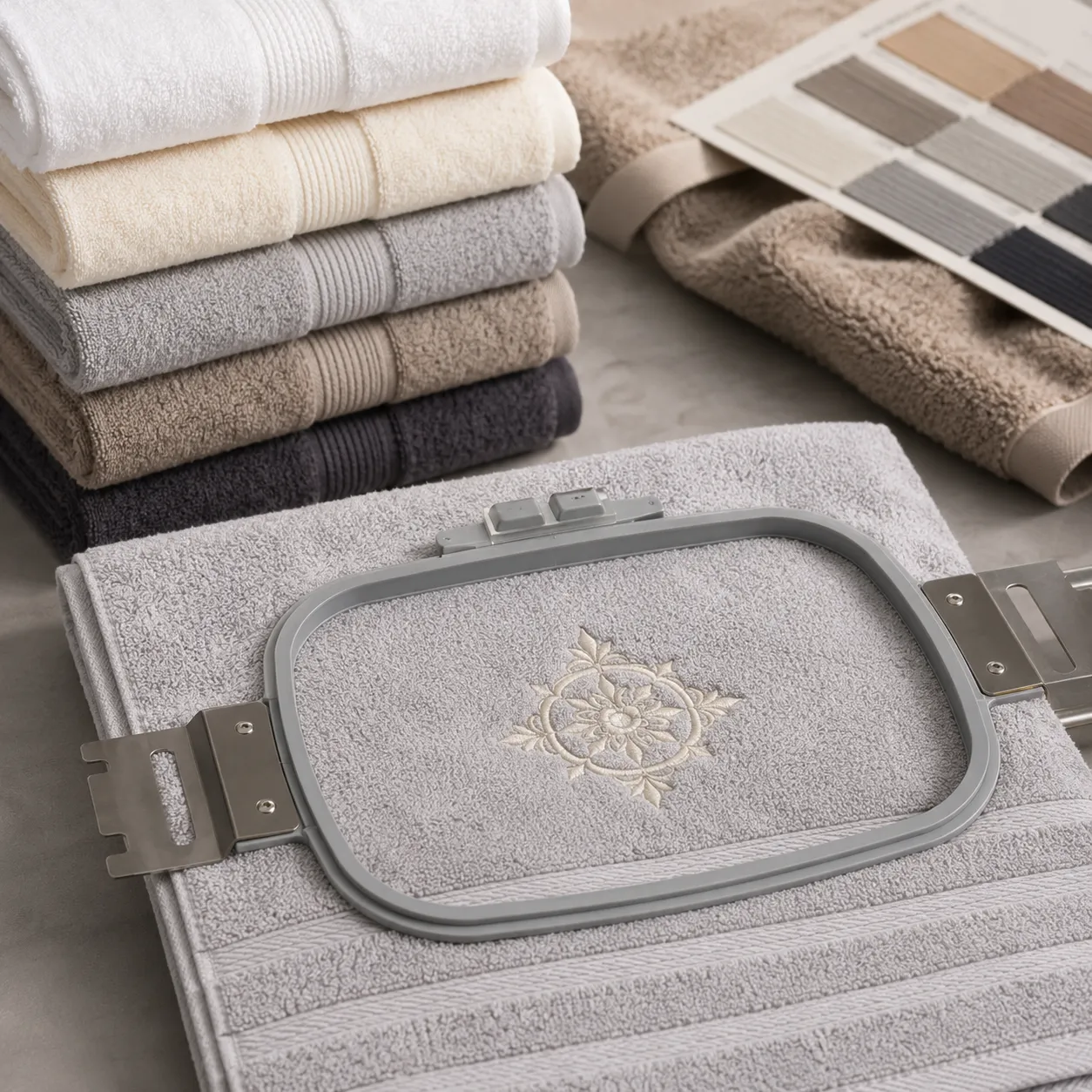
Start With the Towel Body, Not the Logo
For embroidered bath towels, the base towel decides half of the result before the embroidery machine starts. A dense 650 GSM ring-spun cotton towel gives a different stitch surface than a 480 GSM quick-dry hotel towel. High pile can swallow fine lettering. Low pile can show every backing edge if the embroidery is too large or too tight.
In our sample room, we first check three towel-body details: GSM tolerance after pre-wash, pile height around the intended embroidery zone, and border stability. For hotel monogram towels, we normally keep the monogram on the dobby border or 70-110 mm above it. Embroidery placed too close to the lower hem can curl after tunnel drying, especially on heavier bath sheets.
| Bath towel body | Typical GSM | Best monogram use | Risk to control |
|---|---|---|---|
| Hotel standard bath towel | 500-560 GSM | Initials, small crest, room-program logo | Pile can still cover thin 1.2 mm strokes |
| Resort bath towel | 580-650 GSM | Crest, spa mark, VIP suite towel | Heavy stitch blocks can stiffen the face |
| Retail gift bath towel | 520-620 GSM | Personalized initials or family name | Name length changes stitch count and cost |
| Light quick-dry bath towel | 430-490 GSM | Small mark on border only | Backing shadow and puckering are more visible |
A buyer often wants the largest possible crest because it looks strong in a PDF. On a towel, that same crest may become a hard patch. For cotton bath towel GSM above 600, we normally advise a crest width of 75-95 mm for hotel use, or 95-120 mm for retail gift towels where presentation matters more than fast industrial laundry folding.
Monogram Bath Towels 2026 Buyer Guide: Approval Points
The approval path should be short, but it cannot skip the fabric-and-thread interaction. For a new custom bath towel OEM program, we treat the embroidery sample as a functional test piece, not only a color sample. The buyer should approve the towel body, embroidery file, thread color, placement, wash result, and packing orientation before deposit moves into bulk.
- Approve the towel construction first: size, GSM, yarn route, border style, and shrinkage target.
- Send vector artwork with letter height, not only a logo image; we digitize from vector for cleaner satin columns.
- Approve one stitched sample before bulk if the design is new, even if the towel body is already used.
- Run wash review after at least 5 cycles for retail programs and 10 cycles for hotel laundry programs.
- Freeze carton packout, because embroidered faces need folding direction control to avoid thread abrasion in transit.
For reference, our normal MOQ remains 500 pcs per design per color. A hotel can split sizes inside the same project, but a bath towel with a navy monogram and a bath towel with a champagne monogram are separate color lots for thread setup and QC. If a buyer needs 300 pcs for one boutique property, we can sometimes combine with hand towels or washcloths using the same thread, but the bath towel price will usually carry a setup premium.
Stitch Count Has to Be Estimated From a Real File
We do not quote embroidery only by logo size because two 90 mm marks can behave very differently. A serif letter with open spacing may run 4,200-5,600 stitches. A filled shield crest at the same width can exceed 11,000 stitches. These figures are from our 2025 and early 2026 sample records for bath towel monograms between 65 and 115 mm wide, digitized for 120D/2 polyester embroidery thread.
Thread weight also needs a basis. For towel embroidery, we commonly use 120D/2 polyester where hotel laundry durability matters, and rayon only when a retail buyer accepts lower chlorine tolerance in exchange for a softer sheen. On high-pile towels we increase underlay, but underlay is not free: it adds machine time and can make the embroidery feel harder.
| Monogram style | Sample stitch-count range | Typical machine time per towel | Factory note |
|---|---|---|---|
| Two initials, 55-65 mm wide | 2,800-4,100 stitches | 2.0-3.0 minutes | Works well on border or low-pile zone |
| Three initials, 70-85 mm wide | 4,600-6,800 stitches | 3.5-5.0 minutes | Most common hotel approval range |
| Small crest plus initials, 85-105 mm wide | 7,500-11,500 stitches | 5.5-8.0 minutes | Needs wash test before bulk |
| Dense retail emblem, 110-125 mm wide | 12,000-17,000 stitches | 8.0-12.0 minutes | Higher risk of stiff handfeel and puckering |
The practical issue is not only stitch count. If the digitizer uses too much satin stitching over terry loops, the edges can sink after washing. If the file relies on small gap details under 1.0 mm, cotton lint can blur them by the third or fourth laundry review. We usually request minimum stroke width of 1.5 mm for initials and 2.0 mm for crest outlines on bath towels.
Placement Rules That Prevent Crooked Bulk Goods
Towel embroidery placement looks simple until the sewing line handles 2,000 heavy towels in one shift. Terry fabric stretches, dobby borders are not always perfectly straight after dyeing, and a bath towel is large enough to pull against the hoop. We mark placement from stable references: lower hem, side edge, and border line. We do not mark from loose pile.
- For 70 x 140 cm bath towels, our standard monogram center is usually 110-140 mm above the lower hem, depending on border depth.
- For 76 x 152 cm bath sheets, we move the mark higher, often 150-180 mm from the lower hem, so it remains visible when folded.
- For hotel stacks, we confirm the fold face before stitching; a beautiful monogram on the hidden fold is a real procurement mistake.
- For retail boxed towels, we test the box window or belly-band view before finalizing the embroidery position.
A common defect is rotational drift: the monogram is not off-center by much, but it tilts 3-5 degrees against the border. On a single towel this looks minor. In a hotel room stack, it becomes visible immediately. Our inline team uses a placement template and records first-piece measurements at line start, after thread change, and after every 100 pieces for longer runs.
Wash Testing: What We Actually Look For
For embroidered bath towels, wash testing is less about whether the towel survives one laundry cycle and more about whether the embroidery remains flat and legible. We use ISO 6330 as the domestic washing reference for retail-style checks, and for hotel programs we add an internal industrial-laundry simulation with alkaline detergent, 60-75 C wash temperature, and tumble drying. For colorfastness, we reference ISO 105-C06 or AATCC TM61 depending on the buyer's lab route.
Failure points usually appear early. In our 2026 sample bench, weak backing choices often show puckering within 3-5 cycles. Poor thread color selection against reactive-dyed towel bodies tends to show lint contamination and contrast loss after 8-12 cycles. Dense crest embroidery on 620 GSM terry may still look intact after 15 cycles but feel too rigid for a guest towel program.
| Test checkpoint | Acceptance target | Why it matters |
|---|---|---|
| Embroidery puckering | No visible wave beyond 3 mm from stitched edge after 10 cycles | Stops the towel face from looking warped |
| Thread colorfastness | Grade 4 or better on staining where applicable | Prevents dark thread transfer onto white or ivory towels |
| Logo legibility | Initials readable at normal arm distance after drying | Small serif details often blur on high pile |
| Dimensional change | Within agreed towel shrinkage tolerance, often +/-5% | Placement shifts if shrinkage is ignored |
| Backing residue | No hard scratch edge after washing | Guest comfort issue on bath towels |
We push back when a buyer asks for water-soluble topping only and no stable backing on a high-pile bath towel. The first sample may look clean, but after washing the stitches can drop into the pile. A light tear-away backing, correctly trimmed, is usually safer for hotel work. For white towels with dark monograms, we also check loose thread tails carefully because they can show through the fold in retail packaging.
FOB Price Bands With the Assumptions Stated
FOB bands are only useful when the assumptions are visible. The prices below are based on a 70 x 140 cm cotton bath towel, reactive dyed or optical white, 540-620 GSM, one embroidery position, 120D/2 polyester thread, standard export carton, and OEKO-TEX Standard 100 Class I compliant material route. They are not a quote for every crest, but they are a realistic working range from our current cost sheets and recent bath towel embroidery orders.
| Order volume | Simple initials, 3,000-5,000 stitches | Hotel crest, 6,000-10,000 stitches | Dense emblem, 11,000-16,000 stitches |
|---|---|---|---|
| 500-999 pcs | USD 5.85-7.25 | USD 6.35-7.95 | USD 7.10-9.20 |
| 1,000-2,999 pcs | USD 5.10-6.55 | USD 5.55-7.10 | USD 6.25-8.10 |
| 3,000-5,999 pcs | USD 4.72-6.05 | USD 5.12-6.62 | USD 5.78-7.45 |
| 6,000+ pcs | USD 4.48-5.78 | USD 4.86-6.30 | USD 5.42-7.05 |
The spread is driven by towel weight, yarn price, dye color, embroidery machine time, trimming labor, and packing method. A black towel with a metallic-look monogram costs differently from a white towel with navy initials. Metallic thread is another discussion; we avoid it for hotel bath towels unless the buyer accepts lower abrasion performance.
Cost-per-use is where cheap decisions become visible. In one recent resort comparison, a 520 GSM towel with a 4,800-stitch monogram landed near USD 5.30 FOB at 2,400 pcs, while a 610 GSM towel with a 7,200-stitch crest was around USD 6.85 FOB. The lighter towel looked attractive on the PO, but the resort laundry expected roughly 90-110 usable cycles from that construction versus 145-170 cycles from the heavier towel in its wash route. On that basis, the cheaper towel sat near USD 0.053 per expected use, and the heavier option near USD 0.043. That is why we ask for the laundry method before recommending the lowest unit price.
Compliance, Audit, and Paperwork Buyers Should Ask For
For hotel groups and retail brands, documentation should match the product risk. LUMA & CO. TEXTILE operates with OEKO-TEX Standard 100 Class I, BSCI, and ISO 9001 systems. For a monogram program, the buyer should ask whether the towel body, embroidery thread, backing, and packaging inks fall under the same compliance file or need separate declarations.
- OEKO-TEX Standard 100 Class I: useful when towels may contact sensitive skin or family retail channels.
- BSCI audit: checks social compliance and factory management practices, not towel performance by itself.
- ISO 9001: supports controlled production records, inspection plans, and corrective-action tracking.
- Needle control record: important for embroidery lines because broken needle fragments are a preventable safety risk.
- Artwork approval sheet: should show final size, thread code, placement distance, and revision number.
We also keep shade-lot records for towel bodies and thread lots. This matters on repeat orders. A hotel may reorder 800 bath towels six months later and expect the monogram to match the original. If the thread code is only written as "gold" or "beige," the reorder will drift. We prefer Madeira, Gunold, or buyer-approved thread references when color precision matters.
Production Timing From Sample to Export Carton
A realistic production calendar avoids emergency air freight. For a first-time embroidered bath towel order, we normally plan 7-10 days for towel-body lab dip if the color is custom, 5-7 days for embroidery digitizing and stitched sample, and 18-30 days for bulk production after all approvals. Peak hotel replenishment months can stretch embroidery-line scheduling by another 4-6 days.
- RFQ and file check: 1-2 working days when the buyer sends size, GSM, artwork, quantity, and packing request.
- Lab dip or white towel body confirmation: 5-10 working days depending on color and cotton route.
- Embroidery sample: 5-7 working days after artwork and thread color are confirmed.
- Buyer approval and wash review: 3-12 days depending on how many cycles the buyer requires.
- Bulk weaving, dyeing, sewing, embroidery, final inspection, and packing: 18-30 days for most 500-6,000 pc orders.
- Export booking and documents: 3-7 days before vessel cutoff, longer before national holidays.
For urgent hotel openings, we can sometimes use stock white towel bodies and embroider locally in our factory, but the buyer loses control over custom GSM, border design, and dyed color. That route is useful for emergency room readiness, not for a full brand-standard rollout.
The Buyer Files That Keep the Order Clean
The strongest orders arrive with a clear tech pack. It does not need to be complicated, but it must remove guesswork. A one-page sheet covering towel size, GSM, yarn, border, monogram size, thread code, placement, folding, carton mark, and inspection standard will prevent most disputes.
- Artwork file: AI, EPS, or PDF vector, with Pantone or thread reference color noted separately.
- Towel spec: finished size after washing, GSM tolerance, yarn route, border width, and color standard.
- Embroidery spec: width, height, stitch type limits, backing type, placement distance, and allowed tolerance.
- Packing spec: fold face, polybag or belly band, inner quantity, export carton size, and carton drop-test need if applicable.
- Inspection rule: AQL level, critical defects, major defects, minor defects, and photo standard for placement.
For AQL, many buyers use general inspection level II with AQL 2.5 for major defects and 4.0 for minor defects. Critical defects should be zero tolerance. On embroidered towels, critical issues include needle contamination, wrong logo, wrong thread color, and severe staining. Major issues include placement outside tolerance, open seams, obvious puckering, and embroidery thread breaks.
Related reads: for the base towel side, our hotel towel sourcing guide and towel GSM decision framework explain how weight, yarn, and laundry route change the brief. For decoration trade-offs, compare this with embroidery vs sublimation vs jacquard before locking the logo method.
Related reads: if the buyer is still building the RFQ, start with build towel tech pack that mills can quote. For compliance paperwork, how to read an OEKO-TEX certificate is useful before requesting certificates from any mill.
A Practical Signoff Standard for 2026 Orders
For the 2026 buying season, we recommend a signoff standard that treats the towel and the monogram as one product. Approving the bath towel body alone is not enough. Approving the embroidery file on flat fabric is also not enough. The buyer should see the actual stitched result on the actual towel construction, after washing, folded the way the guest or retail customer will see it.
Our factory standard for new embroidered bath towels is simple: one approved physical sample, one approved wash result, one approved packing photo, and one locked technical sheet before bulk. This adds several days at the start, but it reduces the cost of remakes, chargebacks, and hotel opening delays. For a monogram bath towels 2026 buyer guide, that is the main point we would keep: decoration is not a final cosmetic step. It is part of the towel specification.
Send Us the Bath Towel Monogram Brief
Share towel size, GSM target, artwork, quantity, delivery country, and laundry route. We will return a practical OEM spec, MOQ plan, sample timing, and FOB range.
Request a Quote →