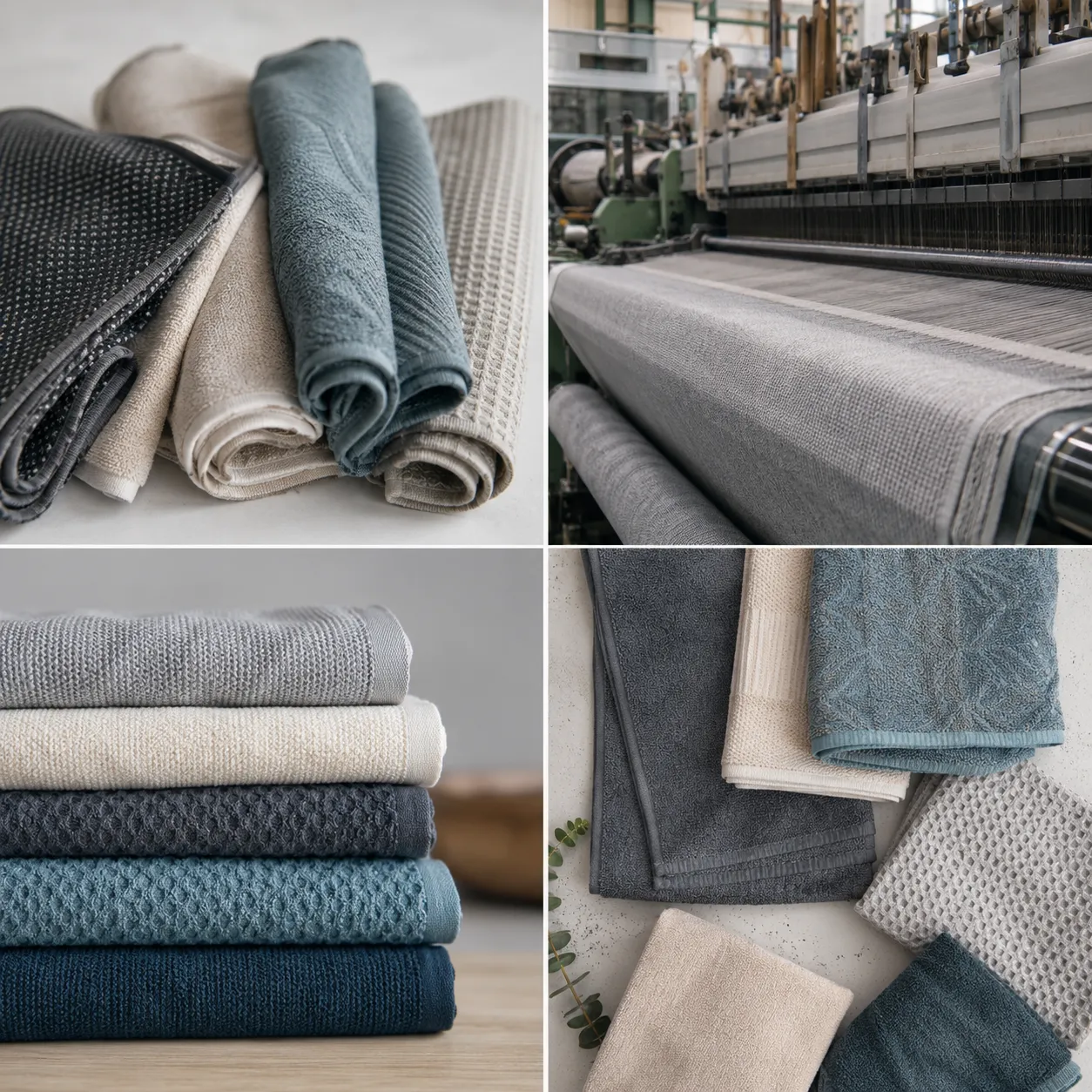
Start with the retail sample, not the product page
For this category, online specs are usually incomplete. Buyers often have dimensions and a recycled-content claim, but not the construction details that control performance. When we benchmark a retail sample, we first record finished size, actual cut size before hem turn-in, total piece weight, fabric weight in g/m², wale and course density if it is warp knit, pile direction if it is brushed, and whether the face print sits on a sheared side or a suede finish.
That matters because two towels can both look like a nomadix fitness towel on screen yet behave very differently in use. A 230-250 GSM brushed microfiber with a tight overlock edge packs small and prints sharply, but a 300+ GSM double-faced knit usually feels thicker, dries slower, and costs more to ship. If a buyer only says "match this style," we cannot quote accurately without measuring the physical sample.
- Measure finished size after wash, not only greige cut size. We check after one home-laundry cycle at 40°C and one tumble-low cycle if the item is marketed as machine washable.
- Record water absorption by weight gain after immersion and drip standardization for a fixed time window; otherwise "absorbent" becomes a subjective word.
- Inspect the edge build. A 4-thread overlock, folded hem, or bound edge changes both cost and curl behavior.
- Check whether the print is transfer sublimation on white base fabric or printed after panel cutting; panel printing usually gives better logo placement but more edge scrap.
| Benchmark point | What we measure at incoming review | Why it affects sourcing |
|---|---|---|
| Fabric construction | 80/20 or 85/15 polyester/polyamide microfiber, brushed suede or smooth knit | Controls handfeel, print clarity, drying speed and cost |
| Finished weight | Total grams per piece and GSM from conditioned sample | Affects absorption, postal cost and gym-user perception |
| Decoration route | Sublimation transfer, panel print, or all-over print after cutting | Drives MOQ, color consistency and seam registration |
| Edge construction | Overlock width in mm, stitch density, corner shape | Affects durability and curling after wash |
| Wash response | Shrinkage %, edge torque, print migration, lint pickup | Predicts complaints after retail launch or studio use |
The construction details buyers usually miss
This category is usually a printed microfiber workout towel, not a cotton sweat towel. The common factory route is warp-knit microfiber in the 220-280 GSM band, then face brushing to create a suede touch. That brushed face gives good image resolution for sublimation, but it also reduces initial wipe aggression compared with a split-fiber terry microfiber used in auto-detailing. For gym use, that tradeoff is often acceptable because the user wants a compact towel that feels soft against skin and packs dry in a bag.
Two technical points matter here. First, if the fabric is too tightly heat-set before printing, the towel can feel slick and spread moisture rather than grab it. Second, if the brushing is too deep, the face can show white stress marks after repeated folding along the same line. We watch both during development. On our side, we normally specify warp-knit brushed microfiber at 235-255 GSM for compact studio towels and 255-285 GSM for larger training towels where users expect a little more body.
- For yoga, spin and circuit studios, we see the best balance around 240-260 GSM with a soft suede face and clean overlock edge.
- For retail packs where the towel must feel more substantial in hand, 260-280 GSM gives better shelf perception but raises courier cost.
- If the buyer wants a recycled claim, we can use GRS-traceable recycled polyester yarn, but the exact percentage depends on blend and final testing.
- Microfiber workout towels should be checked for snag sensitivity against hook tape, exposed zippers and rough locker surfaces.
How we test whether it actually works in a gym
Gym performance is not only about soak-up volume. Users wipe sweat, fold the towel, place it on benches, and wash it frequently with activewear. For that reason, we do not rely on a single absorbency claim. Our internal review for this product type includes basis weight verification, dimensional stability after wash, color fastness to washing, color fastness to perspiration, and water uptake by timed immersion. For color fastness, we typically reference ISO 105-C06 for domestic laundering and ISO 105-E04 for perspiration. For dimensional change, we use the wash conditions agreed in the tech pack and report percent change in length and width separately.
One defect mode specific to printed suede microfiber is edge cupping after heat transfer. If transfer paper dwell time runs too long, the fabric can set unevenly and the panel develops a slight dish shape. It may pass visual inspection flat on the table but curl at the corners after the first wash. Another defect is ghosting at folded areas during sublimation if the panel shifts after initial ink release. Both are process issues, not just fabric issues, and they matter when you are trying to benchmark a nomadix fitness towel style product honestly.
| Test item | Typical method or condition | Pass level we usually discuss with buyers |
|---|---|---|
| Basis weight | Conditioned sample, g/m² | Within ±5% of approved standard |
| Wash shrinkage | 40°C wash, tumble low or line dry per care label | Usually within 3% each direction for microfiber gym towels |
| Color fastness to washing | ISO 105-C06 | Grade 4 minimum on color change for core programs |
| Color fastness to perspiration | ISO 105-E04, acid and alkaline | Grade 4 preferred for dark, saturated prints |
| Seam/edge durability | Internal repeated snag and pull check | No seam opening, no thread run, acceptable corner shape |
Size and weight should match the use case, not the inspiration sample
A retail benchmark may be attractive, but your own channel determines the better specification. For boutique fitness, the most workable sizes we see are 30×80 cm, 40×90 cm and 50×100 cm. The smallest option is easy to clip to a bag or drape over a treadmill bar. The middle size works well for spin, yoga and general training. The larger size moves closer to a mat or bench coverage towel and starts to compete with lightweight bath-size gym formats.
Piece weight should be reviewed together with packaging. For example, a 40×90 cm towel at 248 GSM will land around 89-95 g depending on edge build and moisture regain at packing. Add a belly band, insert card and polybag, and you can push the packed unit above 110 g quickly. That sounds minor until a DTC brand is mailing several thousand units. We often show buyers the postal breakpoints before they approve a heavier handfeel.
| Use case | Common finished size | Working GSM range | Typical packed position |
|---|---|---|---|
| Spin / treadmill | 30×80 cm | 235-255 GSM | Compact, low-postage retail unit |
| Studio / yoga / general fitness | 40×90 cm | 240-265 GSM | Best balance for DTC and club resale |
| Bench cover / larger wipe-down use | 50×100 cm | 255-285 GSM | Higher presence, higher freight per unit |
| Promotional trial item | 30×60 cm | 220-240 GSM | Entry price but less impressive in hand |
If you are early in spec writing, our article on towel sizes and dimensions helps frame size decisions by use case rather than copying a competitor. For gym-first programs, sweat towels for gym spec guide is also worth reviewing because bench coverage, fold behavior and wash frequency matter more than shelf presentation.
Sublimation is usually the right decoration route, but there are limits
Most buyers benchmarking this type of towel want all-over print. For microfiber suede, sublimation is the most efficient route because it gives sharp detail, broad color range and no heavy ink film on the face. We prefer artwork built in CMYK with embedded profiles and a clear tolerance note for visual color shift. If the buyer requires Pantone-critical logo fields, we sample those areas first because sublimation on brushed polyester can read slightly lighter than coated paper proof.
There are also design limits. Large solid dark backgrounds can show fold whitening more readily than mid-tone patterns. Fine hairline text near the edge can distort if the overlock bites too close. And if the towel uses a rounded corner radius under 20 mm, registration around the curve becomes less forgiving during cutting. We tell buyers this early because a cleaner print file often saves more money than negotiating a few cents off sewing.
- Keep critical logos at least 12 mm inside the finished edge to avoid visual crowding from overlock stitches.
- Avoid long unbroken 100% black flood areas if the towel will be tightly folded for retail display.
- For face graphics with gradients, provide vector logos plus raster background layers at final scale.
- Approve one strike-off on actual fabric, not only a paper print, before bulk release.
If your team is still comparing decoration routes across cotton and microfiber, embroidery vs sublimation vs jacquard explains where each method works and where it creates avoidable cost.
Costing: where the money actually goes
A microfiber gym towel is usually quoted from fabric weight, print coverage, edge construction, packaging and order volume. Recycled content raises yarn cost. Full-bleed patterning raises print cost and can increase panel waste. Retail packaging often adds more than buyers expect, especially when they want a thick insert card, barcode sticker, swing tag and individual mailer-ready bag.
For a realistic OEM program, our MOQ is 500 pcs per design per color. Below that, print setup and cutting loss become hard to absorb. For broad guidance, a 40×90 cm brushed microfiber towel around 245-255 GSM with all-over sublimation and standard 4-thread overlock often lands in these FOB China ranges:
| Volume | Specification basis | Indicative FOB USD/pc |
|---|---|---|
| 500 pcs | 40×90 cm, 245-255 GSM, all-over sublimation, standard polybag | USD 2.18-2.66 |
| 1,500 pcs | Same base spec with consolidated print run | USD 1.84-2.21 |
| 5,000 pcs | Same base spec, stable artwork repeat, bulk packaging efficiency | USD 1.46-1.88 |
| 10,000 pcs | Program volume with simplified packout | USD 1.33-1.71 |
Those numbers are not interchangeable with cotton gym towels or plush microfiber terry. They belong to this specific printed suede workout category. If the buyer requests recycled polyester, GRS chain-of-custody paperwork, a retail belly band, or a custom mesh carry pouch, pricing moves upward from there.
Lead times are short only if approvals are clean
This is not a slow category to produce, but it can stall in development if artwork and testing expectations are vague. A workable timeline for a fresh OEM program is usually 3-5 days for quotation after receiving the tech pack or benchmark sample, 7-10 days for lab-dip equivalent print strike-off or digital mock plus physical sample, and 18-28 days for bulk production after approval and deposit, depending on volume and packaging complexity.
- Buyer sends target sample, artwork files, size, GSM target and packaging notes.
- We review construction and issue a quote with assumptions clearly listed.
- Sample or strike-off is made on target fabric with agreed edge construction.
- Buyer approves color, handfeel, dimensions and care label wording.
- Bulk printing, cutting, sewing, inspection and packing run in sequence.
- Final audit and shipping booking follow, with air or sea chosen by launch date.
For launch planning, freight decisions can erase the savings you negotiated on unit price. If this is a seasonal drop, read container vs air freight towel orders before locking your in-stock date.
Compliance and claims buyers should verify
For this product type, the common claim stack is material safety, social compliance and quality-system control. We are OEKO-TEX Standard 100 Class I, BSCI and ISO 9001 certified. If your program uses recycled polyester and you want that claim on packaging, ask specifically for the applicable recycled certification flow on that order, not just a general statement about available yarn.
Buyers also need to align claim language with what the towel actually is. "Quick dry" is generally supportable for lightweight microfiber relative to cotton terry, but "anti-bacterial" should not appear unless there is a verified treatment and a compliant testing basis behind it. On retail packs, inaccurate copy causes more risk than a slightly less exciting feature list.
- Ask for OEKO-TEX certificate scope and check that the product category fits the intended end use. Our guide on how to read OEKO-TEX certificate covers the basics.
- If recycled content is part of the selling story, state the target percentage and certification path in the PO.
- For repeated studio laundering, define the wash care statement before sample approval so shrinkage is judged against the right condition.
- Keep packaging claims tied to tested facts, not trend language copied from retail competitors.
What we would change if you are building your own program
If a brand sends us a nomadix fitness towel sample as inspiration, we do not assume the goal is to clone it exactly. Often the smarter move is to keep the compact printed microfiber concept while adjusting the spec to your channel. For club resale, we may push to 255-265 GSM so the towel feels less insubstantial on the rack. For e-commerce bundles, we may stay near 240-250 GSM and simplify the edge so the delivered cost stays under the next parcel tier. For high-sweat use, we sometimes recommend a dual-surface concept with one suede printed side and one slightly more textured wipe side, though that changes the visual benchmark.
This is also where cost-per-use becomes more useful than first cost. A cheaper 225 GSM towel with weak overlock and aggressive edge curl can trigger returns, bad reviews and replacement orders after a few wash cycles. A slightly heavier, better-set panel that stays flat and keeps print integrity usually performs better for the brand even if FOB is 18-24 cents higher. If your audience is serious gym users, they notice function quickly.
Related reads: if you are comparing fibers rather than only benchmarking one retail item, see microfiber vs cotton towel comparison. If your development pack still has gaps, build towel tech pack that mills can quote will save time on the next RFQ. For wash-life issues in commercial settings, why gym towels fail after 50 washes shows where construction choices start to show up.
The minimum brief we need to quote accurately
A good RFQ for this category is short but precise. Send target size, target fabric type, GSM range, print coverage, edge construction, packaging, order quantity, destination market and any certification requirement. If you are referencing a nomadix fitness towel style product, include one physical sample if possible. Photographs alone do not show brushing depth, fabric density or edge stiffness.
- Target size and allowed tolerance in cm
- Target weight in GSM and, if available, total g/pc
- Material blend, including any recycled polyester requirement
- Artwork files and whether print must be full bleed
- Edge finish: overlock, fold hem, or binding
- Packaging spec, barcode placement and carton pack quantity
- Required standards such as OEKO-TEX 100 Class I, BSCI, ISO 9001
Related reads: for color approval issues, pantone color matching custom towels is useful before strike-off. If MOQ is the sticking point, negotiate towel MOQ without killing margin explains what can be flexed without breaking production economics.
Quote a gym towel program with real test points
Send your sample, tech pack or target spec and we will quote against measurable construction, print and wash-life requirements. MOQ 500 pcs per design per color. WhatsApp +86 13384590853 or email [email protected].
Request OEM Quote →