What Buyers Usually Mean by Mission Cooling Towel
In sourcing conversations, buyers often use mission cooling towel as shorthand for an evaporative sports towel sold for running, golf, tennis, construction crews, theme parks, and summer events. We do not copy another brand's packaging or protected artwork. What we can do is build an OEM towel with the same functional category: soak it, wring it, snap or shake it, and let evaporation pull heat from the fabric surface.
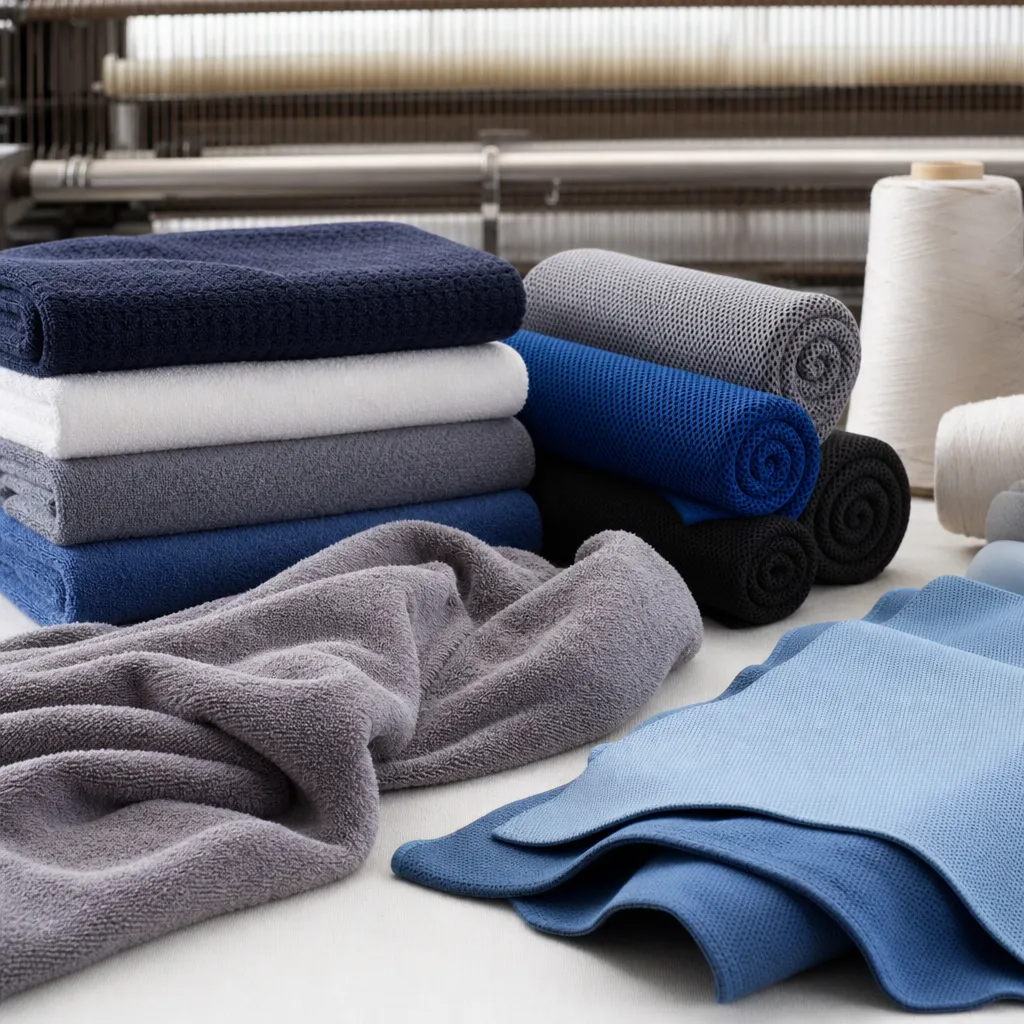
The strongest programs start by separating consumer expectation from exact material choice. Some retail samples use a soft microfiber knit. Some use PVA sponge with a chamois-like grip. Others use a lightweight polyester mesh that cools quickly but feels less plush. Each construction can work, but the quote, print method, dry stiffness, and packing volume change sharply.
| Buyer brief phrase | Factory interpretation | Risk if not specified |
|---|---|---|
| Feels like a retail cooling towel | Usually 150-220 GSM polyester microfiber or 180-260 GSM PVA blend | Factory may quote the cheapest mesh and miss the hand-feel |
| Cold after snapping | Evaporative performance after soak-wring-shake, not chemical cooling | Overclaiming can create returns if packaging promises too much |
| Logo all over | Sublimation on polyester, emboss/deboss or sleeve print for PVA | PVA does not accept detailed full-color print well |
| Compact for event kits | Small size plus pouch or tube packaging | Large towels raise freight cost more than unit cost suggests |
Choose the Fabric Before You Choose the Logo
For custom cooling towels, the first technical fork is microfiber versus PVA. Microfiber is easier for full-color artwork and softer against the neck. PVA holds more water and can feel cooler for longer in dry heat, but it becomes stiff when dry and needs wet packaging instructions. We have seen retail teams choose PVA for a premium sports kit, then reject it later because store staff thought the dry towel felt "plastic." That was not a defect; it was the nature of the material.
Our usual microfiber cooling towel range is 150-220 GSM, using 80/20 or 85/15 polyester-polyamide yarn, warp-knit or weft-knit depending on stretch target. For PVA cooling towels, the useful range is 180-300 GSM after wet finishing. Below 180 GSM, the towel can tear at the edge after repeated wringing. Above 300 GSM, the product cools well but dries slowly and becomes bulky for retail cartons.
- Microfiber knit: best for sublimation, sports clubs, gym chains, marathon merchandise, and full-surface designs.
- PVA sponge: best for heat crews, outdoor work kits, fishing, golf carts, and buyers who prioritize water retention over print detail.
- Polyester mesh: lowest packed weight and fast evaporation, but a rougher touch and lower perceived value.
- Cotton is not our first choice: it absorbs well but dries slowly, so it performs poorly as an evaporative cooling towel in humid conditions.
| Construction | Common GSM | Typical size range | Best decoration | Main caution |
|---|---|---|---|---|
| Polyester microfiber knit | 150-220 GSM | 30 x 90 cm, 30 x 100 cm, 40 x 100 cm | Sublimation or heat transfer label | Can feel warm if too dense |
| PVA sponge cooling towel | 180-300 GSM | 26 x 66 cm, 30 x 80 cm, 33 x 90 cm | Emboss, deboss, printed pouch, paper sleeve | Stiff when dry; limited artwork detail |
| Polyester cooling mesh | 120-170 GSM | 30 x 80 cm, 30 x 100 cm | Sublimation | Lower perceived thickness |
| Microfiber terry hybrid | 220-280 GSM | 35 x 100 cm, 40 x 110 cm | Woven label or simple print | Higher freight and slower drying |
How We Test Cooling Without Making Loose Claims
A cooling towel does not create cold by itself. It works when water evaporates from the fabric surface. In our sampling room, we avoid wording such as "instant ice" or "cools by 30 degrees" unless the buyer has a lab protocol and climate condition behind that claim. Temperature drop changes with ambient humidity, airflow, fabric water content, and how firmly the user wrings the towel.
For development, we use a practical comparison test before moving to third-party validation. We soak samples in water at 22-24 C for 90 seconds, wring to a target remaining water ratio, shake for 5 seconds, then measure surface temperature with an infrared thermometer at 1, 5, 10, and 20 minutes. In a 27 C room at 55% relative humidity, a 190 GSM microfiber knit may show a 4-7 C surface drop in the first few minutes. A 240 GSM PVA towel can hold that cooling window longer, often with slower drying.
For formal quality control, we recommend pairing the functional check with recognized textile tests. Colorfastness to washing can be checked against ISO 105-C06. Colorfastness to rubbing can follow ISO 105-X12. pH value can be checked under ISO 3071, especially for skin-contact products. For baby, spa, or sensitive-skin channels, buyers usually request OEKO-TEX Standard 100 Class I materials; for adult sports merchandise, Class II is also accepted by some retailers, but we can support Class I when the brief requires it.
- Confirm the target use climate: humid gym, dry desert event, beach club, warehouse crew, or golf course.
- Approve one benchmark sample for hand-feel only and one internal sample for performance.
- Test cooling after 1 wash and after 10 wash cycles, because surface finish can change.
- Check edge curl after wet wringing; this is where weak mesh constructions reveal themselves.
- Lock packaging copy only after the towel construction is approved.
Size, GSM, and User Scenario Matter More Than Hype
The most common sourcing mistake is ordering one universal size for every channel. A 30 x 80 cm towel works for a 5K race kit or promotional pouch. It is too short for a tennis player who wants neck coverage between sets. A 40 x 110 cm towel feels useful at a beach club or outdoor gym, but it can double the carton volume compared with a smaller event towel.
For a mission cooling towel alternative sold through retail, we usually see 30 x 90 cm or 30 x 100 cm. For corporate safety programs, 26 x 80 cm PVA is common because workers often wear it under a helmet or around the back of the neck. For hotel pool decks or wellness retreats, buyers may prefer a softer microfiber at 35 x 100 cm with a drawstring pouch, even if the cooling curve is slightly shorter.
| Use case | Recommended spec | Approx. towel weight | Reason |
|---|---|---|---|
| Running event giveaway | 30 x 80 cm, 150-170 GSM microfiber | 36-41 g | Low mailer weight and enough neck coverage |
| Gym retail counter | 30 x 100 cm, 180-200 GSM microfiber | 54-60 g | Better hand-feel and larger logo area |
| Outdoor work crew | 26 x 80 cm, 220-260 GSM PVA | 46-54 g | Higher water retention under heat exposure |
| Resort or beach club | 35 x 100 cm, 200-230 GSM microfiber | 70-81 g | More coverage and better perceived value |
| Golf tournament pouch set | 30 x 90 cm, 180 GSM microfiber | 49 g | Fits pouch, cart bag, and prize table display |
If buyers are building a broader sports assortment, it helps to compare this category with sweat towels for gym and custom microfiber towels. Cooling towels are thinner and more evaporation-driven; sweat towels are built for absorbency and repeated laundering.
Decoration Limits: Sublimation Is Not Always the Answer
For microfiber cooling towels, sublimation gives the cleanest full-color result. It works because polyester receives disperse dye under heat, so the print sits inside the fiber rather than as a thick surface film. On a 170-190 GSM white microfiber base, we can hold detailed gradients, club mascots, event maps, and sponsor panels. Dark base colors are harder because sublimation needs a light ground.
PVA is different. It is sponge-like, hydrophilic, and sensitive to heat pressure. If a buyer wants a PVA cooling towel with a detailed logo, we usually move the design to the packaging, a silicone patch, a hangtag, or an outer pouch. Simple embossing can work, but very fine lines fill in after wet swelling. This is one of those factory-floor constraints that is better to discuss before artwork is approved by marketing.
- Use sublimation for microfiber when artwork has more than 3 colors or edge-to-edge coverage.
- Use woven labels only if the towel will not be worn tightly against the neck; some users feel the label corner.
- Use heat transfer logos carefully because heavy films can block evaporation in the printed area.
- Use printed pouch branding for PVA when the towel surface cannot carry detailed artwork.
- Keep Pantone targets realistic; wet fabric looks darker than dry fabric, especially in blue and green shades.
For buyers comparing decoration routes, our article on embroidery vs sublimation vs jacquard explains why cooling towels rarely suit embroidery. If your brand color is non-negotiable, read Pantone color matching custom towels before approving a digital mockup.
Pricing Bands for Cooling Towel Bulk Orders
Cooling towel bulk pricing depends on fabric, size, decoration, packaging, and inspection level. A small microfiber towel in a polybag is inexpensive to make. A PVA towel in a reusable plastic tube with a printed insert is a different product because the packaging can cost nearly as much as the towel. For export quotes, we usually price FOB Ningbo or Shanghai, with EXW available for buyers consolidating in China.
Below are realistic 2026 factory bands for custom OEM work. They are not spot quotes because yarn price, exchange rate, and packaging artwork can shift the number. Our MOQ remains 500 pcs per design / per color, but price efficiency improves meaningfully after 3,000-5,000 pcs because print setup, sampling, and carton planning spread better.
| Spec and packaging | 500-999 pcs | 1,000-2,999 pcs | 5,000-9,999 pcs | 10,000+ pcs |
|---|---|---|---|---|
| 30 x 80 cm microfiber, sublimation, polybag | USD 0.92-1.28 | USD 0.74-1.05 | USD 0.58-0.82 | USD 0.51-0.73 |
| 30 x 100 cm microfiber, sublimation, mesh pouch | USD 1.35-1.86 | USD 1.08-1.52 | USD 0.86-1.18 | USD 0.78-1.06 |
| 26 x 80 cm PVA, plain towel, printed sleeve | USD 1.18-1.65 | USD 0.98-1.36 | USD 0.82-1.12 | USD 0.74-1.02 |
| 33 x 90 cm PVA, plastic tube, insert card | USD 1.72-2.45 | USD 1.46-2.05 | USD 1.18-1.66 | USD 1.06-1.48 |
| 35 x 100 cm microfiber, pouch, retail hangtag | USD 1.62-2.28 | USD 1.32-1.86 | USD 1.05-1.48 | USD 0.94-1.34 |
Cheap construction can look attractive on a line sheet and fail in use. For example, on a 6,000-piece summer tennis order, dropping from 180 GSM microfiber to 125 GSM mesh might save about USD 0.17 per unit, or USD 1,020 total. If 9% of recipients discard the towel after the first wash because the edge rolls and the print looks thin, the usable giveaway cost rises from roughly USD 0.71 to USD 0.78 per kept towel. That is before counting brand damage or replacement requests.
Packaging, Cartons, and Freight Are Part of the Spec
Cooling towels are often sold as compact accessories, so packaging has unusual weight in the decision. A waterproof zipper pouch is useful for gyms and beach clubs because users can put a damp towel back into a bag. A plastic tube gives strong retail shelf presence but increases carton volume and can crack in cold handling if the plastic grade is too brittle. Paper sleeves are low-cost and good for event distribution, but they do not protect a wet towel after use.
For microfiber, we normally ship dry. For PVA, buyers must decide whether they want dry-packed or pre-moistened packed goods. Dry PVA reduces mildew risk and shipping weight, but the towel feels stiff on first touch. Pre-moistened packing improves opening experience but needs preservative review, better sealing, and stricter storage control. We usually recommend dry-packed PVA for export unless the buyer has a tested retail formula and shelf-life protocol.
- Standard export carton for microfiber: 50-200 pcs per carton depending on pouch and size.
- Plastic tubes reduce loading efficiency; plan carton dimensions before approving tube diameter.
- For Amazon or DTC channels, add barcode placement and drop-test requirements to the tech pack.
- For resort and club programs, zipper pouches need seam strength checks because damp users pull them hard.
- For hot climates, avoid unvented sealed packaging for wet towels unless antimicrobial and shelf-life testing are complete.
If freight timing is tight, compare routes early. A 10,000-piece microfiber order may move by air if the event date is fixed, but tubes or wet-packed goods make air freight painful. Our container vs air freight towel orders guide covers the trade-offs in more detail.
Compliance and Retail Documentation
Because cooling towels touch skin and are often used by children, athletes, and outdoor workers, documentation should not be treated as paperwork afterthought. LUMA & CO. TEXTILE operates under ISO 9001 quality management and holds BSCI social compliance. We can source materials under OEKO-TEX Standard 100 Class I when required, and we keep test reports tied to lot numbers instead of mixing them across unrelated orders.
For a retail-ready evaporative cooling towel, we usually prepare a technical file that includes fabric composition, GSM tolerance, size tolerance, colorfastness data, packaging material, carton marks, care label wording, and sample approval photos. For U.S. or EU retail, buyers may also ask for fiber content labeling, country-of-origin marks, and polybag warning language. We do not advise printing medical-style cooling claims unless the buyer has independent substantiation.
- Confirm the market: U.S., EU, U.K., Australia, Middle East, or mixed export.
- Choose OEKO-TEX Class I or Class II requirement before fabric sourcing begins.
- Approve care instructions with the final construction, not from a generic template.
- Keep one sealed pre-production sample at the mill and one with the buyer.
- Set AQL inspection level before mass production; common towel programs use AQL 2.5 for major defects and 4.0 for minor defects.
Buyers new to textile certification can start with how to read an OEKO-TEX certificate. If your team is building the first formal brief, build a towel tech pack that mills can quote will save several rounds of vague email.
Sampling and Production Timeline
A custom cooling towel program is fast when the buyer has artwork, size, packaging, and compliance requirements ready. It slows down when the buyer asks us to quote "like the famous towel" without deciding whether that means microfiber, PVA, tube packaging, pouch packaging, or a retail header card. We can help define the spec, but every undecided element affects cost and timing.
| Stage | Typical timing | Factory note |
|---|---|---|
| Spec confirmation and quote | 1-3 days | Faster when size, GSM, artwork, and packing are fixed |
| Lab dip or print strike-off | 4-7 days | Sublimation strike-offs are quicker than dyed microfiber lab dips |
| Prototype sample | 5-10 days | PVA molds or special pouches can add time |
| Pre-production sample | 3-6 days after deposit | Used to lock fabric, print, packing, and carton marks |
| Bulk production | 18-30 days | Depends on quantity, decoration, and packaging complexity |
| Final inspection and export docs | 2-4 days | Add time for third-party inspection bookings |
| Sea freight to U.S./EU port | 24-38 days typical | Route and season affect actual transit |
| Air freight | 4-8 days typical | Useful for event recovery, expensive for bulky packaging |
For most orders under 20,000 pcs, a realistic door-to-port plan is 30-45 days after sample approval for production and export preparation, then freight time. For rush microfiber orders with simple polybags, we have completed production in 16-20 days after final approval, but that requires greige fabric availability and clean artwork files.
How to Brief Us for a Better Quote
A useful RFQ does not need to be long. It needs to remove the expensive guesses. Tell us who will use the towel, where it will be sold or distributed, whether the towel must resemble a retail mission cooling towel benchmark, and what packaging the user expects after opening. Photos help, but measurements and material preference help more.
- Target construction: microfiber, PVA, polyester mesh, or open for factory recommendation.
- Size and GSM target, or at least user scenario and packed-size limit.
- Artwork file, Pantone targets, and whether edge-to-edge printing is required.
- Packaging: polybag, zipper pouch, plastic tube, paper sleeve, hangtag, or retail box.
- Compliance requirement: OEKO-TEX Class I, BSCI factory, ISO 9001 process, retailer test protocol, or buyer's own standard.
- Order quantity by design and color; our MOQ is 500 pcs per design / per color.
- Delivery country, target ship date, and whether air freight is acceptable for urgent events.
Related reads: for adjacent sports programs, see country club golf towel program, private label yoga towel OEM specs, and why gym towels fail after 50 washes. For material decisions, compare microfiber vs cotton towel comparison with towel GSM guide.
Build a Cooling Towel Spec That Works
Send us your target use, size, artwork, packaging idea, and quantity. We will recommend microfiber or PVA, quote realistic price bands, and flag any claim or decoration risk before sampling. WhatsApp: +86 13205717266. Email: [email protected].
Request a Cooling Towel Quote →