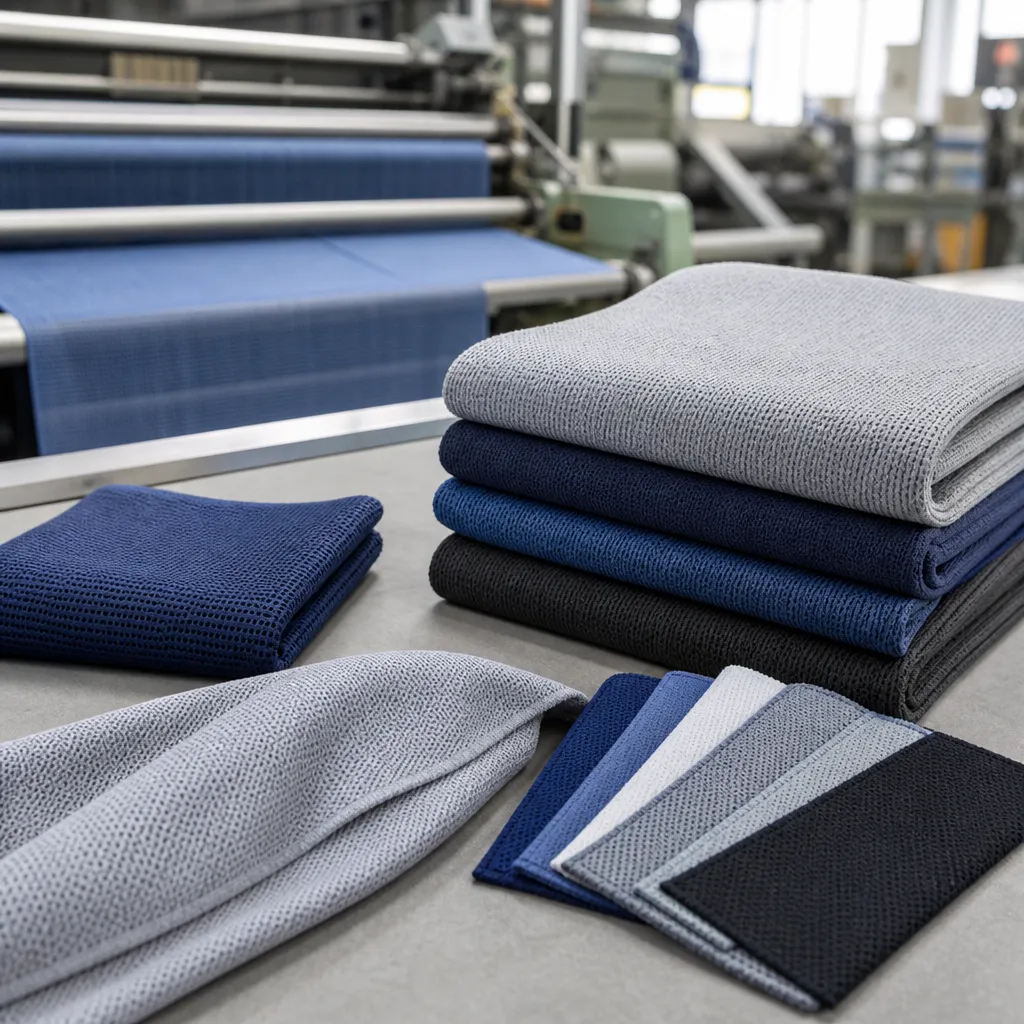
Why the MOQ Is Not Just a Number
For neck cooling towels, the practical MOQ starts at 500 pcs per design / per color in our mill. We can sometimes sample below that, but bulk production below 500 pcs usually pushes the unit price into a range that does not make sense for a brand buyer. The fabric roll still needs dyeing, edge finishing, cutting, logo setup, inspection, and export packing.
The common mistake is treating a cooling towel like a simple giveaway cloth. A towel for the neck is narrow, often packed in a bottle or pouch, and used wet against skin. That means shrinkage, edge feel, odor after drying, and color migration matter. If one of those fails, the buyer does not just lose a low-cost item; the event staff or retail customer touches the defect directly.
| Order quantity | Recommended use | Typical MOQ rule | FOB China price band |
|---|---|---|---|
| 500-999 pcs | Pilot run, small team order, local event | 1 design / 1 color is realistic | USD 1.18-1.72 / pc |
| 1,000-2,999 pcs | Promotional campaign or gym launch | 2-3 colorways possible if same base fabric | USD 0.86-1.26 / pc |
| 3,000-9,999 pcs | Race series, resort retail, club program | Color splits become easier above 1,000 pcs each | USD 0.58-0.92 / pc |
| 10,000-30,000 pcs | National event, distributor stock, retail pack | Best for custom bottle, hangtag, barcode setup | USD 0.43-0.68 / pc |
| 30,000 pcs+ | Seasonal replenishment or chain rollout | Fabric greige booking and carton plan needed | USD 0.36-0.55 / pc |
Those bands assume a standard polyester cooling fabric, one logo position, export carton packing, and normal colorfastness testing. They do not include air freight, import duty, or unusual retail packaging. If a buyer asks for 500 pcs split into five colors, the issue is not that the mill refuses small business; the issue is that dyeing, cutting, packing, and QC all become five small jobs instead of one controlled production run.
Cooling Towels for Neck MOQ and Pricing Drivers
Cooling towels for neck MOQ and pricing are driven first by construction, then by decoration, then by packout. The fabric itself is not expensive at moderate weight, but the towel becomes costly when the buyer adds a plastic tube, carabiner, individual barcode, color insert, or multi-position print.
- Fabric weight: most neck cooling towels sit between 140 and 220 GSM. Below 140 GSM, the towel dries fast but feels flimsy after repeated wring cycles. Above 220 GSM, evaporation slows and freight weight rises.
- Size: common sizes include 30 x 80 cm, 30 x 90 cm, 31 x 100 cm, and 35 x 100 cm. A 30 x 90 cm towel at 180 GSM weighs about 49 g before edging and logo.
- Edge finish: overlock is economical and soft; ultrasonic cut is clean but can feel sharper if the fabric is too thin; bound edge improves retail feel but adds labor.
- Logo method: screen print is efficient for one or two colors, sublimation suits full-surface artwork on white fabric, and silicone patch or woven label raises both cost and lead time.
- Packaging: a single polybag is low cost, while a PET bottle with cap, carabiner, printed insert, and barcode can add USD 0.22-0.48 per unit.
For cost-per-use, we usually ask the buyer how many wet-dry-wash cycles the towel must survive. A 160 GSM towel at USD 0.61 may pass a one-day race giveaway, but if it curls at the edge after 18 washes, a gym selling it at reception will get returns. A 190 GSM towel at USD 0.78 that lasts 55 wash cycles costs about 1.4 cents per use before freight. The cheaper towel at 18 cycles costs about 3.4 cents per use. That is why we push back when the usage is ongoing, not single-event.
Fabric Choices That Change the Quote
Most neck cooling towels use polyester or polyester-nylon blends with a flat, mesh, or waffle-like cooling structure. The cooling effect is not chemical. It comes from water retention plus evaporation across the fabric surface. We test this by soaking the towel in water at 23-25 C, wringing to a controlled wet pickup, exposing it to moving air, and recording surface temperature drop at 1, 3, and 5 minutes with an infrared thermometer.
| Construction | Typical GSM | Hand feel | Cooling behavior | Best use |
|---|---|---|---|---|
| Flat microfiber knit | 150-180 GSM | Smooth, compact | Fast initial cooling, medium water hold | Race giveaways, sports teams |
| Pique cooling mesh | 160-200 GSM | Dryer touch, visible texture | Good airflow and faster dry-back | Gym retail, outdoor work kits |
| Waffle cooling knit | 180-220 GSM | More grip and body | Higher water hold, slower dry | Golf, hiking, resort retail |
| Polyamide blend knit | 170-210 GSM | Softer and more elastic | Stable cooling, better drape | Brand programs needing nicer hand feel |
A specific quirk with neck towels is lengthwise growth after wet wringing. If the yarn tension is not relaxed before cutting, a 90 cm towel can stretch during use and recover unevenly after drying. We pre-relax fabric rolls for 12-24 hours before cutting and check dimensional change after washing under ISO 6330-style domestic laundering. For export programs, we normally hold shrinkage within +/-5% after three washes.
Decoration Choices: Logo Cost vs Wash Risk
Decoration is where many small orders lose control. A one-color screen print on a 30 x 90 cm towel is simple, but a full-bleed sublimation print requires white base fabric, transfer paper, heat control, and panel alignment. If the towel is packed wet by the end user, poor ink fixation can migrate onto the pouch or onto light clothing.
| Logo method | MOQ impact | Added cost range | Main QC risk |
|---|---|---|---|
| One-color screen print | Low; works from 500 pcs | USD 0.06-0.13 / pc | Cracking if paste is too thick |
| Two to three-color screen print | Medium; registration setup needed | USD 0.10-0.22 / pc | Color shift and misregistration |
| Full sublimation print | Medium; best from 1,000 pcs | USD 0.18-0.38 / pc | Panel skew and shade variation |
| Woven label | Low to medium; label MOQ applies | USD 0.05-0.11 / pc | Scratchy label edge at neck |
| Silicone patch | Higher; mold or patch MOQ applies | USD 0.16-0.34 / pc | Patch lifting after wash |
For colorfastness, we use ISO 105-C06 for washing, ISO 105-X12 for rubbing, and a perspiration check aligned with ISO 105-E04 when the towel will sit against the neck during sport. For promotional cooling towels, we normally require grade 4 or better for staining on adjacent fabric. Dark navy, scarlet, and black need more discipline than light blue or grey because wet contact is part of normal use.
Related reads: if the logo choice is still open, compare towel decoration routes in embroidery vs sublimation vs jacquard and review color control basics in Pantone color matching custom towels. For sport-specific towel use, sweat towels for gym spec guide is a useful parallel.
The RFQ Lines We Need Before Pricing
A clean RFQ saves three to five days because we do not have to guess the use case. The quote for a retail neck towel in a printed tube is not the same as a towel handed out at a construction safety event. Even when the size looks identical, the inspection standard and packaging labor can be different.
- State the size in centimeters, including tolerance. For example, 30 x 90 cm, tolerance +/-2 cm after wash.
- Choose target GSM and construction, or send a reference towel for matching. If no reference exists, we recommend 170-190 GSM for most neck use.
- Confirm base color and Pantone reference. For sublimation, clarify whether the towel must be white on the reverse or printed both sides.
- Provide logo artwork in AI, PDF, or high-resolution vector format, with print size and placement in millimeters.
- Define packaging: bulk pack, individual polybag, mesh pouch, PET bottle, kraft tube, hangtag, barcode, or retail carton.
- List compliance needs: OEKO-TEX Standard 100 Class I, BSCI audit file, ISO 9001 factory system, or retailer-specific restricted substance list.
- Share delivery term and market: FOB Ningbo/Shanghai, CIF destination port, DDP by courier, or air freight for event date.
Our standard MOQ remains 500 pcs per design / per color. For a buyer with four colors, we would rather quote 1,000 pcs each in two colors first than 500 pcs each across four colors if the budget is tight. Fewer colorways give better dye control, easier shade approval, and fewer leftover accessories.
Sample and Bulk Timeline in Working Days
Cooling towels move faster than jacquard bath towels, but they still need controlled steps. The slowest part is often not sewing; it is artwork confirmation, packaging proof, and freight booking. For a fixed event date, we work backward from the in-hand date, not from the PO date.
| Stage | Normal timing | What can delay it |
|---|---|---|
| Artwork and spec confirmation | 1-3 days | Missing Pantone code, unclear logo size, packaging not chosen |
| Lab dip or print strike-off | 4-7 days | Dark color approvals, revised artwork, retailer color standard |
| Pre-production sample | 5-9 days | Custom bottle, woven label, silicone patch, new edge finish |
| Bulk fabric and cutting | 7-12 days | Multiple dyed colors, fabric weight change after sample |
| Printing, sewing, and packing | 8-16 days | Individual barcode packout, mixed carton ratios, rush inspection |
| Final QC and export documents | 2-4 days | Carton marks, missing PO data, third-party inspection booking |
| Sea freight after vessel booking | 18-35 days | Destination port, sailing schedule, peak season space |
For most OEM programs, we tell buyers to allow 28-42 days from approved sample to ex-factory. Air freight can solve transit time, but it does not remove dyeing, curing, wash testing, or packing time. For 10,000 pcs in PET bottles, the bottle procurement and cap color approval can add 5-8 days unless we use stock packaging.
Quality Tests That Protect the Buyer
A neck towel has different failure modes from a bath towel. It is twisted, snapped open, worn wet, left in a bag, and sometimes washed with athletic clothing. Our QC plan focuses on those behaviors instead of only checking weight and size.
- Evaporative cooling check: soak, wring, and measure surface temperature drop at fixed intervals under controlled room temperature and airflow. We record the result by fabric lot.
- Wet rubbing test: dark colors are rubbed wet against white cotton fabric to catch dye transfer before bulk release.
- Edge abrasion review: overlock and ultrasonic edges are worn against the neck and checked for scratchy yarn, melted ridges, or loose tails.
- Wring recovery test: towels are twisted by hand for repeated cycles, then measured for length growth and seam distortion.
- Odor after wet storage: sample towels are sealed damp for 12 hours, then opened for odor and color migration review.
For formal export files, we can align reports with ISO 105-C06, ISO 105-X12, ISO 105-E04, and dimensional change testing based on ISO 6330 washing procedures. OEKO-TEX Standard 100 Class I is available for programs requiring skin-contact assurance. Our factory also maintains BSCI and ISO 9001 documentation for buyer audits.
Carton Packout and Freight Math
Freight surprises are common with cooling towel orders because buyers focus on towel weight and forget packaging cube. A 30 x 90 cm towel in a flat polybag is compact. The same towel in a bottle may triple carton volume even though the towel itself weighs less than 60 g.
- Bulk polybag pack: usually 200-300 pcs per export carton depending on GSM and fold method.
- Individual polybag with insert card: usually 150-220 pcs per carton, better for event distribution.
- PET bottle pack: often 80-120 pcs per carton because bottles create empty space.
- Mixed color cartons: useful for store distribution but slower to pack and inspect.
- Master carton marks: should show PO number, SKU, color, quantity, gross weight, net weight, and carton size.
For a 5,000 pc order, switching from individual polybag to bottle packaging can increase carton count from about 24 cartons to 52 cartons. At sea freight rates that may still be acceptable, but by air it can change the landed cost sharply. This is why we ask the buyer to choose packaging before finalizing cooling towels for neck MOQ and pricing, not after the towel sample is approved.
Where Buyers Can Reduce Cost Safely
There are good ways to reduce price, and there are risky ways. Cutting GSM below the use case, removing colorfastness tests, or using a hard edge on a neck product usually creates complaints later. Better savings come from simplifying the order architecture.
- Use one towel size across all colors instead of building separate SKUs for small changes.
- Keep the first order to one or two base colors, then expand after sell-through or event feedback.
- Use stock pouch or stock bottle shapes when timing matters more than custom packaging.
- Print one strong logo position instead of several small marks that add setup and inspection time.
- Approve a realistic tolerance for shade and size, especially on repeat orders where fabric lots differ.
Related reads: for MOQ negotiation without damaging the factory economics, see negotiate towel MOQ without killing margin. For quote preparation, build towel tech pack that mills can quote explains the spec details that prevent slow revisions. If air versus sea is still open, review container vs air freight towel orders.
A Practical Quote Scenario
Here is a realistic order we would quote for a summer outdoor brand: 8,000 pcs, 30 x 90 cm, 180 GSM pique cooling fabric, two body colors, one-color screen print, individual polybag, instruction card, export carton packing, FOB Ningbo. With 4,000 pcs per color, the FOB price would usually sit around USD 0.66-0.82 per pc, depending on final color and logo coverage.
If the same buyer adds PET bottles with custom printed inserts, the price may move to USD 0.92-1.18 per pc and the carton volume may more than double. If they reduce the order to 1,000 pcs split across four colors, the unit price may climb to USD 1.35-1.85 per pc because each color becomes a small production batch with its own setup and shade control.
The quote we prefer is not always the lowest unit price. It is the spec that matches the use case, passes wet-contact testing, and arrives in cartons that the buyer can actually distribute. LUMA & CO. TEXTILE has produced OEM towel programs since 2007 with a 220-person team, annual output around 2.4M towels, and export clients across 47 countries. For neck cooling programs, we treat skin contact, wet use, and packaging cube as the three controls that matter most.
Quote a Neck Cooling Towel Program
Send size, GSM target, logo artwork, quantity, packaging choice, delivery market, and required test standard. We will return MOQ options, FOB China pricing, and a production calendar. WhatsApp: +86 13205717266. Email: [email protected].
Request a Quote →