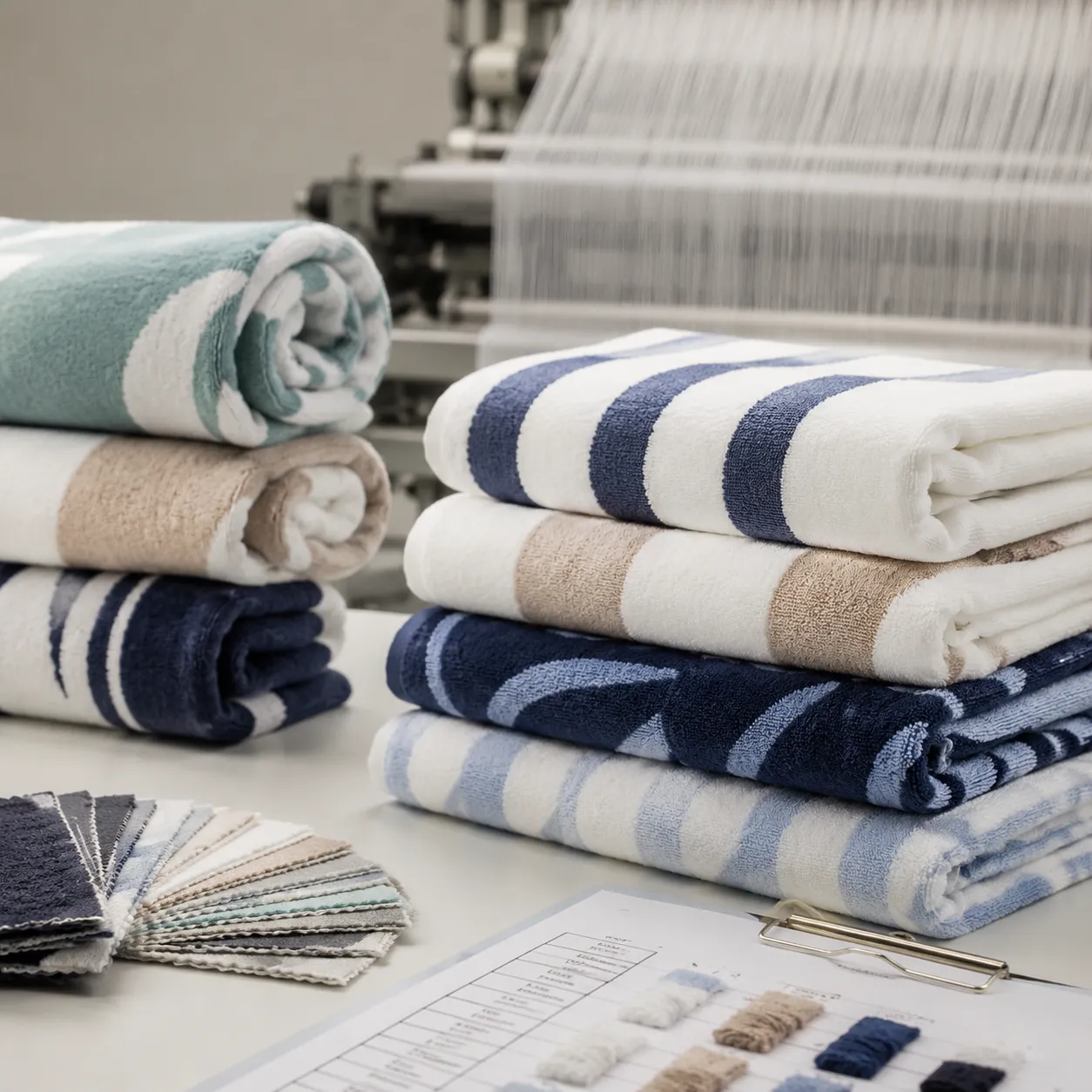
Start with the lines that actually change the towel
If you send us a one-line request such as "soft microfiber bath towel, 70 x 140 cm, white," we cannot quote or sample it accurately. The biggest swings in handfeel, water pickup, drying speed, and claim rate come from a short group of spec lines: knit or woven construction, pile style, fiber split, finished GSM, finished size after wash, edge finish, and wash test standard. Those are the fields that belong at the top of a microfiber bath towels specification sheet.
For bath use, we most often quote two workable constructions. One is warp knit suede + terry microfiber, usually 280-360 GSM, used when the buyer wants a lighter quick-dry towel. The other is coral fleece or double-sided plush microfiber, usually 320-430 GSM, used when softness matters more than scrub feel. If the sheet does not identify construction, two mills can quote the same GSM and deliver towels that feel completely different.
| Spec line | Typical workable range | Why it matters |
|---|---|---|
| Construction | Warp knit terry, suede/terry, coral fleece plush | Changes absorbency speed, drying time and sewing behavior |
| Composition | 80/20 polyester-polyamide or 85/15 | Affects softness, split quality and cost |
| Finished GSM | 280-430 GSM | Drives weight, carton density and feel |
| Finished size after wash | 50 x 100 cm to 90 x 160 cm | Prevents quote disputes on cut size vs finished size |
| Edge finish | Folded hem, overlock, binding | Controls fray risk and edge wave |
| Branding method | Embroidery, patch, woven label | Changes strike-through risk and handfeel around logo |
The construction field needs more than the word "microfiber"
On cotton towels, buyers often anchor on yarn and pile. On microfiber, the construction line does more of the work. We need to know whether you want knitted terry loops, brushed coral fleece, waffle emboss, or a bonded double-face article. Each behaves differently in cutting and finishing.
- Warp knit terry microfiber: better dimensional stability, lower snag risk than looser plush structures, common for gym and travel crossover programs
- Coral fleece plush: softer hand, stronger consumer appeal for home retail, but can show pile crush in vacuum pack if carton compression is too high
- Suede face + terry back: cleaner print or label presentation on one side with better water pickup on the reverse
- Waffle microfiber: lighter look and quicker drying, but not ideal if the buyer expects a full plush bath-towel hand
One topic-specific issue here is needle cut visibility on plush microfiber. If the pile is brushed too aggressively before shearing, a darker lane can show after hemming where the sewing needle compresses the nap. That does not appear on a cotton towel spec, but it matters on microfiber bath programs. Another one is heat-set skew memory in warp knit goods. If the fabric is under-set before cutting, the body can torque slightly after first tumble dry even when the lab dip and handfeel were approved.
How we write GSM, size, and tolerances on a microfiber bath towels specification sheet
These three lines create more avoidable arguments than almost anything else. We recommend writing finished size and finished GSM after one home-laundry cycle unless the program is commercial laundry only. If you quote cut size only, the supplier can be technically correct and commercially wrong at the same time.
| Field | Recommended format | Typical tolerance |
|---|---|---|
| Finished size | 70 x 140 cm after 1 wash at 40 C | plus or minus 3 percent |
| Finished GSM | 340 GSM after finishing | plus or minus 5 percent |
| Piece weight | Computed reference only, not approval basis | informational |
| Skew/Bow | Max 3 percent | pass/fail |
| Edge wave on long side | Max 8 mm lay-flat deviation | pass/fail |
| Shrinkage | Length and width separately | max 4 percent each unless otherwise agreed |
For example, a bath towel planned at 75 x 150 cm in 360 GSM plush microfiber usually lands around 400-420 g per piece depending on hemming allowance and moisture regain at packing. That piece weight is useful for carton planning, but we do not recommend approving bulk on weight alone. Microfiber retains process variation differently than cotton; two towels at similar piece weight can still differ in lay-flat dimensions and pile height.
Absorbency is where most sheets stay too vague
Buyers often write "good absorbency" in the comments field. That does not travel into production. We prefer a measurable absorbency section with one wetting method and one use-condition check. For microfiber bath towels, a simple sink test is not enough because finishing oils and brushing dust can distort early readings.
- Use AATCC 79 or an agreed drop test adaptation to record initial wetting time on the terry or plush side
- Add a practical water pickup percentage method: conditioned dry weight vs saturated drained weight
- Specify whether absorbency is tested before wash, after 1 wash, or after 3 washes
- Record the test side; suede face and terry face can produce very different results on the same towel
On retail bath microfiber, we commonly see acceptable first-wash targets such as initial wetting under 6 seconds on the absorbent side and water pickup at 3.5-5.0 times dry fabric weight, depending on structure. Coral fleece feels soft, but if the split quality is weak or the finishing softener is too heavy, the towel can smear water before it starts absorbing. That is exactly why the microfiber bath towels specification sheet should state both the method and the acceptance number.
If the buyer expects cotton-like thirstiness from a plush synthetic towel, we need to write the test method into the sheet before sampling, not debate it after bulk arrives.
The composition line should include split and denier assumptions
Most buyers request 80/20 polyester-polyamide because the handfeel and water pickup are more reliable than 85/15 at similar GSM. Still, composition alone is incomplete. For bath programs, we also note whether the microfiber is split filament and what the approximate fineness target is, such as 150D/144F or 100D/72F at yarn level depending on the article. You do not always need every yarn detail on the purchase order, but it should be on the internal technical data sheet.
A low-cost offer can miss performance even when it matches color and size. We have seen 85/15 plush articles quoted USD 2.08-2.34 per piece at 3,000 pcs for 70 x 140 cm around 320 GSM, while a better split 80/20 version at 340-350 GSM may sit at USD 2.42-2.76. If the cheaper towel hardens after ten home washes and the better one stays usable through forty or more, the cost-per-use gap is usually in favor of the better spec. That is the kind of trade-off a buyer should settle on paper first.
Branding and trims need their own approval block
A surprising number of claims come from the logo area, not the towel body. Microfiber reacts differently to decoration than cotton because the pile can flatten, melt, or shadow around localized heat and stitch density. If you plan to decorate the towel, the spec sheet should isolate that section instead of burying it in remarks.
| Decoration or trim | What to specify | Common failure mode |
|---|---|---|
| Embroidery | Logo size, stitch count ceiling, backing type, placement | Pile collapse, puckering, hard hand under logo |
| Woven label | Fold type, edge finish, sew sides | Scratchy edge at neck or face contact point |
| Printed patch | Patch base, sew method, wash temp limit | Delamination after tumble drying |
| Hangtag string or bellyband | Material and attachment point | Snagging plush pile during packing |
For embroidered branding on plush microfiber, we usually cap local stitch density and use a softer backing than on cotton terry. Dense satin columns can create a boxed stiff area that does not dry at the same rate as the towel body. Buyers comparing decoration methods should review embroidery-vs-sublimation-vs-jacquard together with their body fabric choice.
Build the wash-test section around the real end use
Home retail, hospitality spa resale, and promotional gifting do not need the same wash sequence. We recommend writing one primary laundering standard and one appearance review checkpoint. For consumer programs, a practical route is 40 C wash and low-to-medium tumble dry for 3, 5, and 10 cycle checkpoints. For hotel resale or spa inventory, add a higher-temperature internal trial if that is how the goods will actually be handled.
- Approve greige or first sample handfeel and construction
- Approve lab dip or approved color standard
- Run size, GSM, absorbency and colorfastness after 1 wash
- Run appearance review after 5 washes: pile crush, edge wave, seam grin, logo distortion
- Lock bulk standard swatch and signed tolerance table before deposit
For colorfastness, we typically write AATCC 61 for accelerated laundering or ISO 105-C06 if the buyer's compliance team prefers ISO format. For rubbing, AATCC 8 is useful when darker shades are involved, especially navy and charcoal. On pale bath colors, the bigger issue is often yellowing after overheated tumble dry rather than crocking. That should be checked in the appearance notes section, not left to memory.
Price moves fast when you change only one line
Microfiber bath towels look simple, but the quote can shift materially when a buyer adjusts GSM, composition, or finishing. Plush brushing passes, edge construction, and individual polybagging can move the price almost as much as the base fabric.
| Program scenario | Volume | Indicative FOB China |
|---|---|---|
| 70 x 140 cm, 320 GSM, 85/15 coral fleece, care label only | 2,000 pcs | USD 2.05-2.28 |
| 70 x 140 cm, 350 GSM, 80/20 plush microfiber, woven brand label | 5,000 pcs | USD 2.39-2.71 |
| 80 x 160 cm, 360 GSM, suede/terry microfiber, embroidery logo | 3,000 pcs | USD 3.12-3.56 |
| 90 x 160 cm, 400 GSM, double-sided plush, gift band + polybag | 1,200 pcs | USD 4.18-4.86 |
Our MOQ remains 500 pcs per design per color, but microfiber bath programs become much easier to price efficiently from 2,000 pcs upward because knitting loss, brushing setup, and carton utilization stabilize. If your assortment is fragmented across many shades, read negotiate-towel-moq-without-killing-margin before splitting the order too finely.
Lead time depends on color approval and finishing queue more than sewing
Buyers sometimes assume microfiber is always faster than cotton. Not necessarily. Sewing is quick, but color approval, brushing, shearing, and heat setting create their own queue. If the microfiber bath towels specification sheet arrives complete, the schedule is straightforward. If construction details keep changing after sample approval, the timeline stretches fast.
- Lab dip or color submit: 3-5 days
- Proto sample with agreed construction: 7-10 days
- Revised fit or handfeel sample if needed: 5-7 days
- Bulk fabric knitting, dyeing, finishing: 18-24 days
- Cut, sew, final inspection, packing: 8-12 days
A realistic total is about 30-40 days from color and sample signoff to bulk completion for repeat constructions, and 40-52 days for new constructions or special packaging. Shipment planning is separate. For mode selection, container-vs-air-freight-towel-orders covers the breakpoints better than any generic freight rule.
What we ask buyers to send before we quote
The cleanest quoting process happens when the sheet reads like an engineering document, not a mood board. We do not need fifty fields. We need the fields that prevent ambiguity in bulk.
- End use: home retail, spa resale, gym, travel, gift-with-purchase
- Construction name or reference sample photo
- Finished size and GSM after wash, with tolerances
- Composition target, preferably 80/20 or 85/15 stated clearly
- Color standard: Pantone, physical swatch, or previous order reference
- Decoration details and placement drawing
- Wash test method and acceptance points
- Packing format: fold, insert, polybag, carton quantity, barcode needs
If you are building the document from scratch, build-towel-tech-pack-that-mills-can-quote is the closest companion piece. For comparison against cotton alternatives, microfiber-vs-cotton-towel-comparison and towel-gsm-decision-framework help buyers avoid using the wrong benchmark.
A short checklist before you approve bulk
Before deposit release or bulk cutting approval, we suggest one last review against the microfiber bath towels specification sheet. Most expensive corrections happen after dyeing and brushing, when the towel body already exists and only the wrong paperwork remains.
- Confirm the approved standard sample matches the quoted construction, not just the color
- Check absorbency result sheet with method named and pass value shown
- Verify post-wash size and skew against the signed tolerance table
- Review logo area by hand for stiffness, show-through or distortion
- Confirm carton count, net weight, gross weight and barcode layout before packing
Related reads: microfiber bath towel sourcing playbook, how to read OEKO-TEX documentation, and towel sizes that mills actually quote against.
We supply against OEKO-TEX Standard 100 Class I, BSCI, and ISO 9001 controls. If you want us to review your current microfiber bath towel spec sheet or build one around a target cost band, send the file to [email protected] or message WhatsApp +86 13205717266 with size, GSM, construction, and target volume.
Need a quote-ready microfiber bath towel spec?
Send your draft technical sheet or target cost band. We will mark the fields that need tightening before sampling and quote against a workable construction.
Request a quote →