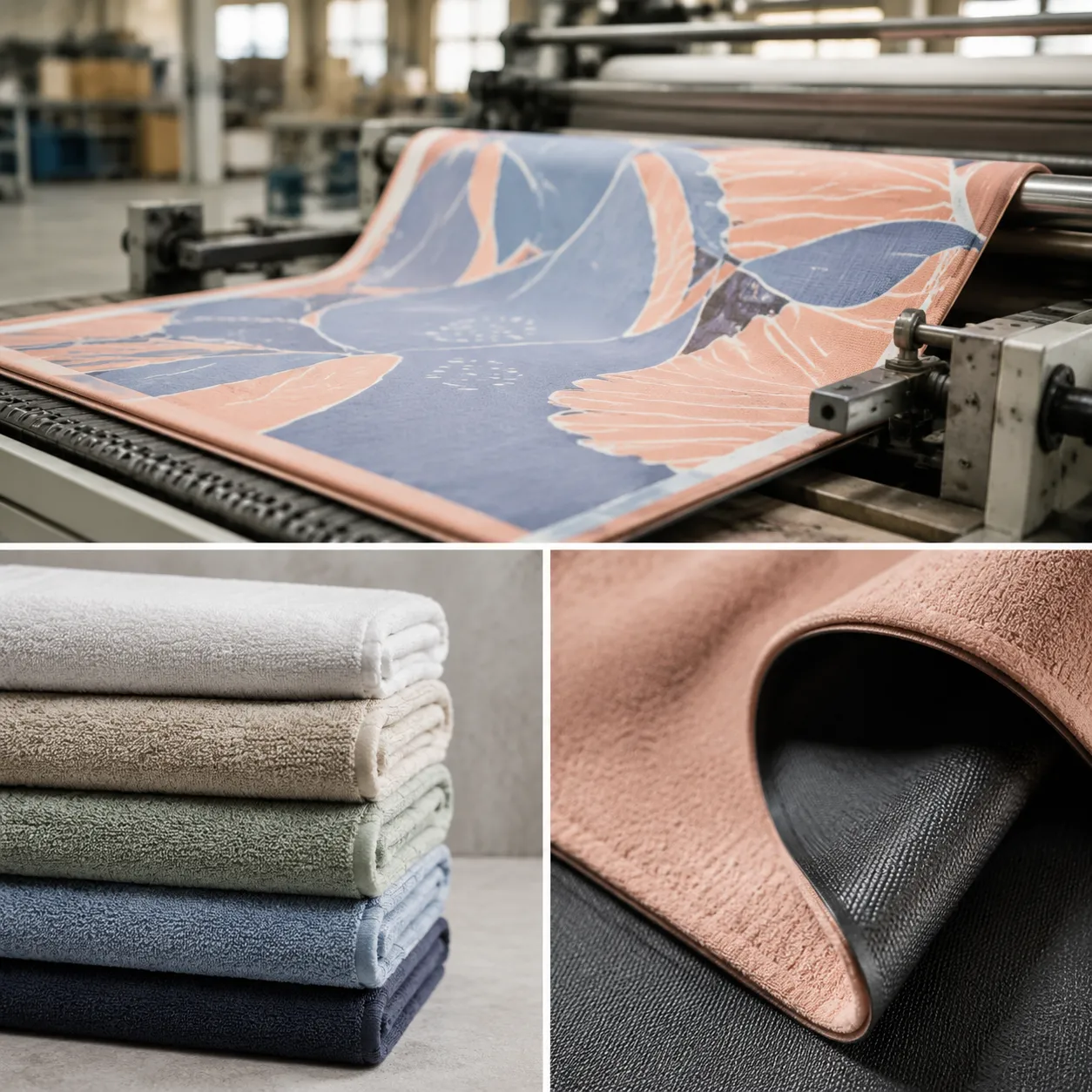
Start with the use case, not the cheapest square meter
The first pricing mistake is treating all cleaning towels as one category. In actual production, a glass cloth, an auto detailing towel, a janitorial wipe, and a retail boxed household towel set are four different products. The knit structure changes absorbency and drag. The edge finish changes scratch risk. The packout changes labor minutes more than most buyers expect. If you are comparing microfiber towels for cleaning MOQ and pricing, begin by naming the end use and the sales channel.
| Use case | Common construction | Typical size | Normal GSM range | Comments |
|---|---|---|---|---|
| Glass and screen cleaning | Short-pile suede or tight warp knit | 30×30 cm to 40×40 cm | 180-260 GSM | Low lint and low drag matter more than bulk feel |
| Household all-purpose wipe | Warp knit or terry microfiber | 30×30 cm to 40×40 cm | 220-300 GSM | Best balance for mass retail and janitorial programs |
| Auto detailing interior/exterior | Coral fleece or dual-pile terry | 40×40 cm to 60×90 cm | 320-550 GSM | Pile height and edge safety drive price |
| Kitchen and foodservice cleaning | Waffle or low-pile knit | 30×30 cm to 40×60 cm | 220-320 GSM | Fast drying and repeated laundering are key |
- If the towel touches painted auto surfaces, avoid coarse overlock thread and cheap hard care labels.
- If the towel is sold in a retail multipack, count barcode labels, insert cards, and polybag thickness before you compare cents per piece.
- If the cloth is for glass, ask for a lint bench after 3 washes, not just a first-look handfeel sample.
The spec lines that change microfiber towels for cleaning MOQ and pricing fastest
At mill level, price does not move from one thing alone. It moves from the stack of small decisions. The biggest cost drivers are fabric weight, knit type, blend ratio, edge construction, decoration, packaging, and how many colors you split across the order. A 30×30 cm cloth may look simple, but changing from 220 GSM warp knit with overlock edge to 360 GSM coral fleece with hidden edge can add more than 35% to FOB cost before packaging.
| Spec line | Lower-cost option | Higher-cost option | What changes in production |
|---|---|---|---|
| Knit / pile | Warp knit | Coral fleece / dual-pile terry | Heavier knitting and brushing steps increase fabric cost and yield loss |
| Blend | 80/20 polyester/polyamide | 70/30 polyester/polyamide | Higher polyamide improves absorbency and softness but raises raw material cost |
| Edge | Overlock | Ultrasonic cut / turned edge | Overlock is fastest; ultrasonic needs cleaner fabric behavior and closer cutting control |
| Logo | Woven label | Emboss, embroidery, heat transfer, belly band set | Extra handling and decoration setup increase MOQ pressure |
| Packout | Master carton bulk pack | Individual polybag or retail box | Manual folding, insertion, and barcode application add labor time |
Two technical details matter here. First, with coral fleece towels, the brushing consistency affects both bulk feel and shade appearance; if brushing is uneven, dark colors can show panel variation even when the dye lot is correct. Second, ultrasonic cutting works well only when the fabric edge seals cleanly; some lower-grade blends fray or harden at the edge, which is unacceptable for scratch-sensitive applications.
Where MOQ really sits: fabric, color, and packaging
Buyers usually ask for MOQ as if there is one number. There is not. We quote MOQ at three levels: per design, per color, and per packout. Our standard factory MOQ is 500 pcs per design per color, but the practical MOQ for an efficient run depends on whether you are using stock shades, custom dyeing, or printed artwork. For bulk microfiber cleaning towels, the hidden MOQ trigger is often packaging rather than fabric.
- Stock greige plus dark stock shades can support smaller trial runs with fewer dyeing constraints.
- Custom Pantone-near shades usually need a fuller dye lot to avoid shade drift between repeat orders.
- Printed insert cards, hang tags, and retail sleeves often carry their own supplier MOQ, separate from towel MOQ.
- Mixed bundles such as 3-pack blue, gray, and black sets are easy in theory but slow folding lines if each SKU needs a different barcode.
| Order type | Practical MOQ | Color flexibility | Typical note |
|---|---|---|---|
| Plain bulk pack with woven label | 500 pcs per color | High | Best for janitorial, B2B resale, and early market testing |
| Custom dyed towel with printed wash label | 1,000-1,500 pcs per color | Medium | Safer for shade consistency and reorders |
| Retail 3-pack with insert and barcode | 1,500 sets | Medium to low | Packaging vendor MOQ may set the floor |
| Embossed logo or complex private label set | 2,000 pcs or 1,000 sets | Low | Setup spread matters more than cloth cost |
If a buyer wants 300 pcs in four colors with custom sleeve packaging, we usually push back. The production line can do it, but the cost per sellable unit becomes poor because folding, sorting, relabeling, and carton assortment eat labor without scale. In that case, we often recommend one body color for the first PO and color expansion on reorder.
Price bands by volume: realistic FOB ranges
The numbers below are realistic FOB China ranges for 2026 orders, assuming standard compliance, OEKO-TEX 100 Class I compliant materials on request, and normal export cartons. They are not universal market prices, because freight terms, currency, and brand packaging can move the final quote. Still, these bands are the right way to frame microfiber towels for cleaning MOQ and pricing before you send RFQs.
| Spec example | 5,000 pcs | 20,000 pcs | 50,000 pcs | Notes |
|---|---|---|---|---|
| 30×30 cm, 220 GSM warp knit, overlock edge | USD 0.31-0.39 | USD 0.24-0.29 | USD 0.21-0.26 | Best entry point for institutional cleaning |
| 40×40 cm, 280 GSM terry microfiber, overlock edge | USD 0.52-0.61 | USD 0.44-0.51 | USD 0.39-0.46 | Strong all-purpose retail and janitorial spec |
| 40×40 cm, 350 GSM coral fleece, ultrasonic cut | USD 0.74-0.88 | USD 0.64-0.76 | USD 0.58-0.69 | Common for detailing and premium household packs |
| 40×60 cm, 400 GSM dual-pile detailing towel, hidden edge | USD 1.06-1.29 | USD 0.92-1.14 | USD 0.84-1.03 | Higher cutting and sewing labor, better surface safety |
Add-on costs are where RFQs separate. A woven label may add around USD 0.02-0.04 per piece depending on fold type. Individual polybagging may add USD 0.03-0.06. A printed paper belly band often lands around USD 0.04-0.08 depending on paper grade and run size. If you need carton marks by SKU and inner pack sorting, that is a small number on paper but a real labor cost in the packing room.
Why two towels at the same GSM still quote differently
Buyers often anchor on GSM because it is easy to compare. But GSM is only fabric mass per square meter. It does not tell you whether the cloth is knitted in a tighter warp structure, whether the pile is brushed, whether the cut size includes generous hemming allowance, or whether the polyamide share is 20% or 30%. We see this confusion most in custom microfiber towels wholesale programs where one supplier quotes a lower price on nominally similar weight but trims performance in places the buyer cannot see from a PDF.
- A 300 GSM tight-knit cloth can feel flatter and cleaner on glass than a looser 300 GSM terry.
- A 70/30 blend usually absorbs faster than 80/20, but many buyers do not request blend verification in the tech pack.
- A larger seam allowance or turned edge increases actual material consumption even at the same finished size.
- Darker shades may need stricter crocking control, especially if the towel is sold for wet and dry dual use.
If performance matters, ask for objective checks. For absorbency, we use a simple timed strike-through comparison alongside internal water pickup benchmarks. For colorfastness, typical references include ISO 105-C06 for domestic laundering and ISO 105-X12 for rubbing. For dimensional stability, wash and dry the towel by the intended end-use cycle, then measure shrinkage after three cycles rather than one.
Lead time: where the days go between deposit and shipment
For a plain microfiber cleaning towel with stock color and standard bulk packing, production can move quickly. For a custom private label launch with lab dips, barcode stickers, inserts, and mixed sets, lead time stretches less because of sewing and more because of approvals. The slowest part is often waiting on artwork confirmation or retail packaging corrections.
| Stage | Plain program | Private label retail program | What to watch |
|---|---|---|---|
| Quote and spec confirmation | 1-3 days | 3-5 days | Missing size tolerance and edge spec cause requotes |
| Lab dip / color approval | Not always needed | 4-7 days | Dark charcoal, navy, and black need clear tolerance expectations |
| Sample making | 5-7 days | 7-12 days | Packaging mockup can add extra rounds |
| Bulk production | 18-25 days | 25-35 days | Fabric knitting and dyeing cadence matters more than stitching time |
| Final inspection and booking | 3-5 days | 4-6 days | Assorted carton count must match booking sheet |
A practical total is 26-33 days for a straightforward reorder and 38-52 days for a new private label retail SKU. If you are shipping by sea, add the route time after ex-factory. If the launch date is fixed, book backward from shelf date, not from PO date. For freight trade-offs, see container-vs-air-freight-towel-orders.html.
The failure modes that create false savings
The cheapest quote becomes expensive when the cloth fails after arrival. For this product category, we most often see trouble in four places: linting on first wash, edge distortion after tumble drying, inconsistent handfeel between cartons, and carton-level SKU mix errors. These are not abstract risks. They come from specific process choices.
- Linting: often tied to unstable brushing or low-grade filament consistency in plush constructions.
- Edge wave: common when ultrasonic temperature is not tuned to fabric thickness or when overlock tension is too tight.
- Shade variation: more visible on brushed dark shades because pile direction reflects light differently panel to panel.
- Packout mistakes: retail assortments fail when inner bag labels and outer carton marks are checked separately instead of as one line clearance process.
If the RFQ only says "microfiber towel, 40×40, gray," the quote is not wrong; it is incomplete. Most post-shipment disputes start there.
We recommend a pre-shipment approval carton for any first order with mixed colors or retail bundles. Open one full carton and verify fold direction, barcode position, set composition, and carton count, not just fabric quality. That catches the expensive mistakes before the container closes.
How we would structure an RFQ for faster, cleaner quotes
The fastest quotes come from buyers who lock the non-negotiables first. For custom microfiber towels wholesale, send the finished size, tolerance, GSM, knit type, blend, edge finish, color count, logo method, unit packing, carton pack, target market, and test requirements. If you are still deciding between two constructions, request two quote columns rather than a vague open quote.
- Name the end use: glass, household, automotive, foodservice, or mixed.
- Specify fabric: warp knit, terry microfiber, coral fleece, waffle, or suede.
- State blend and weight target with tolerance, for example 80/20 at 280 GSM ±5%.
- Define edge: overlock, ultrasonic, turned hem, or hidden edge.
- List packaging exactly: bulk, polybag, belly band, insert, barcode sticker, retail box.
- Add compliance and test requests: OEKO-TEX 100 Class I if required, ISO 105-C06, rubbing fastness, shrinkage limit.
Related reads: build-towel-tech-pack-that-mills-can-quote.html, towel-gsm-decision-framework.html, and pantone-color-matching-custom-towels.html.
A buyer scenario: small trial vs scale launch
Consider two real-world sourcing paths. Buyer A is testing an Amazon household cleaning line and wants 3,000 pieces in one gray color, 40×40 cm, 280 GSM terry microfiber, woven label, plain master carton. Buyer B is launching into specialty auto retail and wants 24,000 pieces, split across three colors, 40×60 cm, 380 GSM dual-pile, hidden edge, printed belly band, barcode by color. Buyer A will pay a higher unit price even with the simpler towel, because scale does not absorb fixed setup as well. Buyer B spends more on fabric and packout, but the larger run lowers unit labor and material waste.
That is the practical reading of microfiber towels for cleaning MOQ and pricing: MOQ is not only a factory gate number, and pricing is not only fabric. The better question is whether the product architecture matches the volume. If not, either the spec is overbuilt for the run size or the run size is too fragmented for the spec.
Related reads: auto-detailing-microfiber-towel-program.html, microfiber-vs-cotton-towel-comparison.html, and negotiate-towel-moq-without-killing-margin.html.
What to ask your supplier before you release the PO
- Can you confirm MOQ by design, color, and packaging format separately?
- Is the quoted blend verified by yarn sourcing documents or only by standard recipe?
- What wash standard will you use for shade and shrinkage evaluation: ISO 105-C06 or buyer-specific method?
- Will bulk be inspected against approved sample, sealed production swatch, or digital artwork only?
- Are OEKO-TEX 100 Class I, BSCI, and ISO 9001 records current and shareable?
- What is the final carton dimension and gross weight for freight planning?
We are OEKO-TEX 100 Class I, BSCI, and ISO 9001 certified, and our standard MOQ is 500 pcs per design per color. For first orders, we would rather narrow the spec and quote accurately than force a low headline price that breaks at sampling or repacking.
Need a spec-based quote for your cleaning towel program?
Send size, GSM, knit, edge, color count, logo method, and packout. We will quote MOQ, FOB bands, and production timing in one sheet. WhatsApp: +86 13205717266 | Email: [email protected]
Request Quote →