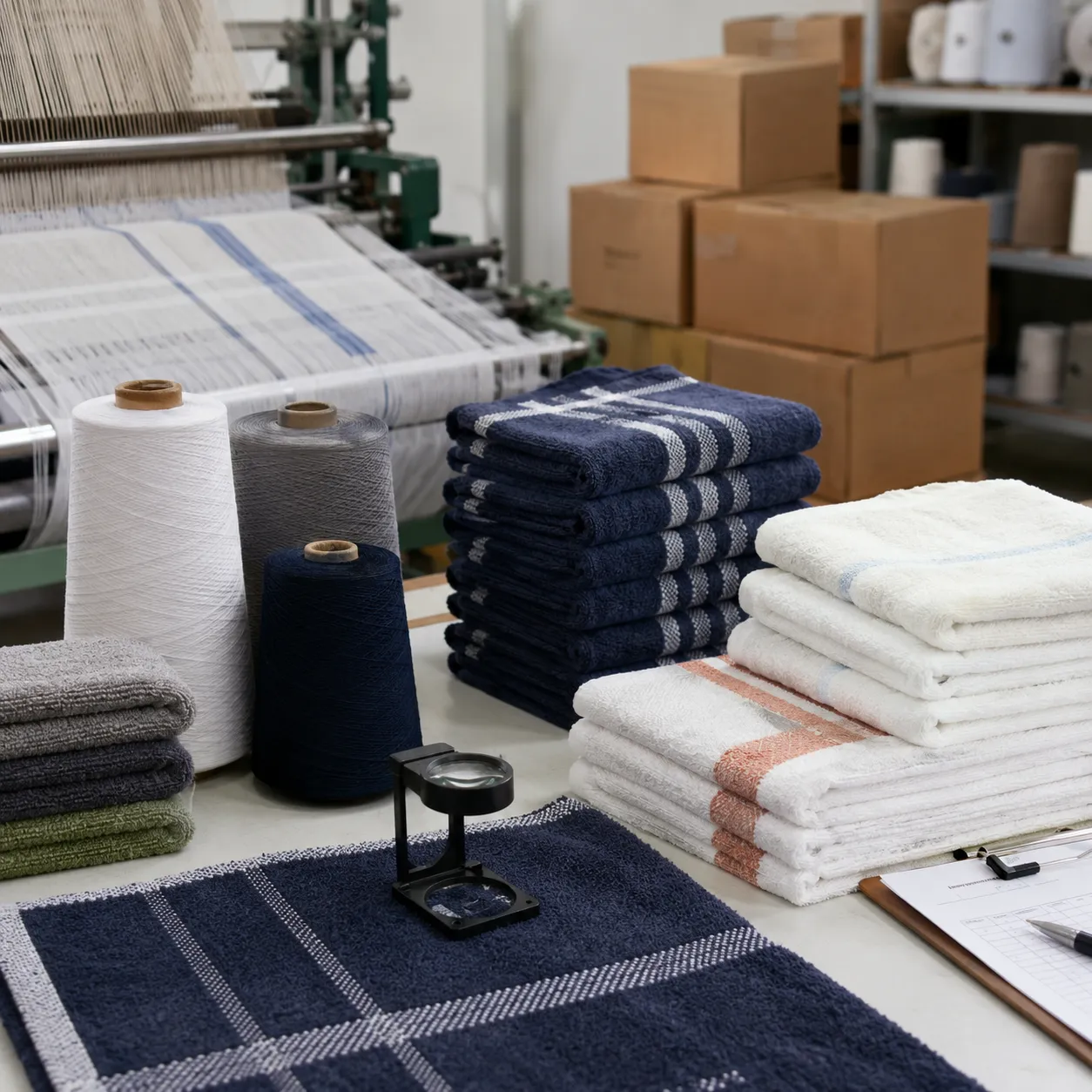
Start with the use case, not the swatch
For auto-detailing programs, we first ask what the towel must do on paint. A 40x60 cm short-pile glass cloth and a 50x80 cm high-pile drying towel cannot share the same approval logic. The buyer should define panel use, target absorbency, whether the towel will be sold retail or consumed in a professional bay, and whether the edge must be paint-safe around piano-black trim.
The sample path is more reliable when the opening brief includes construction details: warp knit or weft knit, 70/30 or 80/20 polyester-polyamide blend, pile style, border type, hanger loop yes or no, and acceptable finished weight. For drying towels, two construction quirks matter immediately: whether the towel uses twisted-loop faces that increase water pickup, and whether the hidden lockstitch at the folded edge creates a stiff ridge that drags on delicate finishes.
| Buyer use case | Typical starting construction | Key approval risk |
|---|---|---|
| Professional detailing bay | 50x80 cm, 900-1100 GSM twist loop, 80/20 blend | Edge drag and wash shrinkage |
| Retail private label | 40x60 cm, 650-850 GSM coral fleece, 80/20 blend | Shelf handfeel differing from bulk |
| Premium coating installer | 50x100 cm, 1000-1300 GSM dual-pile | Lint release on dark panels |
| Entry-level promo pack | 40x40 cm, 500-650 GSM plush knit, 85/15 blend | Absorbency claim overpromised |
- Ask for the actual vehicle-care application before asking for artwork
- Set the finished size tolerance at sample stage, not after bulk cutting
- Define whether approval is based on one wash or five wash cycles
- State if the sample must pass paint-contact review on black gloss panels
What we request before we make the first proto
A workable RFQ for this category is short but technical. We need target size, GSM window, blend ratio, pile structure, edge finish, logo method, packaging, and the standard used for absorbency and colorfastness review. Buyers who send only a reference photo usually receive a sample that looks close but behaves differently in use.
For microfiber drying towels, we normally propose proto sampling off available greige fabric first, then move to dyed bulk-matched sample after construction is approved. That keeps the first round focused on function. If the buyer asks for custom Pantone, woven label, belly band, barcode sticker, and retail bag in round one, timing stretches without improving the first technical decision.
| Input item | What the buyer should send | Why it matters |
|---|---|---|
| Size spec | Cut size and expected post-wash finished size | Microfiber can shift after heat setting |
| Blend ratio | 80/20 or 70/30 target | Affects softness, cost, and absorbency |
| Pile note | Twist loop, coral fleece, dual pile | Changes drying speed and paint feel |
| Edge spec | Microfiber suede band, hidden edge, satin, overlock | Most common source of scratch complaints |
| Test basis | AATCC 135 wash method, internal drop test, crocking review | Prevents argument at signoff |
The sample sequence that prevents rework
We do not recommend skipping directly from a desk brief to a pre-production sample. The safer path has four gates: proto, revised proto, pre-production sample, then sealed production standard. Each gate answers a different question.
- Proto sample: confirms pile construction, handfeel, basic absorbency, and edge choice using nearest available yarn or greige base
- Revised proto: adjusts the one or two issues that matter most, such as border stiffness or oversize shrink allowance
- Pre-production sample: made to approved color, packaging, logo file, and final finishing route
- Sealed production standard: signed control sample kept by buyer and mill QC before bulk cutting starts
This is where the car drying microfiber towel sample approval workflow usually goes wrong in the market: the buyer approves a showroom-pretty proto, but nobody records whether the towel was brushed, washed, and heat-set with the same parameters planned for mass production. In microfiber, finishing temperature changes surface feel quickly. A towel that feels dense and slick after one finishing pass can open up and lose some body after bulk scouring and final setting.
How we frame sample fees, MOQ, and FOB without guesswork
For this category, sample fees depend on whether the mill can cut from an existing base or must open a custom run. A plain proto cut from stock microfiber with standard binding is often charged at USD 35-60 per style plus courier. A custom-sized twist-loop prototype with private-label packaging mockup usually lands around USD 75-140 per style. If the order is placed, we commonly credit part or all of the technical sample fee against bulk, but packaging development charges and third-party lab fees are normally separate.
Our MOQ remains 500 pcs per design per color, but buyers should note that microfiber construction economics do not behave like cotton towels. If a program splits 500 pcs across two sizes and two border colors, the nominal MOQ is met while production efficiency is not. For a stable first order on drying towels, 1,000-2,500 pcs per SKU is where dye lot consistency, edge sewing efficiency, and packing flow become smoother.
| Volume | Indicative FOB China range | Typical construction assumption |
|---|---|---|
| 500 pcs | USD 2.18-3.05 | 40x60 cm, 700-850 GSM coral fleece, care label, polybag |
| 1,200 pcs | USD 2.64-3.72 | 50x80 cm, 900-1050 GSM twist loop, sewn label, belly band |
| 3,000 pcs | USD 3.48-4.96 | 50x100 cm, 1000-1250 GSM dual pile, custom carton marks |
| 8,000 pcs | USD 1.76-2.41 | 40x40 cm, 520-620 GSM plush knit, bulk pack no retail insert |
Those ranges assume FOB China, standard export cartons, and no unusual claim testing. They move upward if the buyer needs a very high polyamide ratio, laser-engraved hangtag hardware, recycled fiber declaration support, or third-party scratch-safety validation.
The tests that matter before signoff
We prefer to keep testing practical. A drying towel does not need every textile test under the sun, but it does need the right few. We usually review finished size after washing with AATCC 135, color change and staining with AATCC 61 when dyed shades are involved, and colorfastness to rubbing with AATCC 8 if the towel is dark navy, black, or deep red. For export compliance and buyer confidence, OEKO-TEX Standard 100 Class I, BSCI, and ISO 9001 records should be current and easy to match to the supplying site.
Two functional checks are especially useful in this category. First is a simple timed absorbency trial: weigh the dry towel, absorb a fixed water volume from a flat hood panel, then reweigh to compare uptake across revisions. Second is a drag check on gloss-black trim and a clean CD test for edge hardness. The CD test is not a formal lab standard, but it quickly exposes a binding seam that feels harmless in hand and still leaves a visible mark under pressure.
- Record pre-wash and post-wash dimensions after the same cycle every time
- Check lint transfer on black paint under direct inspection light
- Review binding seam thickness at the corner fold, not only on the straight edge
- Separate shade approval from performance approval if proto uses nearest stock color
A real revision-sheet example buyers can use
Editors were right to ask for a concrete example because this document is what keeps the approval trail from becoming a WhatsApp memory contest. A revision sheet should show exactly what changed, why it changed, what was retested, and who owns the signoff.
| Round | Buyer comment | Spec change | Retest | Signoff owner |
|---|---|---|---|---|
| Proto 1 | Edge feels firm on piano-black trim; towel dries well but corners drag | Change from folded suede binding 22 mm to hidden edge microfiber wrap 16 mm; reduce corner back-tack density | Repeat panel glide review and AATCC 135 one-cycle size check | Buyer product manager |
| Proto 2 | Handfeel improved; towel lost 4.8% in length after wash | Add 2.5 cm shrink allowance in cut length and increase heat-setting dwell by 12 seconds | Rewash 3 pcs, record average finished size | Mill QA supervisor |
| PPS 1 | Approved on size; dark charcoal sheds light lint under inspection lamp | Add one extra air-blow and brushing pass before final folding; tighten final metal detection and lint rolling step | Black-panel lint check after packing simulation | Brand QA lead |
| Sealed standard | No further comments | Lock spec, photos, test record, carton mark, and approved label file | No retest unless material source changes | Joint buyer-mill signoff |
That level of detail prevents a common dispute: the buyer thinks the factory ignored feedback, while the factory believes the issue was fixed in round two. If the revision sheet names the owner and the retest method, the record is clear.
Lead times: where the days actually go
Sampling calendars for microfiber are often underestimated because the sewing looks simple. The real time is spent waiting for dyeing slots, brushing and setting adjustments, packaging mockups, and courier loops across time zones.
| Stage | Typical days | What can delay it |
|---|---|---|
| RFQ review and spec confirmation | 1-3 days | Missing blend ratio or border requirement |
| Proto sample | 5-8 days | Non-stock pile construction or custom size |
| Buyer review and comments | 3-7 days | No written revision sheet, only marked photos |
| Revised proto or PPS | 6-10 days | Re-dye, custom packaging, or added label trim |
| Bulk production after deposit and signoff | 18-28 days | Peak season queue, carton artwork hold, retest request |
For urgent launches, we sometimes overlap packaging proofing with proto approval, but we do that only after the construction is directionally correct. If you approve packaging first and the towel size later changes from 40x60 cm to 50x80 cm, the insert, bag dimensions, and carton count may all need to be redone.
Three approval mistakes we see in auto-detailing programs
The first mistake is approving only by video. Pile direction, rebound, and edge hardness are hard to judge through a phone camera. The second is skipping wash review because the sample "already feels right." Microfiber finishing can hide future dimensional change. The third is signing off a towel body while leaving label placement, carton marks, or assortment packing unresolved; that almost always creates avoidable bulk holds.
- Do not approve against a single hero sample if the order will mix multiple dye lots later
- Do not treat retail packaging signoff as separate from folding method and final towel volume
- Do not change edge construction after PPS unless you are ready for another validation round
For buyers building their first tech pack, our article on build-towel-tech-pack-that-mills-can-quote.html helps structure the RFQ. If your team is still comparing material behavior, microfiber-vs-cotton-towel-comparison.html and auto-detailing-microfiber-towel-program.html are the better starting points.
What the approved sample pack should contain
The best approval is not just a signed towel. It is a controlled pack that production, QA, and the buyer can all refer to. We normally seal one physical sample with approval date, final spec sheet, revision sheet, test summary, label artwork, folding photo, carton mark, and pack ratio.
- One sealed towel labeled as the production standard
- One digital spec file with final dimensions, GSM tolerance, and blend note
- One revision log showing every accepted change
- One test summary with method names and date
- One packaging set with approved barcode and carton markings
This final pack matters if a reorder happens six months later under a different merchandiser. It also matters when a buyer wants to challenge bulk variance. If the sealed standard is missing, everyone argues from memory. For broader MOQ strategy, negotiate-towel-moq-without-killing-margin.html is useful. For freight planning once approval is complete, see container-vs-air-freight-towel-orders.html.
Need a sample review sheet for your next towel?
Send us your target size, GSM, blend, edge type, and packaging plan. We can map the sample path, quote realistic FOB ranges, and flag the test points before you pay for bulk.
Request a quote →If you want us to review an auto-detailing towel program, contact us at [email protected] or WhatsApp +86 13205717266. Our MOQ is 500 pcs per design per color, and we work under OEKO-TEX Standard 100 Class I, BSCI, and ISO 9001 controls.