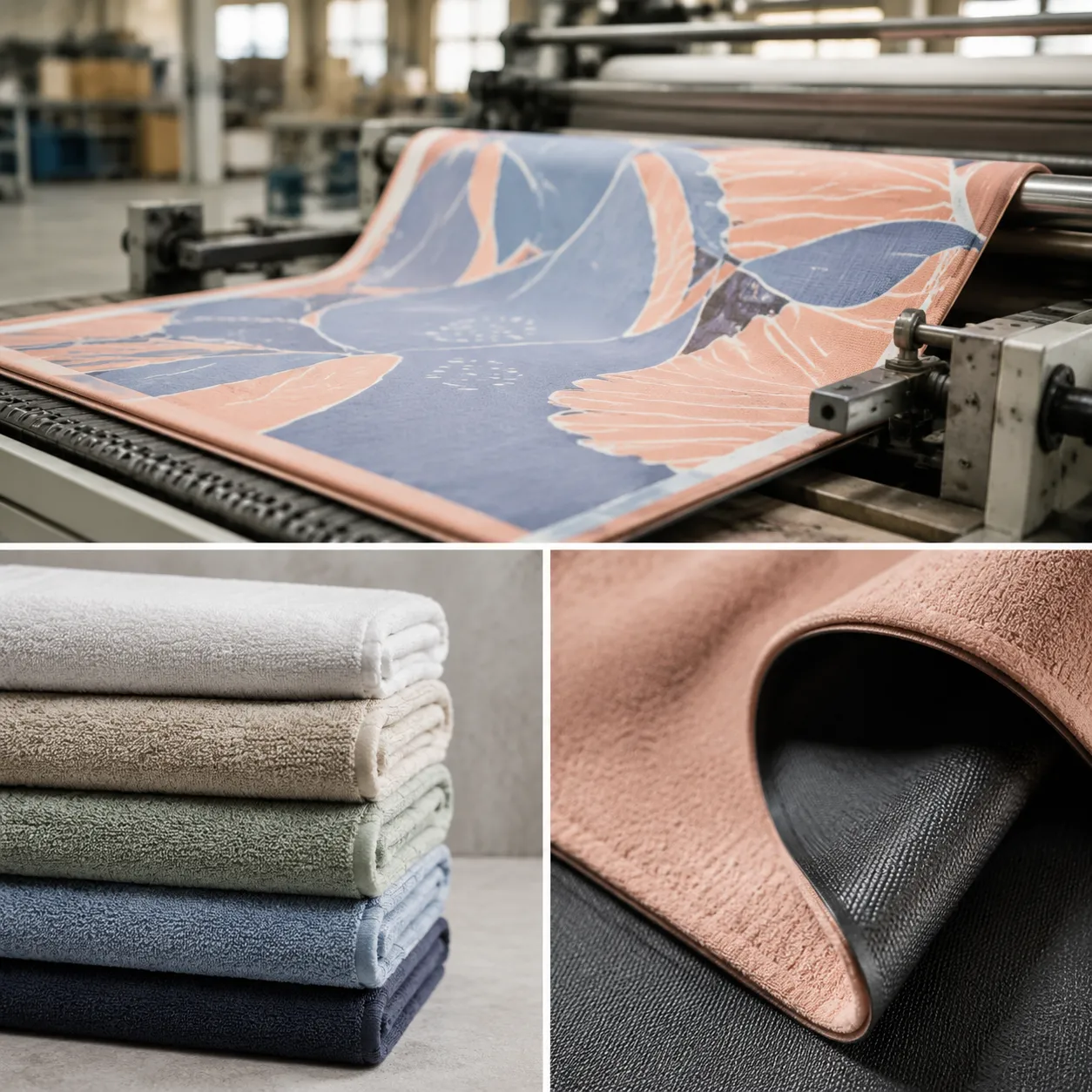
Start with the use case, not the fiber claim
The word "microfiber" tells us very little by itself. For bath use, we first separate the order into one of three real applications: travel and compact drying, spa or salon body wrap use, or retail bath use where handfeel matters more than pack size. Each path points to a different fabric construction and a different risk profile.
For a travel-led program, buyers usually want low bulk, fast drying, and print compatibility. That normally points to warp knit suede or short-pile knitted microfiber around 220-290 GSM. For body-contact bath use, complaints usually come from draggy handfeel and poor first-touch absorbency, so we move toward brushed terry microfiber or coral fleece structures between 300-430 GSM. If the brief says "luxury like cotton" but also wants featherweight freight, the spec is already fighting itself.
| End use | Best-fit construction | Working GSM | Main risk if underspecified |
|---|---|---|---|
| Travel / gym shower | Warp knit suede microfiber | 220-260 | Low absorbency on first wipe if finish is too closed |
| Spa / salon body towel | Brushed terry microfiber | 300-360 | Edge roping and shape distortion after laundering |
| Retail bath towel | Coral fleece or dual-pile microfiber | 360-430 | Soft hand but weak water pickup if pile density is too low |
| Kids / gift set | Printed short-pile knit | 240-320 | Color migration and panel bow on full-bleed designs |
The microfiber bath towel sourcing playbook lives or dies on construction details
Two towels can share the same GSM and still behave very differently. The construction line on the tech pack should specify knitting method, pile style, fiber blend, ground density, and edge treatment. If those are missing, suppliers will fill the gaps with whatever is easiest to source that week.
- Fiber blend: 80/20 polyester-polyamide gives better capillary pickup than 85/15 and noticeably better than 88/12 in bath use.
- Construction: warp knit stays more stable on dimension; coral fleece feels fuller but can show pile direction marks and seam creep.
- Pile height tolerance: keep it within ±0.6 mm across the panel if touch consistency matters for retail.
- Cutting direction: nap direction must be locked before bulk cutting, especially on darker shades where shading is visible carton to carton.
One topic-specific failure we see in coral fleece bath towels is pile crush at the fold line after compression packing. The towel is not defective in yarn terms, but the customer opens the bag and reads the permanent fold memory as low quality. If the order will be vacuum packed or gift boxed tightly, we prefer a denser short pile over a high fluffy fleece. Another failure mode is edge tunneling on wide bath sizes, especially 70 × 140 cm and above, when the overlock thread tension is set for lighter hand towels and not recalibrated for heavier panels.
Absorbency claims need a test method, a load, and a wash condition
Buyers often write "super absorbent" into the RFQ. That does not protect anyone. For microfiber bath towels, we normally propose three measurable checks: water absorption time, water absorption capacity by weight, and drying rate after controlled saturation. The exact protocol matters because fabric softener residue, heat setting, and even laser cutting can change results.
| Property | Recommended method | Commercial target | Important condition |
|---|---|---|---|
| Water absorption time | AATCC 79 | ≤ 6 seconds after 3 home washes | Test after prewashing; raw greige results are misleading |
| Water absorption capacity | Internal gravimetric test | ≥ 4.2 times towel weight | Use 20°C water, 1 min drain, no wringing |
| Dimensional change | AATCC 135 | Length/width within ±4% | 40°C wash, tumble low or line dry must match care label |
| Colorfastness to washing | ISO 105-C06 A1S | Grade 4 minimum | Dark shades should also pass adjacent fabric staining Grade 3-4 or better |
| Colorfastness to rubbing | ISO 105-X12 | Dry 4 / Wet 3-4 | Critical for navy, black, and saturated resort colors |
We also advise running the first absorbency evaluation only after at least three wash cycles. Fresh microfiber can test artificially high or low depending on finishing chemistry. A hydrophilic finish may give a fast first result and then fade; an under-scoured fabric may improve only after detergent removes residual lubricants. If you sell direct-to-consumer, the wash-three-times result predicts complaints much better than the out-of-bag result.
Edge finishing is where a lot of claims begin
Most bath towel complaints are not about the center panel. They start at the perimeter. Microfiber is less forgiving than cotton on edge distortion because the fabric is lighter for its area and tends to track along knit direction. That is why the sew line needs explicit tolerances.
- Overlock width: 6-8 mm is workable for standard bath sizes; below that we see higher curl risk on brushed constructions.
- Stitch density: 9-11 stitches per inch for overlock; decorative hem stitching should not pierce too close to the cut edge.
- Corner squareness: diagonal variance should stay within 1.5 cm on a finished 70 × 140 cm towel.
- Edge waviness: reject if wave amplitude exceeds 8 mm on any 50 cm segment laid flat without hand tension.
A defect unique to microfiber bath towels is heat-hardened edge melt from aggressive hot-knife slitting. The edge can look clean during inline inspection, then feel scratchy after laundering because the fused filament ridge becomes more obvious when the towel softens elsewhere. We avoid hot-knife cutting on body-contact styles unless the construction frays excessively under cold cut. Another recurring issue is needle heating during high-speed sewing, which can locally glaze the pile beside the seam on dark colors.
Do not approve bulk from a tiny hanger sample
Microfiber can mislead in small swatches. A 20 × 20 cm sample hides bow, skew, edge torque, and panel hand variation. For this category, our sample path is more useful when each gate answers one specific risk rather than trying to approve everything at once.
- Approve a lab dip or print strike-off only for color and artwork position, not for handfeel.
- Approve a half-width pilot panel to review pile direction, strike-through, and face/back appearance.
- Approve one full-size sewn prototype in target GSM with final edging, care label, and packaging.
- Wash-test that prototype 3 cycles and 10 cycles before bulk signoff if the order is for retail or hospitality.
- Freeze the approved standard with flat photos, weight tolerance, and measured dimensions after wash.
For printed bath towels, we also ask buyers to sign off on face-versus-back expectation in writing. On many microfiber constructions, especially suede and short pile, deep print saturation on the face can still leave a lighter reverse. That is normal process behavior, not necessarily poor production. If a fully decorative reverse side is mandatory, the construction choice may need to change.
Pricing moves less with color count than with fabric choice and sewing minutes
In cotton towel programs, yarn and terry density usually dominate cost. In microfiber bath towels, knitting source, pile finish, panel weight, and perimeter work matter more. Packaging can also become a large share if the order is gift-boxed or individually pouched.
| Spec example | MOQ | FOB China unit price | Cost pressure point |
|---|---|---|---|
| 70 × 140 cm, warp knit suede, 240 GSM, printed, elastic band pack | 1,000 pcs/design | USD 2.05-2.48 | Print coverage and sewing rework on skew panels |
| 70 × 140 cm, brushed terry microfiber, 320 GSM, solid dyed, hangtag only | 1,000 pcs/color | USD 2.74-3.26 | Ground density and edge stability |
| 80 × 160 cm, coral fleece, 390 GSM, embossed logo, polybag | 800 pcs/color | USD 4.28-5.12 | Pile yield, emboss setup, carton cube |
| Adult wrap size with elastic/closure, 330 GSM brushed microfiber | 1,200 pcs/style | USD 4.85-5.95 | Extra sewing minutes and fit consistency |
For our mill, MOQ is normally 500 pcs per design per color, but many microfiber bath programs become inefficient below 800-1,000 pcs because knitting allocation, dye lot control, and print setup spread poorly. If a buyer pushes for five colors at 150 pcs each, unit cost rises sharply and shade variation risk rises with it. On small runs, reducing colorways is usually smarter than trimming GSM blindly.
Lead time depends on whether you are knitting, printing, or converting stock fabric
Microfiber bath towel lead time is often quoted too loosely. We break it into fabric reservation, color or print approval, cutting and sewing, finishing, and final inspection. The shortest path is usually stock greige converted to a basic solid. The longest path is a custom printed full-size towel with custom packaging and wash testing before shipment.
| Order type | Sampling | Bulk production | Total practical range |
|---|---|---|---|
| Stock-base solid dyed bath towel | 5-7 days | 18-24 days | 23-31 days |
| Custom printed short-pile bath towel | 7-10 days | 24-32 days | 31-42 days |
| Embossed coral fleece bath towel | 8-12 days | 26-35 days | 34-47 days |
| Retail set with box, barcode, insert card | 10-14 days | 30-38 days | 40-52 days |
If the shipment must catch a promotion date, ask for the critical path in days, not a single headline lead time. We have seen orders lose a week not in production but waiting on barcode confirmation or revised care instruction wording. For freight planning, container-vs-air-freight-towel-orders gives the trade-offs more clearly than most forwarder one-pagers.
The QC checkpoint that matters most is after wash, not before packing
Pre-shipment inspection catches count, shade, and workmanship, but many microfiber bath issues only appear after laundering. For that reason, we prefer a retained wash-test lot from bulk, not just from the pre-production sample. Pull pieces from early, middle, and late cutting lots because tension settings and finishing pressure can drift during the run.
- Bulk weight tolerance: ±5% per piece against approved standard, but keep carton average within ±3%.
- Finished size tolerance before wash: ±2 cm on width and length for standard bath sizes.
- After-wash skew: no more than 3% when measured from side seam to cross line after AATCC 135 cycle.
- Needle and contamination control: 100% visual plus inline metal contamination check if the item is sold for infant or sensitive-skin use.
One defect that gets missed in static inspection is print halo on dark microfiber. It appears as a faint light outline around dense artwork because pile leans differently at the print boundary. Another is pressure shading from carton strapping, especially on plush coral fleece. Neither issue is obvious if the inspector checks only folded pieces under warehouse lighting. We inspect opened towels under angled light and compare multiple orientations before release.
Certifications matter, but they do not replace a spec sheet
For this category, buyers usually ask first about OEKO-TEX and sometimes stop there. OEKO-TEX Standard 100 Class I is useful for chemical safety screening, and we hold that certification alongside BSCI and ISO 9001. But none of those certificates tells you whether the towel will stay square, absorb after five washes, or keep a soft hand after tumble drying.
If you need restricted-substance clarity, ask for the exact certificate scope and article group; how-to-read-oeko-tex-certificate is a helpful background read. If you are still building the RFQ, build-towel-tech-pack-that-mills-can-quote is the better place to start because it forces the commercial spec and testing language into one document.
A short RFQ checklist for custom microfiber bath towels
Most sourcing delays happen because the first RFQ is missing one or two technical lines that later turn into arguments. For a microfiber bath towel supplier, these fields save the most time.
- State construction clearly: warp knit suede, brushed terry microfiber, coral fleece, or dual-pile.
- Give fiber ratio target, for example 80/20 polyester-polyamide, plus acceptable tolerance.
- List finished size, finished weight, and whether tolerances are before or after wash.
- Define absorbency and wash tests by method number and cycle condition.
- Specify edge finishing, stitch density, label position, and packaging compression limits.
- Note whether face/back print difference is acceptable.
- Confirm carton dimensions, master carton gross weight limit, and barcode format if retail packed.
Related reads: if you are comparing this category against cotton for hospitality or home use, see microfiber-vs-cotton-towel-comparison. If GSM trade-offs are still not settled, towel-gsm-decision-framework helps narrow the range. For artwork-heavy programs, pantone-color-matching-custom-towels is useful before sampling starts.
Related reads: buyers planning private label launches often pair this with private-label-vs-white-label-towel-programs, while operations teams working toward a broader assortment may want custom-microfiber-towels-wholesale-guide. Auto-care teams asking whether the same mill can convert different microfiber categories can also review auto-detailing-microfiber-towel-program.
Need a microfiber bath towel quote with real test points?
Send the target size, construction, GSM, packaging, and test standard. We can quote from 500 pcs per design per color and flag the weak points before sampling. WhatsApp +86 13205717266 or email [email protected].
Request a quote →