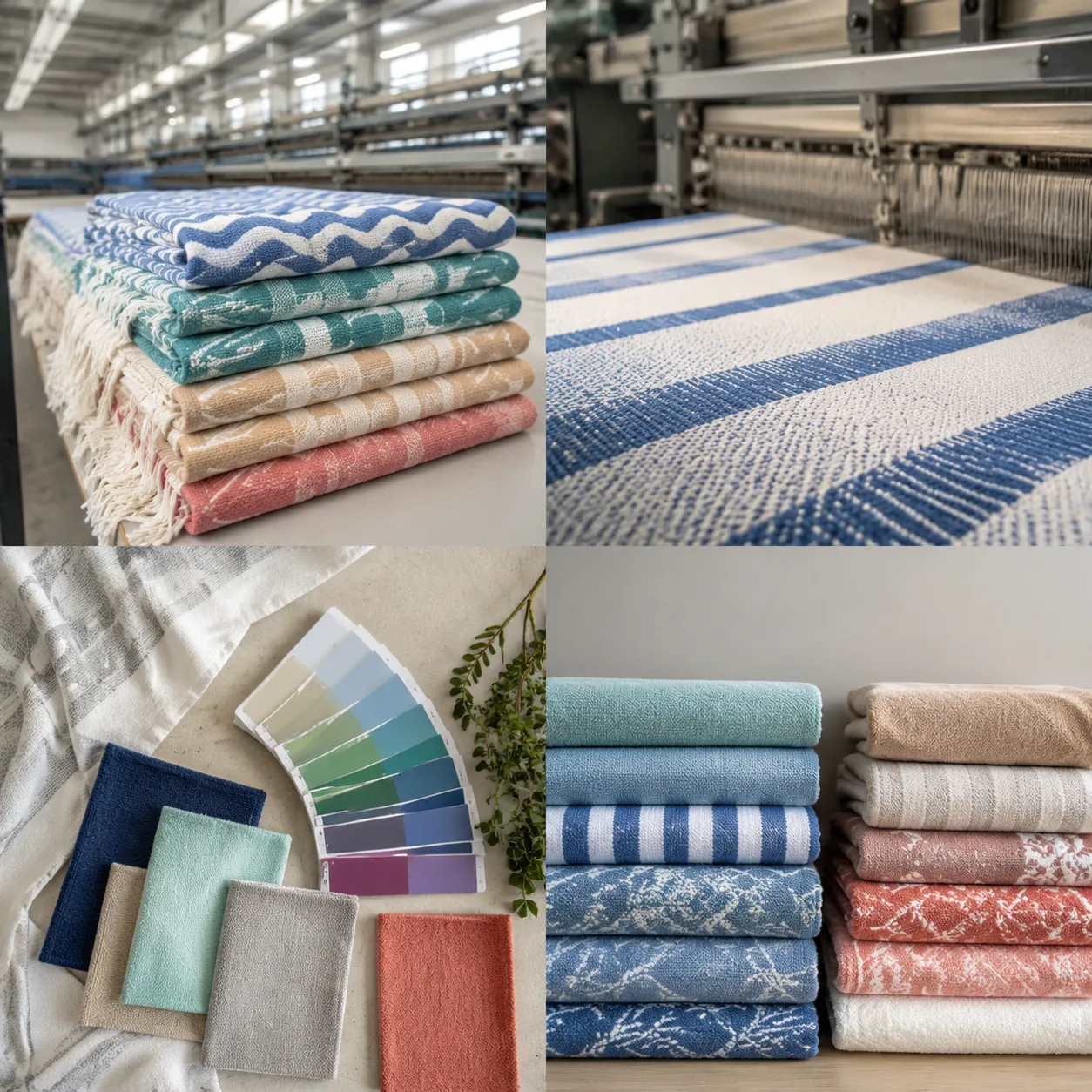
Start With the Constraint That Actually Drives MOQ
For beach towels, the limiting factor is rarely one single number printed on a quotation sheet. It may be yarn dyeing, jacquard loom setup, screen printing screens, label sewing, or export carton consolidation. At our mill in Gaoyang, Zhejiang, our normal MOQ is 500 pcs per design / per color, but buyers can sometimes reduce risk by narrowing the number of variables rather than asking us to cut every line item equally.
A plain solid-color towel with one sewn label behaves differently from a yarn-dyed cabana stripe, and both behave differently from a full-surface reactive print. Negotiation works best when the buyer identifies which part of the specification can stay fixed. If the size, GSM, yarn, border, and carton pack are shared, a lower color split may be more practical. If every color also needs a different Pantone shade, label, hangtag, and polybag artwork, the production floor sees separate small jobs.
| Spec variable | Why it affects MOQ | What we can sometimes consolidate |
|---|---|---|
| Body color | Vat dyeing and shade control need minimum fabric weight | Use fewer body colors and change only embroidery thread or label |
| Stripe layout | Yarn-dyed warp/weft planning creates leftover yarn risk | Keep one stripe repeat and adjust only border color |
| Jacquard artwork | Loom carding and first-piece correction take setup time | Use one woven pattern across all resort zones |
| Packaging | Printed insert cards and barcode stickers create separate packing lanes | Use one master carton mark with SKU stickers |
| Decoration | Embroidery frames, print screens, and placement jigs add setup | Share one logo size across all colorways |
This is why a buyer asking for low MOQ beach towels should not begin with only the target quantity. We need to know which detail matters most commercially: the body color, the artwork, the packaging, or the delivery date.
Custom Beach Towel MOQ Negotiation Guide: What We Review First
Before we answer a MOQ request, our merchandising team builds a small production map. We check the towel construction, decoration method, color count, packaging style, and whether the order can run beside another compatible order. The result is not a bargaining posture; it is a calculation of setup loss, machine time, and QC exposure.
- Construction: terry, velour, flat-woven hammam, microfiber suede, or cotton-poly blend each uses different equipment and finishing settings.
- Size and GSM: common beach sizes are 70×140 cm, 80×160 cm, 90×170 cm, and 100×180 cm; typical GSM runs from 320 to 650 depending on handfeel and use case.
- Color plan: one body color at 1,000 pcs is easier than five body colors at 200 pcs each because shade matching and cutting loss repeat five times.
- Decoration route: embroidery, jacquard, sublimation, reactive print, and woven patch all create different setup economics.
- Compliance: OEKO-TEX Standard 100 Class I, ISO 9001 process control, and BSCI social compliance documentation can be prepared once, but fabric testing still follows the actual material and dye route.
For a new buyer, the fastest route is usually one towel body with one decoration method. A beach club can still create a branded look through border color, corner label, or belly band artwork. Those details cost less to vary than the towel base itself.
The Quantity Breaks Buyers Can Use in Real RFQs
We quote by order structure, not by a universal beach towel price. Cotton market movement, exchange rate, and dye route change the final number, so the ranges below are planning figures we would qualify again at RFQ stage. They are useful because they show where MOQ pressure usually appears.
| Order structure | Typical ex-works band, USD/pc | Practical MOQ note |
|---|---|---|
| 500 pcs, one color, 400-450 GSM cotton terry, sewn label | 3.05-4.10 | Normal entry point for OEM beach towel production |
| 1,000 pcs, two colors split 600/400, same size and label | 2.72-3.68 | Possible when both colors use common dye shades and one packout |
| 2,000 pcs, four colors split evenly, 450-520 GSM velour print | 2.95-4.45 | Print screens and strike-off approval become the key schedule item |
| 3,000 pcs, jacquard logo, two yarn colors, 500-600 GSM | 4.20-5.95 | Better loom efficiency, but yarn-dyed shade approval takes longer |
| 5,000 pcs, private label beach towels with insert card and barcode | 2.55-4.85 | Packaging cost spreads better if artwork is shared across SKUs |
For a custom beach towel MOQ, the phrase “500 pcs” should be read as the base planning unit, not a promise that every complex SKU can run at that level. A 500-piece solid terry towel is one conversation. A 500-piece order divided into five Pantone-dyed grounds with five cartons marks is another.
If a buyer wants ten visual options for a launch, we usually recommend sampling ten and producing three. Reorders can expand the palette after sell-through data replaces guesswork.
Color Splits: Where Negotiation Usually Succeeds
Color split is the most common MOQ request we receive from resort groups and DTC beach brands. It is also the area where buyers can save the most without weakening the towel. The practical method is to keep the base towel identical and change details that sit after fabric production.
- Choose one size, such as 80×160 cm, for all SKUs in the first production run.
- Keep GSM within one construction, for example 430 GSM cotton terry or 360 GSM flat-woven hammam.
- Limit body colors to two or three shades that are already stable in towel dyeing, not difficult fluorescent or deep navy tones without tolerance.
- Use the same woven label size, care label, hangtag, carton quantity, and folding method.
- Differentiate SKUs with embroidery thread color, belly band design, or barcode sticker rather than changing the towel base.
A realistic split colorways plan might be 1,200 pcs total: 500 in sand, 400 in aqua, and 300 in coral. That is easier to discuss than 1,200 pcs split into eight colors at 150 pcs each. The second version increases shade-band risk, and small lots can show more variation after tumble drying because there is less fabric mass to stabilize the process.
Color tolerance should be written into the tech pack. For dyed cotton beach towels, we normally use a visual assessment under D65 light plus buyer-approved lab dip. If the brand requires instrument reading, define the Delta E target before bulk. A practical target is often Delta E ≤ 1.5 for solid brand colors, but textured terry pile can read differently from flat paper Pantone cards, so visual approval still matters.
Decoration Choices Change the Negotiation Room
Decoration is where many small beach towel programs become expensive. A corner embroidery on 500 towels can be manageable. A full-width jacquard logo woven into 300 towels usually is not, because loom setup and yarn planning do not shrink proportionally with quantity.
| Decoration method | MOQ pressure point | Typical added cost, USD/pc | Best use |
|---|---|---|---|
| Corner embroidery | Thread color, frame setup, stitch count | 0.28-0.85 | Resort logo, initials, member program |
| Woven jacquard | Loom setup and yarn-dyed planning | 0.75-1.60 | High-volume club or hotel identity towel |
| Reactive print on cotton velour | Screen or digital preparation plus color fixation | 0.55-1.35 | Retail beach graphics with soft cotton face |
| Sublimation on microfiber | Polyester face and heat transfer control | 0.40-1.10 | Travel towels, promotional graphics, fast-dry programs |
| Woven patch or hem label | Label MOQ and sewing operation | 0.16-0.48 | Private label beach towels with restrained branding |
Two technical details are easy to miss. First, embroidery on high pile can sink unless we use a water-soluble topping and the stitch density is adjusted. Second, printed cotton velour needs fixation and washing after print; if the towel is too plush for the print method, fine lines can blur when pile shifts. Those issues are not theoretical. They show up at sample review as fuzzy logo edges, uneven color hold, or puckering around a dense mark.
For buyers comparing decoration routes, embroidery vs sublimation vs jacquard is a useful companion read. If the towel program is mostly for club members or tournament gifting, our custom golf towel with logo sourcing guide explains similar decoration economics in a smaller format.
A Negotiable MOQ Is Built in the Tech Pack
The strongest MOQ discussions happen before quotation. A complete tech pack lets us see whether we can combine yarn preparation, dyeing, cutting, sewing, inspection, and packing. A loose request like “send your best price for beach towels” forces the mill to add risk into the quote, because too many assumptions remain open.
- Size with tolerance: for example, 80×160 cm after wash, tolerance ±3 cm unless the buyer has a stricter retail requirement.
- GSM target: state a range such as 430-470 GSM rather than a single number if handfeel matters more than exact weight.
- Yarn and pile: specify combed cotton, ring-spun cotton, zero-twist, or microfiber face; do not leave yarn choice to price alone.
- Decoration file: provide vector artwork, Pantone references, logo dimensions, and placement measured from finished edges.
- Packaging and marks: confirm units per polybag, carton quantity, barcode label position, and whether carton marks are SKU-specific.
- Testing expectation: list wash test, colorfastness, absorbency, and restricted substance requirements before sampling.
We run ISO 9001-controlled inspection records at cutting, sewing, and final packing. For chemical safety, our OEKO-TEX Standard 100 Class I certificate supports baby-contact level textile requirements, although each buyer should still confirm the certificate scope against the exact fabric category. BSCI audit documentation supports social compliance review for brand procurement teams.
Related reads: buyers who are still organizing specs should start with build a towel tech pack that mills can quote and towel sizes and dimensions complete guide. For GSM decisions, towel GSM decision framework gives a cleaner way to compare weight, drying time, and handfeel.
Sample Approval Costs Less Than a Bad Minimum
Some buyers try to lower MOQ by skipping the full approval path. We do not recommend that. A smaller bulk order still deserves a controlled sample process because there is less room to absorb mistakes. If 500 towels arrive with the wrong border color, the whole launch can be affected.
- Confirm artwork, size, GSM range, and target price band before sample making.
- Approve lab dip or yarn color under agreed light source, usually D65 for daylight simulation.
- Make proto sample or strike-off depending on decoration route.
- Check towel weight, dimensions after relaxation, pile appearance, stitching, label placement, and packaging mockup.
- Run wash review before bulk approval: we normally use a domestic-style 40°C wash and tumble dry for practical buyer screening, then add ISO methods when required.
- Sign a sample approval record with photos, measurements, and retained reference sample.
For formal lab references, common methods include ISO 105-C06 for colorfastness to domestic and commercial laundering and ISO 105-X12 for rubbing fastness. Absorbency can be checked internally with a drop test or buyer-specific method, but the key is consistency: use the same towel face, same washing condition, and same pass/fail language from sample to bulk.
A sensible sample budget is often USD 45-120 per style for a simple cotton terry sample and USD 80-220 for printed or jacquard development, excluding courier. Those charges may be credited at bulk order in some programs, but we qualify that case by case because yarn dyeing and strike-off work create real cost before production starts.
Price Concessions That Do Not Damage the Towel
There are better ways to reduce launch cost than thinning the towel until guests complain. Beach towels live in visible use: pool deck, sand, saltwater, sunscreen, and repeated laundering. If the buyer saves USD 0.35 by dropping from a 430 GSM combed cotton construction to a loose 310 GSM open-end yarn, the towel may feel acceptable in a showroom but flatten quickly after several wash cycles.
A more balanced example: for a beach club ordering 1,500 pcs, moving from a fully custom dyed ground to an available yarn shade may reduce cost by about USD 0.22-0.38 per towel. Keeping the 450 GSM base and simplifying the label from a multi-color woven patch to a single-color hem label may save another USD 0.12-0.20. That preserves the guest-facing handfeel while removing avoidable setup cost.
- Use a stock-near color instead of forcing a custom dye for the first run.
- Reduce print colors before reducing towel weight.
- Keep carton packing standard, such as 20 or 24 pcs per carton, unless retail distribution needs individual cartons.
- Choose one care label for all markets if language and compliance allow it.
- Plan a reorder window so the first order does not need to carry every possible SKU.
This is the practical heart of a custom beach towel moq negotiation guide: move cost out of complexity before removing material from the towel. A beach towel is touched, carried, washed, and photographed. The base fabric should not be the first sacrifice.
Lead Time and Reorder Planning
MOQ negotiation and delivery timing are connected. A tight delivery date reduces our ability to combine processes or wait for compatible dye lots. If a buyer has eight weeks from deposit to vessel closing, the safest answer may be fewer SKUs rather than a lower quantity per SKU.
| Stage | Typical timing | Notes for beach towel orders |
|---|---|---|
| Tech pack review and quotation | 2-4 days | Faster when size, GSM, artwork, and packout are complete |
| Lab dip or yarn color approval | 5-9 days | Deep shades, neon tones, and yarn-dyed stripes may need extra rounds |
| Proto sample or strike-off | 7-14 days | Jacquard and reactive print usually sit at the longer end |
| Bulk production | 22-35 days | Depends on GSM, order volume, decoration, and finishing load |
| Final inspection and packing | 2-5 days | AQL inspection, carton marks, barcode checks, and retained samples |
| Sea freight booking and departure | 7-14 days before sailing | Varies by port schedule and season |
For seasonal programs, we advise buyers to separate launch order and replenishment planning. Produce the safest three or four SKUs first, collect usage data, then reorder the strongest colors. Our annual production is about 2.4 million towels, but machine capacity still has peaks before summer and before major retail delivery windows.
Related reads: resort and pool programs can compare planning details in beach club resort towel program, beach towels in bulk buyers guide, and container vs air freight towel orders. Those articles help buyers connect MOQ decisions with freight and calendar risk.
Buyer Checklist Before Asking for a Lower MOQ
A lower minimum is easier to review when the buyer gives us a controlled proposal rather than an open-ended request. The list below is the format our merchandising team can quote without repeated clarification.
- Target quantity by SKU, not only total quantity across the program.
- One shared towel size and GSM range, unless there is a clear commercial reason for variation.
- Decoration method selected, with backup option if the first method makes MOQ too high.
- Approved or target Pantone colors, plus flexibility on stock-near shades if available.
- Packaging plan, including whether the order is bulk-packed for resort laundry or retail-packed for resale.
- Required documents: OEKO-TEX Standard 100, BSCI, ISO 9001, test reports, packing list format, and any retailer manual.
- Target ship date and destination port so we can judge whether the plan fits production and logistics windows.
As a 220-person OEM towel mill, we can discuss practical structures around our normal 500 pcs per design / per color MOQ, especially when the buyer keeps construction and packaging stable. We supply more than 80 brand clients across 47 countries, so we have seen enough programs to know that the best first order is rarely the most complicated one. It is the order that arrives on time, matches the approved sample, and gives the buyer clean information for reorder decisions.
For RFQs, send the tech pack, target quantity, delivery country, and any compliance requirements to [email protected] or WhatsApp +86 13205717266. We will tell you plainly which MOQ request is workable, which parts need adjustment, and where the cost is really coming from.
Build a Beach Towel MOQ Plan
Send us your size, GSM, colors, decoration, and target quantity. We will map a practical OEM order structure before sampling.
Request a Quote →