Start with end use, not the fiber claim
For this category, the first fork is simple: is the towel meant for body drying, hair and skin contact after shower, or travel and packability. Buyers often combine all three into one line item, then wonder why the sample feels wrong. A body-drying towel needs bulk water pickup and a handfeel that does not drag on skin. A travel piece needs low packed volume and quick evaporation after use. A retail bath set may need cleaner edge appearance and a softer face even if that costs some drying speed.
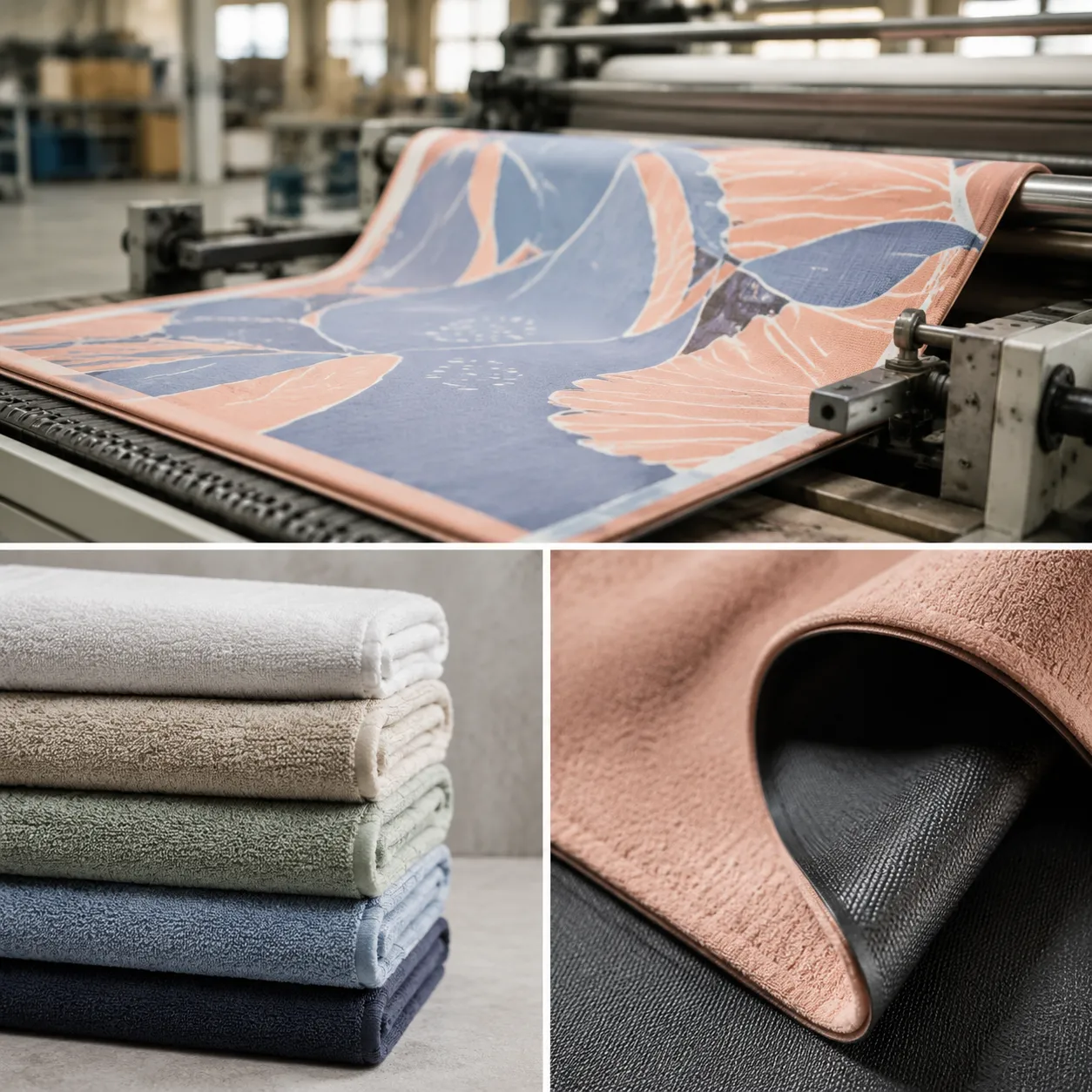
In practical terms, we usually narrow the conversation to three constructions: short-pile warp knit, suede knit, and coral fleece. Short-pile warp knit is the most balanced for bath use. Suede packs small and prints sharply, but it can feel too flat for a full-size household towel. Coral fleece feels plush on first touch, yet if pile density is pushed without controlling edge stability, it can develop skew and heavy lint capture in home laundry. Those are factory choices, not catalog adjectives.
| Use case | Most workable construction | Typical GSM | Main compromise |
|---|---|---|---|
| Gym shower or compact home use | Short-pile warp knit | 260-330 GSM | Less plush than fleece |
| Travel or fast-dry retail | Suede knit microfiber | 180-240 GSM | Lower body-drying comfort |
| Soft-touch retail bath line | Coral fleece microfiber | 300-380 GSM | Bulkier pack and slower drying |
The spec line that changes everything: polyester / polyamide split
If we receive an RFQ that only says "microfiber," we still do not know the cost, absorbency, or touch. The polyester/polyamide ratio drives all three. For bath applications, 80/20 is the most common commercial split because it balances price and water pickup. At 85/15, the towel is cheaper, but you can feel the drop in softness and capillary pull. At 70/30, the hand improves and drying performance rises, though the yarn cost steps up fast and the supply window becomes tighter.
The process detail buyers rarely see is the splitting consistency after knitting and finishing. A microfiber filament must split properly to create surface area. If splitting is incomplete, the fabric may look acceptable under standard light yet underperform in absorbency tests. We usually confirm this through a lab absorbency check and, for higher-risk programs, a microscope cross-section review from the yarn supplier side. That extra verification is not mandatory for every order, but it matters when a brand is making performance claims on pack copy.
- For mass retail bath towels, 80/20 is usually the safest quote base.
- For price-led promotions, 85/15 can work, but we flag the feel risk before sampling.
- For a softer, higher-performance piece, 70/30 is possible if the buyer accepts higher FOB and longer yarn booking.
Why GSM alone will mislead you
A thick number on paper does not automatically produce a better towel. In microfiber, pile geometry and knit density can matter more than adding another 30 or 40 GSM. We have sampled a 290 GSM warp knit that dried the body better than a 345 GSM fleece style simply because the lighter style had a more open, efficient surface for water transfer. On the other hand, an ultra-light 190 GSM towel may dry fast on a rack but leave users reaching for a second pass.
For most bulk bath programs, we steer buyers toward 250-340 GSM if the towel is meant for repeated body drying. Below that band, complaints usually shift toward "too thin" or "does not feel like a bath towel." Above 380 GSM in microfiber, the towel can start losing the quick-dry advantage that made the material attractive in the first place.
| GSM band | How it usually performs | Best fit |
|---|---|---|
| 180-230 | Very light, fast drying, low packed volume | Travel sets, amenity kits, e-commerce bundles |
| 250-340 | Balanced absorbency, acceptable handfeel, stable cost | Mainstream bath and gym shower use |
| 350-390 | Softer first touch, heavier drape, slower line drying | Retail bath collections with comfort priority |
Absorbency has to be specified with a test, not a promise
This was one of the weak points in the rejected draft category-wide, so we prefer to be careful here. Absorbency claims vary by method. If one mill uses a simple drop test and another uses measured water uptake by weight, the conclusions will not line up. For bath towels, we normally reference AATCC 79 for absorbency behavior and add an internal gravimetric pickup check after one wash and after five washes. The second check matters because finishes can temporarily flatter a first sample.
We also like to define the laundering condition before approval. A towel washed in a home machine at 30°C with no softener behaves differently from the same towel washed with fabric conditioner, which can reduce microfiber pickup performance. If the buyer serves hospitality, spa, or gym channels, the approval sample should mirror the real detergent and drying routine as closely as possible.
A good sample is not the one that feels best on day one. It is the one that still behaves the same after the wash routine your customer will actually use.
- Ask the mill to state which absorbency method is being used.
- Request results before wash and after repeated washing.
- Ban softener in the approval wash unless your end user will always use it.
Edge construction is where a lot of complaints begin
In a microfiber bath towel, the body fabric gets most of the attention, but the edge often decides whether returns appear. We see three recurring failure modes: curling on narrow folded hems, waviness after heat exposure, and seam grin on plush fleece structures. A simple overlock plus turn hem may be fine on a low-cost travel towel. It is less fine on a 100×180 cm bath piece that will be hung wet by one corner.
For larger sizes, we often recommend a wider lockstitch hem or a knit binding that stabilizes the perimeter. If the buyer wants an embossed border, we check whether the compressed area creates a visible draw-in after washing. That quirk is specific to microfiber fleece programs: the logo panel can look neat on arrival but pull the silhouette slightly off-square after laundering if heat and pressure are not balanced.
| Edge option | Cost effect | Common risk | Where we use it |
|---|---|---|---|
| Basic folded hem | Lowest | Corner curl on large sizes | Entry travel and promo styles |
| Wider lockstitch hem | Moderate | Less decorative flexibility | Main bath and gym programs |
| Self-fabric or knit binding | Moderate to high | Extra sewing time | Retail bath sets and larger towels |
Decoration should follow the surface, not the other way around
If branding is required, the decoration choice should fit the construction already selected. Embroidery on a lightweight suede bath towel can pucker the face and reduce drape around the logo area. Sublimation looks clean on brushed or suede microfiber, but it is not the right route for dark ground coral fleece where color control and pile direction both complicate the result. Embossing can work on fleece, though we usually keep it to panels instead of full-field artwork.
For brand buyers comparing routes, embroidery-vs-sublimation-vs-jacquard.html explains the visual and durability trade-offs well. If color approval is the bigger issue than the logo itself, pantone-color-matching-custom-towels.html is the more useful starting point.
- Choose sublimation for light-ground printed microfiber where artwork accuracy matters.
- Choose small embroidery only if the base fabric can support stitch density without distortion.
- Choose embossing for plush fleece when the logo is tonal and tactile rather than color-driven.
What the price band really looks like
Below is a realistic FOB China range for straightforward programs. These are not universal market prices and they move with yarn bookings, packaging format, decoration, and order month. They assume standard compliance, no unusual trims, and shipment from East China. We would not quote off this table alone, but it is a workable planning range.
| Spec basis | 500-1,499 pcs | 1,500-4,999 pcs | 5,000+ pcs |
|---|---|---|---|
| 70×140 cm, suede microfiber, 200-220 GSM, care label only | USD 2.18-2.62 | USD 1.84-2.21 | USD 1.63-1.97 |
| 80×160 cm, warp knit, 270-310 GSM, plain dyed | USD 3.12-3.78 | USD 2.71-3.26 | USD 2.39-2.92 |
| 100×180 cm, coral fleece, 320-360 GSM, belly band | USD 5.26-6.44 | USD 4.61-5.68 | USD 4.14-5.09 |
A buyer who pushes the middle line from around USD 2.80 down toward USD 2.30 usually forces one of four changes: smaller size, lower polyamide content, simpler edge finish, or looser carton efficiency assumptions that later reappear as freight waste. We prefer to expose that trade-off early. It keeps the conversation honest and prevents a sample that can never scale.
MOQ, color count, and why small runs become expensive fast
Our standard MOQ is 500 pieces per design per color, but microfiber bath programs can still become inefficient if a buyer spreads that quantity across too many size or packaging combinations. The hidden cost is not only dyeing. It is sewing setup, QC segregation, barcode handling, and carton assortment complexity. A 2,000-piece order split across four colors, two sizes, and three retail sleeve versions behaves more like several mini-orders.
If the brand is still testing the category, we usually recommend reducing variables before reducing quantity. Keep one size, one construction, and one pack format, then test color later. Buyers negotiating MOQ should also read negotiate-towel-moq-without-killing-margin.html. If the RFQ itself is still loose, build-towel-tech-pack-that-mills-can-quote.html saves time on both sides.
- Lock the construction first.
- Limit launch colors to the best two sellers.
- Use one barcode placement standard across all cartons.
- Add retail packaging only after the base towel is approved.
Lead time is mostly driven by sampling discipline
For a microfiber bath towel sourcing playbook to work in real life, the calendar needs to reflect approvals, not just factory days. A plain re-order can move much faster than a first program with new packaging and color matching. For fresh developments, we usually see lab dips or color submit in 3-5 days, sample making in 7-11 days after confirmation, bulk material prep in 10-16 days, sewing and finishing in 12-18 days, and final packing in 3-5 days. That puts most clean orders in a 28-45 day production window after all details are signed off.
Freight then depends on routing. For FOB shipments, buyers should budget separately for vessel timing and port cutoffs. container-vs-air-freight-towel-orders.html covers those trade-offs. If a brand is building a broader hospitality line beside this item, setting-up-hotel-linen-program-90-day-roadmap.html is a useful planning companion.
| Stage | Typical days | What usually delays it |
|---|---|---|
| Color or material confirmation | 3-5 | Late comments on handfeel or shade |
| Prototype / salesman sample | 7-11 | Logo revision, packaging edits |
| Bulk knitting, dyeing, cutting, sewing | 22-34 | Split yarn booking, approval gaps |
| Packing and booking readiness | 3-5 | Barcode and carton mark changes |
Compliance is straightforward, but ask for the right paper
For most brand programs, the minimum document set is clear: OEKO-TEX STANDARD 100 Class I relevance where required by the customer channel, BSCI social compliance visibility, and ISO 9001 process control at factory level. That still does not mean every microfiber bath towel on a quote sheet is automatically covered under the same certificate scope. Buyers should verify product group, certificate holder, and validity period. how-to-read-oeko-tex-certificate.html explains what to check.
If your market asks about microfiber shedding or recycled content claims, ask the mill to distinguish clearly between formal certification and internal material declaration. Those are different documents. We would rather say "claim pending confirmation" than overstate a file that does not fully support the sales language.
The shortest RFQ that still gets accurate prices
A usable inquiry for this category does not need to be long. It needs to remove ambiguity. If we have the five items below, we can usually quote within a realistic band instead of sending a vague estimate that shifts later.
- Finished size and tolerance, for example 80×160 cm ±3%
- Construction type: suede, warp knit, or coral fleece
- Target GSM and fiber split, such as 300 GSM, 80/20
- Branding method and packaging format
- Order quantity by color and delivery term
Related reads: microfiber-vs-cotton-towel-comparison.html, towel-gsm-decision-framework.html, and towel-sizes-dimensions-complete-guide.html.
Related reads: if your program extends beyond bath into hospitality or fitness, see hotel-towel-sourcing-guide-2026.html and why-gym-towels-fail-after-50-washes.html.
Need a quote that matches the real spec?
Send size, construction, GSM, color count, packaging, and target ship window. We will flag any spec conflict before sampling. Email [email protected] or WhatsApp +86 13205717266.
Request Quote →