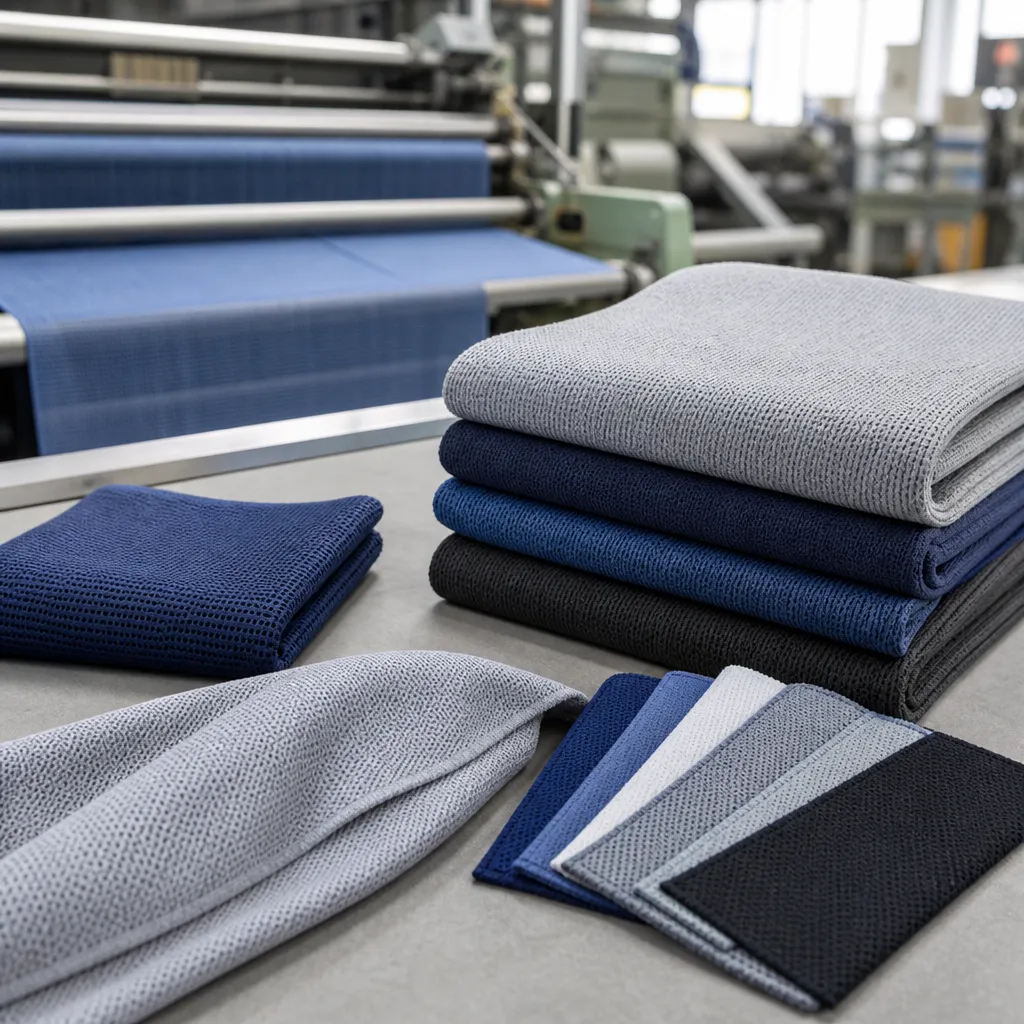
Start with construction, not marketing claims
The first decision is whether you are buying a true body towel for hospitality or home retail use, or a lightweight travel-style item being stretched into bath use. Those are not the same product. For a microfiber bath towel, the fabric structure drives drying speed, drag on skin, print behavior, and how the towel feels after repeated laundering.
In bulk sourcing, we mainly see three workable constructions: warp knit suede, warp knit terry, and coral fleece. Suede gives the cleanest print surface and compact pack size, but it feels flatter and less plush. Terry microfiber has a looped face and better wipe-up feel after shower use. Coral fleece feels fuller in hand, yet it can trap more heat in drying tunnels and is more sensitive to pile crush during compression packing.
| Construction | Typical GSM | Best Use | Common Risk |
|---|---|---|---|
| Warp knit suede | 190-260 GSM | Travel bath towel, printed retail | Feels too thin if buyer expects cotton-like bulk |
| Warp knit terry | 260-340 GSM | Daily-use bath towel, gym or spa retail | Edge waviness if tension is uneven in finishing |
| Coral fleece | 300-430 GSM | Soft-touch bath wrap or home set | Pile matting after hot wash if yarn split is poor |
- If your brief prioritizes fast drying and compact shipping, start with warp knit terry around 280-310 GSM.
- If your brand sells full-surface artwork, suede microfiber is easier to color-control than a high-pile face.
- If your reference sample is a fluffy blanket-like towel, ask whether that handfeel is coming from pile height rather than real absorbency.
What we measure before calling it suitable for bath use
We do not treat sink splash or one-person bathroom trials as proof. For bath use, the measurable points are water uptake, drying time, dimensional stability, colorfastness, and surface behavior after laundering. If a supplier cannot name the test or the acceptance line, the discussion is still at brochure level.
For absorbency, we usually reference AATCC 79 for absorbency of textiles as a quick comparative check, then pair it with a gravimetric internal method: dry specimen weight, controlled water exposure, drip interval, then reweigh to calculate pickup percentage. For a workable microfiber bath towel, we typically target water pickup above 3.6 times fabric weight on a terry structure, or above 2.4 times on suede where fast drying matters more than bulk retention.
For dimensional stability after laundering, ISO 6330 wash procedures combined with ISO 5077 measurement gives a cleaner basis than anecdotal home laundry feedback. On bath towels, we generally hold finished shrinkage to within plus or minus 3 percent in length and width after the agreed wash cycle. For colorfastness, ISO 105-C06 for domestic laundering and ISO 105-X12 for crocking are more useful than a generic statement that color is stable.
| Property | Test reference | Typical acceptance for bulk |
|---|---|---|
| Absorbency response | AATCC 79 | Visible wetting within 4-8 seconds depending on finish |
| Wash dimensional change | ISO 6330 + ISO 5077 | Within +/-3% |
| Colorfastness to washing | ISO 105-C06 | Grade 4 minimum, dark shades may agree at 3-4 |
| Colorfastness to rubbing | ISO 105-X12 | Dry 4-5, wet 3-4 |
| Bursting strength for knit base | ISO 13938-2 | Set by size and GSM, commonly 220-340 kPa |
The spec lines that change price faster than buyers expect
A microfiber bath towel sourcing playbook needs to isolate cost drivers early because this category looks simple but moves quickly on a few lines: fiber ratio, knit structure, GSM, dyeing route, printing route, and edge finish. The jump from a 220 GSM suede towel to a 320 GSM terry towel is not linear because heavier terry also runs slower in finishing and takes longer to cool before packing.
The usual fiber blend is 80 percent polyester and 20 percent polyamide. Some low-cost offers drop the polyamide content and still present the towel as equivalent. It is not equivalent. Lower polyamide usually means weaker capillary pickup and a harsher hand after washing. If price is unexpectedly low, ask for the filament denier and the actual blend shown on the test report or material declaration.
- A hidden cost point is hem width. A narrow 8 mm fold can save fabric but gives more edge torque on larger bath sizes.
- Another is printed area coverage. Full-bleed sublimation on both sides is not priced like a simple border print.
- Bagging matters. Individual EVA zip pouches or ribbon-set retail packing can add more cost than a small GSM increase.
| Spec choice | Cost effect | Why it moves |
|---|---|---|
| 80/20 vs 85/15 blend | +USD 0.11-0.24 per pc | Higher polyamide and better water uptake |
| 260 GSM to 320 GSM terry | +USD 0.36-0.58 per pc | More yarn use and slower finishing |
| Plain dyed to 1-side sublimation | +USD 0.28-0.62 per pc | Transfer paper, setup, and heat process |
| Overlock edge to folded hem | +USD 0.09-0.17 per pc | More stable appearance and labor time |
Size, weight, and edge finish have to match the use case
Bath-format microfiber often gets overspecified on dimensions and underspecified on finish. That creates problems in packing and in user perception. A towel that is wide enough but too light feels insubstantial. A towel with enough GSM but a careless edge finish starts to curl, especially after tumble drying.
For standard sourcing, we see these commercial ranges work best: 70 x 140 cm for mainstream bath use, 76 x 152 cm for retail comfort sizing, and 80 x 160 cm when the buyer wants a beach crossover product. Tolerance should be written clearly. We usually quote cut-size tolerance at +/-2 cm and finished weight tolerance at +/-5 percent for bulk inspection.
On edge construction, overlock is acceptable for promotional or low-pack-volume programs, but a double-fold hem with lockstitch gives a cleaner shelf presentation and better long-edge stability. One failure mode specific to microfiber is seam puckering caused by differential feeding between slippery face fabric and hem fold. We reduce that risk with lower presser-foot pressure and stitch density matched to pile height.
| Finished size | Usual GSM band | Estimated finished weight | Typical program |
|---|---|---|---|
| 70 x 140 cm | 250-310 GSM | 245-315 g | Gym retail, travel bath, value spa |
| 76 x 152 cm | 280-340 GSM | 325-395 g | DTC bath collection |
| 80 x 160 cm | 300-380 GSM | 385-485 g | Beach-bath crossover |
What goes wrong in production on this category
Microfiber bath towels fail differently from cotton towels. Buyers who use a cotton QC checklist alone usually miss the real risks. The most common bulk issues we see are pile crush lines from compression, shade barré across the width on darker terry, uneven shearing on fleece, and a slippery hand caused by excess softener masking poor fabric quality.
Barré is especially important on warp knit terry because slight yarn feed variation can show as horizontal tone bands after dyeing. This is not fixed by better folding or better photography. It must be controlled in knitting and dye lot management. Another category-specific defect is low split efficiency in the microfiber filaments. If splitting is incomplete, the towel feels smooth at first but loses absorbent performance that the buyer expected.
- Ask bulk inspection to check panel-to-panel shade continuity under D65 light box conditions, not only room light.
- For plush styles, request a compression recovery review after pack-out so pile crush is seen before shipment.
- On dark colors, include wet crocking in approval because body towels contact skin directly after shower use.
A practical RFQ format for this article's product
The fastest quotations come from a short, exact RFQ. We do not need a long mood board if the technical lines are complete. For this product, the usual delay comes from briefs that say soft, absorbent, luxury, and quick dry without defining what the buyer means in measurable terms.
- State construction first: suede, terry, or coral fleece.
- List exact size, GSM target, and tolerance.
- Confirm fiber blend, usually 80/20 polyester-polyamide unless there is a compliance reason to change it.
- Specify decoration: plain dyed, yarn dyed trim, embroidery, or sublimation location and coverage.
- Write testing requirements by name, such as ISO 105-C06 grade 4 and shrinkage within +/-3 percent after ISO 6330 wash.
- Add pack-out details: insert card, belly band, polybag type, barcode label, carton count.
If you need help building that sheet, our article on build-towel-tech-pack-that-mills-can-quote is the closest internal reference. Buyers comparing fiber types should also read microfiber-vs-cotton-towel-comparison and towel-gsm-decision-framework.
Price bands by volume for custom orders
Our MOQ is 500 pieces per design per color, but microfiber bath towels become more stable on costing once the order reaches 1,500 pieces because dyeing, cutting, and packing loss distribute better. Below that, decoration and packing choices can dominate the unit price.
| Order volume | Spec basis | FOB China price |
|---|---|---|
| 500-999 pcs | 70 x 140 cm, 280 GSM warp knit terry, plain dyed | USD 2.18-2.74 per pc |
| 1,000-2,999 pcs | 70 x 140 cm, 280 GSM warp knit terry, plain dyed | USD 1.86-2.34 per pc |
| 3,000-7,999 pcs | 76 x 152 cm, 310 GSM terry, folded hem | USD 2.42-3.08 per pc |
| 8,000+ pcs | 76 x 152 cm, 310 GSM terry, 1-side print, retail pack | USD 2.71-3.39 per pc |
Those bands assume standard export cartons, care label, and ordinary color matching. Metallic embroidery, dual-face printing, or gift-box packing moves price outside the range quickly. If you are comparing mills, make sure the quoted GSM is finished GSM, not greige target before dyeing and finishing.
Lead time is mainly about sampling decisions, not sewing speed
For a plain-dyed microfiber bath towel sourcing playbook, the cleanest timeline is usually 3-5 days for yarn and greige confirmation, 5-7 days for sample making, 3-4 days for buyer comments, then 22-30 days for bulk after approval and deposit. Printed versions take longer because strike-off approval and heat-transfer scheduling add steps.
A realistic planning range looks like this: plain dyed in 28-35 days, sublimated in 32-40 days, embroidery-added bath sets in 35-45 days. If the order includes custom retail packaging with multilingual warnings or barcode sequencing, add another 4-6 days unless artwork is already signed off.
- The biggest avoidable delay is an approved handfeel with no approved wash standard behind it.
- Second is artwork approval on a fabric type that was never sampled in the final pile direction.
- Third is changing carton count after drop-test planning and booking dimensions were already confirmed.
Related reads: custom-microfiber-towels-wholesale-guide, container-vs-air-freight-towel-orders, and pantone-color-matching-custom-towels.
Where buyers should push harder during sample approval
Do not approve from an unwashed hanger sample alone. For this category, we recommend approving four things together: unwashed appearance, one-cycle wash result, absorbency result tied to a named method, and edge behavior after drying. That is enough to catch most expensive mistakes before bulk.
If the towel is intended for spa or bath retail, ask the mill to report actual measured values rather than adjectives. Example lines would be finished size after wash, measured GSM after finishing, wash shrinkage percentage, ISO 105-C06 grade, and absorbency pickup ratio from the agreed internal method. That keeps the discussion in measurable territory and avoids invented in-bathroom storytelling.
Compliance-wise, OEKO-TEX Standard 100 Class I, BSCI, and ISO 9001 remain the routine documents buyers ask from us. Depending on market, you may also ask for REACH statement support for chemical compliance on trims or packaging inks. For children-adjacent bath lines, keep labels and packaging components aligned with the same compliance expectation as the textile itself.
For buyers building broader bath or spa programs, spa-towels-need-different-cotton-than-hotel is useful for category comparison, and how-to-read-oeko-tex-certificate helps your compliance review team verify documents correctly.
The spec we would recommend for a first order
If the goal is a commercially safe first launch, we would start with a 76 x 152 cm warp knit terry microfiber bath towel at 300 GSM, 80/20 blend, reactive-solid look or one-side sublimation, double-fold hem, and finished-weight tolerance within 5 percent. That spec balances handfeel, drying speed, carton efficiency, and manageable cost.
For brands trying to undercut that spec sharply, the usual trade-off is not only softness. It is lower absorbency consistency, higher edge distortion, and more customer comments that the towel feels like a cleaning cloth rather than a bath product. Cheap microfiber can still look neat in photos. The problem appears after first wash and first real shower-use cycle.
Need a microfiber bath towel quote
Send size, GSM, construction, artwork, and packing details. We can quote from 500 pcs per design per color and flag any spec lines that are likely to fail in production or wash testing. WhatsApp +86 13205717266 or email [email protected].
Request Quote →