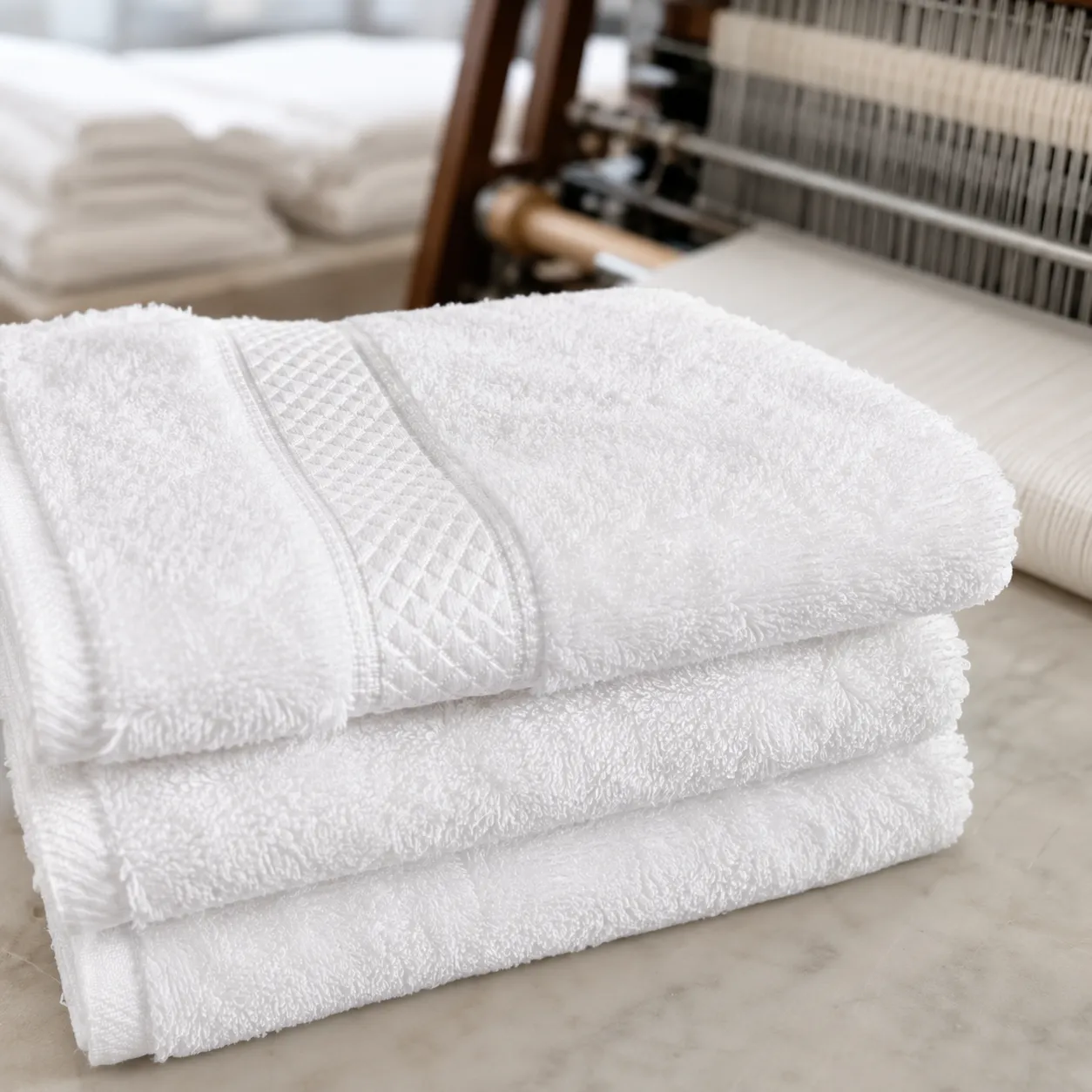
Start with the failure point, not the showroom sample
The face-cloth category gets judged at fingertip level. A customer rubs the surface once and decides whether the set feels substantial or thin. That is why a good development brief for this item should begin with likely abuse: repeated hot washes, peroxide or enzyme chemistry, rubbing against mascara or sunscreen, and frequent mechanical extraction. If the loop is too open, the cloth snags. If the ground yarn is too weak, the corners corkscrew. If the white shade is pushed too blue, some hotel operators love it and some spa operators reject it immediately.
We see more trouble in washcloth programs where the buyer copies bath towel specs directly. A 30×30 cm or 33×33 cm piece behaves differently from a 70×140 cm body towel. Its hem ratio is higher, the sewing line matters more, and a few grams of weight difference can change hand feel sharply because the format is small.
| Use case | Common finished size | Working GSM range | What matters most |
|---|---|---|---|
| Luxury hotel set | 30×30 cm | 550-650 GSM | White shade control, hem stability, bulk hand feel |
| Spa facial service | 33×33 cm | 500-580 GSM | Softness on skin, absorbency, low linting |
| Retail bath collection | 30×30 cm | 600-700 GSM | Shelf hand feel, visual density, giftability |
| Makeup-removal cloth | 25×25 cm | 380-460 GSM | Stain release, dark colorfastness, quick turnover |
The pile yarn choice changes the whole result
For this category, the pile yarn is doing almost all the sensory work. The three builds we quote most often are ring-spun combed cotton, low-twist combed cotton, and zero-twist look constructions using a soluble support yarn during weaving. Each has a different trade-off between first-touch softness and wash durability.
- Ring-spun combed cotton gives the most predictable laundry life. It feels slightly firmer at opening but holds loop definition well after institutional washing.
- Low-twist pile lifts softness without becoming too fragile. For face use, this is often the safest middle ground at 560-620 GSM.
- Zero-twist style constructions feel fuller on day one, but the loops can bloom unevenly if washing chemistry and drying temperature are not controlled.
A detail that rarely appears in generic buying guides: on smaller square towels, low-twist pile can exaggerate edge waviness if the hem tension is not adjusted lower during sewing. We often change both needle count and feeding tension when moving the same yarn from a bath towel to a washcloth. Another very specific point is loop height. On a face cloth, a pile that is too tall can create a plush sample but a slower dry-down after use, which some hospitality laundries dislike.
If you need background on yarn behavior before finalizing the program, combed-vs-zero-twist-cotton-explained.html is the right companion read.
Small format means hemming is not a minor detail
On a washcloth, the border and stitch line occupy a large share of the article. That is why stitching quality shows up faster than on larger towels. We generally steer buyers toward a 10-15 mm turned hem with balanced lockstitch density rather than an oversized decorative border. Deep dobby borders can look elegant in bath towels, but on a 30 cm square they can make the article feel boardy in the hand.
| Construction detail | Safer range | What goes wrong outside range |
|---|---|---|
| Hem width | 10-15 mm | Too narrow frays early; too wide feels stiff |
| Stitch density | 8-10 stitches/inch | Loose sewing opens after bleach; over-dense sewing causes puckering |
| Shrinkage target after 3 home launderings | Within 5% warp and weft | Shape distortion makes set look mismatched |
| Skew / torque control | Within 3% | Corners twist and stack poorly in retail or housekeeping carts |
The defect mode we watch closely is corner torque. It often starts with unbalanced loop tension and becomes obvious only after tumble drying. For white hospitality sets, we test and re-check this after finishing because compacting and shearing can hide the issue in pre-production inspection.
Softness claims need test methods behind them
If a buyer asks for “five-star softness,” that is not a spec. The practical route is to define wash performance and physical tests that support the hand feel expectation. For cotton face cloths, we commonly build the QC sheet around dimensional change, absorbency, colorfastness, and seam integrity, then compare hand panels against the approved standard after wash cycle 1 and wash cycle 10.
- AATCC TM135 for dimensional changes of fabrics after home laundering. This is the simplest way to put numbers around shrinkage and shape retention.
- AATCC TM61 2A for colorfastness to laundering on dyed programs, especially dark charcoal, navy, and black makeup cloths.
- AATCC TM79 for absorbency of bleached textile materials when a spa or hotel group wants rapid wet-out without fabric softener drag.
- ISO 105-C06 as an alternative laundering colorfastness method when the customer quality manual is built on ISO language.
For article development, we also run simple internal checks that matter in real use: visual lint release on black glass after tumble dry, seam grin after aggressive pull at the hem corner, and stain-release trials using foundation and tinted sunscreen on reactive-dyed shades. These are not brochure tests; they catch returns.
White, black, and cosmetic shades should not be treated as the same program
Color changes the sourcing logic. White pieces are usually the easiest to match across replenishment orders, but they put more pressure on whiteness consistency and peroxide tolerance. Black and deep cosmetic shades look clean longer in consumer use, yet they increase the risk of crocking and visible lint. Pale blush, sand, and stone can work beautifully in spa collections, but only if the laundry route is gentle enough to preserve shade clarity.
- For optic white programs, ask for the target whiteness band and whether fluorescent whitening agents are being used. A sample approved under one light box can look different in warm hotel bathrooms.
- For dark shades, request laundering and crocking data, not just a lab dip approval. Makeup cloth programs in black commonly need extra rinsing discipline after dyeing to avoid first-use crock issues.
- For spa neutrals, insist on one approved bulk standard retained at the mill. Soft shades drift more visibly between lots than many buyers expect on a small article.
This is also where branding decisions matter. If the washcloth is part of a larger set, the face cloth often reveals color mismatch first because it sits closest to the eye. For that reason, many private-label brands approve the washcloth lab dip before approving the bath sheet.
Luxury washcloths price differently than larger towels
The unit price looks low because the piece is small, but conversion cost takes a larger share than many buyers assume. Cutting, sewing, inspection, folding, and packing do not scale down in a straight line with area. A very soft 30×30 cm cloth can end up with a tighter margin than a hand towel if the buyer wants dense combed cotton, exact shade control, belly-band retail packing, and low carton counts.
| Spec scenario | MOQ | Indicative FOB China | Notes |
|---|---|---|---|
| 30×30 cm, 560 GSM, combed cotton, white, care label only | 3,000 pcs | USD 0.34-0.43/pc | Hotel or spa replenishment style |
| 30×30 cm, 610 GSM, low-twist cotton, custom dyed, woven brand label | 5,000 pcs | USD 0.46-0.59/pc | Better shelf hand and fuller face |
| 33×33 cm, 650 GSM, zero-twist style, box-set retail packing | 6,000 pcs | USD 0.62-0.81/pc | Gift or DTC collection with higher packing cost |
| 25×25 cm, 420 GSM, black makeup cloth, reactive dye | 5,000 pcs | USD 0.28-0.37/pc | Smaller format, stricter colorfastness control |
Our general MOQ is 500 pcs per design per color, but washcloth economics become more workable from 3,000 pcs upward because sewing, shade setup, and packing overhead stop dominating the quote. If you are trying to hit a very low opening price, the cheapest route is not always best value. For example, a 30×30 cm cloth at 470 GSM may save roughly USD 0.06-0.09 per piece against a fuller 580 GSM build, yet if the lighter version loses hand feel after repeated laundering the replacement cycle arrives earlier and the set looks inconsistent sooner.
Lead time depends more on dyehouse and packing than weaving
For small square towels, weaving itself is rarely the bottleneck. The schedule usually moves around yarn booking, shade approval, finishing capacity, and final folding or retail presentation. White replenishment programs can run faster because there is no lab-dip loop. Complex gift packs run slower because hand packing and barcode verification take time.
| Order type | Sampling | Bulk production | Packing add-on |
|---|---|---|---|
| White hospitality reorder | 3-5 days | 18-24 days | 2-4 days |
| Custom dyed spa program | 7-10 days | 24-32 days | 3-5 days |
| Retail launch with belly band and insert card | 9-12 days | 28-36 days | 5-7 days |
| Urgent air shipment top-up | Existing quality only | 14-18 days if greige stock available | 1-2 days |
If your launch date is fixed, freeze the color and packaging together. Many delays happen because the cloth is finished while the belly band artwork is still changing. For broader planning, build-towel-tech-pack-that-mills-can-quote.html and container-vs-air-freight-towel-orders.html cover the documents and logistics decisions that affect timing.
The sample you approve should include wash data, not just a hand-feel comment
A serious approval pack for this category should be compact but precise. We prefer to send one unwashed control, one washed sample, a mini spec sheet, and the test summary. That avoids the common problem where the design team loves the showroom hand while the operations team later finds the dimensions drift outside tolerance.
- Finished size with tolerance after wash
- Net weight per piece, not only GSM
- Pile yarn type and ground construction
- Hem width and stitch density
- Color standard or whiteness target
- AATCC TM135 shrinkage result and AATCC TM61 2A laundering result where relevant
One number buyers often skip is piece weight. GSM alone does not tell the whole story on a small item. A 30×30 cm article at 600 GSM and a 33×33 cm article at 560 GSM can feel surprisingly close in hand because the absolute mass is similar. That is why the approval sample should list both.
Certification is straightforward, but the paperwork still needs checking
For brand programs selling into baby, spa, hospitality, or gift channels, the baseline documentation is usually uncomplicated: OEKO-TEX 100 Class I for product safety, BSCI for social compliance, and ISO 9001 for quality system discipline. The mistake is assuming a certificate headline alone answers the sourcing question. The scope, validity period, and product category still need verification.
- Ask for the current OEKO-TEX STANDARD 100 Class I certificate number and scope page.
- Check whether the supplier's BSCI audit is current and whether the rated site is the actual production location.
- Confirm ISO 9001 applies to the manufacturing entity handling your order documentation and QC records.
If your compliance team needs a refresher, how-to-read-oeko-tex-certificate.html lays out what to check beyond the logo.
A workable brief for this item fits on one page
The fastest quotations come from short, specific briefs. For luxury washcloths, we can usually quote accurately from one page if it includes finished size, target weight, yarn direction, color, packing, and required tests. The article is small, but the decision points are not.
- State the end use: hotel bathroom set, spa facial room, retail bath collection, or cosmetic removal.
- Give finished size and target piece weight, then add acceptable shrinkage tolerance after laundering.
- Name the pile preference: ring-spun combed, low-twist, or zero-twist style.
- Specify white standard or Pantone-related shade target for dyed goods.
- List required tests such as AATCC TM135 and AATCC TM61 2A.
- Attach the packing requirement down to fold count, polybag rule, barcode label, and carton quantity.
Related reads: towel-gsm-decision-framework.html, pantone-color-matching-custom-towels.html, and private-label-vs-white-label-towel-programs.html.
Related reads: hotel-towel-sourcing-guide-2026.html, spa-towels-need-different-cotton-than-hotel.html, and ../industries/airbnb-vacation-rental-towels.html.
Need a quote for luxury washcloths?
Send size, GSM, color, packing, and target quantity. Our MOQ is 500 pcs per design per color. We can review specs, test requirements, and bulk timing by email at [email protected] or WhatsApp +86 13384590853.
Request OEM pricing →